Comparisons

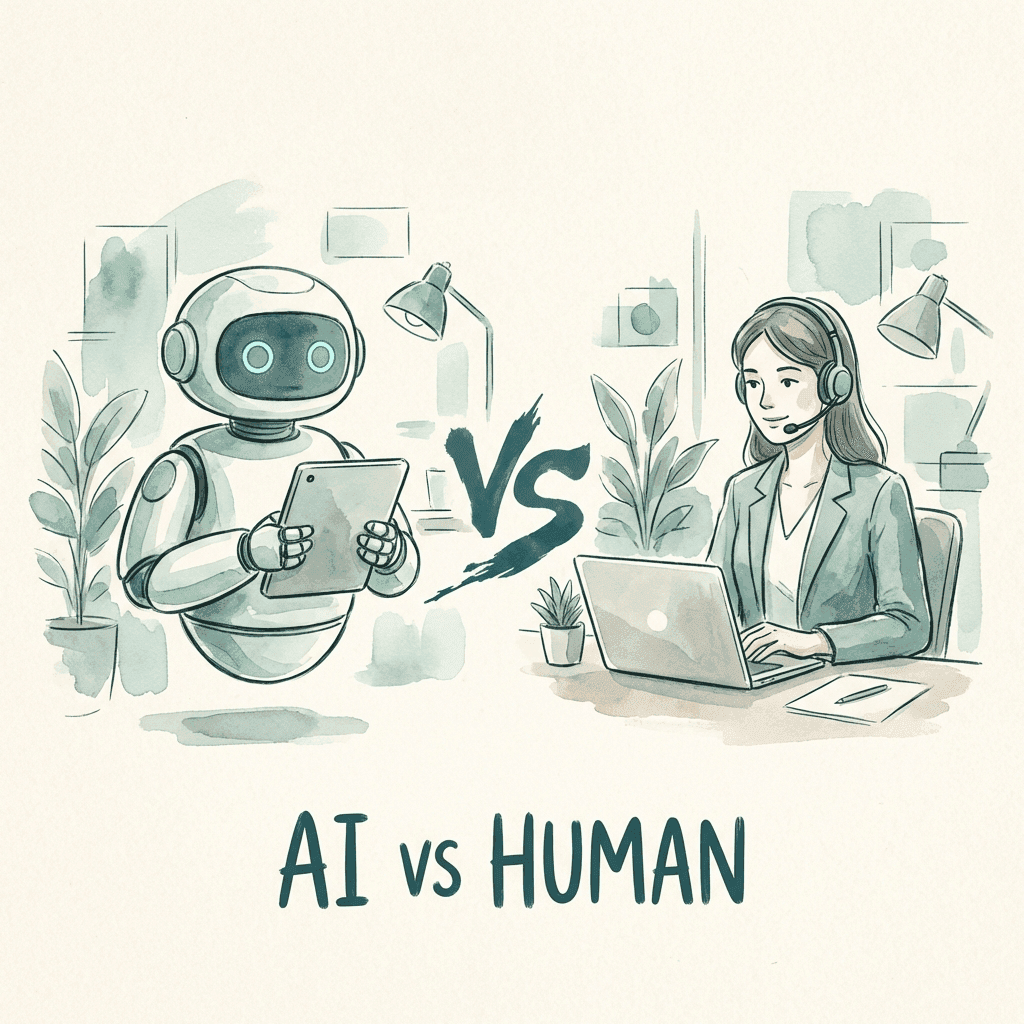
Virtual Employees vs Human Staff: Cost, Quality & Scalability (2026)

A clear-eyed comparison of virtual employees vs human staff in 2026 — the real cost difference, where each wins on quality, and which scales without breaking.

By Dooza Team·April 7, 2026·9 min read
Virtual employees vs human staff — cost, quality, and scalability comparison

The virtual employees vs human debate used to be a niche conversation for startups too small to hire. In 2026, it's a board-level question. Virtual staff — both AI employees and remote humans — now do work that used to require a full in-house team, at a fraction of the cost.

This guide breaks down the real trade-offs: cost, quality, scalability, and the specific situations where a human still wins. No hype, no “AI will replace everyone” — just the math and the judgment calls.

Cost: Where the Gap Is Brutal

A full-time in-person executive assistant (EA) in the US averages $5,000–$8,000/month all-in (salary, benefits, taxes, equipment, software). An equivalent virtual staff hire — a remote VA from the Philippines or LATAM — lands closer to $700–$2,500/month. An AI employee handling the same scope of repetitive work? $29–$300/month.

The outsourced vs AI gap matters too. Outsourced humans still need management, time-zone coordination, sick days, and turnover. AI doesn't. For repeatable knowledge work — writing, support replies, data entry, scheduling — AI is now an order of magnitude cheaper than even the cheapest remote employee.

The honest picture: humans still cost more because they think. The question is how much of your work actually requires thinking, versus how much is pattern-matching that AI does for pennies.

Quality & Output: AI vs Human, Honestly

For structured, repetitive tasks — drafting product descriptions, answering FAQs, sorting tickets, generating reports — modern AI is at parity with a competent junior employee, and faster. For nuanced judgment, relationship-building, creative direction, or anything requiring real context about your company's soul, humans still win.

The human vs AI quality gap isn't about IQ. It's about accountability. A human owns the outcome; AI executes the instruction. If your instruction is bad, AI ships bad work confidently. A senior employee pushes back; AI rarely does.

The practical answer: use AI for output, humans for judgment. The best teams in 2026 layer them — AI drafts, humans review and approve.

Scalability: The Real Unlock

Doubling a human team takes months: hiring, onboarding, training, culture-fit. Doubling an AI team takes a slider. This is where the virtual employees vs human comparison stops being close.

  • Humans scale linearly. 10x the workload = 10x the headcount = 10x the cost and management overhead.
  • Outsourced teams scale faster but break. Quality control collapses around 20–30 people without serious management investment.
  • AI scales instantly and flat. Going from 100 tickets/day to 10,000 tickets/day costs almost nothing extra.

For any business with spiky demand — ecommerce, agencies, SaaS support — this is the killer feature. You stop hiring for peaks and start paying only for what you use. It's the same logic that pushed founders from in-person executive assistants (EAs) to overseas virtual assistants (VAs) over the last decade — except this next jump is bigger.

Watch: how founders combine the best of executive assistants and virtual assistants — and where AI now extends that hybrid model.

When to Use Each

Use AI / virtual employees for:

  • Customer support (Tier 1 — order status, returns, FAQs)
  • Content production (blogs, product copy, social posts)
  • Data entry, CRM updates, report generation
  • Lead qualification and outbound first-touch
  • 24/7 chat and after-hours coverage

Use human staff for:

  • Strategy, brand voice, creative direction
  • Complex sales and account management
  • Hiring, culture, and people leadership
  • Crisis handling and high-stakes negotiation
  • Anything where being wrong has legal or reputational fallout

The outsourced teams and remote employees middle ground still has a place — for work that's too nuanced for AI but doesn't need an in-house hire. Think bookkeeping, design tweaks, video editing.

The Verdict

The virtual-vs-human question isn't either/or anymore. The winning model in 2026 is a small core of senior humans owning judgment and relationships, layered on top of AI employees doing the volume work, with a thin layer of outsourced specialists for the in-between tasks.

A two-person founding team in 2026 can ship the output of a 20-person team in 2022. That's not a prediction — it's the new baseline. The companies that figure out the layering early are the ones that pull away.

If you want to see what an AI employee actually does day-to-day before committing to anything, try Dooza — the same workflow this comparison describes, running live.

Frequently Asked Questions

What are virtual employees?

Virtual employees are workers — human or AI — who perform business tasks remotely instead of in-house. The term covers remote contractors, outsourced teams, and AI employees that handle work like support, content, and admin without physical presence.

Are virtual employees cheaper than human staff?

Significantly. A US full-time hire averages $5,000–$8,000/month all-in. Remote/outsourced humans run $1,200–$2,500/month. AI employees handling repeatable work cost $29–$300/month. The exact savings depend on what work you're replacing.

Can AI fully replace human employees?

Not yet, and probably not fully ever. AI replaces repetitive, structured work very well. Strategy, brand voice, complex sales, hiring, and crisis management still need humans. The winning model is layering — AI for output, humans for judgment.

What's the difference between outsourced teams and AI employees?

Outsourced teams are humans in another location — they need management, time-zone coordination, and turnover handling. AI employees are software — they scale instantly, run 24/7, and cost a flat fee. For volume work, AI wins on cost and consistency; for nuance, outsourced humans still beat AI.

When should I hire human staff instead of using virtual employees?

When the work requires real judgment, accountability, relationship-building, or company-specific context. Strategy roles, senior sales, leadership, and creative direction still belong to humans. Everything repetitive should default to virtual or AI.

How scalable are virtual employees compared to human staff?

Human teams scale linearly — 10x workload means 10x headcount and overhead. AI employees scale flat — going from 100 to 10,000 tickets a day costs almost nothing extra. This is the single biggest reason fast-growing companies are switching.

Related Articles

5 Proven Ways AI Employees Save Small Businesses 20+ Hours/Week
AI Automation

5 Proven Ways AI Employees Save Small Businesses 20+ Hours/Week

Discover how AI-powered employees are helping small businesses automate their daily operations, from email management to social media posting.

7 min read
Read
Best Sintra AI Alternative in 2026 (No Credit Caps)
Comparison

Best Sintra AI Alternative in 2026 (No Credit Caps)

Looking for a Sintra AI alternative? Discover why Dooza offers better AI employees with simpler setup, transparent pricing, and superior automation.

9 min read
Read

Ready to scale your business?

Join thousands of companies using Workforce to automate their work. Get started for free today.

No credit card required · 14-day free trial · Cancel anytime