AI Customer Support for Service Businesses: Bookings, Quotes, and Follow-Ups
AI customer support for service businesses can help with booking questions, quote requests, missed follow-ups, and support handoffs.
12 min read
June 8, 2026
AI customer support for service businesses is a high-intent topic because customer service teams are under pressure to respond faster without creating risky, fully automatic replies. Gartner reported that 91% of customer service leaders felt pressure to implement AI in 2026, which makes practical deployment content more useful than generic AI hype.
Service businesses lose revenue when customer questions sit unanswered: appointment availability, service area, pricing, quotes, preparation instructions, and reschedules.
This article is written for founders, operators, ecommerce teams, agencies, and service businesses that want customer support automation connected to real tools, not a standalone chatbot that creates another inbox to manage.
What AI customer support for service businesses means in 2026
AI customer support for service businesses means using AI to assist with booking-related questions, quote intake, follow-up reminders, and structured handoffs to the owner or team.
The important distinction is that deployment is not the same as buying software. A support workflow needs a trigger, customer context, business rules, connected tools, approval boundaries, escalation paths, and a report that shows what happened.
Dooza AI customer support runs this for you: a Dooza engineer connects your Gmail, Shopify Inbox or Gorgias, AI drafts each reply from your policies, products and past replies, a Dooza specialist checks it, and you approve before anything sends. Anything unusual goes to the Dooza team and anything sensitive goes to you.
Why this matters now
Customer support is one of the best places to start with AI because many requests repeat: order status, appointment questions, pricing questions, document requests, refund policy questions, missed-call follow-ups, and basic troubleshooting. These are frequent enough to save time, but structured enough to review safely.
The goal is not to remove humans from every support conversation. The goal is to remove the slow middle steps: finding the right thread, summarizing the issue, drafting the first reply, applying the right label, escalating the risky case, and following up when nobody has time.
For the full cluster foundation, start with how to automate customer support with AI, then use this guide for the specific workflow angle. When you are ready, Dooza AI customer support runs it for you: AI drafts each reply, a Dooza team checks it, and you approve before anything sends. 14-day free trial (card at signup), then $300/month for up to 250 customer messages.
The workflow to automate
A reliable customer support automation workflow should be small enough to test and clear enough to measure. Start with one support channel and one repeatable request type before expanding.
Booking questions: Draft answers about availability, service details, preparation, and next steps.
Quote intake: Ask for location, photos, service type, urgency, and preferred contact method.
Missed follow-up: Remind the team when a lead or customer has not received a reply.
Service area: Answer or route requests based on approved location rules.
Owner handoff: Summarize customer need, urgency, and recommended next action.
Good support automation is visible. The user should see what was drafted, what was skipped, what was escalated, and what still needs a human decision.
Where Dooza deployment fits
Dooza AI customer support is a managed service: AI drafts each customer reply, a Dooza team checks it, and you approve before anything sends. It works inside Gmail, Shopify Inbox or Gorgias. 14-day free trial (card at signup), then $300/month for up to 250 customer messages, month to month, no setup fee.
A practical Dooza customer support deployment can include connecting Gmail, defining support categories, writing reply rules, creating labels, drafting first-response templates, setting escalation rules, and reporting the support work that was handled or queued for review.
Begin with quote intake and follow-up summaries. These save time without requiring AI to make pricing decisions.
How to measure success
Measure faster reply times, completed intake details, fewer missed follow-ups, and booking or quote conversion lift.
The most useful scorecard is short: average first-response time, support messages summarized, drafts created, edit rate, auto-label accuracy, escalation rate, and unresolved cases. If the scorecard is too long, owners stop reading it and the automation becomes hard to trust.
Video walkthrough
Watch this related video before mapping the workflow into your business. The video gives practical context; with Dooza, the next step is a free 30-minute pilot call where a Dooza engineer scopes your tools, review rules, and reporting.
Bottom line
AI customer support for service businesses works best when it starts as a narrow deployment, not a giant transformation project. Connect the right tool, define the support rule, keep risky work human-approved, and measure the result weekly.
If you want help with setup instead of another self-serve tool, book a free pilot call. A Dooza engineer scopes your pilot, and every pilot comes with a 100% refund within 14 days.
Frequently Asked Questions
Can AI support service businesses without giving wrong prices?
Yes. AI can collect quote details and draft responses while leaving final pricing and unusual commitments to a human.
Should customer support AI send replies automatically?
Not at first. The safer rollout is to let AI draft, label, summarize, and route support messages, then add auto-send only inside approved rules with clear filters and limits.
What customer support work should stay human?
Refund exceptions, angry customers, legal threats, medical or financial claims, account security issues, and unusual promises should stay human-reviewed.
How does Dooza fit this workflow?
Dooza AI customer support is a managed service: AI drafts each customer reply from your policies, products and past replies, a Dooza specialist checks it, and you approve before anything sends. It works inside Gmail, Shopify Inbox or Gorgias. 14-day free trial (card at signup), then $300/month for up to 250 customer messages.
Ready to Start Your Pilot?
Automate your business with AI employees that work 24/7. Start with a refundable pilot: 100% refund within 14 days.
AI Receptionist Pricing in 2026: What 24 Services Cost
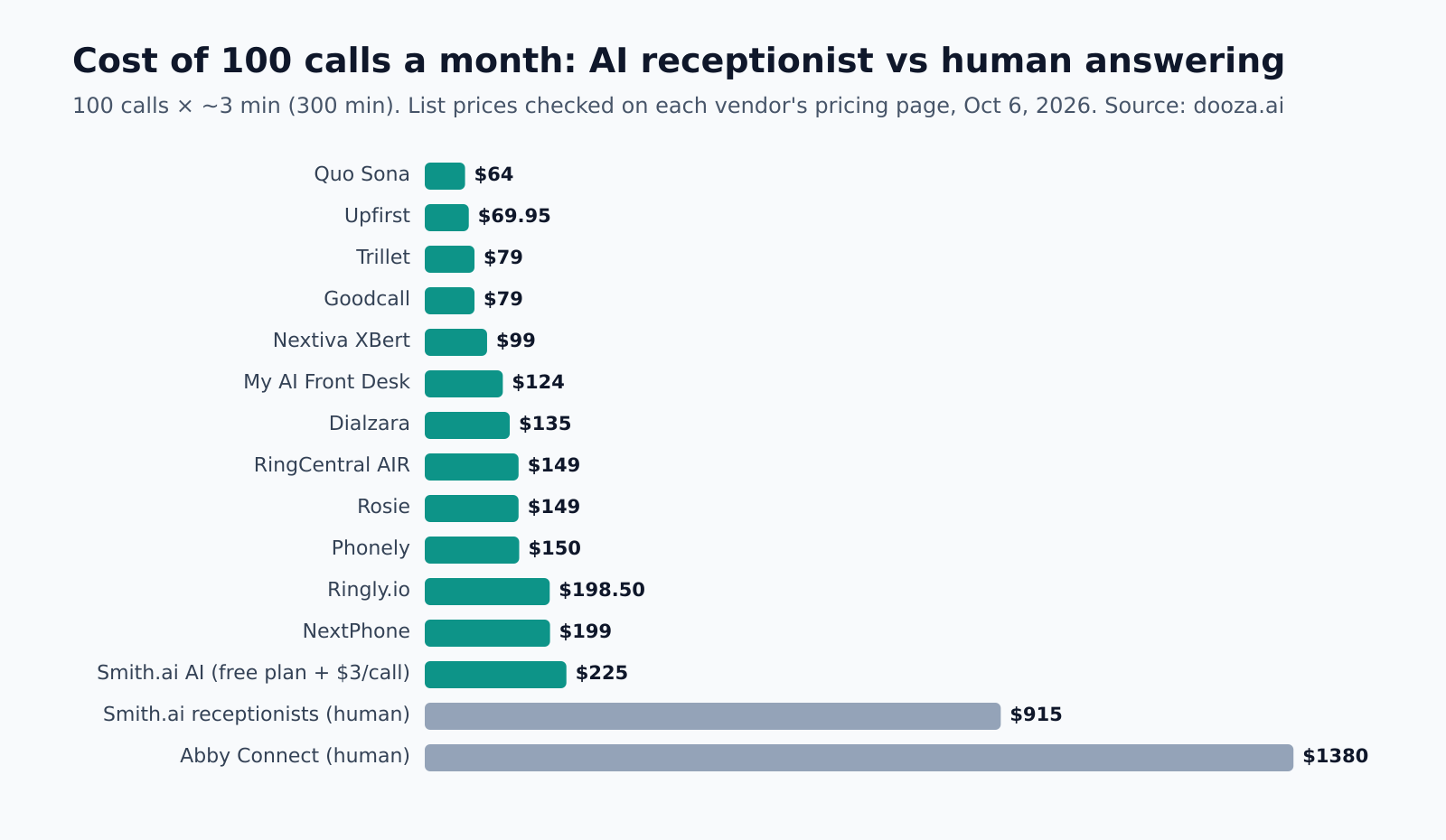
We checked the pricing pages of 24 AI receptionist and answering services on October 6–14, 2026. Entry plans run $0 to $199 a month; 100 calls a month costs about $49 to $213 with AI, versus $395 to $1,380 with a human answering service.
Best AI Answering Services for Small Business (Oct 2026)
20 AI receptionists and human answering services compared on entry price, included minutes or calls, overage and billing unit, from each vendor's own pricing page (checked Oct 2026).
Start with a refundable pilot — 100% refund within 14 days. A Dooza engineer scopes it with you on a free 30-minute call. Pricing depends on the product; see pricing.