AI Employees
AI Chatbot vs AI Employee for Customer Support
Compare an AI chatbot with an AI employee for customer support, including tool access, approvals, reporting, and deployment needs.
12 min read
ReadDiscover the ultimate comparison between AI employees and human employees. Learn costs, benefits, and how to implement AI workers for your business in 2025.
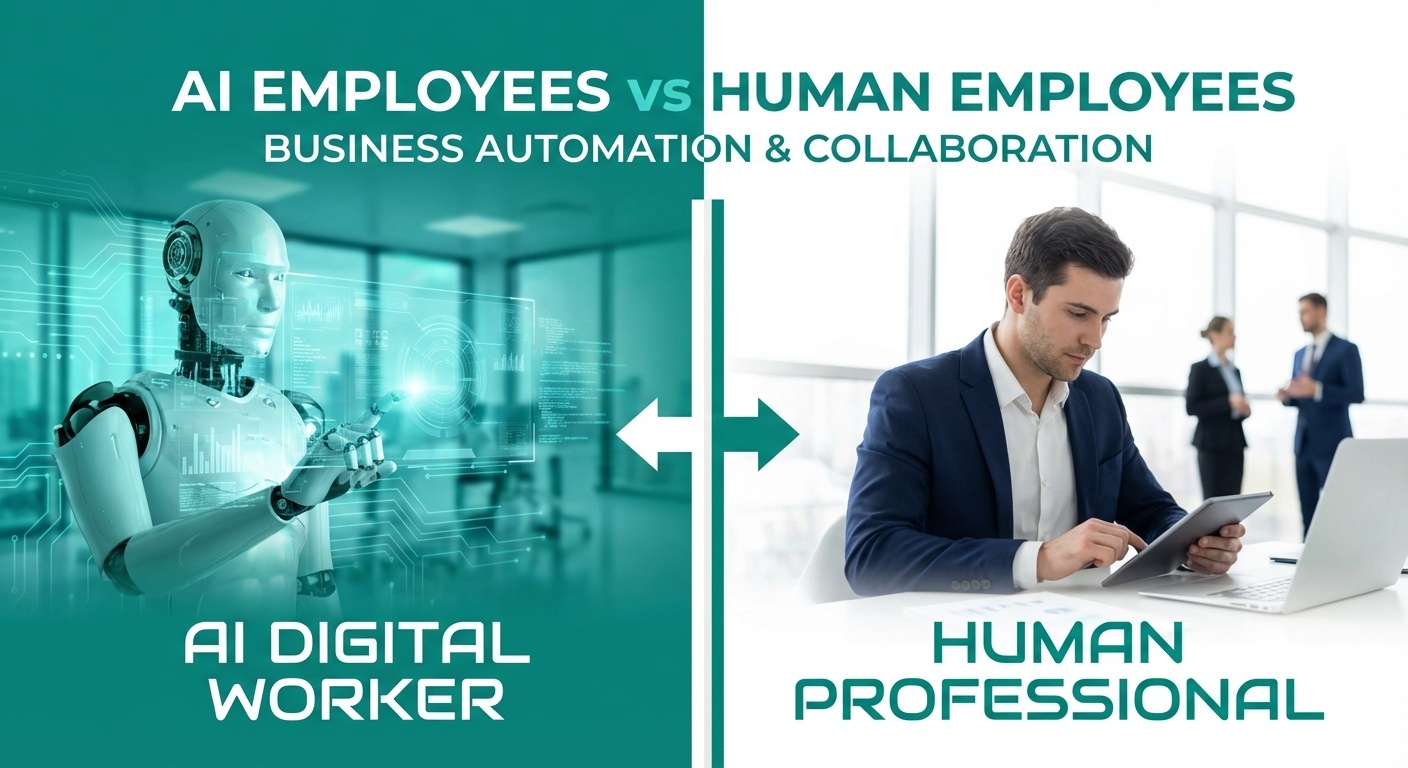
Which is better for your business in 2025: AI employees or human employees? This is the question that every business owner, entrepreneur, and startup founder is asking right now. The rise of AI employees has revolutionized how we think about work, productivity, and business growth. In this comprehensive guide, we'll break down everything you need to know about AI employees versus human employees, so you can make the best decision for your business.
The workplace transformation happening right now is unlike anything we've seen before. Companies are extremely unhappy with their current workforces, and AI is giving them what they think they've always wanted—reliable, consistent, and cost-effective labor. This shift started in 2023 and has accelerated significantly in 2024 and 2025.
Before we dive deeper, here's an excellent video explaining what AI employees are and how they're changing the business landscape:
As you can see, AI employees are transforming how businesses operate. Let's explore this topic in detail.
AI employees are artificial intelligence systems designed to perform tasks that were traditionally done by human workers. These digital employees can handle customer service inquiries, manage social media accounts, automate email responses, process sales leads, and even conduct initial sales calls. Unlike their human counterparts, AI employees work around the clock without taking breaks, holidays, or sick days.
The concept of AI employees has moved beyond simple chatbots and automated response systems. Modern AI employees, like those offered by Dooza.ai, are sophisticated digital workers that can understand context, learn from interactions, and provide personalized responses. They represent a paradigm shift in how businesses approach staffing and operational efficiency.
According to recent research from Stanford's Human-Centered AI Institute, there's been a significant shift in what skills businesses value. Data analysis and process monitoring skills—tasks that AI excels at—are diminishing in value, while skills related to prioritizing, organizing, training, and effective communication are growing in importance.
AI employees can be configured to handle virtually any business function that involves information processing, communication, or automation. From answering customer questions to processing orders, from managing social media to conducting initial sales outreach, AI employees are capable of handling a wide range of tasks that previously required human intervention.
The key differentiator between traditional automation and AI employees is the ability to learn and adapt. Traditional automation follows rigid rules and cannot handle exceptions. AI employees, on the other hand, can learn from each interaction, improve their performance over time, and handle situations that weren't explicitly programmed into their system.
This adaptive capability makes AI employees incredibly valuable for businesses of all sizes. Small businesses can now access capabilities that were previously only available to large corporations, while large enterprises can dramatically reduce operational costs and improve efficiency.
The workplace transformation happening right now is unlike anything we've seen before. Daniel Miessler, a prominent voice in the AI industry, recently made a provocative statement: "The ideal number of human employees inside of any company is zero." While this might sound extreme, it reflects a growing sentiment among business owners who are increasingly dissatisfied with traditional workforce models.
Companies are extremely unhappy with their current workforces, and AI is giving them what they think they've always wanted—reliable, consistent, and cost-effective labor.
The reasons are clear and compelling:
As reported by Fortune, this represents a fundamental change in the employer-employee relationship, one that will reshape industries for decades to come.
Here's another video that explains how to build an AI employee:
Let's break down the key differences between AI employees and human employees across multiple dimensions:
AI Employees:
Human Employees:
AI Employees:
Human Employees:
AI Employees:
Human Employees:
AI Employees:
Human Employees:
One of the most significant factors driving the adoption of AI employees is cost. Let's break down the comprehensive numbers:
Total annual cost per human employee: $75,000 - $200,000+
Total annual cost per AI employee: $2,400 - $24,000
When you add it all up, AI employees can cost 50-90% less than their human counterparts over a 12-month period.
AI employees process information and complete tasks at speeds that are impossible for humans. They can analyze thousands of data points in seconds, respond to customer inquiries instantly, and handle unlimited simultaneous conversations. This capability is particularly valuable for businesses that need to scale quickly without the traditional constraints of hiring more staff.
According to research testing AI against over 100,000 humans, AI systems have now crossed thresholds in certain cognitive tasks that were previously considered uniquely human.
Human employees, regardless of their experience or dedication, are susceptible to errors. Fatigue, distraction, and rushing can all lead to mistakes. AI employees, when properly configured, maintain near-perfect accuracy in their designated tasks. They don't make typos, they don't misread information, and they don't forget important details.
The quality of work produced by AI employees is consistent and reliable. Each task is completed to the same standard, following predetermined protocols and quality guidelines.
That said, humans excel in areas requiring emotional intelligence, creative problem-solving, and complex decision-making. AI is excellent at processing information and executing tasks, but humans remain superior in areas requiring empathy, intuition, and nuanced understanding.
In today's global economy, businesses operate around the clock. Customers expect instant responses regardless of time zone or hour. AI employees make 24/7 operations possible without the expense and complexity of shift scheduling, night differentials, and overtime pay.
This is particularly valuable for customer service operations. A human agent can only handle perhaps 20-30 conversations per day effectively. An AI employee can handle hundreds or thousands simultaneously, with consistent response times and quality.
When your business experiences sudden growth or seasonal spikes, hiring human employees takes time. You need to post jobs, screen applicants, conduct interviews, and complete onboarding. AI employees scale instantly. Need to double your capacity? Simply adjust your subscription or deploy additional AI workers.
This scalability also works in reverse. During slow periods, you don't have to worry about paying idle employees. AI employees are elastic—you scale up when you need them and scale down when you don't.
AI employees are particularly effective in the following business functions:
AI employees excel at handling routine customer inquiries. They can answer frequently asked questions, process simple requests, and route complex issues to human agents. This hybrid approach ensures customers get quick answers to common questions while human agents focus on more complex issues that require empathy and creative problem-solving.
AI customer service representatives never lose patience, never raise their voice, and never treat customers differently based on their mood. Every interaction is professional, courteous, and consistent.
Manual data entry is tedious, error-prone, and expensive. AI employees can process documents, extract information, and enter data with remarkable accuracy. They can work through thousands of records in the time it would take a human to process a hundred.
AI employees can handle initial outreach to prospects, qualifying leads and scheduling appointments. They can send personalized emails, follow up with prospects, and even conduct initial discovery calls. This allows your human sales team to focus on closing deals rather than prospecting.
AI employees can schedule posts, respond to comments, monitor brand mentions, and analyze engagement metrics. They maintain a consistent posting schedule and engagement level that would be difficult for human social media managers to sustain.
From welcome sequences to follow-up campaigns, AI employees can manage complex email workflows that nurture leads and convert customers. They ensure every subscriber receives the right message at the right time.
AI employees can manage calendars, schedule appointments, and send reminders. They can handle rescheduling requests and cancellations without human intervention.
AI employees can score and qualify leads based on predefined criteria, ensuring your sales team focuses only on the most promising opportunities.
Despite the many advantages of AI employees, there are areas where human workers remain essential:
When problems require creative solutions, out-of-the-box thinking, or nuanced judgment, humans excel. AI can follow patterns and execute predefined solutions, but humans remain better at handling unprecedented situations.
Understanding and responding to emotions is a distinctly human capability. Sales conversations, customer complaints, and team leadership all require emotional intelligence that AI cannot replicate.
While AI can analyze data and provide insights, strategic decisions ultimately require human judgment, experience, and intuition.
Business is fundamentally about relationships. While AI can assist in relationship management, the deep, trust-based relationships that drive business success require human connection.
Content that inspires, designs that move, and ideas that innovate all require creativity. AI can assist creative workers, but the spark of true creativity remains human.
When situations escalate or require nuanced handling, human intervention is essential. AI can flag issues, but humans are needed to resolve complex conflicts.
The future of work isn't about choosing between AI employees and human employees—it's about finding the right balance. The most successful businesses in 2025 will be those that strategically deploy AI for tasks where it excels while retaining human talent for activities that require human touch.
Let AI Handle:
Keep Humans for:
This hybrid approach allows businesses to reduce costs, improve efficiency, and enhance customer satisfaction while maintaining the human elements that drive loyalty and innovation.
Transitioning to AI employees requires thoughtful planning. Here's your step-by-step guide to implementation:
Before implementing AI employees, audit your current operations to identify tasks that are repetitive, rules-based, and high-volume. These are ideal candidates for AI automation.
Begin with a single function—perhaps customer service or email follow-ups. Measure the results and learn from the implementation before expanding to other areas.
Select an AI employee platform that aligns with your business needs. Look for platforms that offer customization, integration with your existing tools, and proven track records. Dooza.ai provides AI employees that can automate inbox, social media, SEO, and sales calls 24/7.
Work with your AI platform to configure your digital employees. Provide them with the information, protocols, and guidelines they need to represent your brand effectively.
Track performance metrics and gather feedback. Use this information to continuously improve your AI employees and refine your hybrid workforce strategy.
Yes, for most businesses, AI employees provide significant return on investment. They reduce labor costs, improve consistency, and enable 24/7 operations that would be impossible with human staff alone.
Not entirely. While AI excels at many tasks, humans remain essential for complex problem-solving, emotional intelligence, creative work, and strategic decision-making. The best approach is a hybrid model.
Work with your AI platform provider to configure your digital employees with brand guidelines, common responses, and company-specific information. Most platforms offer intuitive interfaces for ongoing training and updates.
Configure your AI employees to recognize limitations and escalate to human team members when appropriate. This ensures customers always receive the assistance they need.
Reputable AI employee platforms prioritize security and compliance. Look for platforms that offer data encryption, access controls, and compliance with relevant regulations.
Implementation time varies depending on complexity, but most businesses can deploy basic AI employees within days or weeks. More complex implementations may take longer.
Most modern AI platforms integrate with popular business tools including CRM systems, email platforms, social media tools, and more. Check with your platform provider for specific integrations.
The learning curve is minimal. Most AI employee platforms are designed for ease of use and require minimal technical expertise. Ongoing management primarily involves monitoring performance and making adjustments as needed.
AI employees should be positioned as enhancements to your team, not replacements. They handle routine tasks, freeing your human team to focus on higher-value work that requires human skills.
The capabilities of AI employees will continue to expand. As AI technology advances, digital employees will handle increasingly complex tasks, making them even more valuable to businesses of all sizes.
Modern AI employees have advanced natural language processing capabilities that allow them to understand context to a remarkable degree. However, they may still struggle with highly nuanced situations that require deep emotional understanding.
Yes, most AI employee platforms support multiple languages, enabling global businesses to provide consistent service across different regions.
The debate between AI employees and human employees isn't about choosing one over the other—it's about understanding how each can contribute to your business success. AI employees offer unmatched efficiency, consistency, and scalability for routine tasks. Human employees bring creativity, emotional intelligence, and strategic thinking that AI cannot replicate.
The most successful businesses in 2025 and beyond will be those that strategically leverage both AI and human talent. By understanding the strengths and limitations of each, you can build a workforce that maximizes efficiency while maintaining the human elements that drive innovation and customer loyalty.
Whether you're a small business owner looking to compete with larger companies or an enterprise seeking operational efficiency, AI employees offer a compelling solution. The key is to start with clear objectives, choose the right implementation partner, and maintain a balanced perspective on the role of AI in your workforce.
Ready to explore how AI employees can transform your business? Learn more about Dooza.ai and how our AI employees can automate your inbox, social media, SEO, and sales calls 24/7. Build, grow, and scale your business with AI employees today.
Visit Dooza.ai to get started with AI employees for your business.
Automate your business with AI employees that work 24/7.
Compare an AI chatbot with an AI employee for customer support, including tool access, approvals, reporting, and deployment needs.
Comparing AI employees to human virtual assistants? Discover the pros, cons, costs, and when to use each—plus why a hybrid approach might be your best option.
Join thousands of companies using Workforce to automate their work. Get started for free today.
No credit card required · 7-day money-back guarantee · Cancel anytime