AI Automation
Top AI Automation Companies to Watch in 2026
Discover the leading AI automation companies transforming business workflows in 2026. Learn how agentic AI and digital workers can boost your efficiency.
10 min read
ReadDiscover 11 marketing automation best practices to streamline your workflow. Free up your team and boost ROI with AI-powered strategies you can use today.
Imagine a world where your marketing runs on autopilot, nurturing leads, personalizing emails, and coordinating multi-channel campaigns while you sleep. This isn't a futuristic fantasy; it's the reality smart automation makes possible. The true goal of automation isn't just to do more marketing, but to do less manual work while achieving far better, more targeted results. Imagine your smartest marketer, cloned, working 24/7 without ever needing a coffee break. This is the dream AI-powered automation delivers, giving your team the freedom to focus on the high-impact strategy and creative thinking that truly drives business growth.
This guide moves beyond generic advice to deliver actionable marketing automation best practices. We'll provide a comprehensive roadmap for transforming your operations from a series of disjointed tasks into a sophisticated, self-sufficient engine. You will learn how to implement everything from intelligent lead scoring and hyper-personalized email sequences to advanced behavioral triggers and unified sales and marketing workflows. Each practice is a building block toward a more efficient and effective marketing machine.
We'll also explore how to orchestrate these systems with AI agents, like those from Dooza.co, turning repetitive processes into intelligent, automated workflows. By the end of this article, you will have a clear, step-by-step framework to implement these strategies, reclaim your most valuable asset—time—and let your marketing efforts scale effortlessly. Let's dive into the practices that will turn your marketing into a powerhouse that frees you for what matters most.
Effective marketing automation isn’t about blasting the same message to everyone; it’s about delivering the right message to the right person at the right time. This is where lead scoring and segmentation become indispensable. This practice involves automatically ranking leads based on their engagement, demographic data, and overall fit, ensuring your sales team and AI agents focus their energy on the most promising opportunities. Imagine an intelligent system that automatically prioritizes every new lead, freeing your team from the soul-crushing task of manual sorting and guesswork.
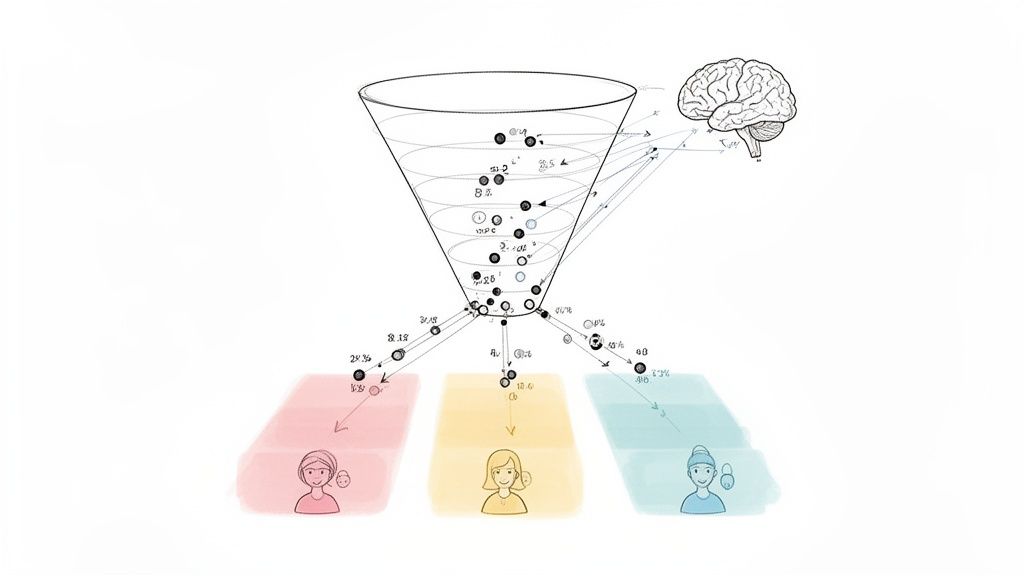
This method transforms your funnel from a simple list into a dynamic, intelligent system. For example, a prospect who downloads a pricing guide gets 25 points, while someone who only visits your homepage gets 5. An AI system can automatically segment these high-scoring leads into a "Hot Leads" list and enroll them in a targeted nurture campaign that speaks directly to their needs. This level of personalization dramatically increases conversion rates and accelerates the sales cycle, all while your team focuses on closing deals, not sifting through data.
Lead scoring acts as a powerful filter, preventing sales teams from wasting time on unqualified leads. When a lead's score crosses a predefined threshold—say, 100 points—the system can automatically assign it to a sales representative for immediate follow-up. This seamless handoff between marketing and sales is a cornerstone of efficient automation. It's the difference between your sales team calling random numbers and having a curated list of interested buyers delivered to them every morning.
Key Insight: Without proper scoring and segmentation, you risk alienating high-potential leads with generic content while your sales team chases low-interest prospects. This practice ensures every interaction is relevant and impactful.
Generic email blasts are a thing of the past. The core of modern marketing automation best practices lies in delivering highly personalized experiences at scale through automated email sequences. This approach involves sending a series of tailored messages triggered by specific user actions or data, ensuring every communication feels timely and relevant. Imagine an AI agent that automatically crafts and sends the perfect follow-up email, guiding each customer on a unique journey without you ever having to write a single line of copy.
This strategy transforms email from a simple broadcast tool into a dynamic conversation. For instance, a new user who signs up for your SaaS trial receives a welcome sequence that highlights key features they haven't used yet. A customer who buys a product might get a post-purchase sequence with related recommendations, similar to Amazon's "Customers who bought this also bought..." emails. This level of personalization builds stronger relationships and drives significant engagement, all on autopilot.
Personalized email sequences nurture leads and customers automatically, moving them through the funnel efficiently. Instead of a single, easily ignored email, a well-crafted drip campaign maintains a consistent, helpful presence in the inbox, keeping your brand top-of-mind. This continuous engagement is crucial for complex sales cycles and customer retention. It’s like having a dedicated account manager for every single customer, working around the clock.
Key Insight: Without personalization, your emails are just noise. By tailoring sequences to user behavior and data, you turn your automation platform into a powerful relationship-building engine that nurtures leads and delights customers 24/7.
Modern customers don't live in a single channel, and neither should your marketing. Multi-channel orchestration is the art of coordinating your efforts across email, social media, SMS, and your website to create a single, unified customer experience. Instead of siloed campaigns, this practice ensures every message is synchronized, so customers receive a consistent narrative no matter where they interact with your brand. Imagine an AI-powered team where your email agent, social media manager, and support agent all share the same brain, working in concert to deliver seamless campaigns without you lifting a finger.
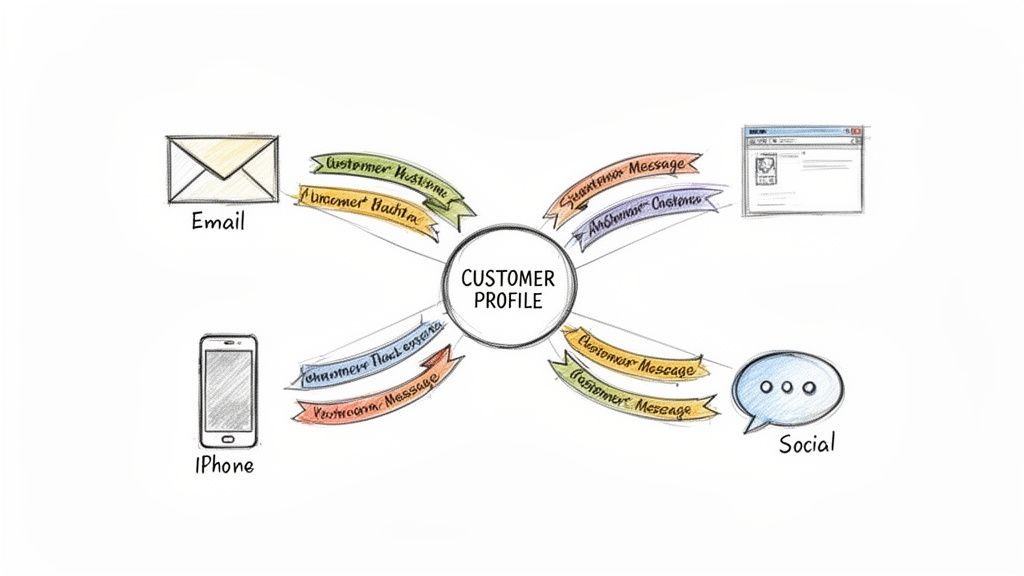
This strategy moves beyond simple multi-channel marketing to true orchestration. For instance, after a customer clicks a link in your promotional email about a new running shoe, an AI agent could automatically follow up with a targeted ad on their Instagram feed showing a video of the shoe in action, followed by a personalized Instagram direct message with a limited-time offer. This cohesive approach makes your brand feel omnipresent and deeply attuned to the customer's journey.
Orchestration prevents the jarring experience of receiving contradictory messages on different platforms. It ensures that your automated marketing feels like a helpful, continuous conversation rather than a series of disconnected shouts. This consistency builds brand trust and significantly boosts engagement and conversion rates by meeting customers on their preferred channels with the right context. It’s the dream of truly integrated marketing, made real by AI.
Key Insight: Without orchestration, your multi-channel efforts can feel fragmented and even annoying to customers. A truly integrated strategy transforms your automation from a simple tool into an intelligent, customer-centric ecosystem.
Instead of relying on rigid, time-based schedules, the most effective marketing automation best practices hinge on real-time user actions. Event-based automation activates workflows based on specific behavioral triggers like a website visit, a form submission, or a purchase. This approach ensures your messages are not just sent, but are delivered at the exact moment of peak relevance when a prospect is most engaged. Imagine an autonomous system that responds instantly to customer actions, creating a perfectly timed and personalized journey without any manual intervention.
This strategy shifts your marketing from a monologue to a dynamic conversation. For instance, when a customer abandons their shopping cart, an AI agent can immediately trigger a follow-up email sequence with a 10% discount. Similarly, a new user signing up for a SaaS trial can instantly receive the first email of a guided onboarding series showing them the exact first step to take. This responsiveness makes your marketing feel incredibly intuitive and helpful, dramatically increasing engagement and conversion rates while you focus on bigger goals.
Event-based triggers are powerful because they are rooted in customer intent. A message sent after a user takes a specific action is exponentially more relevant than a generic weekly newsletter. This timeliness builds trust and demonstrates that you are paying attention to their individual needs, fostering a stronger customer relationship from the very first interaction. It’s the closest you can get to a one-on-one conversation, scaled to thousands.
Key Insight: Relying solely on time-based campaigns is like speaking to an empty room. Event-based automation ensures you are speaking directly to an engaged individual at the precise moment they are ready to listen.
Instead of casting a wide net, Account-Based Marketing (ABM) uses a spear-fishing approach, focusing your marketing and sales efforts on a curated list of high-value target accounts. This B2B strategy treats each company as a market of one, delivering hyper-personalized, coordinated campaigns to key decision-makers within that organization. Imagine deploying an AI workforce that orchestrates bespoke outreach across email, social media, and support for each of your dream clients, ensuring a unified and compelling message without the manual grunt work.
This model flips the traditional marketing funnel on its head. Instead of generating thousands of individual leads, you identify your most valuable potential customers first and then create campaigns specifically designed to engage them. For example, a cybersecurity firm might run an ABM campaign targeting a specific bank by showcasing a custom-built demo that addresses that bank's unique, publicly-known vulnerabilities. This level of personalization makes your brand impossible to ignore.
ABM aligns marketing and sales resources with laser precision, eliminating wasted effort on unqualified prospects and maximizing ROI. By concentrating on accounts with the highest revenue potential, you ensure every marketing dollar and every sales call contributes directly to your most important business goals. It's one of the most effective marketing automation best practices for B2B companies seeking to land larger, more complex deals and free their teams from chasing low-value leads.
Key Insight: Standard lead generation measures success by volume, but ABM measures success by account penetration and revenue. This shift ensures you're not just busy; you're building relationships that directly impact your bottom line.
Effective nurturing is the engine of marketing automation, guiding prospects from initial curiosity to purchase-ready. This practice involves creating automated sequences that deliver timely, relevant content based on a lead’s stage in the buyer's journey. By pairing these workflows with progressive profiling, you can gather crucial data over time without overwhelming new leads with long, intimidating forms. Imagine an autonomous system that not only educates your prospects but also enriches their profiles with each interaction, preparing them perfectly for sales.
This dual approach transforms lead generation from a one-time data grab into an ongoing conversation. For example, a new lead might only provide an email for a top-of-funnel ebook. Later, when they request a case study, the form intelligently asks for their company size and job title. This gradual information exchange builds trust and provides your AI agents with the data needed to personalize future communications, ensuring every message resonates.
Lead nurturing workflows prevent promising leads from going cold, ensuring your brand stays top-of-mind while freeing your sales team to focus on closing. Progressive profiling makes this process frictionless by respecting the user's time and building a detailed contact record incrementally. This method increases form conversion rates and improves lead quality, as the information gathered is contextual and timely.
Key Insight: Without structured nurturing and progressive profiling, you risk either losing leads due to a lack of follow-up or scaring them away with high-friction forms. This practice creates a seamless journey that feels helpful, not intrusive.
True marketing automation isn’t a "set it and forget it" tool; it’s a dynamic engine for growth that requires constant tuning. This practice involves treating your campaigns as living systems, continuously monitoring key metrics, analyzing performance data, and systematically testing improvements. Imagine having an AI co-pilot that not only executes tasks but also provides clear, data-backed insights on how to improve, turning your marketing efforts into a self-optimizing machine that gets smarter every day.
This data-driven approach transforms your strategy from guesswork into a precise science. For example, instead of wondering why a nurture sequence is underperforming, an AI can pinpoint the exact email causing a 40% drop-off, test three new subject lines, and automatically implement the winner. This relentless optimization is how companies like Netflix and Amazon dominate, and it’s a crucial marketing automation best practice that lets you achieve similar results without a massive data science team.
Continuous optimization is what separates stagnant campaigns from high-performing ones that deliver exceptional ROI. By regularly analyzing performance, you can identify bottlenecks in your funnel, understand what resonates with your audience, and double down on successful tactics. This feedback loop ensures your automation efforts evolve and improve over time, freeing you from wasting ad spend and missing opportunities.
Key Insight: Without a structured process for monitoring and optimization, your automation workflows will inevitably become outdated and ineffective. Data-driven analysis is the only way to ensure your marketing engine runs at peak performance and adapts to changing customer behavior.
Static, one-size-fits-all content is a relic of the past. Modern marketing automation empowers you to deliver dynamic content that adapts in real-time to each visitor, creating a truly personalized experience. This practice involves showing different messages, offers, and visuals based on known data like their industry, past behavior, or location. Imagine your website automatically changing its headline to match a visitor's specific industry, making them feel instantly understood and seen.
This level of personalization transforms your digital properties from static brochures into interactive, responsive assets. For example, an e-commerce site like Amazon shows you products based on your browsing history. A B2B platform could display different case studies to visitors from the healthcare industry versus the finance industry. This tailored approach makes every interaction feel relevant, significantly boosting engagement and conversions, all happening automatically in the background.
Dynamic content directly addresses a user's specific context, making your marketing far more effective. Instead of forcing visitors to find what’s relevant to them, you present it to them proactively. This reduces friction, builds rapport, and accelerates their journey through the funnel. It's one of the most powerful marketing automation best practices for making prospects feel seen and valued, creating a "wow" moment that builds brand loyalty.
Key Insight: Personalization is no longer just about using a first name in an email. True dynamic content adapts the core message, offers, and imagery to match the individual, turning generic interactions into meaningful conversations.
The most sophisticated automation workflows are useless if they run on bad data. Your automation engine is only as powerful as the quality of the fuel you give it, and in this case, that fuel is clean, accurate contact information. Data hygiene involves regularly cleaning, validating, and updating your contact lists to remove duplicates, invalid emails, and inactive subscribers, ensuring your messages always reach their intended audience. Imagine a system where your AI agents never waste resources on dead-end contacts because the database is perpetually self-cleaning.
This practice transforms your contact list from a cluttered digital attic into a high-performance asset. For example, an AI agent can automatically identify and merge duplicate contacts, flag emails that consistently hard-bounce, and segment inactive contacts into a re-engagement campaign. This prevents high bounce rates and protects your sender reputation—all tedious tasks that can now be fully automated, freeing your team for more strategic work.
Poor data quality directly translates to wasted resources, skewed analytics, and potential damage to your brand’s email deliverability. Implementing regular database hygiene is one of the most critical marketing automation best practices because it ensures your efforts are precise and effective. Clean data means higher engagement rates, more accurate personalization, and a better return on your automation investment.
Key Insight: Without consistent data hygiene, your automation system works harder, not smarter. You risk sending personalized content to the wrong people or, worse, to email addresses that don't even exist, actively harming your sender score.
Marketing automation’s greatest potential is lost when sales and marketing operate in silos. This best practice is about creating a unified revenue team by establishing shared metrics, clear lead definitions, and complete visibility into the prospect's journey. Imagine a world where marketing hands off a perfectly warmed-up lead, and the sales rep’s screen instantly populates with the lead’s entire history—every email opened, every page visited, every webinar attended. This alignment ensures automation serves its ultimate purpose: generating revenue efficiently.
This strategic unity transforms your funnel from a leaky bucket into a high-pressure pipeline. When both teams agree on what constitutes a Marketing Qualified Lead (MQL) versus a Sales Qualified Lead (SQL), friction disappears. For example, an MQL could be defined as a lead with a score of 100+ from a target industry, while an SQL is an MQL who has also requested a demo. This clarity ensures a seamless handoff where high-value leads are actioned immediately, dramatically improving win rates.
Misalignment is expensive; it can waste up to 30% of your leads and kill team morale. By establishing a formal Service Level Agreement (SLA), you create a contract between marketing and sales that defines responsibilities, response times, and feedback protocols. This eliminates guesswork and holds both teams accountable for their part in the revenue cycle, making it one of the most crucial marketing automation best practices for sustainable growth.
Key Insight: Without alignment, your automation platform is just an expensive email tool. With it, it becomes the central nervous system of your revenue engine, ensuring every action from both teams is coordinated and impactful.
Effective marketing automation runs on high-quality data. Without it, your carefully crafted workflows, personalization efforts, and lead scoring models will fail. Prioritizing data hygiene means regularly cleaning, standardizing, and updating your contact database to remove outdated, duplicate, or incorrect information. Think of it as routine maintenance for your marketing engine; it ensures every automated action is based on accurate, reliable intelligence, freeing you from the nightmare of chasing down data errors.
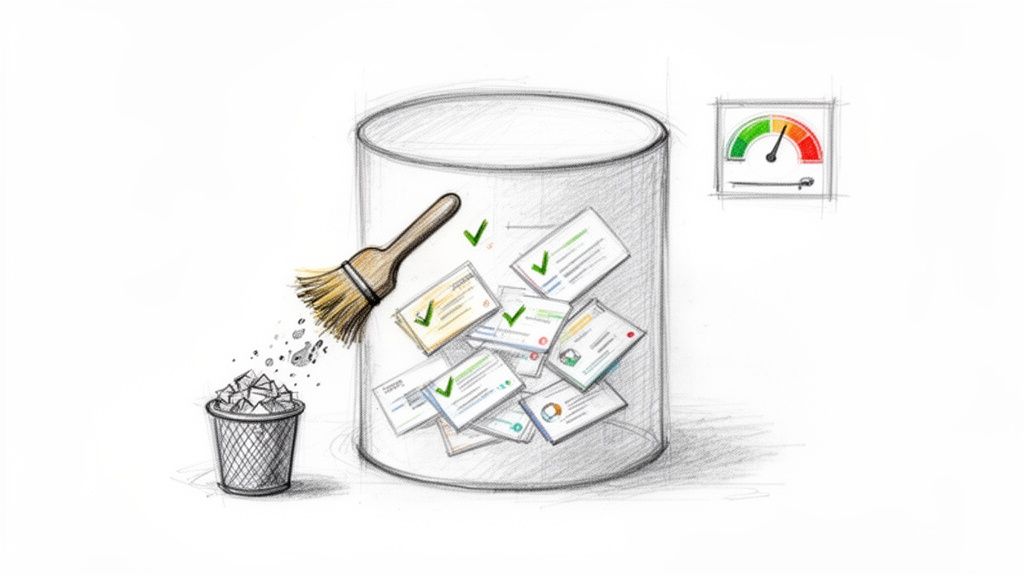
This practice prevents embarrassing and costly mistakes, such as sending emails to the wrong person, addressing prospects by an incorrect name, or marketing to leads who have left their company. By maintaining a clean database, your automation platform can execute with precision, improving deliverability, engagement rates, and overall campaign ROI. It transforms your CRM from a digital junk drawer into a source of strategic truth, all without tedious manual cleanup.
Poor data quality silently sabotages your marketing efforts, leading to skewed analytics, wasted ad spend, and damaged brand reputation. A commitment to data hygiene is one of the most crucial marketing automation best practices because it directly impacts the performance of every other strategy. It ensures your segmentation is accurate, your personalization is relevant, and your sales team trusts the leads they receive.
Key Insight: Your automation is only as smart as the data it uses. Neglecting data hygiene is like asking an AI to navigate with a broken compass; the results will be inefficient, unpredictable, and ultimately off-course.
| Strategy | 🔄 Implementation complexity | ⚡ Resource requirements | 📊 Expected outcomes | 💡 Ideal use cases | ⭐ Key advantages |
|---|---|---|---|---|---|
| Implement Lead Scoring and Segmentation | Medium — model setup, CRM integration, ongoing tuning | Moderate — behavioral & firmographic data, CRM, analytics resources | ↑ Conversions ~30–50%; better lead prioritization and routing | High-volume lead gen, sales prioritization, B2B/B2C | Automated prioritization, personalized outreach at scale, continuous model refinement |
| Create Personalized Email Sequences & Drip Campaigns | Low–Medium — workflow and content setup, A/B testing | Moderate — email platform, copy assets, segmentation data | ↑ Opens 15–25%, ↑ CTR 20–30%; reduces manual workload | Onboarding, lead nurturing, cart recovery, lifecycle campaigns | Scalable personalization, consistent touchpoints, high efficiency in messaging |
| Develop Multi-Channel Marketing Orchestration | High — integrations, unified journey mapping, channel coordination | High — multiple channel tools, shared data layer, cross-team ops | ↑ Conversions 20–40%; ↑ LTV 30–50%; better attribution | Brand campaigns, product launches, omnichannel retail | Unified customer experience, reduced channel conflict, richer insights |
| Leverage Behavioral Triggers & Event-Based Automation | Medium–High — real-time tracking and trigger logic | Moderate–High — event tracking infrastructure, developer support | CTRs 40–50% higher vs time-based; faster recovery and higher relevance | E‑commerce cart recovery, SaaS onboarding, time-sensitive alerts | Timely, contextually relevant messages; scalable real‑time responses |
| Implement Account-Based Marketing (ABM) for High-Value Targets | High — account research, bespoke campaigns, sales alignment | High — intent data, personalized content, coordinated sales effort | ↑ Deal size 40–50%, shorter sales cycles 20–30%, higher close rates | B2B enterprise deals, high-value accounts, targeted agency work | High ROI per account, deeper multi‑stakeholder engagement, stronger alignment |
| Establish Lead Nurturing Workflows with Progressive Profiling | Medium — multi-stage flows and adaptive forms | Moderate — content library, smart forms, scoring rules | ↑ Conversions 25–35%; ↓ form abandonment 20–30% | Long B2B purchase cycles, education-led funnels, slow-selling products | Gradual data capture, richer profiles, improved readiness for sales handoff |
| Monitor, Analyze & Optimize Campaign Performance | Medium — dashboarding, attribution, testing processes | Moderate — analytics tools, reporting cadence, analyst time | Data-driven improvements ~20–30%; faster issue detection and ROI clarity | Ongoing campaign optimization, multi-channel programs | Continuous optimization, better budget allocation, replicable insights |
| Create Dynamic Content Based on Visitor & Audience Data | Medium–High — real-time rules, content variants, API work | Moderate–High — quality audience data, dev integration, content creation | ↑ Conversions 15–40%; higher engagement and lower unsubscribes | Personalized sites/emails, product recommendations, segmented landing pages | Real-time relevance, scalable personalization across channels |
| Maintain Data Quality & Regular Database Hygiene | Low–Medium — processes, validation rules, periodic cleansing | Low–Moderate — validation tools, scheduled maintenance, policies | ↑ deliverability 10–20%; ↓ bounce rates and wasted spend | Any organization reliant on email/automation, list-heavy programs | Better deliverability, actionable targeting, protects sender reputation |
| Align Sales & Marketing with Shared Goals & Lead Definitions | Medium — governance, SLAs, shared metrics and feedback loops | Moderate — shared dashboards, regular syncs, executive sponsorship | ↑ revenue 20–30%; higher close rates and improved forecasting | Organizations with handoff friction or scaling sales/marketing ops | Cleaner handoffs, accountability, improved lead quality and forecasting |
You've just navigated a comprehensive flight plan covering the essential marketing automation best practices that separate high-growth teams from the rest. We've moved beyond basic email blasts and into the realm of intelligent, AI-orchestrated marketing engines. From the precision of lead scoring and multi-channel orchestration to the critical discipline of data hygiene and sales alignment, each practice is a vital component of a system designed not just to automate tasks, but to amplify your team's strategic impact.
The core message threaded through each of these strategies is a fundamental shift in perspective. True marketing automation isn't about replacing human ingenuity; it's about liberating it. It’s about building a sophisticated, self-optimizing framework that handles the relentless, data-intensive work, freeing your team to focus on the high-value activities that machines can't replicate: creative breakthroughs, empathetic customer conversations, and big-picture strategic planning. This is the dream of AI: less time on spreadsheets, more time on strategy.
The journey from manual effort to automated excellence can feel daunting, but it starts with a few foundational pillars. If you remember nothing else, internalize these core principles:
Reading about these practices is one thing; implementing them is another. The dream of reclaiming your time and achieving exponential growth is closer than you think. Don't try to boil the ocean. Instead, build momentum with a focused, phased approach.
Here’s your immediate, actionable plan to get started:
Adopting these marketing automation best practices is your ascent from the turbulence of manual marketing to the clear skies of strategic, predictable growth. You are building an asset for your business, an engine that works for you 24/7, engaging prospects and delighting customers while you and your team focus on the next big idea. This isn't just about efficiency; it's about building a more resilient, intelligent, and human-centric marketing organization.
Ready to stop managing tasks and start orchestrating strategy? The Dooza.co platform provides a team of collaborative AI agents designed to execute these best practices, from segmenting audiences to running multi-channel campaigns. Hire your first AI employee today and transform your marketing automation vision into a reality at Dooza.co.
Automate your business with AI employees that work 24/7.
Discover the leading AI automation companies transforming business workflows in 2026. Learn how agentic AI and digital workers can boost your efficiency.
Discover 7 practical AI automation examples that save time, reduce costs, and boost productivity. Learn how to implement these workflows in your business today.
Join thousands of companies using Workforce to automate their work. Get started for free today.
No credit card required · 7-day money-back guarantee · Cancel anytime