AI Business Automation ROI: How to Calculate the Real Return on Your AI Investment
Not sure if AI automation is worth the investment? Learn how to calculate AI business automation ROI with real numbers, frameworks, and comparisons so you can make a confident decision.
10 min read
July 8, 2026
Every business owner considering AI automation asks the same question: "Will this actually pay for itself?" It is the right question. In a world where every vendor claims their tool will "transform your business," you need a way to cut through the hype and look at actual numbers.
The good news is that AI business automation ROI is not theoretical or speculative. The data is in, the case studies are real, and for most small businesses the math is overwhelmingly favorable. The challenge is not whether AI automation delivers ROI — it is knowing how to calculate it for your specific situation so you can make a confident investment decision.
This guide gives you the frameworks, the real numbers, and the comparisons you need to evaluate AI automation ROI honestly.
Why Measuring AI Automation ROI Matters More Than Ever
We are past the early-adopter phase of AI in business. In 2026, AI automation is not a novelty — it is becoming a baseline expectation. Businesses that have not yet adopted AI workflows are not just missing an advantage; they are falling behind competitors who already have.
But "everyone else is doing it" is not a business case. Here is why measuring ROI specifically matters right now:
Budgets are tighter. After years of economic uncertainty, every dollar needs to justify itself. You cannot afford to invest in tools that do not deliver measurable returns.
The tool landscape is overwhelming. There are hundreds of AI automation tools, and many are expensive. ROI analysis helps you compare options objectively instead of being swayed by feature lists and marketing promises.
Stakeholder buy-in requires numbers. Whether you are convincing a business partner, a board, or yourself, "it feels like it should help" does not cut it. You need concrete projections grounded in your own business data.
Opportunity cost is real. Every month you spend evaluating AI tools without implementing them is a month of lost leads, slow follow-up, and revenue left on the table. Calculating ROI helps you move from deliberation to action.
The video above breaks down the lowest-risk way to start adding AI to your business — a practical framework for getting real returns without betting the farm on unproven technology.
Real AI Automation ROI Numbers You Can Benchmark Against
Before diving into your own calculation, here are the industry benchmarks that set expectations:
McKinsey Global Institute reports that companies using AI see revenue increases of 3 to 15 percent and cost reductions of 10 to 20 percent in the functions where AI is applied.
Nucleus Research found that for every dollar spent on AI and analytics technology, companies generated an average return of $13.01.
Salesforce Research shows that high-performing sales teams using AI are 2.8 times more likely to report significant revenue increases than teams without AI.
Harvard Business Review found that companies responding to leads within one hour are 7 times more likely to qualify a lead, directly impacting conversion rates and revenue.
Forrester reports that AI-powered lead scoring and follow-up can increase conversion rates by 15 to 30 percent while reducing cost per lead by up to 50 percent.
These are not cherry-picked success stories. They represent broad data across industries and company sizes. For small businesses specifically, the ROI tends to be even higher because the baseline is often so inefficient — moving from "no automation at all" to "AI-powered follow-up" is a massive leap in performance.
The AI Business Automation ROI Calculation Framework
Here is a practical framework you can apply to your own business in about 15 minutes. No spreadsheet required — just honest answers to a few questions.
The basic formula
ROI = (Value Gained - Cost of Automation) / Cost of Automation x 100
The trick is accurately calculating "Value Gained." Here is how to break it down into three measurable components:
Component 1: Time savings
How many hours per month do you or your team currently spend on manual follow-up, lead management, and appointment scheduling? Multiply those hours by your effective hourly rate (or the rate of the person doing that work). That is the time-savings value.
Example: 15 hours per month on manual follow-up x $75/hour = $1,125 per month in recovered time.
Component 2: Revenue from recovered leads
How many leads per month go cold because of slow response or inconsistent follow-up? What is your average deal value? Even a conservative improvement — converting two or three more leads per month — can represent significant revenue.
Example: 3 additional conversions per month x $2,000 average deal value = $6,000 per month in new revenue.
Component 3: Hiring costs avoided
What would it cost to hire someone to do the work the AI is handling? This includes salary, benefits, training time, management overhead, and turnover risk.
Example: Avoided cost of a part-time SDR = the salary and commission you no longer pay.
Putting it together
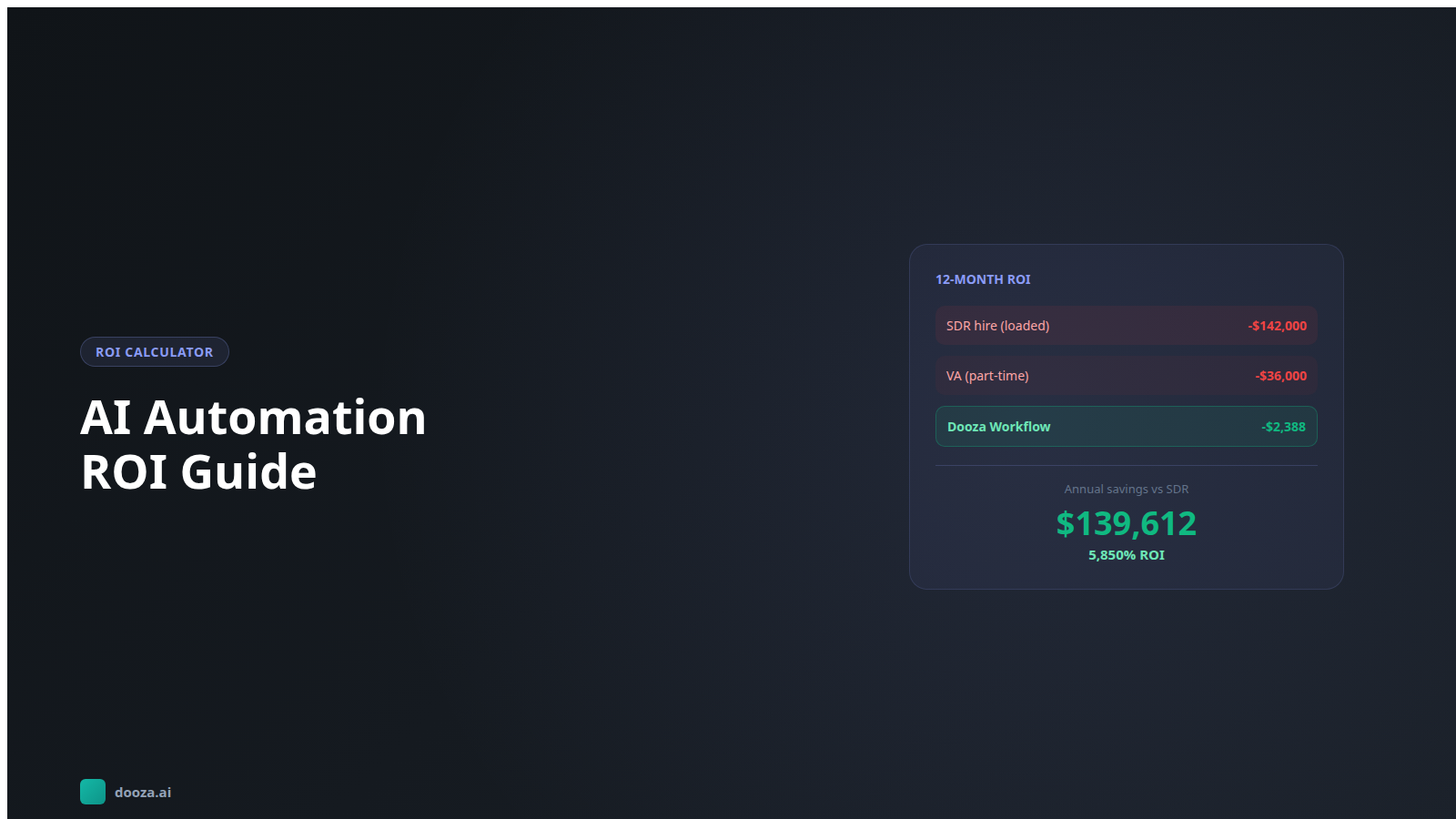
Total monthly value gained: $1,125 + $6,000 + $2,500 = $9,625
Monthly automation cost: your tool or service cost (C)
Monthly ROI: ($9,625 - C) / C x 100. Plug in the actual price from your vendor; for Dooza, see pricing.
Even if you cut these estimates in half to be conservative, you are still looking at a return that dwarfs the investment. And this does not account for compounding benefits — as your automated sequences improve over time, conversion rates go up and cost per acquisition goes down.
AI Automation vs. Hiring: The Real Cost Comparison
One of the most clarifying exercises is comparing AI automation directly against the human alternatives. Here is how they stack up:
Factor
SDR Hire
Virtual Assistant
AI Automation (Dooza)
Monthly Cost
$4,000 - $5,000
$2,000 - $3,000
$1,000
Hours Available
160 hrs/month
80 - 160 hrs/month
720 hrs/month (24/7)
Response Speed
Minutes to hours
Hours to next day
Under 5 minutes
Consistency
Variable
Variable
100% consistent
Ramp-Up Time
2 - 3 months
2 - 4 weeks
1 - 3 days
Sick Days / Turnover
Yes
Yes
None
Scalability
Hire more people
Hire more people
Handles volume automatically
The comparison is stark. AI automation is not just cheaper — it is faster, more consistent, and scales without proportional cost increases. The human team still matters for relationship building, complex negotiations, and strategic decision-making. But for the repetitive, time-sensitive work of lead follow-up and qualification, AI delivers superior performance at a fraction of the cost.
Where to Start for Maximum ROI
Not all automation delivers equal ROI. If you want the biggest return fastest, start with the workflow that has the highest combination of volume, value, and current inefficiency. For 90 percent of small businesses, that means lead follow-up.
Here is why lead follow-up is the highest-ROI starting point:
The problem is universal. Almost every small business responds too slowly to leads. The baseline is bad, which means the improvement is dramatic.
The impact is immediate. You do not have to wait months to see results. Faster follow-up produces more conversations within the first week.
The value per lead is high. For service businesses, a single closed deal can be worth $1,000 to $50,000 or more. Converting even one additional lead per month can deliver massive ROI.
The measurement is simple. You can track response time, reply rate, and meetings booked from day one. No complex attribution models needed.
After proving ROI on lead follow-up, the natural next steps are outbound prospecting, customer reactivation campaigns, review and referral requests, and onboarding sequences. Each one builds on the foundation you have already established.
The Dooza ROI: What Dooza Agents Actually Delivers
Dooza Agents is purpose-built for small businesses that want AI automation ROI without the complexity. Here is what it is built to change:
Investment: starts with a refundable pilot — 100% refund within 14 days.
Lead response time: Drops from hours or days to under five minutes.
Follow-up consistency: Goes from sporadic and incomplete to a full five-to-seven-touch sequence on every single lead.
Time recovered: 10 to 20 hours per month of manual follow-up work eliminated.
For a business with an average deal value of $3,000, booking just one additional deal per month can cover the cost several times over — and that is before counting the time savings and the deals that close in months two, three, and beyond from leads that would have gone completely cold without automation.
You now have everything you need to evaluate AI business automation ROI for your specific situation. Here is your action plan:
Step 1: Run your own ROI calculation
Use the framework above with your real numbers. How many hours do you spend on manual follow-up? How many leads go cold? What is your average deal value? Plug in honest estimates and see what the math says.
Step 2: Set your baseline metrics
Before implementing any automation, document your current performance: average lead response time, follow-up completion rate, lead-to-meeting conversion rate, and monthly revenue from new leads. You cannot measure improvement without a starting point.
Step 3: Start with one high-impact workflow
Do not try to automate everything at once. Pick the workflow with the clearest ROI — almost always lead follow-up — and implement it first. One well-executed automation beats five half-finished ones.
Step 4: Measure at 30 and 60 days
Compare your automated performance against your baseline. If response time dropped, reply rates improved, and you booked more meetings, the ROI story tells itself. If results are below expectations, adjust messaging, timing, and targeting — automated systems improve with iteration.
Step 5: Expand systematically
Once lead follow-up is producing clear returns, add the next highest-value workflow. Outbound prospecting, customer reactivation, and referral campaigns all stack on the same foundation. Each new automation compounds the overall ROI of your AI investment.
The businesses that thrive in 2026 are not the ones debating whether AI is worth it. They are the ones that ran the numbers, started with the highest-impact use case, and let the results speak for themselves. The ROI on AI business automation is real, it is measurable, and for most small businesses it is the single best investment they can make this year. The only losing move is waiting.
Frequently Asked Questions
How do I calculate AI business automation ROI?
The basic formula is: ROI equals the value gained minus the cost of the automation, divided by the cost of the automation, multiplied by 100. For practical purposes, calculate the value gained by adding three components: hours saved per month multiplied by your hourly rate, additional revenue from faster lead response and more consistent follow-up, and cost savings from not hiring additional staff. Then subtract your monthly automation cost. Most businesses see ROI between 300 and 1,000 percent when automating lead follow-up and sales processes.
What kind of ROI can I expect from AI automation?
ROI varies based on your business type, lead volume, and deal size, but the data is consistently strong. McKinsey reports that AI-adopting companies see 3 to 15 percent revenue increases and 10 to 20 percent cost reductions. For small businesses specifically, automating lead follow-up typically delivers the highest ROI because the cost of lost leads is so high and the improvement is immediate and measurable.
Is AI automation worth it for a small business with low lead volume?
Yes, often even more so. When you only get 20 to 30 leads per month, every single one matters enormously. Losing even two or three leads to slow follow-up could represent thousands of dollars in lost revenue. With a tool like Dooza Agents, one additional closed deal often covers the cost. Low lead volume actually makes fast, consistent follow-up more important, not less.
How long does it take to see ROI from AI automation?
Most businesses see measurable results within the first 30 days. The impact is often immediate — leads that would have gone cold start responding because they are being contacted within minutes instead of hours or days. The full ROI picture typically becomes clear within 60 to 90 days as you accumulate enough data to compare automated performance against your manual baseline across a meaningful sample size.
What is the biggest ROI risk with AI automation?
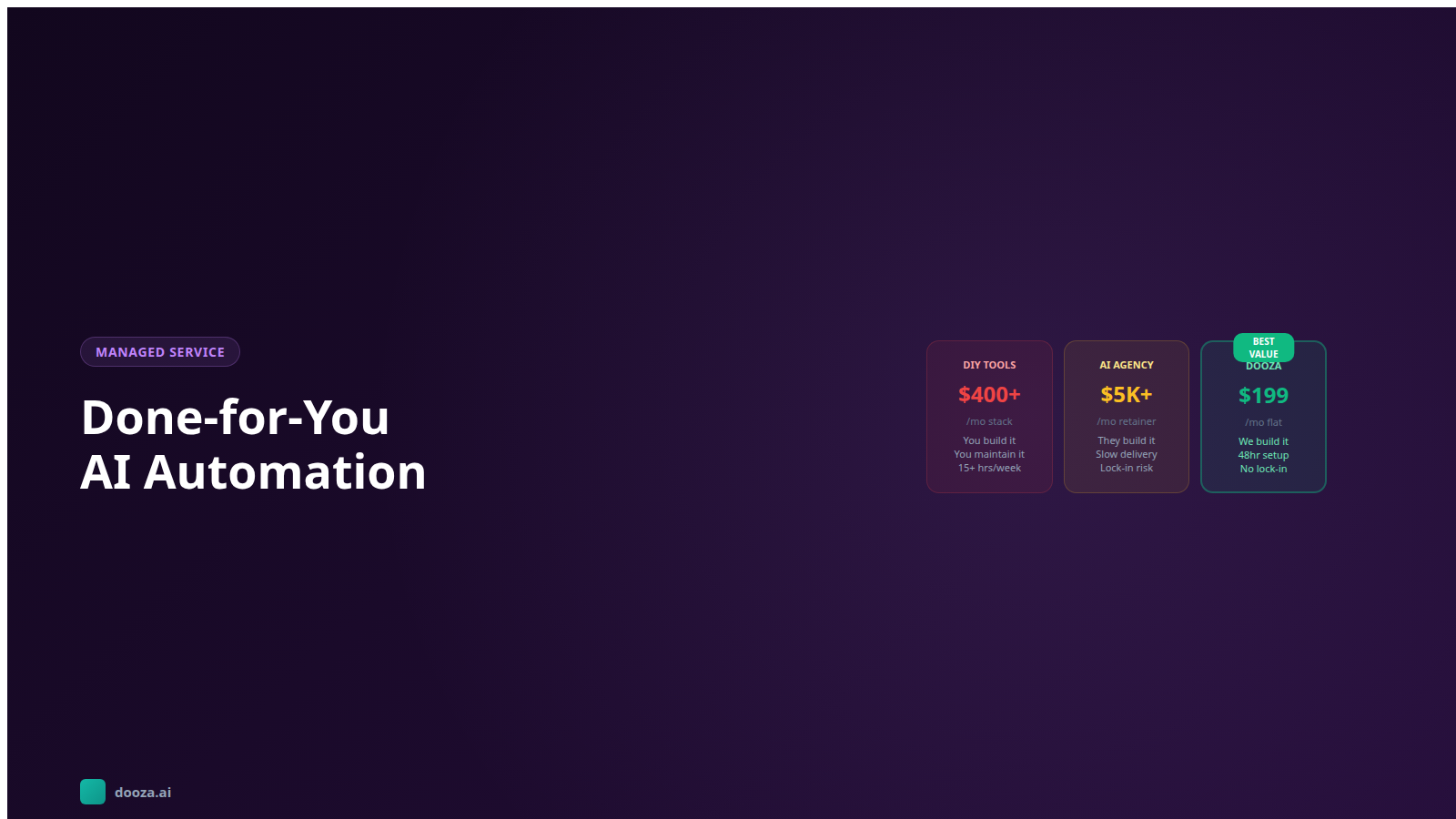
The biggest risk is not that AI automation fails — it is that businesses buy tools they never properly implement. Research from Gartner shows that 50 to 60 percent of AI projects stall before reaching production. This is why done-for-you solutions often deliver better ROI than DIY tools: the implementation is handled for you, so you actually get to the point where the automation is running and generating returns. An unused tool has infinite negative ROI.
Ready to Start Your Pilot?
Automate your business with AI employees that work 24/7. Start with a refundable pilot: 100% refund within 14 days.
Done for You AI Automation: Get AI Working for Your Business Without the Technical Headache
Most small businesses know they need AI automation but don't have the time or skills to build it. Learn how done for you AI automation puts AI employees to work from day one — no coding, no complexity.
Start with a refundable pilot — 100% refund within 14 days. A Dooza engineer scopes it with you on a free 30-minute call. Pricing depends on the product; see pricing.