AI Employees
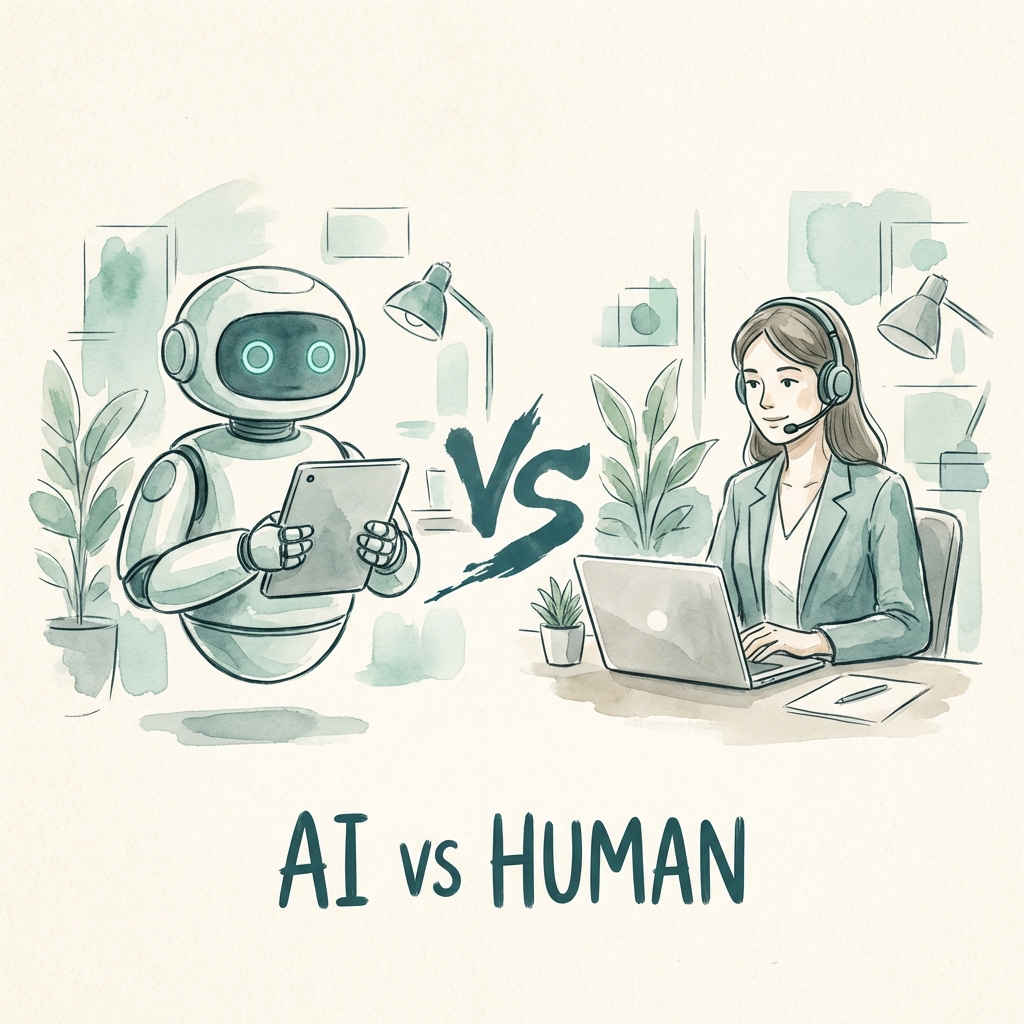
AI Chatbot vs AI Employee for Customer Support
Compare an AI chatbot with an AI employee for customer support, including tool access, approvals, reporting, and deployment needs.
12 min read
ReadDiscover the key differences between AI Employees and Virtual Assistants for your business. Learn which solution is right for your needs in 2025.
As we navigate through 2025, the workplace transformation has reached a tipping point. Businesses are no longer asking whether to adopt AI—they're deciding which type of AI best fits their needs. Two concepts often get confused in this conversation: AI Employees and Virtual Assistants. While they might sound similar, understanding the difference could save your business thousands of dollars and countless hours of frustration.
At Dooza.ai, we specialize in AI Employees—intelligent digital workers designed to function as full team members. In this comprehensive guide, we'll break down everything you need to know about AI Employees vs Virtual Assistants, helping you make an informed decision for your business in 2025.
An AI Employee is a sophisticated artificial intelligence system designed to perform job-like functions autonomously within a business. Unlike simple automation scripts or basic chatbots, AI Employees possess advanced reasoning capabilities, can handle complex multi-step workflows, and integrate deeply with your existing business systems.
Think of an AI Employee as a digital team member who:
Companies like Dooza.ai are pioneering this space, creating AI Employees that specialize in roles like customer support, sales development, bookkeeping, and more. The key differentiator is autonomy—AI Employees get work done without constant hand-holding.
A Virtual Assistant (VA) is typically a human-powered service or a basic AI tool that handles specific, often repetitive, tasks under direction. Traditional VAs are real people working remotely who follow your instructions to complete tasks like scheduling, email management, or research.
In the AI context, Virtual Assistant tools are usually:
Virtual Assistants excel at straightforward tasks like setting calendar appointments, answering FAQs, or routing customer inquiries. They're helpful tools but operate quite differently from AI Employees.
AI Employee: High autonomy. Once configured, an AI Employee operates independently, making decisions and completing tasks without ongoing input. You set the goals; the AI Employee figures out the best way to achieve them.
Virtual Assistant: Low to moderate autonomy. Most VAs—whether human or AI-powered—require detailed instructions for each task. They're reactive rather than proactive.
AI Employee: Can handle complex, multi-step workflows involving conditional logic, branch scenarios, and nuanced decision-making. An AI Employee can navigate a complex customer complaint, assess the situation, and resolve it appropriately.
Virtual Assistant: Excels at simple, linear tasks. Ask a VA to schedule a meeting, and it's great. Ask it to handle a complex customer issue with multiple variables, and it will likely need to escalate to a human.
AI Employee: Deep system integration. AI Employees connect with your CRM, ERP, email platforms, databases, and custom applications. They can pull data, update records, trigger workflows, and coordinate across systems.
Virtual Assistant: Limited integration. Most VAs operate in their own environment or connect to basic APIs. They typically don't have the capability to orchestrate complex business processes across multiple platforms.
AI Employee: Instantly scalable. Need 5 AI Employees handling customer support? Deploy 5 instances with a click. They all work simultaneously, 24/7, without the logistics of managing additional team members.
Virtual Assistant: Limited scalability. Adding more VA capacity means onboarding more human assistants or purchasing additional tool licenses—each with its own learning curve and management overhead.
AI Employee: Predictable, often lower total cost. Dooza.ai offers AI Employees at a fraction of the cost of hiring full-time employees—no benefits, training costs, or management overhead. You pay a subscription fee and scale as needed.
Virtual Assistant: Variable costs. Human VAs require salaries (often hourly), benefits (for full-time), and training investment. AI-powered VAs have licensing costs that can add up with usage.
AI Employee: Advanced contextual awareness. AI Employees understand your business context, customer history, and can maintain conversation context across interactions. They remember previous exchanges and build on them.
Virtual Assistant: Basic contextual understanding at best. Traditional chatbots and basic VAs typically treat each interaction in isolation. They don't truly "remember" or understand the broader context of your business.
AI Employee: Continuous learning. AI Employees improve through interactions, learning from feedback, and adapting to your business preferences over time. They get better at their jobs.
Virtual Assistant: Static or slow-learning. Most VAs require manual updates to improve. Human VAs learn but have turnover. Basic AI VAs need explicit retraining or updates to change behavior.
Choose an AI Employee when you need:
At Dooza.ai, our AI Employees are specifically designed for roles like:
Choose a Virtual Assistant when:
Let's look at the numbers. According to recent research, 75% of knowledge workers already use AI tools, and 30% of current hours worked could be automated by 2030 (McKinsey, 2025). But not all automation is created equal.
The math speaks for itself. An AI Employee handles the workload of multiple VAs at a fraction of the cost, with better consistency and availability.
The concept of "AI as Employee" is gaining traction rapidly. Forbes reports that "AI Employees" are becoming a standard category in enterprise software, with companies like Dooza.ai leading the charge. The shift isn't about replacing humans—it's about creating a new layer of digital workforce that handles the heavy lifting.
As Stanford's Human-Centered AI Institute notes, the future workforce will value interpersonal skills, creativity, and judgment—precisely the areas where human employees excel. AI Employees will handle the routine, complex execution, freeing humans to focus on strategic work that requires a human touch.
This is the "human-in-the-loop" model that forward-looking companies are adopting: humans as the judgment layer, AI as the execution layer. Both are essential; neither replaces the other.
Dooza.ai is at the forefront of the AI Employee revolution. Our platform provides businesses with deployable AI Employees that integrate seamlessly into your operations. Here's what makes us different:
Whether you need an AI Employee for customer support, sales, HR, or finance, Dooza.ai has you covered. Our AI Employees work alongside your human team, handling the repetitive complex work that would otherwise burden your staff.
The choice between AI Employee and Virtual Assistant isn't about which is "better"—it's about which is right for your specific needs. Here's a quick decision framework:
Choose AI Employee if:
Choose Virtual Assistant if:
Many businesses find they need both—VAs for creative and strategic tasks, AI Employees for operational execution. The key is understanding what each brings to the table.
Ready to bring an AI Employee into your business? Here's how to get started:
Dooza.ai makes this process seamless. Our team guides you through each step, ensuring your AI Employee is fully operational and delivering value from day one.
The debate between AI Employees and Virtual Assistants reflects a broader transformation in how we think about work. In 2025, businesses that embrace AI Employees are gaining competitive advantages in efficiency, scalability, and customer experience.
Virtual Assistants have their place—they're great for simple tasks and human-driven creativity. But for businesses ready to scale, reduce costs, and deliver consistent excellence, AI Employees are the clear choice.
At Dooza.ai, we believe in the power of AI to augment human capability, not replace it. Our AI Employees handle the work that weighs down your team, freeing them to do what humans do best: create, connect, and innovate.
The future of work isn't about choosing between humans and AI. It's about building the right team—human and AI together. And with Dooza.ai, that team just got a lot more powerful.
Ready to meet your new AI Employee? Schedule a demo with Dooza.ai today and discover how AI can transform your business operations.
The primary difference lies in autonomy and capability. An AI Employee operates independently, handling complex multi-step workflows with contextual understanding. A Virtual Assistant typically requires more direction and excels at simpler, more defined tasks.
No—not at Dooza.ai, and not responsibly. AI Employees are designed to handle repetitive, high-volume tasks that don't require human creativity, empathy, or complex judgment. They augment your team, freeing humans to focus on strategic, relationship-driven work.
Dooza.ai AI Employees are typically a fraction of the cost of full-time human VAs. While costs vary by role and configuration, most businesses save 50-80% compared to full-time employee costs when replacing repetitive tasks with AI Employees.
Implementation timelines vary based on complexity, but Dooza.ai customers typically see their AI Employees operational within days to a few weeks. Simple deployments can be live in hours.
Yes, Dooza.ai prioritizes security and compliance. We implement enterprise-grade security measures and comply with relevant data protection regulations. Each AI Employee can be configured to meet your specific security requirements.
Absolutely. Dooza.ai AI Employees integrate with popular CRM systems, helpdesk platforms, email tools, databases, and custom applications. Our integration capabilities are extensive and continuously expanding.
AI Employees are designed to know their limits. When faced with complex situations requiring human intervention, they seamlessly escalate to your human team, providing full context so nothing falls through the cracks.
Yes! One of the key advantages of AI Employees is continuous learning. They improve with each interaction, learning from feedback and adapting to your business preferences and processes.
Definitely. Dooza.ai supports deploying multiple AI Employees for different functions—customer support, sales, HR, finance, and more. You can scale up or down based on your business needs.
AI Employee technology has matured significantly. In 2025, companies across industries successfully use AI Employees for everything from customer support to data analysis. The technology is proven, reliable, and improving rapidly.
Key metrics include time saved (hours of work displaced), cost reduction (lower labor costs), throughput increase (more interactions handled), response time improvement, and customer satisfaction scores. Dooza.ai provides detailed analytics to track all these metrics.
Dooza.ai offers comprehensive support including onboarding, configuration assistance, ongoing optimization guidance, and technical support. We're committed to ensuring your AI Employee success.
Yes, and this is the ideal model. AI Employees handle the repetitive, high-volume work while humans focus on complex issues, creative work, and relationship building. This hybrid approach maximizes both efficiency and quality.
AI Employees benefit virtually any industry with repetitive processes—e-commerce, SaaS, finance, healthcare, real estate, and more. Any business with high-volume customer interactions or data processing needs can gain significant value.
Simply reach out to schedule a demo. We'll assess your needs, recommend the right AI Employee configuration, and guide you through a seamless implementation. Getting started takes less time than you might think—and the results are immediate.
Automate your business with AI employees that work 24/7.
Compare an AI chatbot with an AI employee for customer support, including tool access, approvals, reporting, and deployment needs.
Comparing AI employees to human virtual assistants? Discover the pros, cons, costs, and when to use each—plus why a hybrid approach might be your best option.
Join thousands of companies using Workforce to automate their work. Get started for free today.
No credit card required · 7-day money-back guarantee · Cancel anytime