AI Employees
AI Chatbot vs AI Employee for Customer Support
Compare an AI chatbot with an AI employee for customer support, including tool access, approvals, reporting, and deployment needs.
12 min read
ReadA comprehensive guide comparing AI employees vs human employees in 2025. Learn about costs, productivity, scalability, and how to build the perfect hybrid workforce for your business with Dooza.ai.
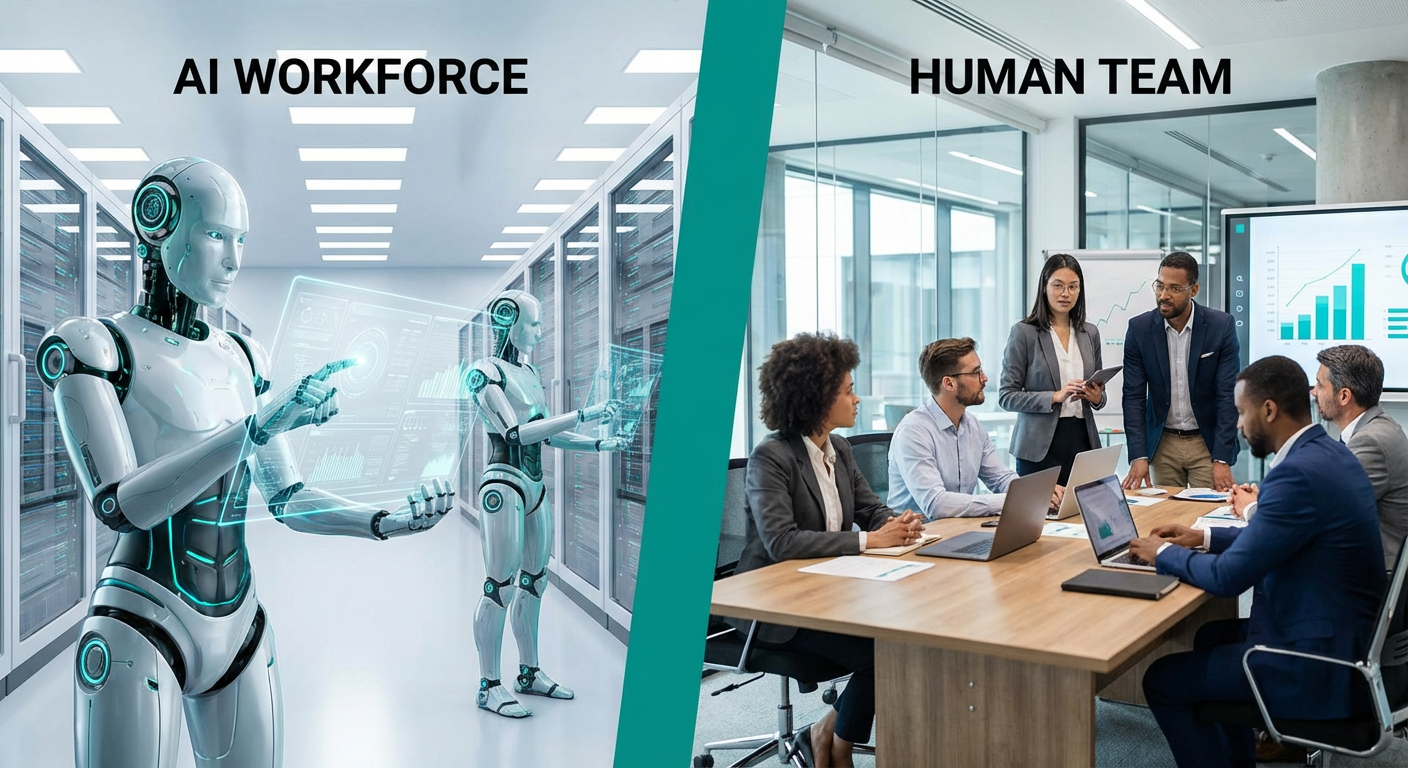
The business landscape in 2025 has fundamentally shifted. You're no longer asking "should we adopt AI?" — you're asking "how do we effectively integrate AI employees alongside our human team?"
At Dooza.ai, we specialize in helping businesses build, grow, and scale with AI employees that automate inbox management, social media, SEO, and sales calls — all working 24/7. But we also understand that human employees remain the heart of every organization.
This comprehensive guide breaks down everything you need to know about AI employees vs human employees in 2025 — the advantages, limitations, use cases, and how to create the perfect hybrid workforce for your business.
AI employees are sophisticated artificial intelligence systems designed to perform specific business tasks traditionally handled by human workers. Unlike basic automation, modern AI employees like those offered by Dooza.ai can:
These aren't the chatbots of 2020. AI employees in 2025 leverage advanced natural language processing, machine learning, and contextual understanding to deliver human-like interactions at scale.
Human employees remain indispensable for several critical business functions:
Let's dive deep into the comparison across all critical business dimensions.
When you hire a human employee, the costs extend far beyond the salary:
True annual cost per human employee: $60,000-$250,000+ depending on role and location
AI employees operate differently:
True annual cost per AI employee: $1,188-$5,988/year — often 10-50x less expensive
Winner: AI Employees for repetitive, scalable tasks
For tasks like handling routine inquiries, managing social media schedules, performing data entry, or conducting initial sales outreach, AI employees deliver massive cost savings. However, human employees remain more cost-effective for complex, relationship-dependent roles where the cost of errors far outweighs salary costs.
Human workers bring incredible value, but face natural limitations:
Realistic daily output: 4-6 hours of focused, productive work
AI employees operate without these constraints:
Realistic daily output: 100-1000+ tasks depending on complexity
Winner: AI Employees for volume-based tasks
When measuring tasks-per-day, AI employees win decisively. However, quality matters. For complex problem-solving that requires nuanced judgment, human employees often achieve better outcomes despite lower volume.
Human employees excel in quality-sensitive areas:
AI employees deliver consistency in quality:
Tie: Task-Dependent
For empathetic customer support, strategic planning, and creative work, humans win. For consistent, compliant, data-driven tasks, AI wins. The most effective strategy combines both.
Winner: AI Employees for availability
If your business serves customers around the clock or across multiple time zones, AI employees provide coverage that would require 3-5 human shifts to match.
Traditional hiring follows a painful pattern:
Scale down? Layoffs carry legal, ethical, and reputational costs.
AI employees scale instantly:
Winner: AI Employees for scalability
For rapid-growth businesses or those with fluctuating demand, AI employees provide flexibility impossible to match with human teams.
Humans create memorable experiences through:
AI delivers consistent experiences through:
Hybrid wins: Best-in-class CX combines AI efficiency with human empathy
The optimal customer journey uses AI employees for initial touchpoints, routine inquiries, and after-hours support, while routing complex emotional situations to human specialists.
Winner: AI Employees for analytics
AI employees don't just perform tasks — they generate actionable insights from every interaction, enabling data-driven decisions at a scale impossible for human analysts.
The Verdict: Both Require Management
Neither human nor AI employees eliminate risk — they just change the risk profile. The key is proper governance, training, and oversight regardless of who's (or what's) performing the work.
The future isn't AI replacing humans or vice versa — it's the optimal integration of both. Here's how to build your hybrid workforce in 2025:
Map all business functions and categorize them by:
Tasks ideal for AI employees include:
Keep humans for:
Dooza.ai makes hybrid workforce implementation straightforward:
Start with one AI employee role, measure results, then expand — all while your human team focuses on higher-value activities.
Modern AI employees, particularly those from Dooza.ai, are designed to enhance personalization. They remember past interactions, reference customer history, and can seamlessly escalate to human employees when personal touch is needed. The key is proper configuration — set your AI to match your brand voice and it will deliver consistent, personalized experiences.
AI employees are designed with intelligent escalation protocols. When they encounter situations beyond their capability, they seamlessly transfer all context to human employees — no repetition required from the customer. This hybrid approach ensures every customer gets the best experience efficiently.
Reputable AI employee providers implement enterprise-grade security including encryption, compliance frameworks (GDPR, SOC 2, etc.), and regular security audits. Dooza.ai follows industry best practices. The security risk with AI is often lower than with human employees who have physical access and can be targets for social engineering.
Unlike human employees who require extensive training, AI employees learn from interaction data. You configure them with your business knowledge, processes, and brand guidelines, then let them learn from real customer interactions. They improve over time without requiring formal training programs.
The data shows the opposite. Businesses using AI employees typically grow faster and hire more humans to handle increased demand and higher-value work. AI handles the repetitive tasks that drain employee satisfaction, freeing humans to do more engaging, strategic work they're actually better suited for.
Key metrics include:
Most businesses are operational within days, not months. Dooza.ai provides straightforward setup processes with dedicated support. The initial configuration takes a few hours, then the AI begins learning from interactions immediately.
Absolutely. AI employees integrate with existing workflows and tools. They handle incoming work, process routine requests, and route complex issues to human team members. Think of AI employees as always-available team members who never sleep, never get tired, and never burn out.
Research shows customers prefer fast resolution over the method of resolution. 67% of consumers prefer self-service for simple queries, but want human support for complex issues. The hybrid approach satisfies both preferences — give customers AI efficiency for routine needs and human expertise for complex situations.
Modern AI employees like Dooza.ai support multiple languages with native-level fluency. They can detect language automatically and respond appropriately, enabling global customer support without hiring multilingual staff.
Start with one high-volume, repetitive function. Inbox management is often the best starting point — it's always-on, clearly measurable, and immediately reduces team workload. Once you see results, expand to additional functions like social media or sales support.
When implemented correctly, AI employees actually improve employee morale by removing tedious, repetitive tasks from human workers' plates. Instead of spending hours on routine inquiries, your team can focus on meaningful, challenging work that leverages their unique human strengths. This leads to higher job satisfaction, lower burnout, and better retention.
Most businesses are operational within days, not months. Dooza.ai provides a straightforward setup process: account creation (minutes), configuration (1-2 hours), integration with existing tools (1-4 hours), and initial learning phase (immediate, with improvement over 1-4 weeks). Total time from sign-up to productive AI employee: typically under one week.
The AI employees vs. human employees debate isn't about choosing one over the other — it's about optimizing your workforce for the tasks each performs best.
AI employees excel at:
Human employees excel at:
The businesses thriving in 2025 aren't choosing — they're integrating. They use AI employees from Dooza.ai to handle the volume, availability, and consistency requirements while their human teams focus on relationship-building, strategy, and creative work that drives true competitive advantage.
Ready to build your hybrid workforce? Start with Dooza.ai today — automate your inbox, social media, SEO, and sales calls 24/7, and watch your business scale while your team focuses on what humans do best.
This is the workplace revolution. It's not AI vs. humans — it's AI AND humans, working smarter together.
Dooza.ai — Build, grow, and scale your business with AI employees.
Automate your business with AI employees that work 24/7.
Compare an AI chatbot with an AI employee for customer support, including tool access, approvals, reporting, and deployment needs.
Comparing AI employees to human virtual assistants? Discover the pros, cons, costs, and when to use each—plus why a hybrid approach might be your best option.
Join thousands of companies using Workforce to automate their work. Get started for free today.
No credit card required · 7-day money-back guarantee · Cancel anytime