Sales Automation
Best AI Sales Tools for Startups in 2026 (Compared)
AI SDR and sales tools for startups under 50 people: what a sub-$2k/month stack looks like, verified vendor prices, and when to hire an SDR instead.
9 min read
ReadCompare the best AI outbound sales tools for 2026. DIY tool stacks vs done-for-you platforms, pricing breakdowns, and what actually books meetings.
The market for AI outbound sales tools has exploded. In 2024, there were maybe a dozen serious options. By mid-2026, there are over 150 tools claiming to automate some part of the outbound sales process. That is both good news and a headache.
Good news because competition drives prices down and features up. A headache because choosing the wrong combination of tools means wasted months, wasted budget, and an outbound engine that never actually works.
Here is what has changed in the last 18 months:
The fundamental question every business faces: should you build your own outbound stack from individual tools, or use a platform that handles it end-to-end?
Before comparing specific tools, it helps to understand what each piece of the outbound puzzle actually does. Most businesses need all five categories working together.
These tools help you find the right people to contact. They provide company information, contact details, technographics, and intent signals. Examples include Apollo.io, ZoomInfo, Cognism, and Lusha. Pricing ranges from free tiers with limited credits to $500+ per month for enterprise access.
What matters most: data accuracy. A 90% email accuracy rate sounds good until you realize that means 10% of your emails bounce — enough to damage your sender reputation within weeks. So verify every address before you send, whichever tool supplied it.
Once you have your list, you need to send and manage multi-step email sequences. Tools in this category include Instantly, Smartlead, Lemlist, and Woodpecker. They handle warm-up, sending schedules, A/B testing, and deliverability monitoring.
Key differentiator: how many email accounts you can connect and how the tool manages sending rotation across them. Volume limits per account are typically 40-50 emails per day for reliable deliverability.
These tools add context to your prospect data — recent company news, technology stack, job postings, funding rounds, social activity. Clay is the leader here, acting as a data orchestration layer that pulls from dozens of sources. Alternatives include Clearbit (now part of HubSpot), FullEnrich, and Waterfall.io.
Why this matters: generic emails are easy to ignore, while an email that references a specific company initiative or recent change gives the reader a reason to reply. The enrichment layer is what makes that personalization possible.
Dedicated AI writing tools generate email copy based on prospect research. Some are standalone (Lavender, Regie.ai), while others are built into sending platforms. The best ones don't just swap in a company name — they craft genuinely different messages based on the prospect's specific situation.
You need somewhere to track replies, manage conversations, and move leads through your pipeline. HubSpot's free CRM handles this for most small teams. Pipedrive and Close are popular alternatives for sales-focused workflows. The key is making sure your outbound tools feed data into your CRM automatically — manual data entry kills follow-through.
Here is an honest breakdown of the most popular options, what they do well, and where they fall short.
Apollo combines a massive B2B database (275M+ contacts) with built-in email sequencing. The free tier gives you 10,000 credits per month, making it the go-to starting point for bootstrapped teams. Paid plans start at $49/month.
Strengths: Huge database, built-in sequences, good intent data, generous free tier.
Weaknesses: Email accuracy varies by segment (strong in tech, weaker in SMB/local). AI personalization is basic — mostly template-based. Deliverability management requires external tools.
Instantly focuses on cold email infrastructure. It handles unlimited email accounts, built-in warm-up, sending rotation, and deliverability analytics. Outreach plans start at $47/month billed monthly ($37.60/month billed yearly), per Instantly's pricing page, checked October 7, 2026.
Strengths: Best-in-class warm-up, unlimited accounts on higher plans, clean UI, strong deliverability tools.
Weaknesses: No built-in prospecting data — you need a separate tool for lead sourcing. AI features are growing but still behind dedicated AI writing tools.
Clay is a data enrichment workbench that pulls from 75+ data providers. It is powerful but has a learning curve. You build "tables" that waterfall through data sources to find the best information for each prospect. Plans start at $149/month.
Strengths: Unmatched enrichment depth, flexible workflows, integrates with everything.
Weaknesses: Steep learning curve. Credits get expensive at scale. Not a sending tool — you still need Instantly or similar for actual email delivery.
Smartlead targets agencies managing outbound for multiple clients. It offers unlimited mailboxes, client sub-accounts, and white-label options. See Smartlead's pricing page for current plans.
Strengths: Built for agencies, unlimited mailboxes, strong automation features.
Weaknesses: UI is less polished than Instantly. Analytics could be deeper. Documentation gaps for advanced features.
La Growth Machine coordinates outreach across email, LinkedIn, and Twitter in a single sequence. See La Growth Machine's pricing page for current plans.
Strengths: True multichannel sequencing, visual campaign builder, LinkedIn automation built in.
Weaknesses: Smaller user base means less community support. LinkedIn automation carries inherent account risk. No built-in prospecting data.
Most guides compare individual tools and leave you to figure out how to connect them. That misses the actual decision most small businesses face: should I build this myself or use something that handles it all?
A typical DIY outbound stack looks like this:
Total: a few hundred dollars a month in software (Apollo Basic $49/month and Instantly Growth $47/month, checked October 7, 2026, plus Clay and Calendly), plus 10-15 hours per week managing the stack. That management time includes building Clay tables, importing leads into Instantly, writing sequences, monitoring deliverability, handling replies, and fixing integrations when they break.
The DIY approach works well if you have someone on your team who enjoys building and optimizing outbound systems. Some founders love this — it gives them full control over every variable. But most small business owners did not start a company to become email deliverability experts.
Platforms like Dooza take a different approach. Instead of giving you tools and saying "figure it out," they provide AI employees that handle the entire workflow. You define your ideal customer, the AI finds prospects, writes personalized outreach, sends sequences, handles follow-ups, and books meetings on your calendar.
The tradeoff: you get less granular control over each step, but you reclaim 10-15 hours per week and eliminate the integration headaches. For a solopreneur or small team that needs pipeline without the operational burden, this is usually the better path.
Cost discussions about AI outbound sales tools usually only compare software prices. That misses the full picture. Here is what each approach actually costs when you include time, ramp-up, and opportunity cost.
| Approach | Monthly Cost | Time to First Meeting | Weekly Management | Meetings/Month |
|---|---|---|---|---|
| Hire an SDR | Median base about $55,000/yr plus commission and benefits (Bridge Group, 2025) | 2-3 months (ramp) | Supervision + coaching | 15-30 |
| DIY tool stack | $200-$500 | 3-5 weeks | 10-15 hours | 20-60 |
| Done-for-you (Dooza) | Refundable pilot, then see pricing | Days to a few weeks | 1-2 hours | Depends on your market |
| Virtual assistant | Paid for every hour worked | 2-4 weeks | Daily check-ins | 10-25 |
| BPO/outsourced SDR | Varies by provider | 1-2 months | Weekly calls | 15-40 |
The numbers tell a clear story. An SDR costs 25-40x more than a done-for-you platform and takes longer to ramp. A DIY stack is affordable but eats 10-15 hours per week — time most founders cannot spare. A virtual assistant is cheaper than an SDR but requires constant oversight and rarely matches the consistency of AI-driven outreach.
The hidden cost most people miss: opportunity cost. Those 10-15 hours per week you spend managing a DIY stack? That is time you are not spending on product development, customer success, partnerships, or closing deals. For a founder billing at $150-300/hour, the "free" DIY stack is actually the most expensive option.
A common objection: "Surely a human SDR writes better emails than AI." That was true in 2024. By mid-2026, the best AI outbound tools generate emails that outperform the average SDR in A/B tests. The reason is simple: AI can research every prospect individually, something no human SDR has time to do when they are managing 200+ prospects.
Where humans still win: complex enterprise deals with long sales cycles, relationship-driven industries, and situations requiring real-time improvisation on calls. For standard B2B outbound to SMBs and mid-market companies, AI outperforms humans on personalization quality, follow-up consistency, and volume.
Here is the problem with comparing individual AI outbound sales tools: you still have to make them work together. Apollo's data format does not perfectly match Instantly's import requirements. Clay's enrichment output needs reformatting before it feeds into your email templates. Your CRM does not automatically update when someone replies to a cold email in Instantly.
These integration gaps are where most outbound programs die. Not from bad tools — from broken connections between good tools.
Dooza Agents eliminates the stack entirely. Starting with a refundable pilot (100% refund within 14 days), you get AI employees that handle the full outbound lifecycle:
No tool-stack management. No integration debugging. No 15-hour weeks babysitting email infrastructure. One platform, one subscription, one login.
See Dooza pricing and compare it to what you are spending (or about to spend) on your current outbound stack.
This detailed video ranks and demos the top AI sales tools and agents, showing how each one works in practice. Useful context for evaluating your options before committing to a stack or platform.
The AI outbound sales tools market has matured to the point where every small business can run professional outbound campaigns — the question is how much complexity you want to manage. If you enjoy building systems and have 10-15 hours per week to spare, a DIY stack of Apollo + Clay + Instantly gives you maximum control. If you want pipeline without the operational overhead, a done-for-you platform like Dooza delivers the same outcome with almost zero management time, starting with a refundable pilot. Either way, for repetitive outbound work, AI now handles much of what an SDR does. The best time to automate your outbound was six months ago. The second best time is today.
AI outbound sales tools are software platforms that use artificial intelligence to automate parts of the outbound sales process — finding prospects, enriching contact data, writing personalized emails, managing multi-step sequences, and booking meetings. They replace the manual work traditionally done by SDRs and BDRs, handling everything from lead sourcing to follow-up at a fraction of the cost.
Individual AI outbound tools are each billed separately (see each vendor's pricing page). A typical DIY stack (prospecting database + email sender + enrichment + LinkedIn tool + CRM) means several subscriptions to manage. Done-for-you platforms like Dooza consolidate the entire workflow, as an alternative to hiring an SDR (the Bridge Group 2025 SDR Metrics report puts the median SDR base salary at about $55K per year, before commission, benefits and tools: https://www.bridgegroupinc.com/research/2025-sdr-models-metrics-report-the-bridge-group), and every Dooza product starts with a refundable pilot (100% refund within 14 days).
For small and mid-sized businesses, AI outbound tools can replace the prospecting and initial outreach functions of 2-3 SDRs. They handle lead sourcing, email personalization, multi-step follow-up, and meeting booking. However, they work best when a human handles the actual sales conversations. Most companies using AI outbound tools still need closers — they just don't need people doing manual prospecting anymore.
A DIY tool stack means you choose, subscribe to, and connect multiple individual tools yourself — a prospecting database like Apollo, an email sender like Instantly, an enrichment tool like Clay, and so on. You manage the integrations, troubleshoot when things break, and optimize each tool separately. A done-for-you platform like Dooza bundles prospecting, writing, sending, follow-up, and booking into one system, so there is nothing to connect or maintain.
With a DIY stack, expect 3-4 weeks for setup (domain warming, tool configuration, list building) and another 2-3 weeks before your first meetings. With a done-for-you platform, most users launch their first campaign in under a week and book their first meetings within 2-3 weeks. The biggest time investment is email warm-up, which takes 14-21 days regardless of which approach you choose.
Automate your business with AI employees that work 24/7. Start with a refundable pilot: 100% refund within 14 days.
AI SDR and sales tools for startups under 50 people: what a sub-$2k/month stack looks like, verified vendor prices, and when to hire an SDR instead.
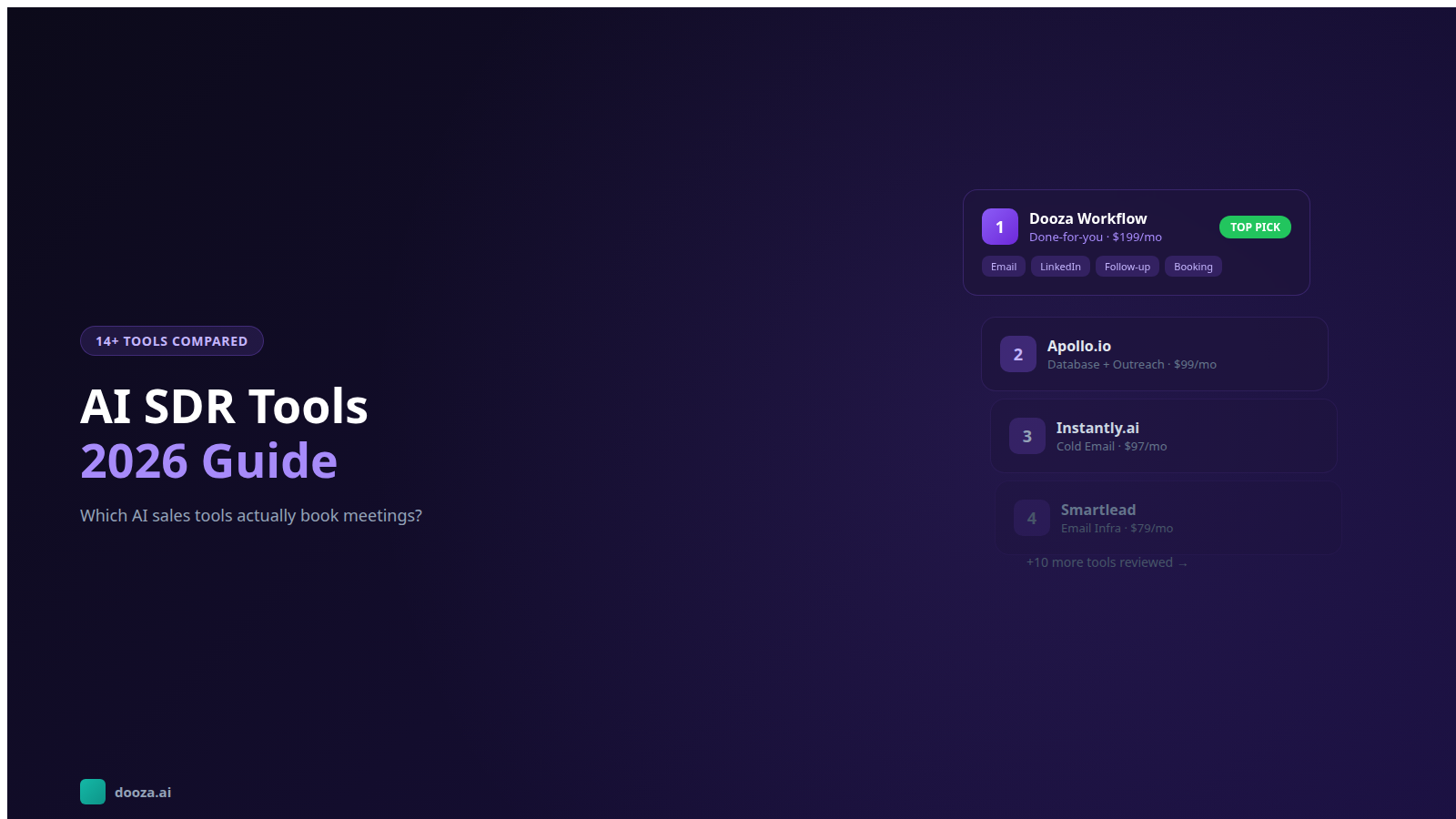
Compare the top AI SDR tools for automated prospecting and outreach. DIY platforms vs done-for-you AI employees for sales development.
Start with a refundable pilot — 100% refund within 14 days. A Dooza engineer scopes it with you on a free 30-minute call. Pricing depends on the product; see pricing.
Refundable pilot · 100% refund within 14 days · No contracts