Conversational AI
Conversational AI for Customer Support: When It Works Best
Conversational AI for customer support works best when it has business context, escalation rules, and connected support tools.
12 min read
ReadHow conversational AI handles customer service in 2026 — NLU vs old chatbots, real-world examples, deployment steps, and the metrics that matter.
Conversational AI for customer service is the technology that lets businesses hold natural, multi-turn support conversations without staffing every channel around the clock. Grand View Research estimates the conversational AI market will reach $49.9 billion by 2030, with customer service driving most of that growth. If you run support in 2026, understanding how this works is no longer optional.
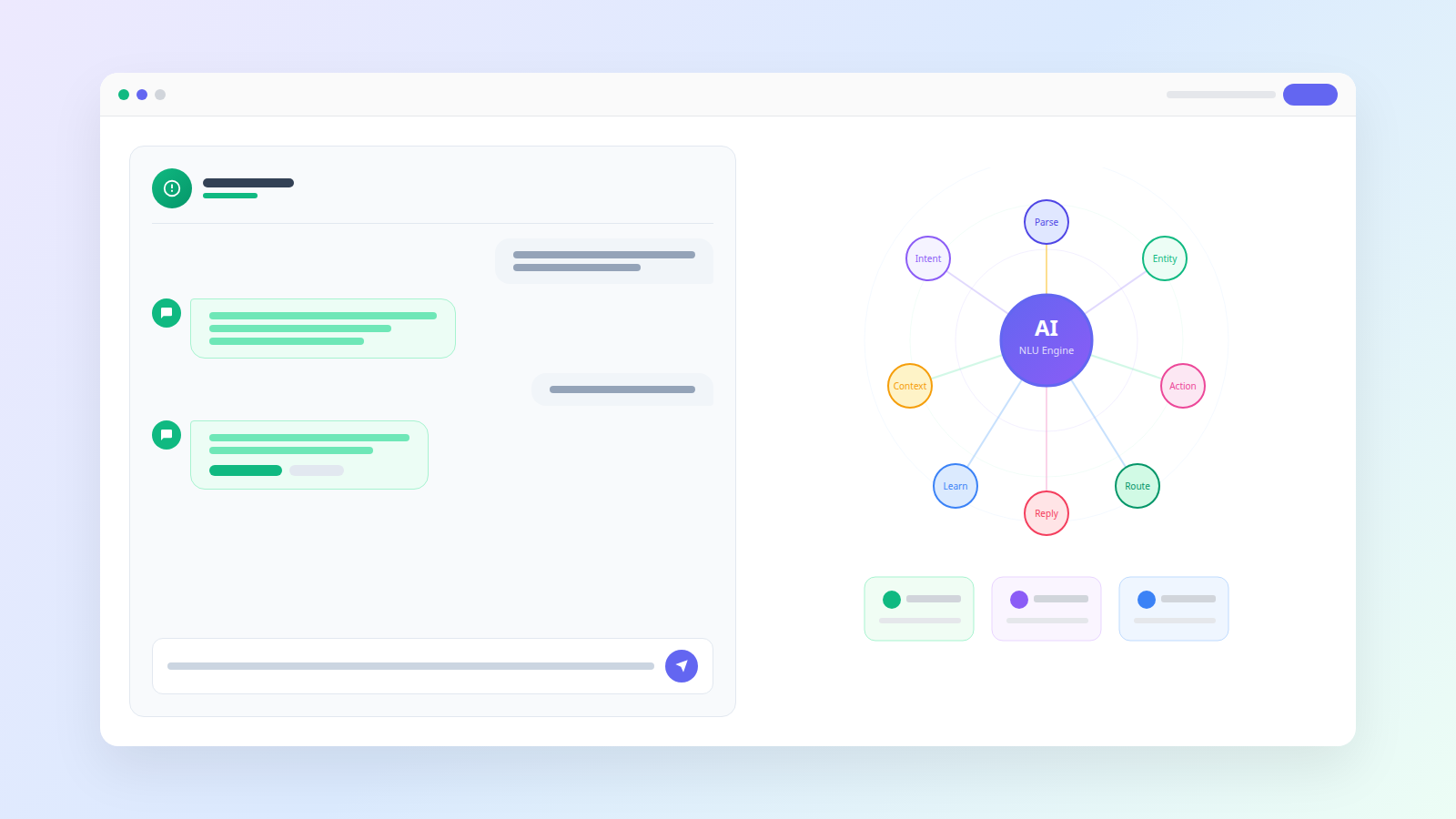
Conversational AI uses natural language understanding (NLU), machine learning, and large language models to interpret customer requests, maintain context, and take action — not just serve canned responses.
Old-school chatbots followed decision trees. Type "refund" and you got a scripted paragraph. Phrase it differently and the bot gave up. Modern conversational AI understands intent regardless of phrasing. Ask "where is my order?" and it checks carrier status and gives the exact delivery date. That is the gap between automated customer support that works and automation that creates more problems.
The proof is in production. Domino's DOM handles millions of pizza orders through natural language across text, voice, and smart speakers. Sephora's Virtual Artist combines conversational AI with augmented reality so customers ask questions and try on makeup in one session. Bank of America's Erica has processed over two billion interactions for balance checks, spending insights, and financial guidance. If enterprises at this scale trust conversational AI, the question for smaller businesses is how to automate customer support with AI the right way.
Here is what happens in every interaction:
This workflow separates genuine conversational AI for customer support from scripted chatbots that give automation a bad name.
Most conversational AI platforms target enterprises with six-figure budgets. Dooza brings the same NLU and context management to businesses without a machine learning department. Configure your brand voice, upload your knowledge base, and start resolving tickets within a day.
Every Dooza product starts with a refundable pilot — 100% refund within 14 days. If you want to see what an AI customer support agent looks like in practice, Dooza is the fastest way to get there.
Review weekly for the first month, then monthly. The data shows exactly where to invest — knowledge base, thresholds, or integrations.
This video covers conversational AI fundamentals — how NLU works, why it matters for customer-facing applications, and what separates effective implementations from chatbots that frustrate customers.
Conversational AI for customer service is no longer reserved for Fortune 500 companies. The tools are accessible, costs are reasonable, and results are proven from fast food to financial services. Start with a focused pilot on your highest-volume ticket category, measure the results, and let the data guide expansion. Get started with Dooza.
Conversational AI for customer service uses natural language understanding and large language models to hold natural, multi-turn support conversations. Unlike rule-based chatbots that follow decision trees, it understands intent regardless of phrasing, maintains context across exchanges, and takes actions like looking up orders or initiating returns.
Traditional chatbots follow scripted decision trees and fail when customers phrase things unexpectedly. Conversational AI uses machine learning to understand intent, extract details, and maintain context across multiple turns. It also connects to backend systems to take action rather than just providing canned responses.
Major brands use it at scale today. Domino's DOM processes millions of orders through natural language. Sephora's Virtual Artist combines product Q&A with augmented reality try-ons. Bank of America's Erica has handled over two billion interactions for balance checks, spending insights, and account management.
Enterprise platforms can cost tens of thousands per year, but accessible options exist. Dooza pricing depends on the product, and every Dooza product starts with a refundable pilot — 100% refund within 14 days. See <a href="/pricing">pricing</a> for details.
With modern platforms like Dooza, deployment can happen in a single day. Upload your knowledge base, configure your brand voice, and connect your support channels. Most businesses start on one channel, validate over two weeks, then expand based on performance data.
Focus on five metrics: resolution rate, customer satisfaction scores, average handle time, escalation rate, and cost per resolution. Review weekly for the first month, then monthly. The data guides where to invest in knowledge base improvements and integration expansions.
Automate your business with AI employees that work 24/7. Start with a refundable pilot: 100% refund within 14 days.
Conversational AI for customer support works best when it has business context, escalation rules, and connected support tools.
Generative AI for customer support can draft replies, summarize tickets, improve FAQs, and speed up support when guardrails are clear.
Start with a refundable pilot — 100% refund within 14 days. A Dooza engineer scopes it with you on a free 30-minute call. Pricing depends on the product; see pricing.
Refundable pilot · 100% refund within 14 days · No contracts