How to Scale a Small Business From Idea to Market Leader
Discover how to scale a small business with our proven guide. Learn to automate operations with AI, streamline growth, and secure your market position.
23 min read
January 18, 2026
Scaling your business isn't just about getting bigger. It’s about growing smarter. Imagine a business where your revenue climbs dramatically, but your costs barely budge. That's the dream of scaling. You’re building well-oiled machines—automated, repeatable systems that handle a flood of new business without you breaking a sweat. This isn't just growth; it's freedom.
Is Your Business Actually Ready to Scale?
Every founder dreams of hitting that growth hockey stick, but gunning the engine on a wobbly foundation is a classic recipe for disaster. Before you start pouring money and energy into expansion, you need to take a hard, honest look in the mirror. Are you really prepared for the pressure that comes with growth?
The real dream of scaling isn't just about more revenue; it's about building a business that doesn't need you in the trenches every single day. Imagine taking a two-week vacation, completely unplugged, and returning to find that new sales were closed, customers were delighted, and your bank account grew. That's the operational freedom that AI and automation create.
This isn't a gut feeling. Readiness shows up in tangible signals within your business. The aim is to finally break free from that stressful 'feast or famine' cycle, where you're constantly chasing the next big client just to keep the lights on. Scalability begins with stability.
The Bedrock of Growth: Predictable Revenue
The number one sign that you're ready to scale is predictable revenue. This doesn't mean you can pinpoint your income to the exact dollar each month. It means you have a reliable, repeatable system for generating sales. Can you look at your pipeline and confidently forecast the next quarter? If your income feels like a surprise party every month, scaling will just make that chaos bigger and scarier.
For example, a small digital marketing agency was completely dependent on sporadic word-of-mouth referrals. Before they even thought about hiring, they focused on building a simple, automated lead-gen funnel using an AI agent. They taught the AI their ideal client profile. Now, they know that spending $500 on ads reliably brings in three qualified leads, which the AI nurtures automatically. They had cracked the code to predictable income, giving them the confidence to finally bring on their next team member.
Creating Consistency with Repeatable Processes
Do you have a documented, step-by-step way of doing things? If you pulled aside three different people on your team and asked them how to complete a core task, would you get the same answer? If the answer is no, you're not ready. Scaling demands consistency. Without it, quality tanks, customers get angry, and your team is thrown into disarray.
A business that's truly ready to scale is one where the system is the star, not the founder. Your processes need to be so clear that a new hire can get up to speed in days, not weeks.
This is where the magic of AI automation truly shines. Imagine a sales process so perfectly defined that an AI agent handles all initial lead qualification, sends perfectly timed follow-up emails, and books meetings directly onto your sales team's calendars—all while you sleep. This isn't a fantasy. It's what happens when you turn gut-feel actions into a documented workflow. This automation frees up your team to focus on what they do best: building relationships and closing deals.
Before you chase after more customers, ask yourself these crucial questions:
Is our customer onboarding process the same every time? Can anyone on the team give a new client a fantastic and consistent first impression?
Do we have clear quality control? How do you make sure every product that leaves the building or service you deliver lives up to your standards?
Is our sales process repeatable? Do you know the exact steps a lead takes from the first "hello" to a signed contract?
If you can confidently say "yes" to these, you've built a solid foundation. You've created a machine that's ready to handle more volume without breaking down. Now, you can start adding fuel to the fire.
Creating Your Blueprint for Scalable Operations
Growth without a plan isn't really growth—it's just chaos. To scale your small business without everything falling apart, you need a rock-solid operational blueprint. Think of it as creating an instruction manual so clear that your company can run smoothly, even when you’re not there. This is how you shift from being the central gear in your business to the architect of a self-sustaining machine, freeing up your time for what truly matters.
Imagine a new hire being fully productive in days, not weeks, because your processes are perfectly documented and an AI assistant guides them through every step. This isn't a dream; it's the result of intentional, strategic planning. When you standardize your critical functions, you lay the foundation for predictable, stress-free expansion.
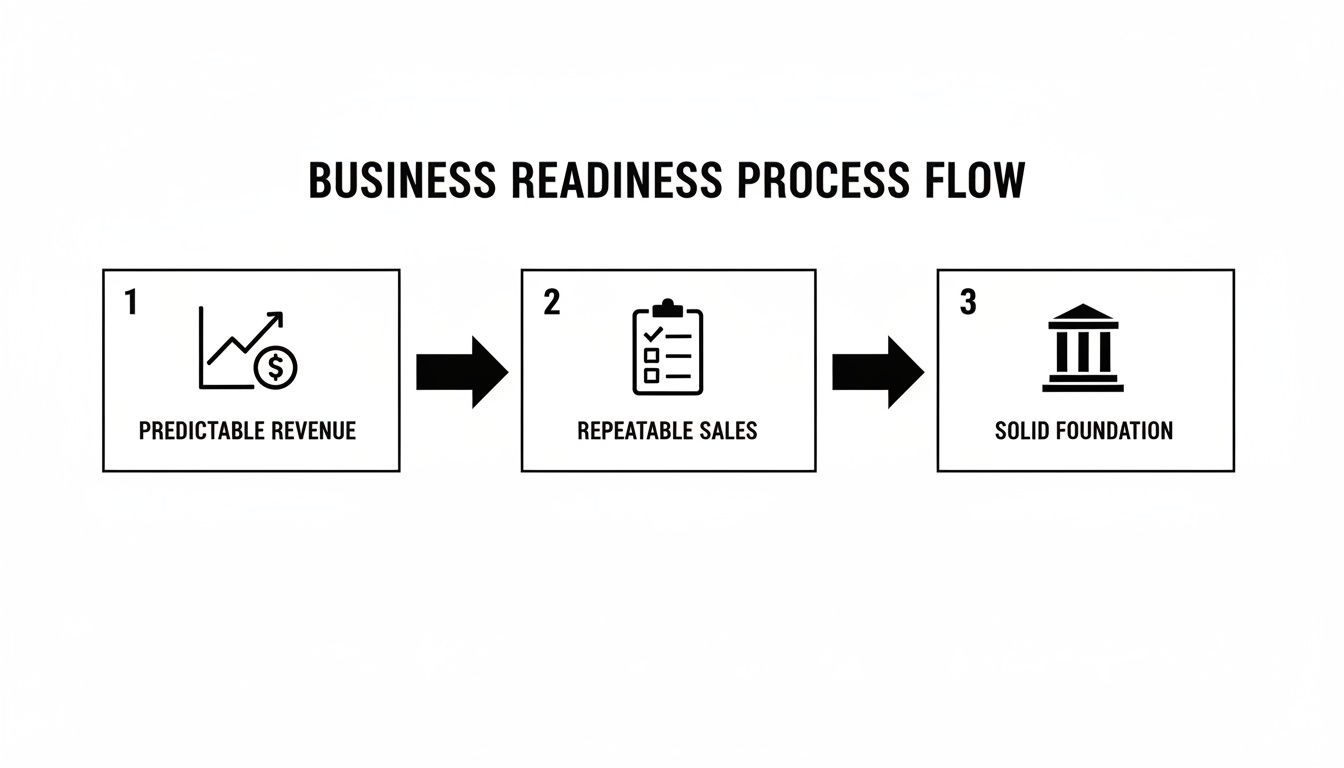
This is the core idea: a business ready for scaling starts with predictable revenue and repeatable sales, all built on a solid operational foundation.
Each step here builds on the last. It shows that you can't just slap a growth plan onto a shaky business model. You need stability and predictability first.
Map Your Core Workflows
First things first: you have to get everything out of your head and onto paper (or a screen). Every single task that's essential to your business—from how a new lead is first contacted to how a final product is delivered—needs to be mapped out. This isn't about creating bureaucracy; it's about creating clarity.
Consider an e-commerce brand that was constantly struggling with fulfillment. They mapped out every single step from "order received" to "package shipped." In doing so, they immediately spotted three major bottlenecks. They created a simple visual flowchart, standardized their packing procedure, and implemented a checklist. The result? They slashed packing errors by a staggering 90% and could finally handle a surge in holiday orders without collapsing.
The goal is to build a business where the system is the expert. Your documented processes become the single source of truth, ensuring quality and consistency no matter who is performing the task.
Once you have these workflows defined, they become the perfect instruction manual for AI agents. An AI can’t guess how you want things done, but it can execute a well-defined process flawlessly, 24/7. This is your first real step toward building a truly automated operation that frees you from the daily grind.
Standardize Everything for Consistency
Standardization is the engine that drives scalability. It’s what ensures every customer gets the same great experience and every project meets the same high bar for quality. Without it, you're just reinventing the wheel with every new sale, which is completely exhausting and inefficient.
Here are a few high-impact areas to standardize right away:
Customer Communication: Create templates for common emails, from initial inquiry responses to post-purchase follow-ups. An AI can then use these to provide instant, perfect answers.
Sales Process: Define the exact stages of your sales pipeline and the specific actions required to move a lead from one stage to the next. Let an AI automate the follow-ups.
Project Delivery: Use checklists and project management templates to ensure no critical steps are missed during client work.
This is where modern tools can make a huge difference. The adoption of AI is fundamentally changing how companies scale. Projections show it will add $15.7 trillion to the global economy by 2030, and the businesses that get on board will have a massive advantage. In fact, 23% of small businesses using AI saw a 12-point boost in profit likelihood over those who didn't.
Build Your Automated Workforce
With your processes documented and standardized, you're finally ready to bring in automation. This is where you get to reclaim your time and truly start to scale. Instead of hiring a person for every repetitive task, you can deploy an "AI employee" from a platform like Dooza to handle it perfectly every single time.
Imagine an AI agent managing your entire customer support inbox. It uses your standardized email templates to answer common questions instantly, 24/7. It escalates complex issues to a human, but handles 80% of the volume on its own. This frees up your human team to focus on solving the high-value problems that actually build deep customer loyalty, all while you focus on the big picture.
Building Your Automated Growth Engine with AI
You’ve mapped out your processes and gotten your operations down to a science. Now it's time to fire up the engine. This is where the dream of a self-sustaining, automated business gets real. Artificial intelligence is the fuel that will power your growth, turning your carefully designed blueprint into a dynamic, 24/7 operation that prints money while you sleep.
Think about having an employee who never gets tired, never makes a mistake, and executes your strategy flawlessly every single time. This isn't science fiction; it's the reality for smart small businesses today. You can build a workforce of AI employees to handle the repetitive, time-sucking tasks that are holding you and your team back, freeing you to live the life you intended when you started your business.
This isn’t about just grabbing a few random tools. It’s about building an intelligent system where your AI team works together to get results while you focus on steering the ship.
Hire Your First AI Employee
Dipping your toes into automation can feel like a massive leap, so my advice is always to start small. Pick one high-impact area that’s a constant drain on your time. For many businesses, that’s search engine optimization. SEO is a non-negotiable for growth, but it's often a complex, slow-moving beast that demands endless attention.
This is a perfect first job for an AI employee. Imagine hiring an AI SEO specialist. You give it your goals, and it just... goes. It analyzes your competitors, uncovers the right keywords, optimizes your website, and even helps with link-building. It works tirelessly in the background, pushing your site up the search rankings while you're finally free to run your company.
This is the fundamental shift: you move from doing the work to directing the work. Your AI workforce handles the execution, freeing you up to be the visionary your business needs.
Let’s take a local bakery owner who wants to rank for "best custom wedding cakes." Instead of spending her nights trying to learn SEO, she hires an AI employee. The AI researches what top bakeries are doing, finds long-tail keywords like "vegan wedding cakes in [city]," and automatically optimizes her website content. All the owner has to do is watch the qualified leads roll in, freeing her up to bake.
Assembling Your AI Dream Team
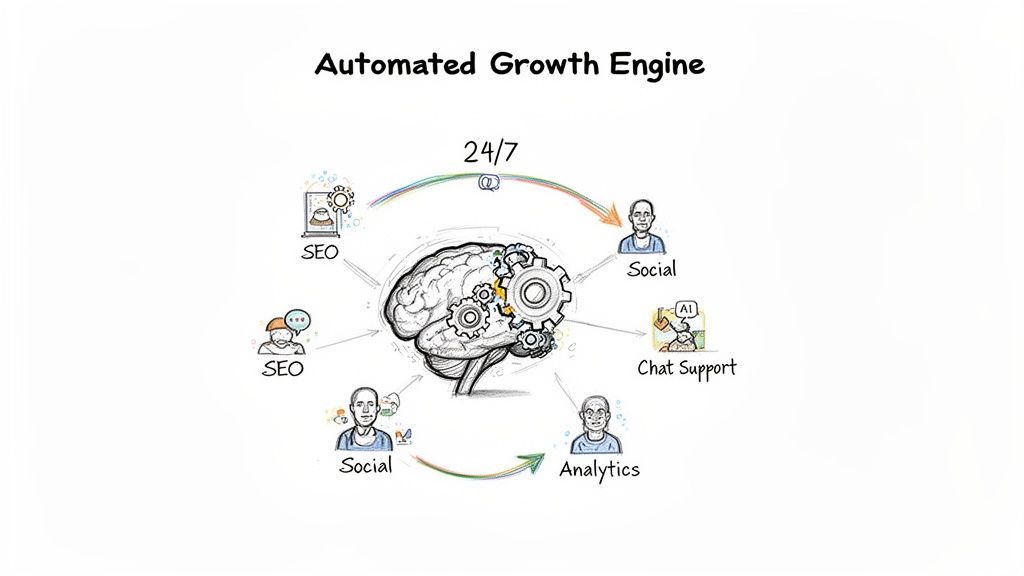
Once you see the magic of one AI employee reclaiming hours of your week, the next step is to build out a full team. This is how you create a business that grows on autopilot. Each AI agent tackles a different piece of your operational puzzle, working together seamlessly.
Here’s what your automated dream team could look like:
Your AI Social Media Manager: This agent takes your content strategy and brings it to life. It schedules posts, writes compelling captions, and even creates on-brand visuals, ensuring your business stays active and engaging across all platforms—even when you’re on vacation.
Your AI Customer Support Specialist: This agent offers instant, 24/7 help to your customers. It can answer common questions, handle simple issues, and flag complex problems for a human, so no customer ever feels ignored.
Your AI Sales Development Rep: This agent works your leads around the clock. It sends personalized follow-ups, qualifies prospects based on the rules you set, and books meetings directly on your sales team's calendar, filling your pipeline while you sleep.
These aren't just separate tools; they're a cohesive team. For instance, your AI support agent might notice a common customer question, which then prompts your AI social media manager to create content that addresses it proactively. Platforms like Dooza even let your human team members collaborate directly with their AI coworkers. We go deeper into building this out in our guide on AI for social media management.
Thriving in a Competitive Market
The entrepreneurial spirit is on fire. One recent year saw a record 5.5 million new business applications filed in the U.S., followed by another 5.2 million the next. With 99.9% of all U.S. businesses being small firms, the competition is intense.
Despite that, optimism is high—a whopping 78% of these businesses are planning to expand. The real difference-maker for those who succeed will be the smart use of technology. We’re already seeing that businesses using AI for analytics and campaigns are reporting stronger growth and are better prepared for challenges like rising costs. You can explore more about these small business growth trends.
Building your automated engine isn't just about clawing back a few hours. It’s about creating a powerful competitive advantage that allows your small business to operate with the efficiency of a much larger company. While your competitors are stuck in the weeds with manual tasks, your AI team is busy acquiring customers and driving revenue—all while you sleep. This is how you win.
Mastering Customer Acquisition at Scale
When your business starts to grow, your customer base needs to grow with it—often exponentially. But here’s the catch: the personal touch that won over your first loyal customers can't get lost in the shuffle. The real challenge is maintaining that connection when you're dealing with hundreds or even thousands of clients instead of a handful. This is the moment you have to shift from pure manual effort to building a smart system that attracts, nurtures, and keeps customers on autopilot.
Imagine waking up to a calendar packed with qualified sales meetings that were booked by your AI assistant while you were sleeping. Think about an email funnel that automatically segments new leads, sends them perfectly timed, personalized follow-ups, and nudges them toward a sale without you lifting a finger. This isn't just about efficiency; it's the framework for scaling your business without burning out.
This journey, from a total stranger to a raving fan, has to be smooth, automated, and totally consistent. As you get bigger, you just can't afford to have leads falling through the cracks or loyal customers feeling ignored.
Building Your Automated Marketing Funnel
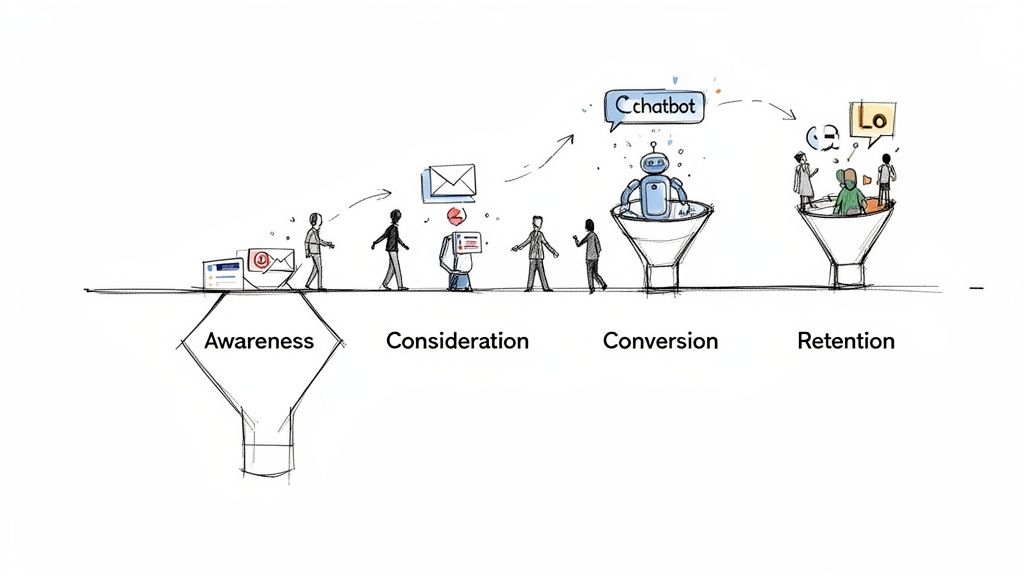
Your marketing funnel is simply the path a prospect takes from first hearing about you to actually buying something. In the early days, you probably guided people along that path yourself. That’s just not possible at scale. The goal now is to automate this journey so precisely that it still feels personal and responsive to what each individual needs.
Let's take a boutique consulting firm as an example. Instead of a partner manually emailing every single person who downloads their latest whitepaper, they deploy an AI agent. This AI instantly sends a thank-you email, then follows up three days later with a relevant case study. If the lead clicks that case study, the AI flags them as "highly engaged" and sends a personalized invitation to book a discovery call. The partner just shows up to a pre-warmed, pre-qualified meeting.
The real magic of an automated funnel is its ability to learn and adapt. It's not just a pre-set series of emails; it's an intelligent system that reacts to customer behavior in real-time. You never miss an opportunity.
This level of automation frees up your team to do what they do best: have high-value conversations and close deals, not get bogged down in administrative follow-ups. If you're looking for more advanced ways to get in front of the right audience, you can see how AI can rank your business on Google.
From Acquisition to Advocacy: Retention at Scale
Getting new customers is only half the battle. Keeping them is what builds a truly sustainable, profitable business. As your customer count explodes, you absolutely need systems to make every single one feel heard and valued. It’s a well-known fact that keeping a customer is far, far cheaper than finding a new one.
This is where automated feedback loops and proactive support become your secret weapon. You can't personally check in with 1,000 customers, but an AI agent certainly can.
Here are a few automated retention strategies that work wonders:
Proactive Support: An AI employee can monitor how customers are using your product and reach out before there's a problem. For instance, if a user hasn't logged into your software in 30 days, the AI can send a friendly, "Hey, we miss you!" email with some helpful tips to get them re-engaged.
Automated Feedback Loops: After a customer support chat or a new purchase, an automated system can ask for feedback. This does two things: it makes the customer feel like their opinion matters, and it gives you a constant stream of insights to make your service even better.
Personalized Onboarding: For new customers, an AI can walk them through a personalized onboarding process. It delivers tutorials and tips based on their specific goals, making sure they get value right away and are less likely to churn.
This is how you scale customer service without losing that all-important human touch. While an AI handles the routine check-ins and first-line questions, your human team is freed up to tackle complex issues and build deeper relationships. You're not just growing a customer base; you're building a loyal community that will champion your brand.
Financial Planning for Sustainable Growth
Let's be honest: rapid growth is a cash-hungry beast. If you want to scale without running out of fuel, you have to stop glancing at your bank balance and start thinking like a CFO. It’s all about getting a tight grip on your cash flow and tracking the metrics that actually predict what's coming next.
The dream is to build a financially resilient business. You want to be able to make those big, bold moves—like launching a game-changing marketing campaign—with the confidence that comes from solid data, not just a gut feeling. It’s about knowing exactly where every dollar is going and how it’s working to push your company forward.
Moving Beyond Revenue to Smart KPIs
Revenue is great for the ego, but profit and cash flow are what actually keep the lights on. As your business grows, your financial focus has to get sharper. It needs to shift to the Key Performance Indicators (KPIs) that paint a true picture of your business's health.
The two most important metrics in this playbook are Customer Acquisition Cost (CAC) and Customer Lifetime Value (LTV).
CAC is simply what it costs you, in total, to win a single new customer. LTV is the total revenue you can realistically expect from that customer throughout their entire time with you. The real magic happens when you look at them together.
The LTV to CAC ratio is your north star for profitable growth. When your LTV is significantly higher than your CAC, you've essentially built a money-making machine. For every dollar you pour into sales and marketing, you're getting multiple dollars back over the long run. That's your green light to hit the accelerator.
A healthy LTV/CAC ratio is generally considered to be 3:1 or better. Imagine a subscription box startup figures out its CAC is $50. If the average customer sticks around for 12 months paying $20/month, their LTV is $240. That's a LTV/CAC ratio of nearly 5:1—an incredibly strong signal that they should reinvest every spare dollar into finding more of those customers.
Building a Financial Model for Growth
A financial model isn’t just some spreadsheet you build once and forget about; it’s your roadmap. It lets you play out different scenarios—"what if we double our ad spend?" or "what if sales dip by 10%?"—and see how they impact your cash. This is how you start making proactive decisions instead of constantly reacting to financial surprises.
A good model will help you answer critical questions:
When can we actually afford that next hire? By forecasting your revenue and expenses, you can pinpoint the exact month your cash flow can comfortably support another salary.
What's the real ROI on our marketing spend? You can track how a budget increase in Q1 actually affects your revenue and CAC in Q2 and Q3.
How much funding do we really need? If you're thinking about raising capital, a solid financial model shows investors exactly how you'll use their money and what return they can expect.
This kind of financial clarity is a total game-changer. It’s no surprise that 58.4% of small businesses recently met or beat their revenue goals. According to some great research on these small business trends on Bluevine, companies with a real financial plan are the ones that thrive, even when they have to raise prices to manage rising costs. It just proves that a strong value proposition, backed by smart financial management, is a winning combination.
Choosing the Right Fuel for Your Growth
At some point, you'll likely need an injection of capital to fund a major expansion. The funding route you choose can dramatically alter your company's future, so it’s crucial to understand the landscape before you make a move.
Here's a quick look at the most common funding sources to help you weigh your options.
Funding Options for Scaling Your Business
Funding Option
Best For
Pros
Cons
Bootstrapping
Founders who want to maintain 100% control and ownership.
Complete autonomy, no debt payments or giving up equity.
Growth is limited by personal funds and revenue; can be much slower.
Venture Capital
High-growth startups with massive market potential and a clear exit strategy.
Access to huge amounts of capital and powerful networks.
You give up significant equity and some control; high-pressure for fast returns.
Angel Investors
Early-stage companies that need seed funding and hands-on mentorship.
Often more flexible terms than VCs; can provide invaluable guidance.
Still involves giving up equity; finding the right investor-founder fit is key.
Business Loans
Established businesses with predictable cash flow needing funds for specific projects.
You maintain full ownership of your company and don't dilute equity.
Requires repayment with interest, can be difficult to secure without a strong history.
Ultimately, having the right financial strategy gives you the freedom and the confidence to scale aggressively. It’s the difference between hoping for growth and actually engineering it.
When your financial plan is as solid as your operational one, you’re not just building a bigger business—you’re building one that's meant to last. You can explore our Dooza pricing plans to see how automating key operations can directly reduce your overhead and boost your financial efficiency.
Common Questions I Hear About Scaling
When you're on the brink of growing your business, it's totally normal for a million questions to start swirling. I've been there. Scaling is a huge leap, and the path isn't always clear. Let's tackle some of the most common questions and worries that keep founders up at night.
When Is the Right Time to Start Scaling My Business?
The "right time" isn't just when you're getting slammed with orders. It's when you have a proven, reliable system for handling that demand.
You're likely ready if you have consistent profitability, a predictable customer acquisition channel, and happy clients who don't need you to personally solve every problem. If you're still in "firefighter mode" every day, it's too early. Your first job is to get your core operations running like a well-oiled machine without you having to be in the middle of it all.
Think of it this way: you want to pour fuel on a controlled fire, not a chaotic one. Once you’ve built that stable, repeatable model, that's your green light.
How Can I Scale Without Sacrificing Quality?
This is the big one, right? The key is embedding quality into your systems and using smart automation. Start by documenting your standards. I mean really documenting them—checklists, templates, and clear workflows that show anyone on your team exactly what a great outcome looks like.
Then, start handing off the repetitive, error-prone tasks to technology. For instance, an AI employee can manage your entire first line of customer support. This guarantees every customer gets an instant, consistent, and high-quality response based on the very standards you just documented.
This isn't about replacing people; it's about elevating them. Automation handles consistency, which frees up your human team to focus on the complex, high-value problems where they can truly shine. Your overall customer experience can actually improve.
What Is the Biggest Mistake Owners Make When Scaling?
Hands down, the single most costly mistake is scaling prematurely. It's so easy to get caught up in a sudden spike in demand and immediately throw money at marketing and hiring before your internal operations are ready for the flood.
It’s a classic case of putting the cart before the horse. It always leads to the same place: chaos, a burned-out team, and—worst of all—unhappy customers who are now dealing with delays and shoddy work. The allure of more revenue is powerful, but it's a trap if you haven't built the foundation first.
I’ve seen it happen: a company launches a massive ad campaign, but their fulfillment process is still a manual mess. What happens? A tidal wave of shipping delays and terrible reviews. You have to live by this mantra: systems first, scale second.
Can a Solopreneur Really Scale a Business?
Absolutely. In fact, it's more possible today than ever before. Technology, especially AI, has completely changed the game. A single person can now use a platform like Dooza to build an entire automated workforce without the massive overhead of a traditional team.
You can literally "hire" an AI to be your SEO expert, another to run your social media, and a third to handle your support inbox. This goes way beyond just using a few separate tools. You’re creating a cohesive team of AI employees that work together, 24/7, flawlessly executing the game plan you've laid out.
This gives you the operational muscle of a much larger company. You can outmaneuver bigger, slower competitors, all while staying lean and in control. A great first step for many is automating customer service, and there are many excellent Gorgias alternatives for customer service automation that can get you started. This is how you build an empire of one.
Scaling isn't about working harder; it's about building smarter systems. At Dooza, we provide the AI employees that become the backbone of your growth engine. Imagine having a dedicated team for your SEO, social media, and customer support, working tirelessly so you can finally focus on the big picture.
How Do AI Assistants Work? A Complete Guide for Small Business Owners
Learn how AI assistants work under the hood — from neural networks and LLMs to memory, tools, and real business applications. A practical guide for small business owners.