AI-Native Service Company: How It Works and How to Build One
An AI-native service company sells a completed outcome while agents run the repeatable work. See how the model works, where Dooza fits, and how to build one.
12 min read
September 15, 2026
The short answer
An AI-native service company sells a completed business outcome and uses AI agents to perform most of the repeatable work required to deliver it. Humans do not disappear. They move to the places where judgment, trust, accountability, taste, negotiation, or unusual exceptions matter most.
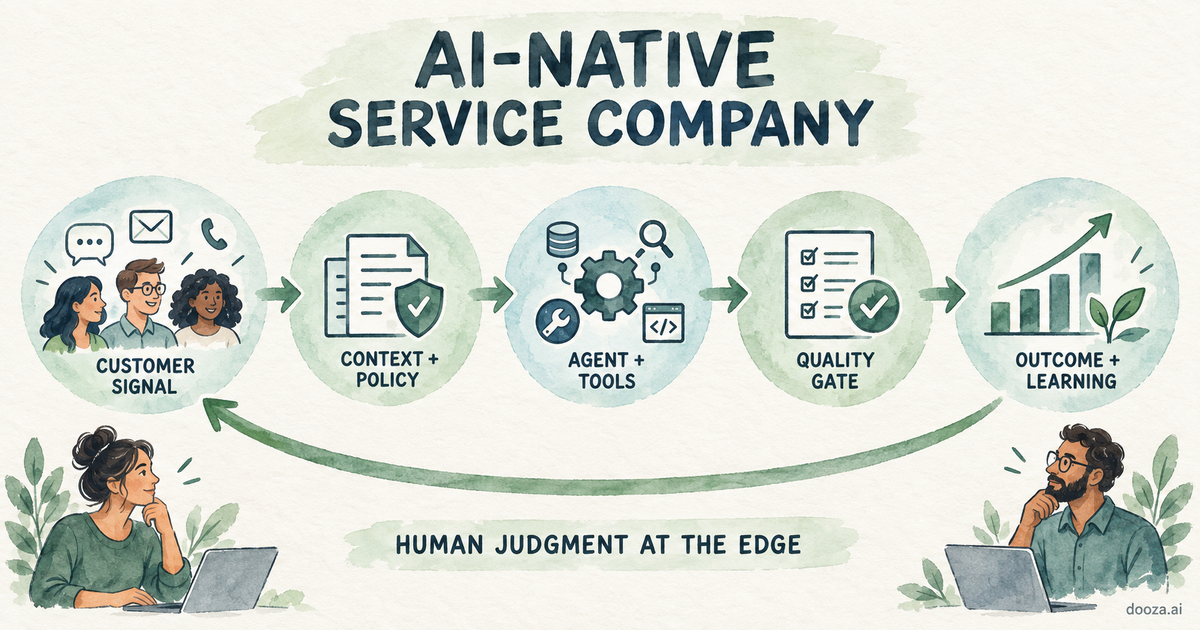
That is different from a traditional agency using ChatGPT to write faster, and different from a software company giving customers another tool to operate. The operating system of the business is designed around AI from day one: customer signals flow into a shared company context; agents work through policies and connected tools; quality gates check the result; approved work reaches the customer; and every outcome improves the next run.
Dooza fits this model as a product-led service. A business describes the AI employee it needs, and Dooza engineers build it, connect it to the business's tools and context, deploy it with approval rules, and keep it working. The customer is buying a working capability—not a blank automation canvas and a manual to read.
What is an AI-native service company?
A service company normally sells expertise and execution: answer the calls, keep the books, qualify the leads, run the campaign, process the claim, or resolve the support queue. Historically, more customers meant more people because people carried information between systems and performed every step.
An AI-native service company changes the delivery engine. It captures the knowledge of its best operators, makes that context readable to machines, gives agents access to bounded tools, and turns the recurring parts of service delivery into observable software loops.
Model
What the customer buys
Who operates the work
How it scales
Traditional service firm
People, expertise, and hours
Employees and contractors
Add headcount
SaaS company
Access to a tool
The customer's team
Add software seats and usage
AI-enabled agency
A conventional service delivered faster
People using AI copilots
Improve worker productivity
AI-native service company
A defined, completed outcome
Agents run repeatable work; specialists own exceptions and judgment
Improve loops and add compute before adding coordination layers
The distinction is architectural. If every important step still waits for a human to copy information, decide which tool to open, and move the task forward, the company may be AI-assisted, but it is not yet AI-native.
The big idea from the video: build the company as a loop
In the featured YC Root Access talk, Y Combinator General Partner Tom Blomfield argues that companies have long been structured like Roman legions: instructions travel down a hierarchy and reports travel back up, with humans acting as the routing layer. His alternative is a company built from self-improving AI loops.
A practical AI-native loop has seven parts:
Signal: a customer message, support ticket, sales call, payment event, product event, document, or deadline enters the system.
Context: the agent retrieves the relevant customer history, company knowledge, examples, and current state.
Policy: explicit rules define what is allowed, what must be logged, and what requires approval.
Tools: the agent can search, draft, calculate, update a CRM, prepare a report, or call another approved system.
Quality gate: deterministic checks, a second model, or a qualified human reviews the output in proportion to the risk.
Action: the system delivers the approved outcome, updates the source of truth, and records what happened.
Learning: acceptance, rejection, edits, customer response, and business metrics feed back into the next run.
The learning step is what changes automation into an operating advantage. A workflow that repeats yesterday's mistakes is merely automated. A workflow that detects failure, proposes an improvement, tests it safely, and retains what works can become better over time.
The useful unit of design is not the prompt. It is the closed loop from real-world signal to measured outcome.
Why AI-native services are different from AI software
Customers do not usually want an agent builder. They want their receivables followed up, their qualified leads delivered, their inbox under control, or their content published correctly. An AI-native service company owns more of that result.
That creates an attractive opportunity and a harder responsibility. The provider can combine software margins with domain expertise, but it also owns service quality, exceptions, and customer trust. The workflow must work on messy real inputs—not only in a demo.
The strongest starting markets tend to have frequent digital work, reasonably standard inputs, a measurable definition of done, and expensive human coordination. The companion Y Combinator guide to building an AI-native services company adds an important warning: uncontrolled variance can destroy the model. If every customer requires a completely different process, data model, and exception policy, the service cannot compound into a reusable delivery system.
What does Dooza do?
Dooza builds and maintains AI employees for real business workflows. A customer explains the job in plain language; Dooza engineers connect the relevant tools, assemble the company context, configure the workflow and its approvals, put it live, and continue improving it.
That is a product-led service because the experience combines a repeatable platform with implementation and ongoing operation. The public Dooza offer is not simply “here is a model—write prompts.” It is “describe the work you need done, and we will build the AI employee that does it.”
Current examples include:
Ranky for visibility work such as research, SEO content, media embeds, and publishing workflows.
Lead Gen Pro for scoped prospect searches, credit-aware runs, deduplication, and CSV delivery.
Outbound Pro for approved outbound email campaigns, reply syncing, and follow-up workflows.
Voice Pro for configured call-answering, qualification, booking, and summary-routing workflows; its exact deployment scope is confirmed during onboarding.
Custom agents for marketing, sales, support, and operations when a business has a repeatable workflow that does not fit a prebuilt employee.
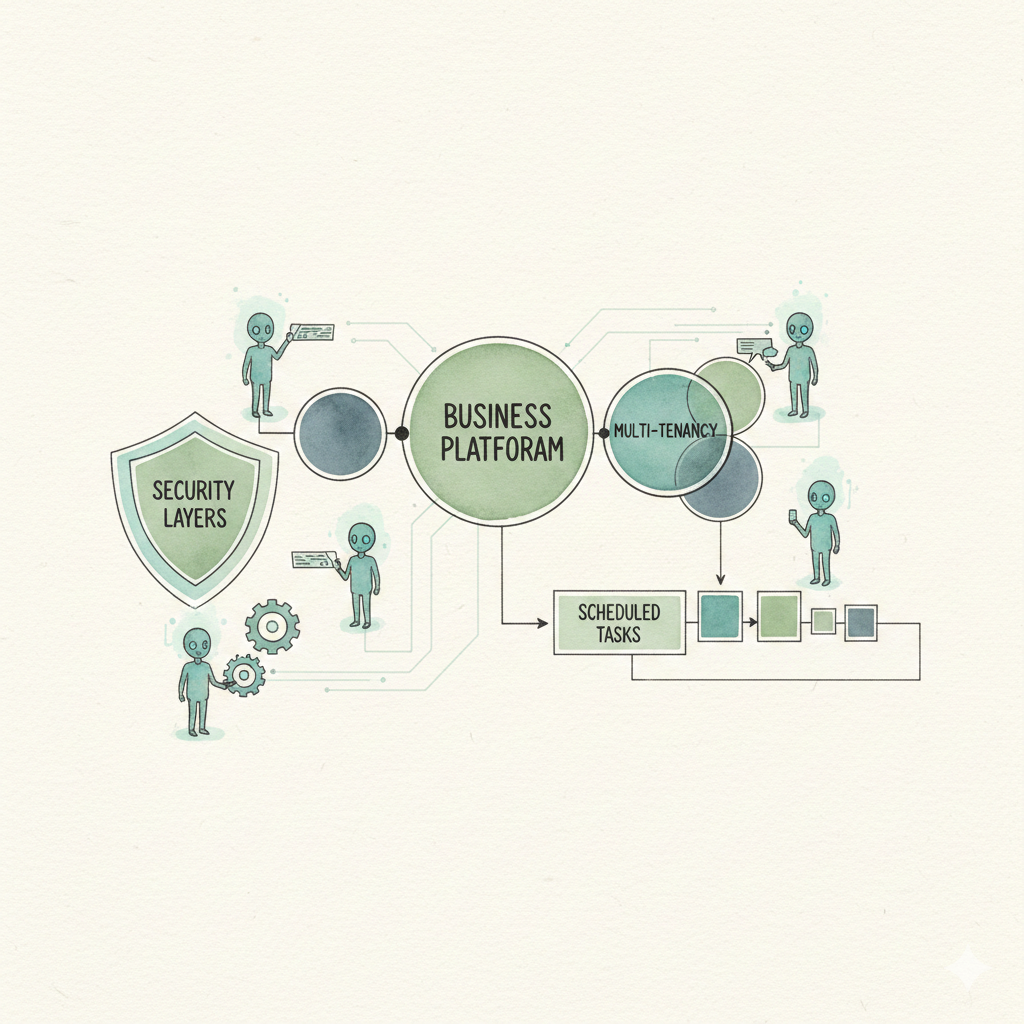
Dooza's role is the layer between raw model capability and dependable business operation: company context, tool connections, policies, approval paths, logs, monitoring, and maintenance. Sensitive actions can remain behind human approval instead of being silently automated.
This does not mean every Dooza workflow is fully autonomous or self-improving on day one. Autonomy should be earned. A sound deployment begins with observable work and human review, then removes unnecessary gates only after the system has enough evidence to justify it.
How to build an AI-native service company
1. Choose one narrow outcome
Do not start with “we automate businesses.” Start with a result a customer can recognize: every qualified inbound lead receives a reviewed response within five minutes; every invoice exception is categorized and routed; or every support ticket receives a useful first draft.
A narrow promise gives you a clear workflow, a quality standard, a price anchor, and a measurable reason to exist.
2. Deliver it manually before you automate it
Work with the first customers closely enough to see the real inputs, exceptions, and unstated judgment. Record the decisions. Save the examples. Notice where a senior operator departs from the written process. That tacit knowledge will become the seed of your company brain.
3. Map the full service loop
Write down the trigger, required context, decision policy, tools, quality checks, final action, owner, and success metric. If one of those fields is missing, you have a task demo—not a production service.
4. Make the business legible to AI
The video repeatedly returns to legibility: meetings, customer calls, decisions, playbooks, and outcomes need durable artifacts. Use searchable transcripts, structured CRM fields, versioned policies, and one source of truth for customer state. Respect consent, privacy, retention rules, and access boundaries; “record everything” is not a license to collect data indiscriminately.
5. Build a small company brain
Do not begin with a giant knowledge graph. Start with the context required for the first outcome: approved examples, service policies, customer facts, tool definitions, and an exception log. Make it easy for both agents and humans to retrieve the same answer.
6. Add quality gates before autonomy
Use deterministic validation whenever possible: required fields, schema checks, duplicate detection, arithmetic checks, allowed claims, permission checks, and rate limits. A second model can critique subjective output. Qualified humans should approve high-stakes decisions, unusual promises, payments, deletions, regulated advice, and ambiguous exceptions.
7. Give one person direct responsibility
Each loop needs a directly responsible individual. That person owns its outcome, reviews failures, decides which improvements ship, and can stop the system. Agents can coordinate information; they cannot absorb legal or moral accountability.
8. Close the learning loop
Capture why work was accepted, edited, rejected, escalated, refunded, or praised. Review failure clusters weekly. Improve the policy, context, or tool—not just the prompt. Promote common exceptions into tested paths and keep rare exceptions visible.
9. Standardize before you scale
Choose a default stack, onboarding checklist, service boundary, input schema, and approval model. Say no to custom work that cannot become part of the reusable system. This is how delivery knowledge compounds instead of resetting with every customer.
The economics: measure outcomes, not token theatre
Blomfield's phrase “burn tokens, not headcount” is intentionally provocative. The useful interpretation is not “replace people at any cost.” It is: before adding another coordination-heavy role, test whether better context, tooling, and agent capacity can increase throughput for the current team.
Track the economics at the level of an accepted outcome:
Revenue per completed case or recurring service unit
Model, tool, and infrastructure cost per accepted outcome
Human review minutes per outcome
Rework, refund, and escalation rate
Cycle time and on-time completion
Gross margin by customer cohort
A rising token bill is not automatically progress. If usage grows while acceptance falls, review time rises, or customers churn, the loop is getting worse. AI-native companies need operating leverage, not impressive consumption graphs.
Keep humans at the edge—where they create the most value
The video describes people living “at the edge,” where the company's intelligence meets reality. For a service company, that means humans remain central to discovery, trust, taste, negotiation, ethical judgment, novel situations, and high-stakes exceptions.
The aim is to stop using people as middleware. A specialist should not spend the day copying a customer's details from email into a CRM, asking a manager which template to use, and writing another status update. The system should route the context automatically so the specialist can make the decision only they should make.
A good test is simple: if the work requires accountability or a relationship, keep a named human owner. If it is repeated information movement with clear rules, design it into the loop.
Seven mistakes that stop an AI-native service company from working
Selling “AI” instead of an outcome. Customers cannot measure a buzzword.
Automating an undefined process. Agents amplify contradictions in a bad workflow.
Accepting unlimited customer variance. Bespoke delivery prevents the system from compounding.
Using one giant agent for everything. Smaller bounded loops are easier to test, secure, and improve.
Treating a second model as perfect quality control. Model-based checks can fail in correlated ways; high-risk work still needs deterministic controls and accountable humans.
Collecting data without governance. Access, consent, retention, and deletion rules belong in the architecture.
Claiming autonomy too early. Start in draft or approval mode, measure reliability, and expand permissions deliberately.
A practical 90-day roadmap
Days 1–15: define and observe
Choose one painful, high-frequency service outcome.
Interview five to ten target customers and manually deliver the service.
Write the first service boundary, exception taxonomy, and success metric.
Days 16–45: build the supervised loop
Connect one source of truth and the minimum required action tools.
Run the agent in draft mode with full logs.
Add deterministic validators and a human approval queue.
Measure acceptance rate, review time, latency, and cost per accepted outcome.
Days 46–75: reduce variance
Cluster failures and convert common exceptions into tested paths.
Standardize onboarding inputs and reject unsupported edge cases.
Move proven low-risk actions from review-every-time to sampled review.
Days 76–90: productize the service
Package the outcome, scope, turnaround time, and escalation policy.
Price for the value delivered while protecting gross margin.
Create an operating dashboard and assign a DRI to every live loop.
Only then add the next adjacent workflow.
Watch: Building And Structuring An AI Native Company
This 21-minute Startup School Paris presentation is the source for the company-brain and self-improving-loop framework used in this guide. Blomfield is explicit that the model remains early and theoretical, which is exactly why bounded, measurable deployments matter.
The verdict
An AI-native service company is not a chatbot wrapped in consulting language. It is a service business whose delivery system is built around context-rich agents, explicit policies, connected tools, quality controls, measurable outcomes, and a learning loop.
Dooza's answer is to make that model accessible to businesses that do not want to assemble the infrastructure themselves: describe the AI employee, let Dooza build and connect it, keep sensitive work behind approval, and improve the workflow after it meets real operations.
If you want to build your own AI-native service company, begin with one narrow outcome and one supervised loop. If you want the operating capability inside your existing business, book a Dooza setup call and bring the workflow that consumes the most repeated human coordination.
Frequently Asked Questions
What is an AI-native service company?
An AI-native service company sells a defined business outcome and uses AI agents, connected tools, explicit policies, and quality gates to perform most repeatable delivery work. Humans retain accountability, relationships, judgment, and unusual exceptions.
How is an AI-native service company different from SaaS?
A SaaS company primarily sells access to a tool that the customer operates. An AI-native service company owns more of the completed outcome, including workflow operation, quality control, exception handling, and ongoing improvement.
What does Dooza do?
Dooza is a product-led service that builds and maintains AI employees. Dooza engineers connect business tools and context, configure policies and approvals, deploy the workflow, and keep it working for marketing, sales, support, and operations use cases.
Does an AI-native company remove humans?
No. It removes unnecessary human coordination from repeatable work. Named humans should remain responsible for strategy, trust, ethics, high-stakes decisions, regulated judgment, and novel exceptions.
What is the best first workflow to automate?
Choose a frequent, digitally observable workflow with a clear definition of done and low-cost failure, such as drafting support replies, qualifying inbound leads, preparing reports, or routing invoice exceptions. Start with human approval.
How do you know when an AI workflow is ready for more autonomy?
Expand autonomy only after measured acceptance is consistently high, failure modes are understood, deterministic controls are in place, escalation works, and the cost of an error is acceptable. Keep high-risk actions human-approved.
Ready to Get Started?
Automate your business with AI employees that work 24/7.
Best AI Agentic AI Tool for Automation in USA (2026)
Looking for the best AI agentic AI tool for automation in the USA? See why Dooza is built for American businesses that need email, SEO, social media, sales, and phone automation in one AI workforce.