If AI Takes All Jobs, Who Buys Everything? The Freemium Future of Business (And How Dooza AI Employees Save You)
A viral video asks a chilling question: if AI automates everyone's jobs, who will buy your products? We break down the video's insights, explore the 'freemium' economy shift, and show how Dooza's AI employees can help you automate without destroying your customer base.
9 min read
July 20, 2026
The Big Question: If AI Takes All Jobs, Who Buys?
There's a video making the rounds—over 3.2 million views and counting—that poses a deceptively simple question: "If AI takes all of our jobs, who's going to buy everything?"
It's the kind of question that stops you mid-scroll. Because for all the breathless hype about AI replacing workers, cutting costs, and boosting efficiency, almost nobody is talking about the other side of the ledger: consumer demand.
If every company automates away its workforce, who's left with a paycheck? And if nobody has a paycheck, who's buying your products?
In this post, we'll break down the video's key insights—the alarming statistics, the Henry Ford myth, the freemium future, and the two-tier economy that's already emerging. Then we'll offer a practical, optimistic alternative: how businesses can automate intelligently using AI employees like those from Dooza.ai—without destroying the very customer base they depend on.
The Alarming Numbers: 300 Million Jobs at Risk
The video opens with a gut-punch of data. A recent study predicts that 40% of all global jobs could be affected by artificial intelligence. That's 300 million full-time positions—including roles in legal, engineering, and customer service—that could be replaced or radically transformed.
And it's not just a prediction. It's already happening.
The video cites a survey of 697 companies by Metro G, a research firm. The findings are stark:
Companies that did not use AI in 2023 hired 89% more agents than those that did.
Among companies that did use AI, 36.8% laid off an average of 26.1% of their employees—all within a single year, and just within call centers.
Call centers have already been hammered by outsourcing, understaffing, and automation. Now AI is delivering the knockout punch. The video shows a warehouse where nine robots do the work of 250 humans. That's a 96% reduction in headcount.
From a purely financial perspective, this looks like a win for business owners. Lower payroll, higher margins. But the video asks: what happens when everyone does this?
The Henry Ford Myth: Why Paying Workers Matters
The video takes a detour into history, recounting the famous story of Henry Ford doubling his factory workers' wages to $5 a day in 1914. The popular myth is that Ford did this so his workers could afford to buy the Model T they were building—boosting company revenue.
As the video points out, that's "basically complete nonsense." Ford's real motive was to reduce turnover and poach talent from competitors like Dodge. But the video argues there's a "nugget of truth" in the fairy tale:
"If the employment rate suddenly drops as hard as it did in the call centers from the study in every company around the world, then companies will undeniably struggle with reduced revenue as people without jobs don't have the buying power they once did."
This is the core paradox of automation: you can't sell to people who have no money.
Even workers who keep their jobs will cut back spending out of fear that they might be next. The result? A downward spiral of reduced demand, further layoffs, and economic contraction.
The Freemium Future: Video Games as a Crystal Ball
So what's the solution for businesses? The video offers a chilling answer: cater exclusively to the wealthy.
It points to the video game industry as a crystal ball. Free-to-play games—like Fortnite, Genshin Impact, and Candy Crush—are now the most profitable in the world. Their secret? A freemium pricing model where the vast majority of players pay nothing, while a tiny fraction—affectionately called "whales"—spend thousands or even millions of dollars on in-game perks.
The video argues that this model is already spreading to the real economy. As automation eliminates middle-class jobs, businesses will increasingly focus on selling to other wealthy business owners and asset holders. Everyone else becomes "entertainment"—a backdrop for the rich to show off their advantages.
"The people who have the most financial means don't work for their money—they own income-producing assets. And if automation does replace jobs on an even more widespread scale, that will make your ability to work less valuable and simultaneously income-producing assets more valuable."
This is the two-tier economy: a small class of owners who control the AI and the capital, and a vast class of people who are either unemployed or working gigs for scraps.
The Two-Tier Economy: Owners vs. Everyone Else
The video's conclusion is bleak but hard to dismiss: AI isn't going to change your world—it's just going to continue a trend that's already been happening for years.
Income inequality has been rising for decades. The pandemic accelerated it. AI will turbocharge it. The rich get richer, the middle class gets hollowed out, and the poor get left behind.
But here's the thing: it doesn't have to be this way.
Businesses have a choice. They can use AI as a blunt instrument to slash headcount and squeeze every last penny out of their operations—or they can use AI as a force multiplier that augments their human workers, improves customer experience, and creates new opportunities.
The difference is how you implement automation.
What Businesses Can Do: Automate Smart, Not Blindly
The video's warning is real, but it's not inevitable. Here's what forward-thinking companies can do to avoid the doom loop:
Automate repetitive tasks, not entire roles. Use AI to handle the boring, repetitive stuff—data entry, email sorting, basic customer queries—so your human employees can focus on creative problem-solving, relationship-building, and high-value work.
Invest in reskilling. Instead of laying off workers when you introduce AI, train them to work alongside the AI. A customer service agent who knows how to use AI tools is far more valuable than one who doesn't.
Keep your customers employed. If you automate your entire workforce, you'll have no one left to buy your products. A more sustainable approach is to automate selectively, maintaining a healthy base of employed customers who can afford your goods.
Use AI to improve service, not just cut costs. AI can handle customer queries 24/7, respond instantly, and personalize interactions at scale. That's not just cost-saving—it's a competitive advantage.
And that's where Dooza.ai comes in.
How Dooza AI Employees Solve the Problem
At Dooza.ai, we've built a suite of AI employees designed to help businesses automate intelligently. Instead of replacing your entire team, our AI workers handle specific tasks—freeing up your human staff to do what they do best.
Here's how each of our AI employees can help you avoid the pitfalls the video describes:
Maily – Your AI email assistant. Maily handles inbound customer emails, sorts them by priority, drafts responses, and even resolves common issues automatically. No more overflowing inboxes or missed messages. Your human team only steps in for complex cases.
Somi – Your AI social media manager. Somi schedules posts, responds to comments and DMs, and monitors brand mentions across platforms. She works 24/7, so your customers always get a timely response—without you needing to hire a full-time social media team.
Ranky – Your AI SEO specialist. Ranky analyzes your website, identifies keyword opportunities, and optimizes your content to rank higher on search engines. More organic traffic means more customers—without ad spend.
Stan – Your AI lead generation agent. Stan identifies potential customers, reaches out with personalized messages, and qualifies leads before passing them to your sales team. He works around the clock, so you never miss a sales opportunity.
Together, these AI employees form a virtual workforce that can handle the bulk of your customer support, marketing, and sales operations. They never take breaks, never call in sick, and never ask for a raise.
But here's the key: they don't replace your human employees entirely. They augment them. Your human team focuses on high-value tasks like strategy, creative work, and complex problem-solving—while the AI handles the grunt work.
This approach keeps your customers employed (because you're not laying off everyone), keeps your service quality high (because AI never sleeps), and keeps your costs under control (because AI is far cheaper than a full human team).
It's the smart automation that the video's dystopian scenario overlooks.
Watch: If AI Takes All Of Our Jobs... Who's Going To Buy Everything?
Before we wrap up, watch the video that inspired this post. It's a thought-provoking 15-minute deep dive that every business owner should see.
Frequently Asked Questions
Will AI really replace 300 million jobs?
According to a study cited in the video, AI could affect 40% of global jobs and replace up to 300 million full-time positions, especially in legal, engineering, and customer service fields. However, many roles will be augmented rather than eliminated.
What is the 'freemium economy'?
The freemium economy is a business model where basic services are free, but premium features are paid for by a small number of high-spending customers (called 'whales'). The video argues this model is spreading from video games to the broader economy as automation reduces the number of people with disposable income.
How can businesses avoid the problem of customers losing buying power?
Businesses should automate strategically—not just to cut costs, but to improve service and scale. Using AI employees like Dooza's for customer support, email, and lead generation allows companies to maintain high-quality interactions without massive layoffs, preserving customer income and loyalty.
What is Dooza.ai and how does it help?
Dooza.ai provides AI employees (Maily for email, Somi for social media, Ranky for SEO, Stan for leads) that work 24/7 without breaks. They handle customer queries, tickets, and repetitive tasks, allowing human workers to focus on higher-value work. This helps businesses automate without destroying their customer base.
Is the future really as bleak as the video suggests?
The video presents a worst-case scenario, but it's not inevitable. By adopting automation thoughtfully—and using tools like Dooza to augment rather than replace—businesses can thrive while keeping their customers employed and able to buy.
Ready to Automate Your Business with AI?
The video raises important questions, but we believe there's a better way forward. Instead of blindly cutting jobs and hoping for the best, you can use AI to supercharge your team and delight your customers—all while keeping your business profitable and your customer base intact.
Dooza.ai's AI employees are ready to start working for you today. Whether you need help with email, social media, SEO, or lead generation, we have an AI worker that fits your needs.
Ready to automate your business with AI?
Book a free consultation with our team and see how Dooza's AI employees can work for you.
Don't let the future happen to you. Shape it. With Dooza.ai, you can automate intelligently, keep your customers employed, and build a business that thrives in the age of AI.
Frequently Asked Questions
Will AI really replace 300 million jobs?
According to a study cited in the video, AI could affect 40% of global jobs and replace up to 300 million full-time positions, especially in legal, engineering, and customer service fields. However, many roles will be augmented rather than eliminated.
What is the 'freemium economy'?
The freemium economy is a business model where basic services are free, but premium features are paid for by a small number of high-spending customers (called 'whales'). The video argues this model is spreading from video games to the broader economy as automation reduces the number of people with disposable income.
How can businesses avoid the problem of customers losing buying power?
Businesses should automate strategically—not just to cut costs, but to improve service and scale. Using AI employees like Dooza's for customer support, email, and lead generation allows companies to maintain high-quality interactions without massive layoffs, preserving customer income and loyalty.
What is Dooza.ai and how does it help?
Dooza.ai provides AI employees (Maily for email, Somi for social media, Ranky for SEO, Stan for leads) that work 24/7 without breaks. They handle customer queries, tickets, and repetitive tasks, allowing human workers to focus on higher-value work. This helps businesses automate without destroying their customer base.
Is the future really as bleak as the video suggests?
The video presents a worst-case scenario, but it's not inevitable. By adopting automation thoughtfully—and using tools like Dooza to augment rather than replace—businesses can thrive while keeping their customers employed and able to buy.
Ready to Start Your Pilot?
Automate your business with AI employees that work 24/7. Start with a refundable pilot: 100% refund within 14 days.
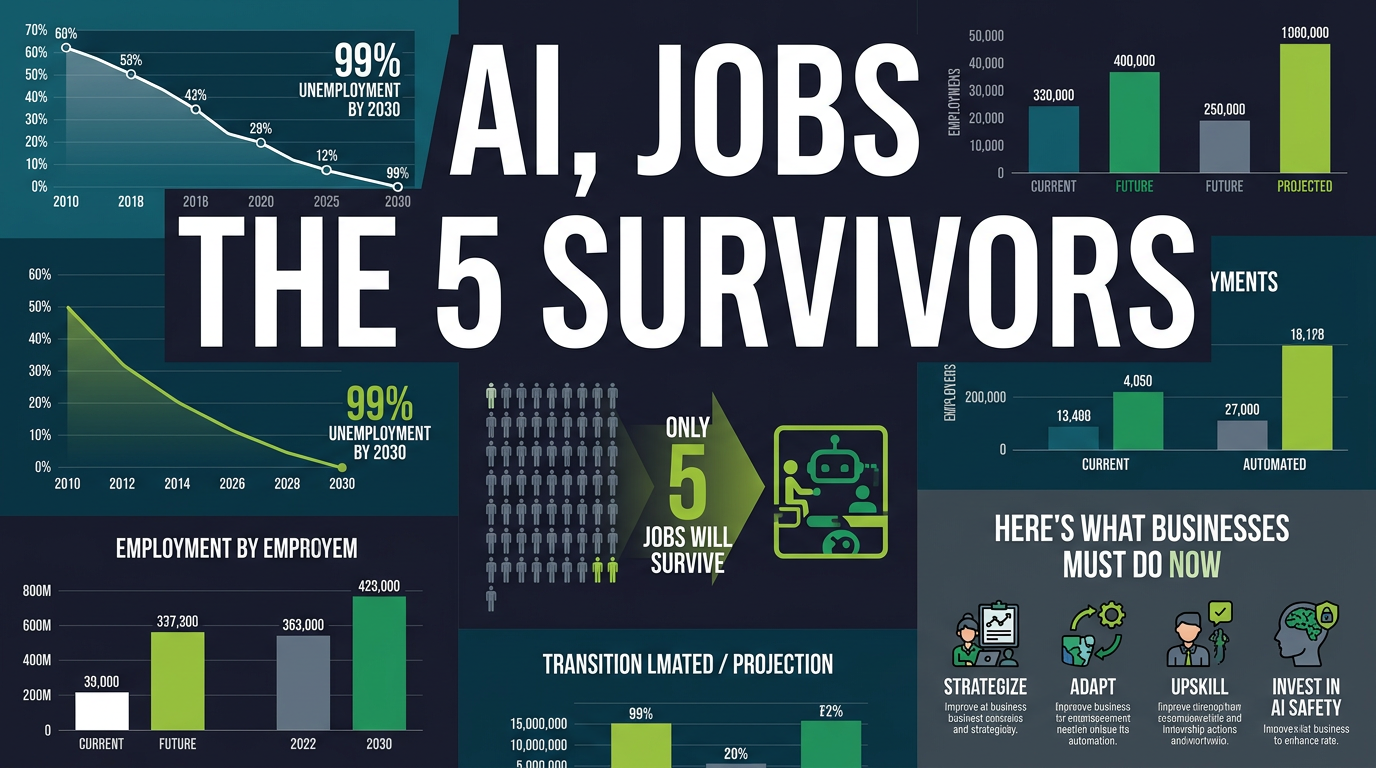
AI Safety Expert Predicts 99% Unemployment by 2030: Only 5 Jobs Will Survive – Here's What Businesses Must Do Now
Dr. Roman Yampolskiy, a leading AI safety researcher, warns that superintelligent AI could eliminate 99% of jobs within five years. In this deep dive, we explore the key insights from his chilling interview and reveal how Dooza's AI employees can help your business thrive in the age of automation.
Google’s Gemini Era: What It Means for Business Automation and Why You Need AI Employees Now
Google’s Gemini demo reveals a future where AI understands context, images, and voice seamlessly. But for businesses, the real revolution is in deploying specialized AI employees that work 24/7. Discover how Dooza’s AI workforce can turn this vision into practical automation.
Start with a refundable pilot — 100% refund within 14 days. A Dooza engineer scopes it with you on a free 30-minute call. Pricing depends on the product; see pricing.