How to Automate Lead Follow Up and Stop Losing Sales to Slow Response Times
Most leads go cold because nobody follows up fast enough. Learn how to automate lead follow up with AI so every prospect gets a timely, personalized response.
9 min read
July 8, 2026
Here is a stat that should keep every small business owner up at night: 78 percent of customers buy from the company that responds first. Not the company with the best product. Not the one with the lowest price. The one that simply showed up first.
And yet the average business takes over 42 hours to respond to a new lead. By that point your prospect has already talked to three of your competitors, bookmarked a fourth, and forgotten they ever filled out your form. If you want to stop bleeding revenue, you need to automate lead follow up — and this guide will show you exactly how.
Why Most Leads Go Cold (and It Is Not Your Product's Fault)
Let's be honest about what actually happens when a lead comes in for most small businesses:
The form submission lands in an inbox that nobody checks until after lunch.
Someone sees it, thinks "I'll get to that later," and gets pulled into a client call.
"Later" becomes tomorrow. Tomorrow becomes next week.
By the time you reach out, the lead doesn't even remember filling out the form.
This is not a people problem. Your team is not lazy. They are busy doing the work that is already on their plate. The issue is structural: manual follow-up does not scale. When you rely on humans to remember, prioritize, and execute every follow-up touchpoint, leads will always slip through the cracks. It is inevitable.
The businesses that win are not necessarily working harder. They have built systems that respond instantly and follow up persistently — without anyone needing to think about it.
The Speed-to-Lead Numbers That Should Change How You Operate
Speed to lead is not just a nice-to-have. The data on this is overwhelming and consistent across industries:
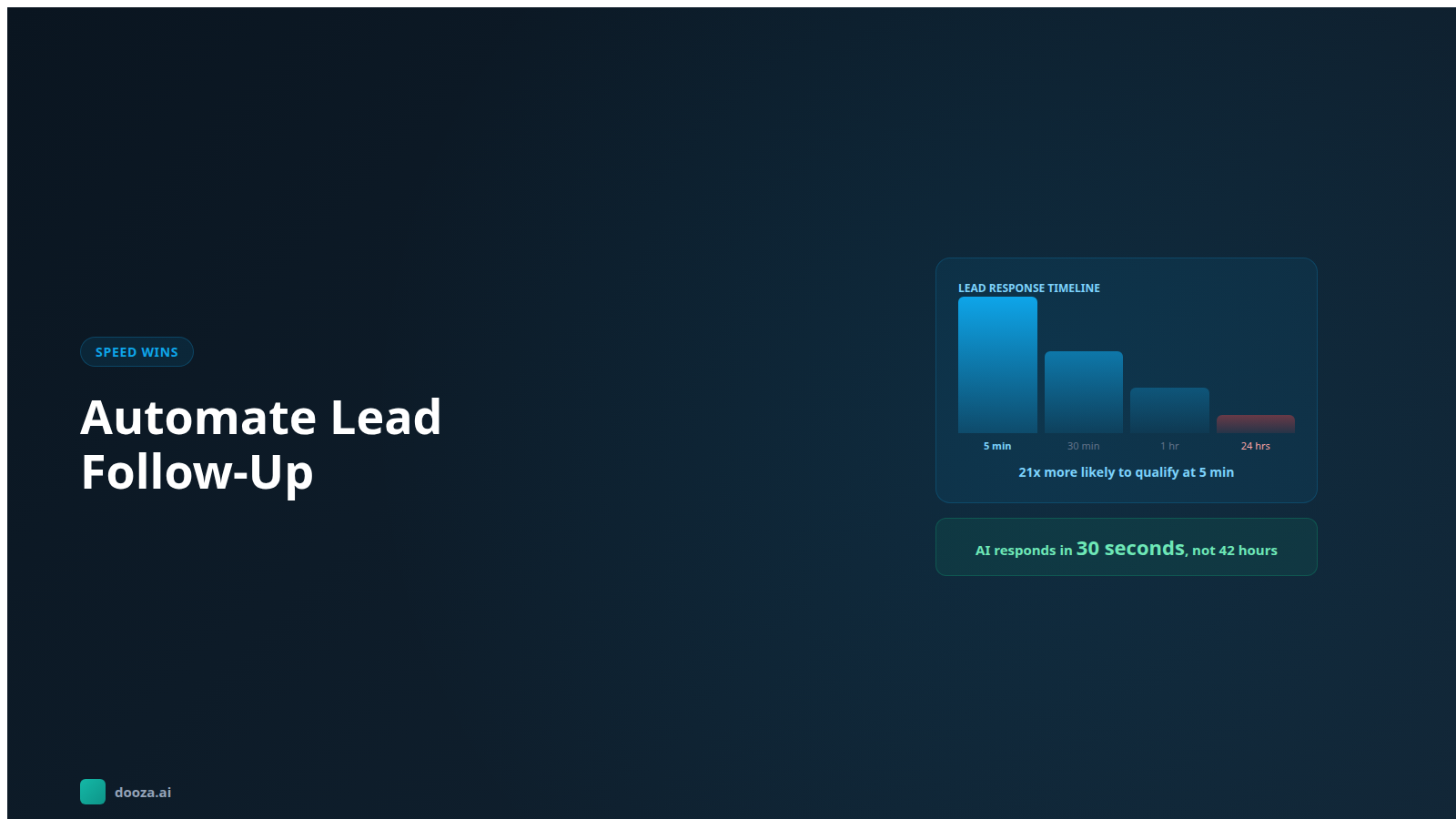
Responding within 5 minutes makes you 21 times more likely to qualify a lead compared to waiting 30 minutes (Lead Response Management Study).
After 10 minutes, there is a 400 percent decrease in the odds of qualifying an inbound lead (InsideSales.com).
50 percent of sales go to the vendor that responds first (InsideSales.com).
Companies that contact leads within one hour are 7 times more likely to have a meaningful conversation than those that wait even 60 minutes longer (Harvard Business Review).
Yet only 27 percent of leads ever get contacted at all (Forrester Research).
Read that last stat again. Nearly three out of four leads — people who actively raised their hand and said "I am interested" — never hear back. That is not a marketing problem. That is a follow-up problem. And it is exactly the problem you solve when you automate lead follow up with the right tools.
The persistence gap is just as bad
Speed is only half the equation. The other half is persistence. Research from Marketing Donut shows that 80 percent of sales require at least five follow-up contacts. But 44 percent of salespeople give up after a single attempt, and 92 percent give up before the fifth try.
So the window where deals are won — between follow-up number two and follow-up number five — is almost completely empty for most businesses. That is a massive opportunity if you can fill it.
What It Really Means to Automate Lead Follow Up
When people hear "automate lead follow up," they often picture spammy drip campaigns that blast the same generic email to everyone. That is not what we are talking about here.
Modern AI-powered follow-up is something fundamentally different:
Instant response: Within seconds of a lead submitting a form, filling out a chatbot, or sending a message, they receive a personalized reply.
Context-aware messaging: The AI references what the lead actually asked about, their industry, their company size — whatever information is available — so the message feels like a real human wrote it.
Multi-step sequences: Not just one email but a coordinated series of touchpoints over days and weeks, each with a different angle and call to action.
Smart timing: Messages go out at optimal times based on engagement data, not just when someone remembers to hit send.
Automatic handoff: When a lead replies, books a meeting, or signals buying intent, the system routes them to a human for the actual sales conversation.
The goal is not to replace human selling. It is to make sure every lead gets the consistent, timely follow-up that humans intend to do but rarely execute at scale.
How AI Follow-Up Sequences Actually Work
Let's walk through what a typical automated follow-up sequence looks like in practice. Say you run a marketing agency and someone fills out your "Get a Free Audit" form at 9:47 PM on a Tuesday.
Here is what happens without automation
You see the notification Wednesday morning. You are in back-to-back calls until noon. You draft an email after lunch but get sidetracked. Thursday you finally send it. The lead has already booked a call with a competitor who responded Tuesday night.
Here is what happens with automation
9:47 PM (instantly): The lead receives a personalized email acknowledging their request, referencing their business name, and offering two time slots for a call.
Wednesday 10:00 AM: A follow-up email lands with a short case study relevant to their industry.
Thursday 2:00 PM: A brief check-in message — "Just wanted to make sure this didn't get buried in your inbox."
Monday 9:00 AM: A different angle — perhaps a link to a relevant blog post or video with a soft CTA.
Wednesday 11:00 AM: A final message offering value and a last call to action before the sequence closes.
Each message is written in a natural, conversational tone. The lead feels like they are talking to a real person who is genuinely trying to help. Meanwhile, you did not lift a finger.
Brad Smith from AutomationLinks does a great job breaking this down in the video above. He walks through how AI can handle the entire follow-up flow from first touch to booked meeting — worth watching if you want to see this in action.
What to Look for in an AI Follow-Up Tool
Not all follow-up automation is created equal. Here is what separates tools that actually move the needle from ones that just add complexity:
Speed of first response
The tool needs to fire the first message within minutes, not hours. If it batches sends or requires manual triggers, it defeats the purpose. Look for instant or near-instant response capabilities.
Personalization beyond mail merge
Inserting a first name is not personalization. Good AI follow-up tools pull in context — what the lead asked about, their company, their role — and craft messages that feel individually written. This is where AI genuinely outperforms traditional drip campaigns.
Multi-channel capability
Email alone is not always enough. The best tools can coordinate across email, SMS, and even LinkedIn outreach to reach leads where they are most active.
Easy setup without technical overhead
If you need a developer to configure the tool, it is already too complicated for most small businesses. The best solutions are done-for-you or require minimal configuration — you describe your business, your offer, and your ideal customer, and the system handles the rest.
Clear analytics
You should be able to see open rates, reply rates, and meeting bookings at a glance. If you cannot measure it, you cannot improve it.
How Dooza Agents Automates Lead Follow Up for You
This is where most tools fall short for small businesses: they give you powerful features but expect you to build everything yourself. You end up spending weeks writing email sequences, configuring triggers, and troubleshooting integrations instead of actually talking to customers.
Dooza Agents takes a different approach. It is a done-for-you AI employee platform — meaning you get a pre-built AI worker that handles lead follow-up from day one. No sequence building. No template writing. No integration headaches.
Here is what that looks like in practice:
Instant lead response: When a new lead comes in from your website, landing page, or ad campaign, Dooza's AI employee responds within minutes with a personalized message.
Persistent multi-touch follow-up: The AI runs a complete follow-up sequence — typically five to seven touchpoints over two to three weeks — so no lead falls through the cracks.
Natural, human-sounding messages: Every email is crafted by AI that understands your business, your offer, and your target audience. No robotic templates.
Meeting booking: When a lead is ready to talk, the AI handles scheduling directly — no back-and-forth needed.
Handoff to you: Qualified, booked leads land on your calendar. You show up and close.
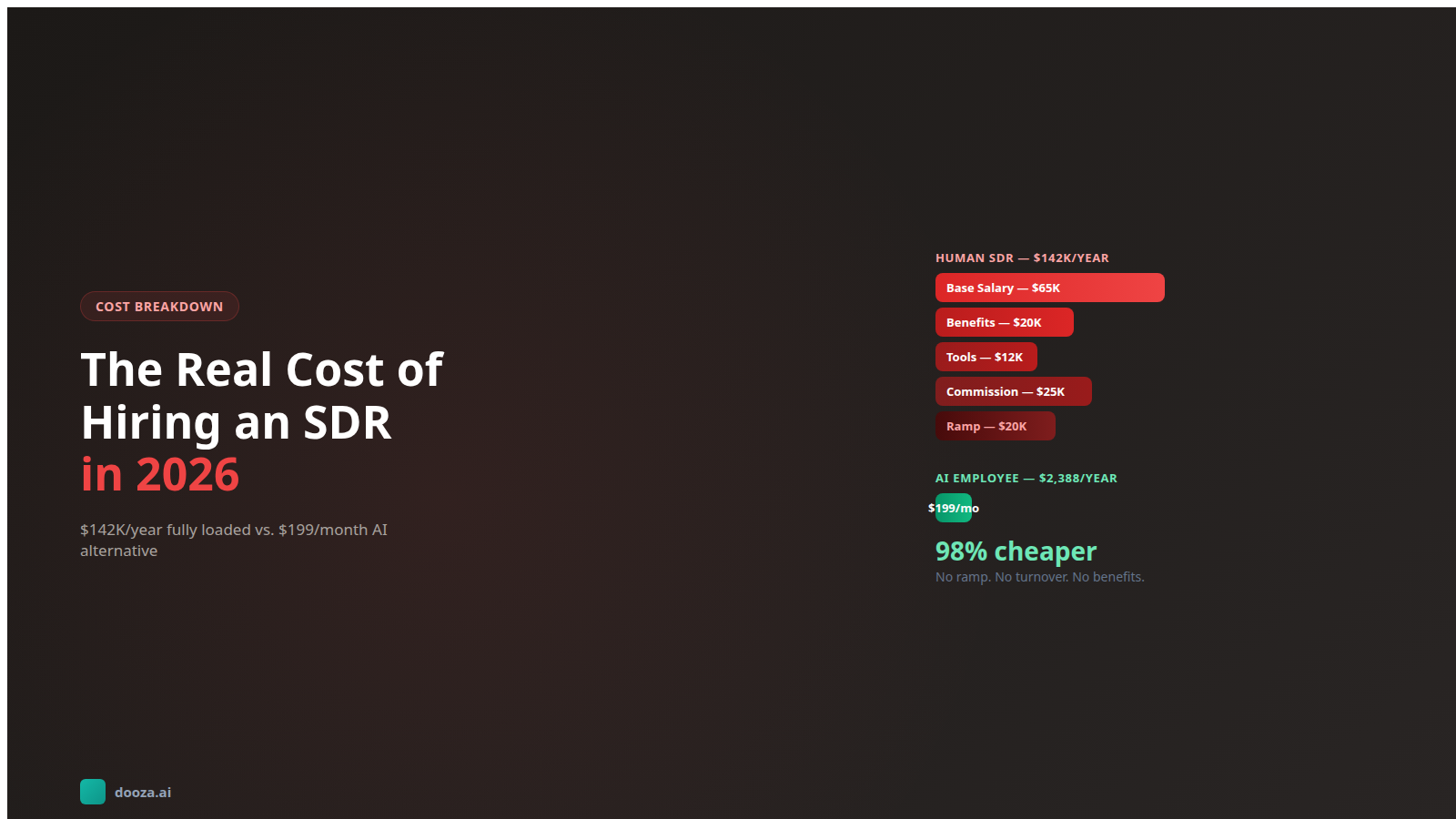
Unlike a human SDR (median US base about $55,000 a year, Bridge Group 2025), a virtual assistant paid for every hour they work, or a BPO arrangement, it has no hourly limit. And unlike a human hire, it works 24/7 without sick days, training ramps, or inconsistent performance.
Whether you choose Dooza or another tool, here is a practical roadmap to automate lead follow up for your business:
Step 1: Audit your current response time
Go back through your last 20 leads and check how long it took to respond to each one. Be honest. If the average is over an hour, you are leaving money on the table — and now you have a baseline to improve against.
Step 2: Map your follow-up sequence
Write out the ideal sequence of touchpoints you would send if you had unlimited time. How many messages? What would each one say? Over what time period? This becomes your blueprint.
Step 3: Choose your tool
If you want full control and have the time to build, look at tools like ActiveCampaign, HubSpot, or GoHighLevel. If you want it done for you so you can focus on closing deals, Dooza Agents is purpose-built for this.
Step 4: Launch and measure
Start with your highest-value lead source — the one where faster follow-up would have the biggest revenue impact. Run the automation for 30 days and measure three things: response time, reply rate, and meetings booked. Compare to your manual baseline.
Step 5: Iterate
No sequence is perfect on day one. Look at where leads drop off in the sequence and adjust messaging, timing, or the number of touchpoints. The beauty of automation is that improvements compound — once you optimize a sequence, every future lead benefits.
The businesses that grow in 2026 and beyond will not be the ones with the biggest ad budgets or the flashiest websites. They will be the ones that respond fastest and follow up most consistently. The good news is that this is no longer a staffing problem. It is a systems problem — and systems are something any business can build, starting today.
Frequently Asked Questions
What does it mean to automate lead follow up?
Automating lead follow up means using software — typically powered by AI — to automatically send personalized emails, SMS messages, or other touchpoints to new leads on a set schedule. Instead of manually remembering to follow up, the system handles the entire sequence for you, responding within minutes and continuing outreach over days or weeks until the lead replies or books a meeting.
How fast should I follow up with a new lead?
Research consistently shows that responding within five minutes of a lead coming in gives you the best chance of converting. A study by Lead Response Management found that contacting a lead within five minutes makes you 21 times more likely to qualify them compared to waiting 30 minutes. After an hour, your odds drop dramatically. This is why automation is so important — no human team can consistently respond that fast around the clock.
Can AI follow-up replace a human salesperson?
AI follow-up is best at handling the early stages of the sales process — initial response, qualification questions, appointment booking, and nurture sequences. It replaces the repetitive, time-sensitive work that most salespeople either forget or deprioritize. When a lead is qualified and ready to talk, the AI hands them off to a human for the actual sales conversation. Think of it as replacing the busy work, not the relationship building.
How many follow-ups should I send before giving up on a lead?
Data from multiple sales studies suggests that 80 percent of deals require at least five follow-up touches, yet 44 percent of salespeople give up after just one attempt. A good automated follow-up sequence should include five to eight touchpoints spread over two to four weeks, mixing different message types and angles. With automation, there is no cost to being persistent — the system handles it without any extra effort on your part.
Is automated lead follow up affordable for small businesses?
Yes. Automated follow-up tools are significantly cheaper than hiring additional staff. A dedicated SDR costs four to five thousand dollars per month, and even a virtual assistant runs two to three thousand dollars monthly. Platforms like Dooza Agents offer done-for-you AI follow-up that starts with a refundable pilot (100% refund within 14 days), making it accessible for solopreneurs and small teams who need enterprise-level follow-up without enterprise-level budgets.
Ready to Start Your Pilot?
Automate your business with AI employees that work 24/7. Start with a refundable pilot: 100% refund within 14 days.
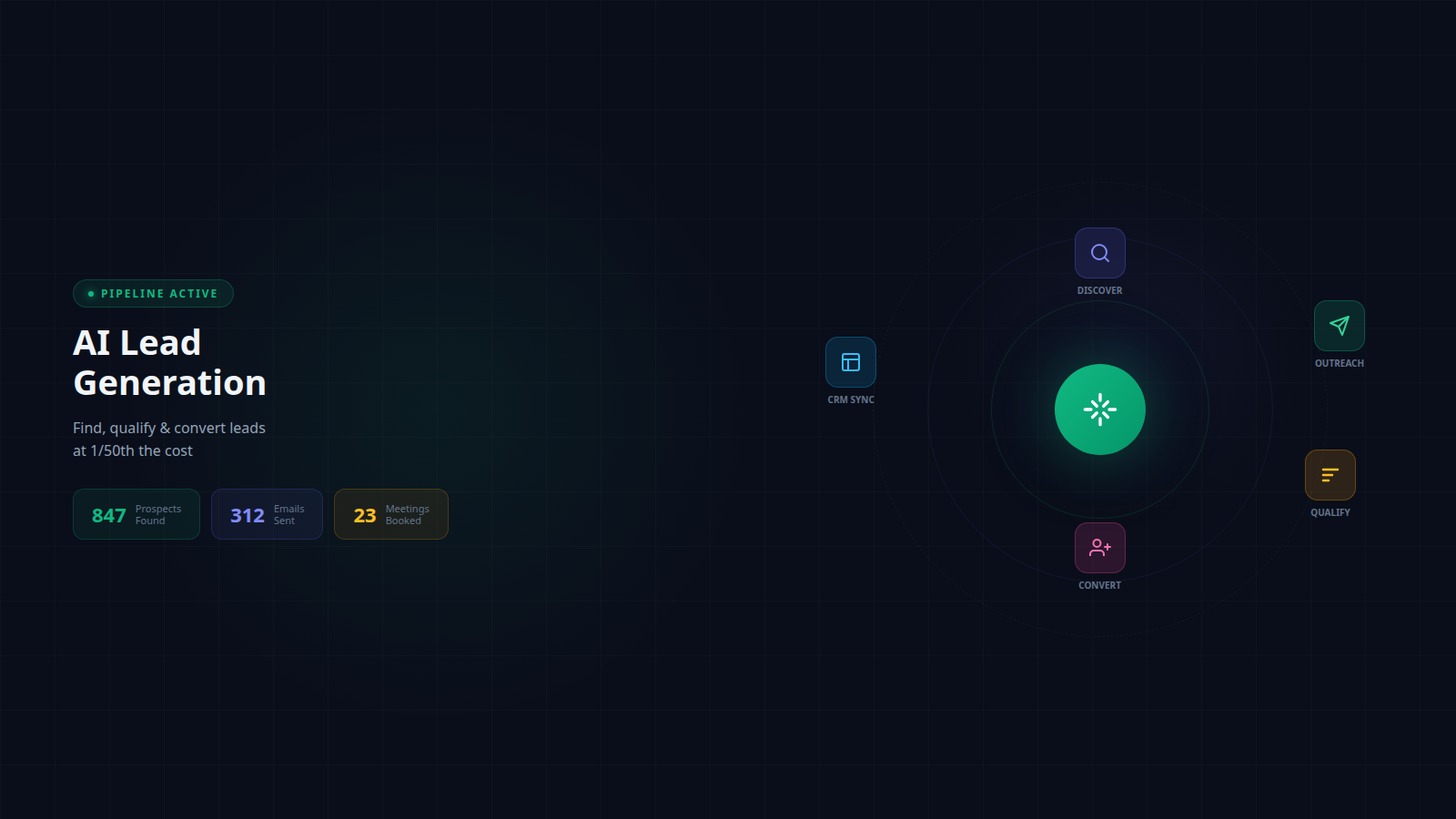
AI Lead Generation for Small Business: The Complete 2026 Playbook
How small businesses use AI to find, qualify and follow up with leads without a full sales team. Step-by-step setup, the main tools, and how to measure your own return.
The Real Cost of Hiring an SDR in 2026: Salary, Tools, and Hidden Expenses
By our estimate, hiring an SDR costs roughly $100K-$110K in year one once you add variable pay, benefits, tools, and ramp time. Sourced breakdown and a smarter alternative.
Start with a refundable pilot — 100% refund within 14 days. A Dooza engineer scopes it with you on a free 30-minute call. Pricing depends on the product; see pricing.