The Real Cost of Hiring an SDR in 2026: Salary, Tools, and Hidden Expenses
By our estimate, hiring an SDR costs roughly $100K-$110K in year one once you add variable pay, benefits, tools, and ramp time. Sourced breakdown and a smarter alternative.
14 min read
July 7, 2026
The True Cost of Hiring an SDR: Beyond the Job Posting
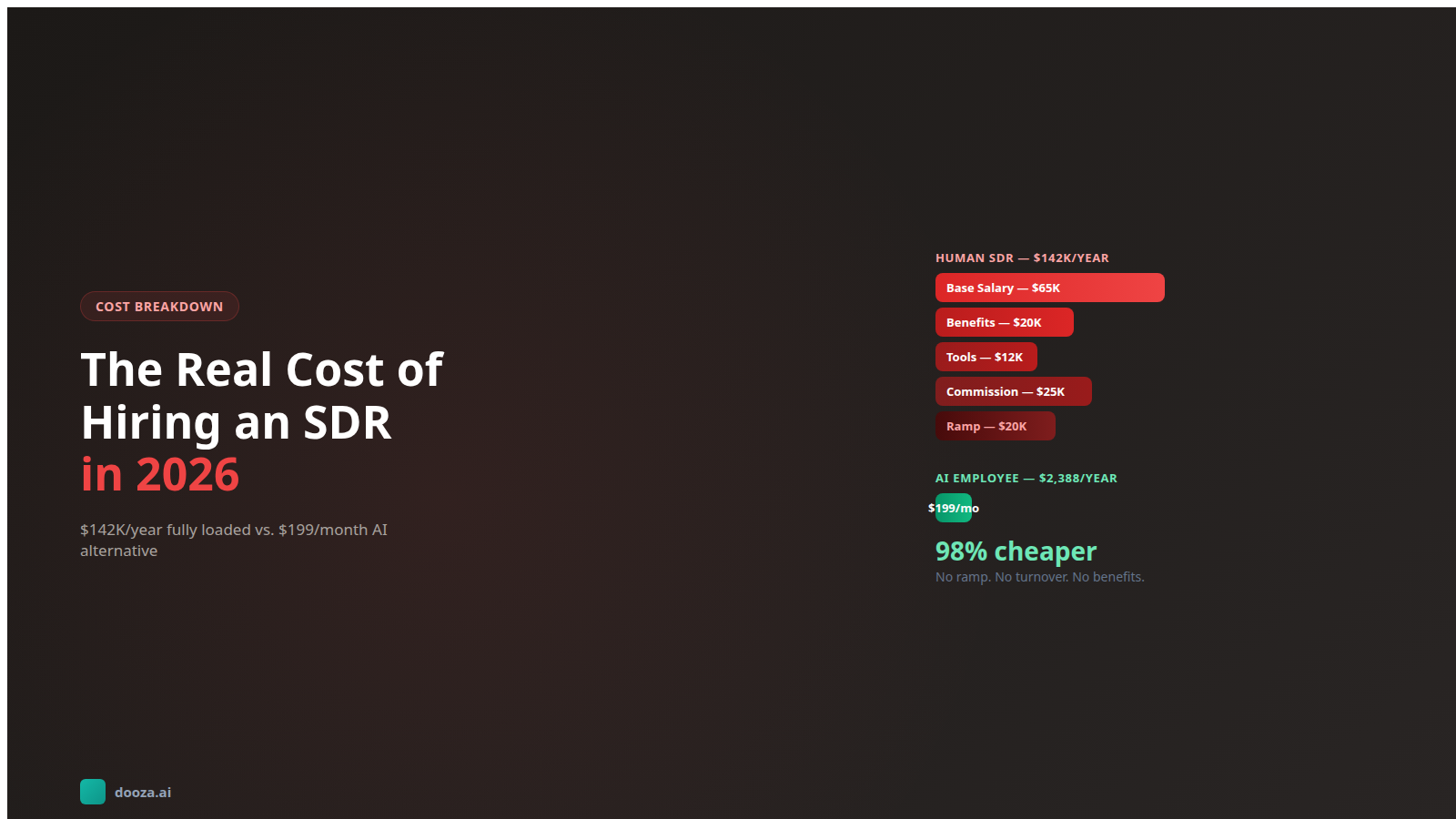
When you post a job listing for an SDR, the salary looks manageable. $55,000 base. Around $80,000 OTE. You think: "I can afford that." But the cost of hiring an SDR goes far beyond what shows up on the offer letter. Add benefits, tools, management time, ramp costs, and turnover risk, and by our estimate that hire becomes a roughly $100K-$110K first-year commitment, before they book a single meeting.
This is not an argument against hiring salespeople entirely. Great SDRs exist, and at certain stages of growth, human sales teams are essential. But for small businesses, startups, and solopreneurs who need pipeline now without the financial risk, understanding the full cost picture changes the calculus completely.
Let us break down every dollar. Figures from outside sources are linked and were checked on 2026-10-07; everything labeled "our estimate" is our own modeling.
Base Salary: About $55,000-$58,000
The Bridge Group's 2025 SDR Metrics report (351 companies) puts median SDR OTE at $80,000, with a 68:32 base-to-variable split: $55,000 base and $25,000 variable. Built In's 2026 salary page lists an average base of $57,921 and average total compensation of $83,110, with individual salaries ranging from $26K to $170K. Pay runs higher in major metros and for more experienced reps.
For this analysis, we will use a $55,000 base, the Bridge Group median.
Commission and Variable Compensation: About $25,000
Variable pay at the median is about $25,000 per year (Bridge Group), and Built In reports average additional cash of $25,189. Plans differ, but the Bridge Group's median 68:32 split means roughly a third of OTE is variable.
The catch: you pay the base whether they hit quota or not. Commission is variable, but the base salary is fixed from day one, including the roughly three months before they are fully productive. And only 60% of SDRs hit quota in the Bridge Group's latest data, the lowest rate in the study's history.
Benefits and Employment Costs: About $17,000
This is where the real cost of hiring an SDR starts to diverge from the offer letter. Our estimate, using public data:
Health insurance: about $7,900/year for individual coverage. The KFF 2025 Employer Health Benefits Survey reports an average single-coverage premium of $9,325, with workers paying 16%, which leaves the employer about $7,885.
Payroll taxes: Social Security and Medicare are 7.65% of pay (about $6,100 on $80K OTE), plus small federal and state unemployment taxes. The BLS Employer Costs for Employee Compensation table shows these legally required items alongside the rest.
Retirement and savings: about 3% of compensation on average across private employers (BLS: 3.3%), roughly $2,400 on $80K.
Workers' comp insurance: about 0.9% of compensation per BLS, roughly $700.
Paid leave: BLS puts paid leave at 7.5% of private-industry compensation. It is already inside the salary figures above, so do not add it on top, but it is output you pay for and do not get.
Our estimate: about $17,000/year in benefits and employment costs (health $7,900 + payroll taxes $6,100 + retirement $2,400 + workers' comp $700).
Sales Tools and Software: About $2,600-$3,800/year
An SDR needs tools to do their job. Using only prices we verified on vendor pages on 2026-10-07:
CRM:HubSpot Sales Hub Professional is listed at $90-$100 per seat per month (about $1,080-$1,200/year), plus a one-time $1,500 onboarding fee. Starter seats are far cheaper but limited.
Prospecting data:LinkedIn Sales Navigator Core is US$119.99/month, or US$1,079.88/year billed annually (about $1,080-$1,440/year; checked October 7, 2026).
Email sequencing:Instantly outreach plans are $47 (Growth) to $97 (Hypergrowth) per month billed monthly, or $37.60 to $77.60 per month billed yearly (about $450-$1,160/year; checked October 7, 2026).
Those three tools total roughly $2,600-$3,800/year, excluding the one-time HubSpot onboarding fee. Many teams also pay for a contact database, a dialer, and deliverability tooling, which we have not priced here, so treat this as a floor.
Equipment and Workspace: $1,500-$3,000 (our estimate)
Even for remote SDRs, you need a laptop, a headset, software licenses, and potentially a home office stipend. We estimate first-year equipment and workspace cost at $1,500-$3,000.
The Realistic Total: Year One
All figures are our estimate, built from the sourced numbers above.
Cost Category
Low Estimate
High Estimate
Base salary
$55,000
$58,000
Variable compensation
$25,000
$25,000
Benefits & employment taxes
$17,100
$17,100
Sales tools & software (three tools above)
$2,600
$3,800
Equipment & workspace
$1,500
$3,000
Recruiting costs (prorated)
$2,000
$5,000
Year One Total
$103,200
$111,900
Monthly Equivalent
$8,600
$9,325
Our model puts a mid-market SDR near $100K-$110K fully loaded in year one, assuming they earn the full variable payout. That is the real cost of hiring an SDR, not the $55K base salary on the job listing.
The Hidden Costs Most Companies Miss
The line items above are the obvious costs. But there are several hidden costs that make the true picture even more expensive. These are our estimates, not survey data.
Management Time
An SDR does not manage themselves, especially in the first six months. Someone, usually the founder or VP Sales, spends several hours per week on coaching, pipeline reviews, role-playing, and troubleshooting. If we assume 5-10 hours per week and that person's time is worth $100-$200/hour, that is roughly $2,000-$8,000/month in indirect management cost.
This is the cost nobody puts on a spreadsheet, but every founder who has managed an SDR knows it is real. Those weekly pipeline reviews, the constant Slack questions, the "can you review this email before I send it?" messages add up fast.
Training and Onboarding
Formal onboarding programs for SDRs take weeks, during which you are paying full salary for someone who is not yet producing. Add the time of whoever runs the training (usually senior reps pulled away from quota-carrying work), and onboarding carries a real cost on top of the ramp period.
Bad Hire Risk
Not every hire works out. When a hire fails, you absorb months of fully loaded cost with little to show for it, plus the cost of restarting the hiring process. The Bridge Group's finding that only 60% of SDRs are at quota shows how common underperformance is.
Opportunity Cost of Empty Seats
Between deciding to hire, posting the job, interviewing, making an offer, waiting through notice periods, and onboarding, there are typically months with no outbound activity from that seat. Whatever pipeline outbound would have produced in that window is pipeline you do not get.
The Ramp Time Problem: Paying Full Price for Partial Output
Here is a reality that SDR compensation models do not fully account for: an SDR's first quarter is essentially a training investment with limited return. The Bridge Group's 2025 data puts average ramp at 3.0 months.
Month 3: Starting to find a rhythm. Messaging improving, volume increasing.
Month 4 onward: Full ramp.
The Bridge Group reports a global median monthly quota of 10 held first meetings (Stage 0) per SDR. During the first three months you pay roughly $25,000 in fully loaded cost by our estimate, before a rep is carrying that full quota. At $8,600-$9,325 per month and 10 held meetings, a rep who exactly hits the median quota costs roughly $860-$930 per meeting, and during ramp the cost per meeting is higher.
Compare that to AI: the "ramp time" is typically the 2-3 week email warm-up period. After that, the system runs continuously. No learning curve, no sick time.
The Turnover Tax: Why SDR Tenure Kills ROI
Even if you hire a great SDR and get through ramp successfully, the clock is already ticking. In the Bridge Group's 2025 report, average SDR tenure is 1.9 years and median annual attrition is 40% (the middle half of companies range from 21% to 57%).
Think about what that means financially:
Months 1-3: Ramp period (about 3.0 months on average). Negative ROI.
Months 4-23: Productive period, if the SDR is at quota. Positive ROI.
Around month 23: The average SDR leaves. Pipeline goes cold. You start over.
That is roughly 20 productive months from the average SDR after ramp. Then you repeat the entire process: recruiting, interviewing, onboarding, ramp, and crossing your fingers that the next hire works out. With 40% median annual attrition, a typical team replaces a large share of its SDRs every year, and each replacement means another ramp period of about three months.
Why SDRs Leave
Understanding why SDRs leave explains why turnover is structural, not fixable:
Career progression: Most SDRs see the role as a stepping stone to Account Executive, and want to promote, internally or at another company, once they have enough experience.
Burnout: The SDR role is repetitive and rejection-heavy. Daily cold calls, constant email prospecting, and aggressive quotas lead to burnout faster than most sales roles.
Compensation ceiling: SDR OTE has a natural cap. Once an SDR realizes they cannot significantly increase their earnings without moving to an AE role, they move on.
Better offers: The SDR job market is competitive. A good SDR gets recruiter messages regularly. Loyalty is expensive to maintain.
You cannot solve the SDR turnover problem with perks, culture, or even higher pay. The role itself is designed to be temporary. That structural reality means your cost per SDR is always higher than it appears on paper.
The AI Alternative: What AI Outbound Gets You
Now compare that roughly $100K-$110K first-year SDR commitment to AI-powered outbound.
Here is what changes:
Factor
Human SDR
AI Outbound (Dooza Agents)
Annual cost
Roughly $100,000-$110,000 in year one (our estimate)
Pricing depends on the product; starts with a refundable pilot
Ramp time
About 3 months (Bridge Group 2025)
Typically 2-3 weeks of email warm-up
Working hours
40 hours/week
Runs continuously
Paid leave
About 7.5% of compensation (BLS, all private industry)
None needed
Turnover risk
40% median attrition per year (Bridge Group 2025)
No hiring churn
Management needed
Several hours/week (our estimate)
Lower; Dooza engineers build and maintain the agents
Personalization quality
Good (but time-limited)
Researches each prospect before writing
Follow-up consistency
Varies by rep
Sequences run automatically
Emotional state
Varies (rejection fatigue)
Consistent
The math favors automation for email-based outreach. A human SDR at roughly $8,600-$9,325 a month who hits the Bridge Group median quota of 10 held meetings costs about $860-$930 per meeting. Pricing for Dooza depends on the product, so see the pricing page and compare against your own cost per meeting.
Dooza Agents vs Hiring an SDR: Side-by-Side
Let us get specific about what Dooza Agents does and how it maps to the daily tasks of an SDR.
What an SDR Does Every Day (illustrative)
Research prospects
Write personalized emails
Send emails and manage sequences
Handle replies and follow-ups
Update the CRM
Make cold calls
Attend team meetings and pipeline reviews
What Dooza Handles Automatically
Prospect research: AI finds and researches companies matching your ICP daily, pulling data from websites, LinkedIn, job boards, and news sources. No manual research time.
Email personalization: Each email is individually crafted based on the prospect's specific situation: their company's recent activity, their role, their likely pain points. Not template-based.
Sequence management: Multi-step campaigns run automatically with optimized timing. No manual sends, no forgotten follow-ups.
Reply handling: AI reads and classifies every reply. Interested leads get meetings booked. Objections get addressed. Out-of-office replies get rescheduled. Opt-outs get honored immediately.
Meeting booking: Qualified prospects are booked directly onto your calendar. You show up and close; the AI handles the work upstream.
The only thing Dooza does not replace is the cold calling function, and for most B2B outbound programs in 2026, email and LinkedIn are generating better ROI than cold calls anyway.
With Dooza Agents, you get the prospecting and outreach work of an SDR without the hiring, ramp, turnover, or day-to-day management overhead of a new employee.
This video breaks down the real-world comparison between AI-powered outbound and traditional SDR teams, covering cost, effectiveness, and when each approach makes sense.
Bottom Line
The cost of hiring an SDR is not the $55K salary on the job posting. By our estimate it is roughly $100,000-$110,000 in the first year when you account for variable pay, benefits, tools, and recruiting, before management time and the cost of turnover (median attrition is 40% a year, per the Bridge Group). For enterprise sales teams selling $100K+ deals, that investment makes sense: you need humans for complex negotiations and relationship building. But for small businesses, startups, and solopreneurs who need consistent pipeline from email and LinkedIn outreach, the math points toward AI. Dooza Agents delivers the prospecting, outreach, and meeting-booking functions of an SDR, with no hiring ramp and no turnover risk, starting with a refundable pilot (100% refund within 14 days). Before you post that SDR job listing, run the numbers. Your budget will thank you.
Frequently Asked Questions
What is the average salary for an SDR in 2026?
The Bridge Group's 2025 SDR Metrics report puts median SDR on-target earnings (OTE) at about $80,000, split roughly 68:32 between base and variable pay ($55,000 base and $25,000 variable). Built In's 2026 salary page lists an average base of $57,921 and average total compensation of $83,110. Pay is higher in major metros and for experienced reps.
How long does it take for a new SDR to ramp up?
The Bridge Group's 2025 report puts average SDR ramp time at about 3.0 months, the lowest since 2010 (it peaked at 3.8 months in 2014). During ramp you pay full salary and benefits for partial output. By our estimate, three months of fully loaded cost is roughly $25,000 before the SDR generates meaningful pipeline.
What is the average SDR turnover rate?
The Bridge Group's 2025 report found median SDR attrition of 40% for 2024, with the middle half of companies between 21% and 57%. Average SDR tenure is 1.9 years. Each departure means recruiting a replacement and repeating the ramp period, so turnover is a recurring cost, not a one-off.
Can AI really replace an SDR?
AI can take over the prospecting, email outreach, and initial follow-up parts of an SDR's job: lead sourcing, email personalization, multi-step sequences, reply management, and meeting booking. What AI cannot replace is the human relationship building needed for complex enterprise sales, phone-based discovery calls, and real-time objection handling. For small and mid-sized businesses doing email-led outbound, AI can cover most of the SDR workflow.
Is it better to hire a fractional SDR or use AI sales tools?
Fractional SDR pricing varies by vendor and by hours, so compare quotes on a monthly basis. AI outbound runs around the clock without hour limits, and Dooza pricing depends on the product (every product starts with a refundable pilot: 100% refund within 14 days). Fractional SDRs make more sense when you need phone-based outreach or complex account-based strategies that require human judgment.
Ready to Start Your Pilot?
Automate your business with AI employees that work 24/7. Start with a refundable pilot: 100% refund within 14 days.
Start with a refundable pilot — 100% refund within 14 days. A Dooza engineer scopes it with you on a free 30-minute call. Pricing depends on the product; see pricing.