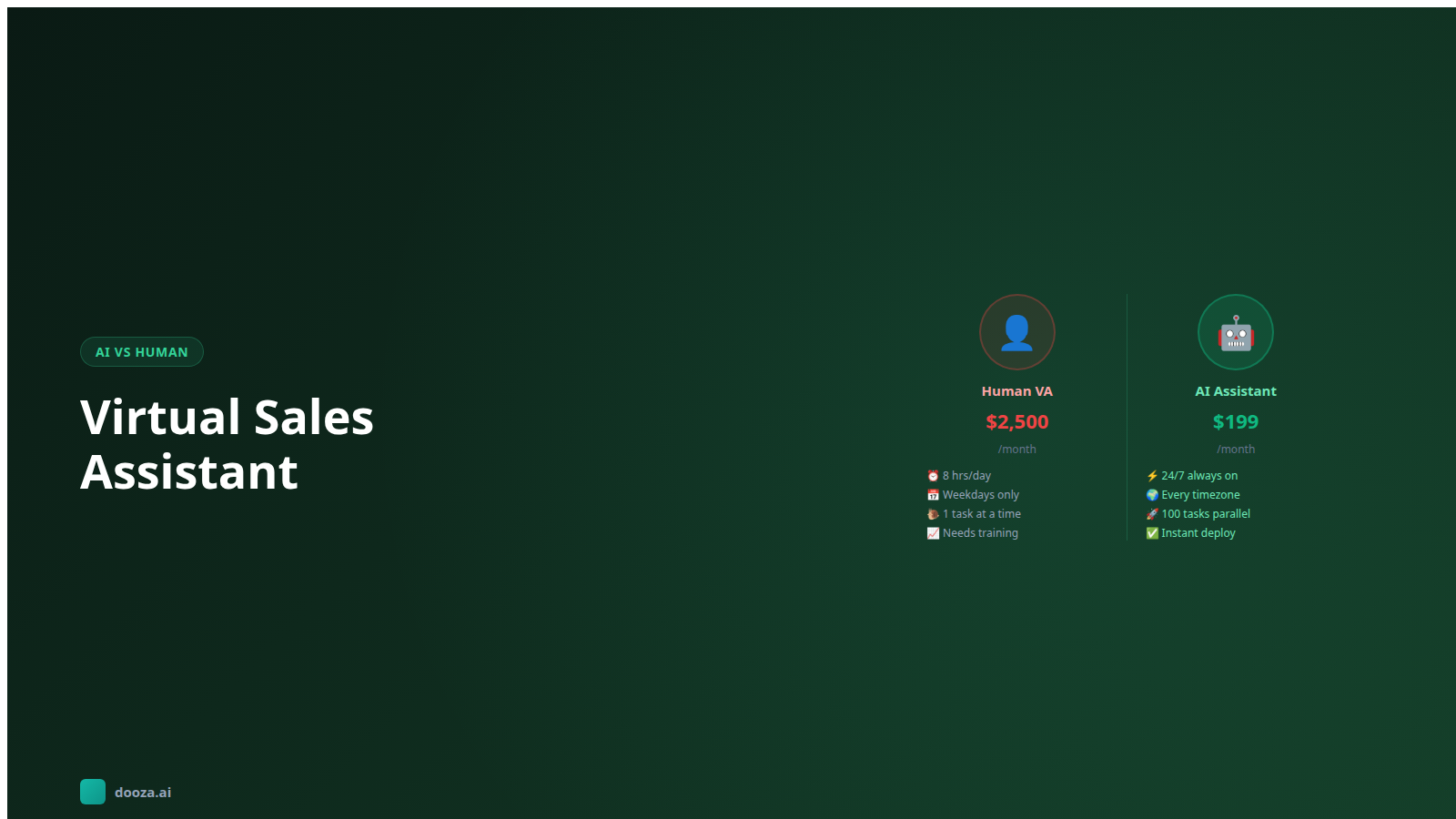
Sales
Virtual Sales Assistant: AI vs Human VAs Compared (Cost, Capability, ROI)
AI virtual sales assistants versus human VAs. Compare capabilities, limitations, and when each makes sense for your business.
13 min read
ReadSpeed to lead stats show responding in 5 minutes makes you 21x more likely to qualify a lead. Learn why most businesses fail and how AI fixes it.
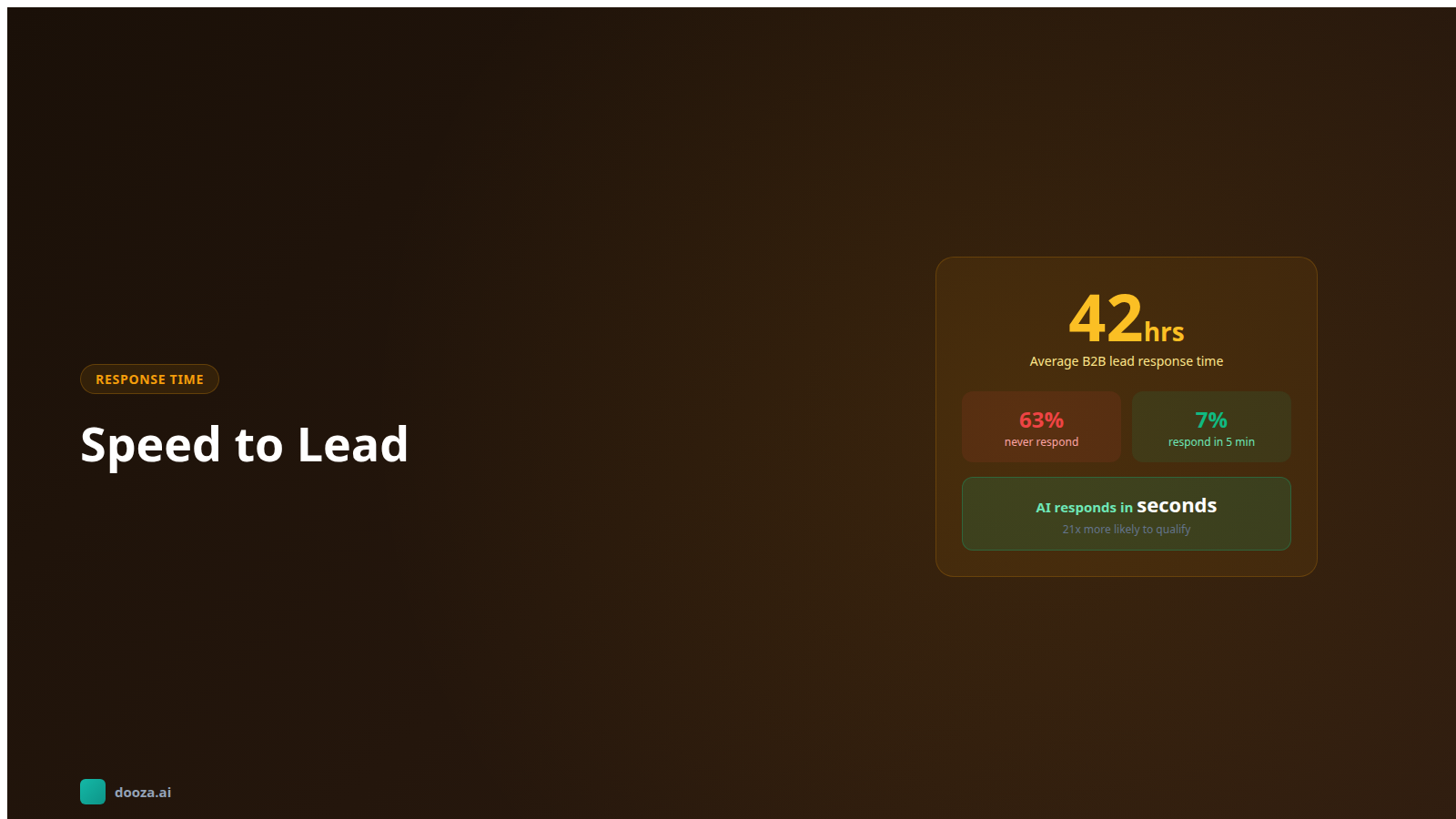
Speed to lead is the time between when a prospect takes action — fills out a form, sends an email, clicks "contact us" — and when your team actually responds. It is the single most predictive metric for whether that lead becomes a customer or disappears forever.
And most businesses are terrible at it.
Here is the uncomfortable truth: while you are "getting back to leads within the same business day" and feeling good about it, your competitors are responding in under 5 minutes. The leads that land in your inbox at 3 PM and sit there until tomorrow morning? They have already booked a demo with someone else by the time you open them.
Speed to lead is not a nice-to-have metric. It is a make-or-break number that directly determines how much revenue you capture from the demand you have already paid to generate. Every dollar you spend on ads, content, SEO, and referrals is partially wasted if your response time is too slow.
The research on lead response time is not subtle. It is brutal.
Let that sink in. If you respond to leads within 5 minutes, you are already in the top 7% of all B2B companies. The bar is absurdly low — which means the opportunity is absurdly high.
Say you generate 100 leads per month and currently convert 5% of them. That is 5 new customers. Now say your average response time is 4 hours. The data suggests that dropping to a 5-minute response time could improve your conversion rate by 3x to 5x. That is 15 to 25 new customers from the same 100 leads. Same ad spend, same marketing budget, same product — just a faster response.
If your average customer lifetime value is $5,000, the difference between a 4-hour and 5-minute response time is $50,000 to $100,000 per month in revenue. Not from more leads. From the leads you already have.
If fast response is so valuable, why do 93% of businesses fail at it? Because the problem is structural, not motivational.
A prospect fills out your contact form at 2:30 PM. You are in a client meeting until 3:30. You have 4 other items to handle when you get back. By the time you respond at 5 PM, the lead is cold. This is not laziness — it is the reality of running a business without dedicated sales coverage.
In many small businesses, lead response is everyone's job — which means it is no one's job. Sales, marketing, the founder, and support all have access to the inbox. Everyone assumes someone else is handling it. Nobody checks until the next day.
A significant portion of web inquiries happen outside business hours — evenings, weekends, holidays. Without 24/7 coverage, these leads sit for 12 to 60 hours before getting a response. By Monday morning, a Friday night lead is ancient history.
Even motivated teams hit limits. When a business grows from 10 leads per week to 50, the same manual response process breaks. People miss leads, responses get delayed, and quality drops as volume increases. The process that worked at 10 leads per week crumbles at 50.
"Thanks for reaching out! We will get back to you within 24 hours." That is not speed to lead. That is a placeholder. Auto-responders confirm receipt but do not qualify, engage, or advance the prospect. A lead who receives an auto-responder and then waits 6 hours for a real response has effectively waited 6 hours.
Improving your speed to lead does not require a complete sales overhaul. Start with these high-impact changes:
Define a maximum response time and hold your team accountable. Recommended targets:
Track actual response times and review them weekly. What gets measured gets managed.
Every lead submission should trigger an immediate notification — push notification on your phone, Slack alert, SMS message, whatever you check most frequently. Do not rely on email inbox scanning. The notification should be impossible to miss.
Pre-write responses for your 5 most common inquiry types. When a lead comes in, you grab the template, personalize the first 2 sentences, and send. This cuts response drafting from 10 minutes to 2 minutes.
One person (or system) owns lead response at all times. During business hours, that might be your sales rep. After hours, it should be an automated system. There should never be ambiguity about who is responsible for the next lead.
Do not make the prospect wait for a response and then wait again to schedule a meeting. Include a booking link in your first response. "I'd love to learn more about [their situation]. Here's my calendar — grab a time that works for you: [link]." This collapses two steps into one.
Here is the fundamental issue with human-powered lead response: humans are not always available. They sleep, eat lunch, attend meetings, go on vacation, and have bad days. AI does not.
An AI lead response system works like this:
The result: every single lead gets a meaningful, personalized response within seconds. 24 hours a day, 7 days a week, 365 days a year. No sick days, no lunch breaks, no "I was in a meeting."
Speed to lead is not about working harder — it is about removing humans from the initial response loop entirely. Dooza Agents gives you an AI employee whose only job is to make sure no lead ever waits for a response.
Here is what happens when a lead comes in with Dooza:
That is a complete speed to lead workflow — from inquiry to booked meeting — in under 2 minutes. Try doing that with a human team.
Dooza never sleeps, never misses a lead, and never takes 42 hours to respond.
Start with Dooza Agents and stop losing leads to slow response times. Or compare plans to find the right fit.
This video breaks down the research behind speed to lead, explains why response time is the most important sales metric, and shows how top performers use it to close more deals.
Speed to lead is the highest-leverage improvement most businesses can make. You have already spent the money to generate the lead. Responding in 5 minutes instead of 5 hours can multiply your conversion rate by 5x to 21x — with zero additional marketing spend. The data is clear, the math is simple, and the technology exists to make instant response the default, not the exception. Stop competing on product features and start competing on response time. The fastest response wins 78% of the time. Make sure that is you. Dooza makes every lead response instant — starting with a refundable pilot (100% refund within 14 days).
The gold standard is under 5 minutes. Buyers often choose the company that responds first, so responding within a minute or two is ideal. At minimum, aim for under 10 minutes during business hours. Any response time over 30 minutes dramatically reduces your chances of qualifying the lead.
The impact is dramatic and well-documented. Leads contacted within 5 minutes are 21 times more likely to be qualified than leads contacted after 30 minutes. After 10 minutes, there is a 400% decrease in lead qualification odds. The average B2B company responds in 42 hours, which means most businesses are leaving the vast majority of their potential conversions on the table.
Yes. AI lead response systems trigger within seconds of a form submission, email inquiry, or chat message. The AI reads the inquiry, classifies the lead, generates a personalized response, and either answers the question, books a meeting, or routes to the right person — all within 10 to 30 seconds. This is not a generic auto-responder. Modern AI generates contextual replies that address the specific question or interest the lead expressed.
Shockingly slow. A study by Drift found that the average B2B lead response time is 42 hours. Only 7% of companies respond within 5 minutes. 55% of companies take more than 5 business days to respond — or never respond at all. This means that simply responding within an hour puts you ahead of the vast majority of your competition.
Track the time between a lead's first action (form submission, email, chat message) and your first meaningful response. Do not count auto-responder confirmations — measure the first response that actually addresses their inquiry. Most CRMs can track this automatically. Review the data weekly and set alerts for any response that exceeds your target threshold. Common benchmarks: under 5 minutes is excellent, under 30 minutes is acceptable, over 1 hour needs immediate improvement.
Automate your business with AI employees that work 24/7. Start with a refundable pilot: 100% refund within 14 days.
AI virtual sales assistants versus human VAs. Compare capabilities, limitations, and when each makes sense for your business.
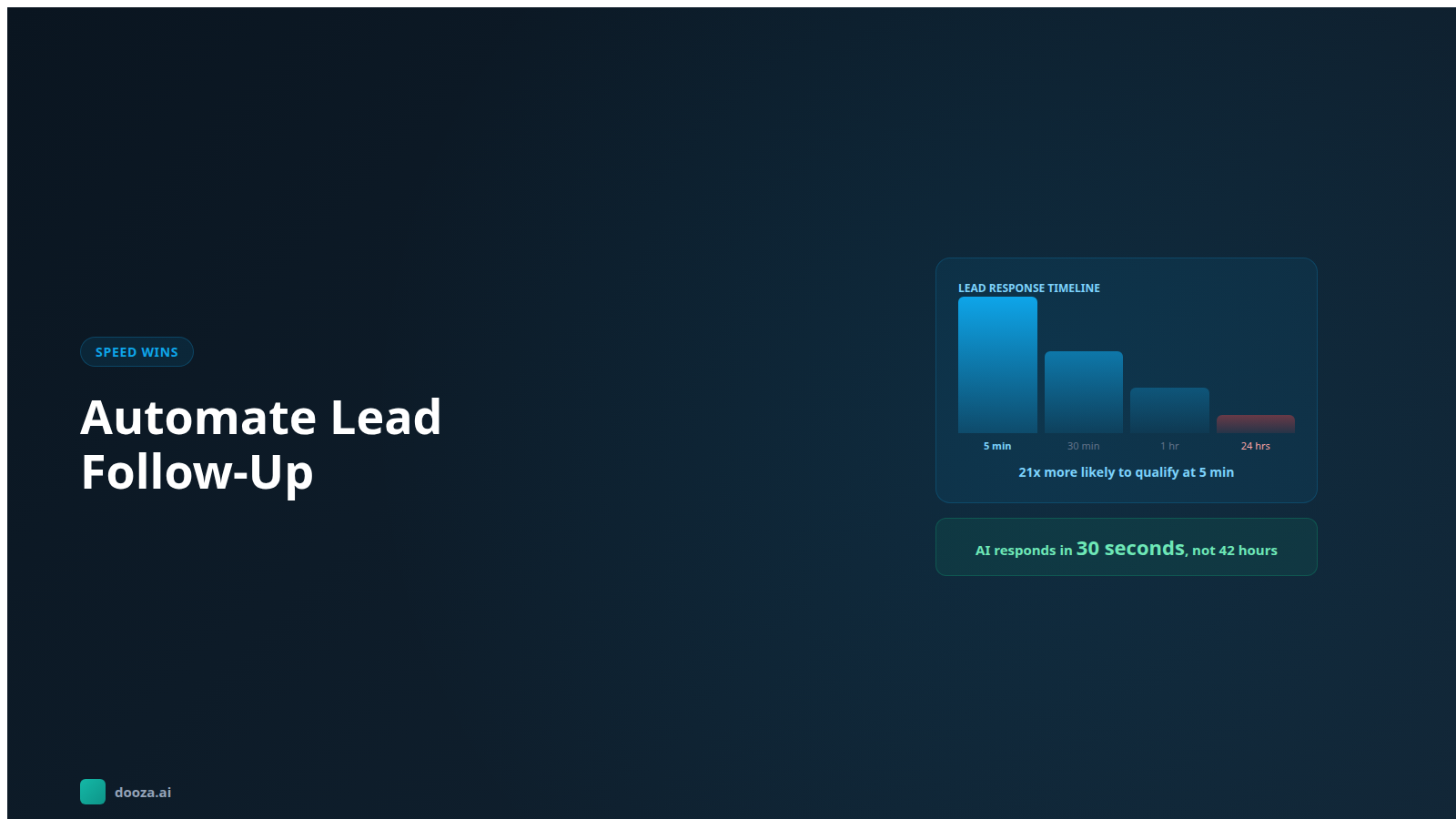
Most leads go cold because nobody follows up fast enough. Learn how to automate lead follow up with AI so every prospect gets a timely, personalized response.
Start with a refundable pilot — 100% refund within 14 days. A Dooza engineer scopes it with you on a free 30-minute call. Pricing depends on the product; see pricing.
Refundable pilot · 100% refund within 14 days · No contracts