
AI Education
Her Entire Team Was AI. Nobody Could Tell.
A founder's Slack team was secretly AI at 10 PM. The tweet went viral, and it shows how AI employees are changing small business work.
5 min read
ReadThe essential AI toolkit for marketing, digital, and creative agencies. Tools for client outreach, content, reporting, and operations at scale.
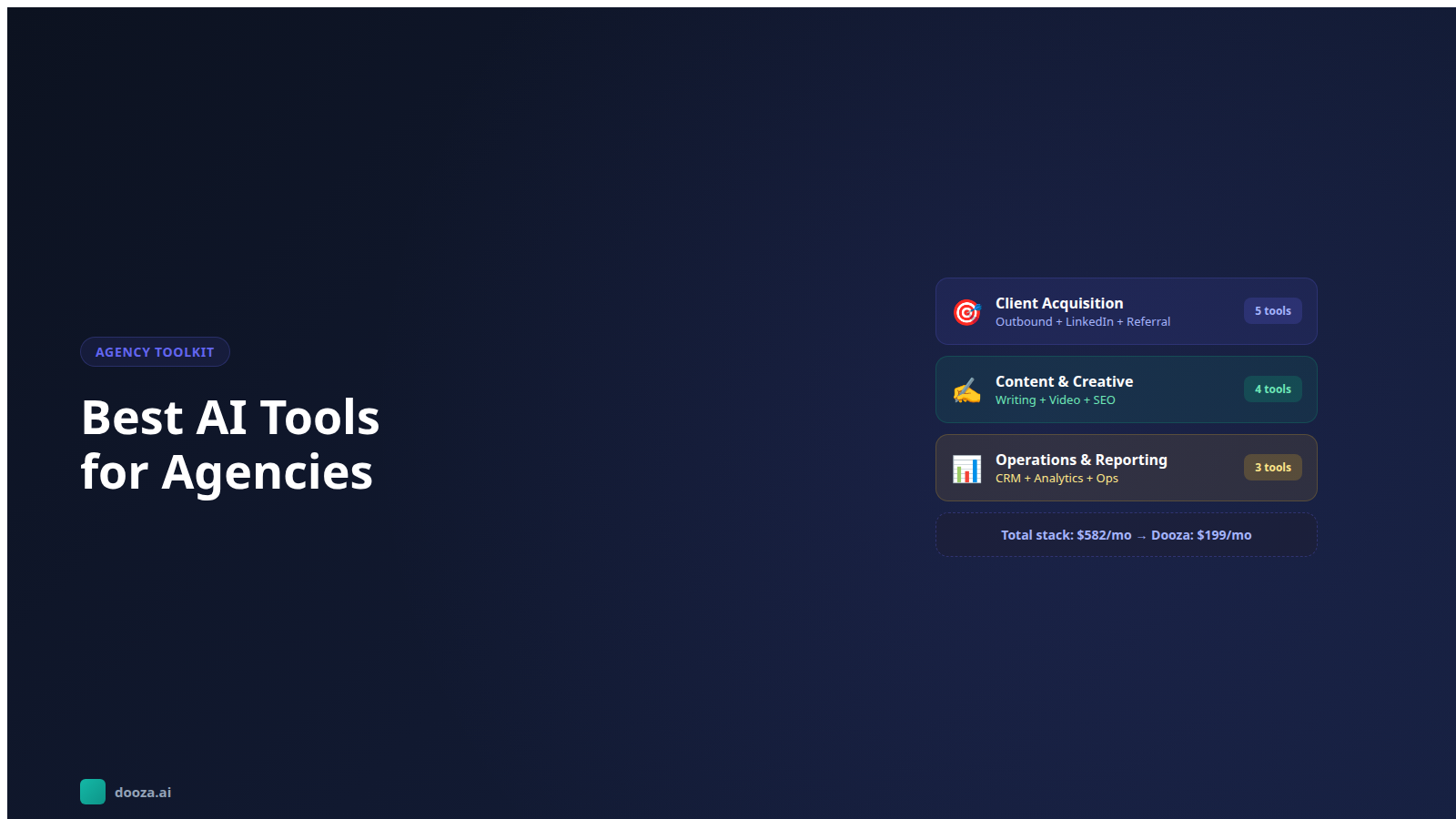
Every agency founder has heard the pitch: "AI will transform your agency." But most best AI tools for agencies lists just rehash generic tool directories without addressing how agencies actually work. Let us fix that.
Agencies face a unique set of pressures that make AI adoption both urgent and tricky:
The agencies winning in 2026 are not the ones using the most AI tools. They are the ones using the right AI tools to solve their two biggest problems: getting new clients and delivering more value to existing ones without growing headcount proportionally.
This guide covers both. We will start with the tools that bring in new business, then move to the tools that help you deliver at scale.
Let us be honest: most agencies are terrible at their own marketing. The cobbler's children have no shoes. You build growth systems for clients all day, then have zero time to prospect for your own business. AI changes that equation.
The fastest path to new agency clients in 2026 is AI-powered outbound. Instead of waiting for inbound leads (which requires months of content marketing), you proactively reach companies that match your ideal client profile.
Here is how it works for agencies:
This approach generates 10-30 qualified discovery calls per month for agencies that implement it well. At an average agency deal size of $3,000-$10,000/month retainer, even 2-3 closed clients from AI outbound pays for the entire AI stack for the year.
LinkedIn remains the primary platform where agency buyers (CMOs, VPs of Marketing, founders) spend time. AI tools can automate LinkedIn engagement: connection requests, post engagement, DM sequences, and content creation.
Tools like Taplio, AuthoredUp, and Shield help with LinkedIn content strategy. For outreach, Expandi and Dripify handle automated connection and messaging sequences. The best approach combines LinkedIn visibility (content) with LinkedIn outreach (DMs) — your content warms up prospects before your DM arrives.
A word of caution: LinkedIn is aggressive about detecting automation. Keep daily actions low (20-30 connection requests, 50-80 profile views) and make sure your messages are genuinely personalized. Mass-connecting with generic pitches will get your account restricted.
Referrals are the highest-converting lead source for most agencies (40-60% close rate vs. 10-20% for cold outreach). AI can systematize what most agencies leave to chance:
Content production is where most agencies first adopt AI — and where the mistakes are most visible. Here is what works and what to avoid.
Claude, ChatGPT, Gemini — the foundational LLMs. Every agency should have team access. Use them for first drafts, brainstorming, research summaries, and client-specific content adaptation. None of them produce publish-ready content for demanding clients, but they speed up first drafts.
Jasper — built specifically for marketing teams. Templates for ads, emails, landing pages, and social posts. Brand voice settings ensure consistency across clients. Best for agencies managing high-volume content for multiple brands.
Writer — enterprise-focused AI writing platform with strong brand governance features. Useful for agencies managing content for large clients with strict brand guidelines.
The honest assessment: AI writing tools are excellent for volume work (social posts, email variations, product descriptions, blog drafts) and poor for thought leadership, strategic narratives, and creative concepts that require genuine insight. Use them to handle the 80% of content that is functional, and invest human time in the 20% that needs to be exceptional.
Midjourney and DALL-E — AI image generation for concepts, mood boards, social graphics, and content imagery. Midjourney produces higher-quality results for most agency use cases but requires Discord-based workflows (or their new web app).
Runway, Pika, and Kling — AI video generation tools. Useful for social video content, explainer clips, and client presentations. Quality has improved dramatically but still works best for short-form content rather than full production videos.
Canva AI — Canva's built-in AI features handle bulk design tasks: resizing for social platforms, generating design variations, removing backgrounds, and creating templates. For agencies that produce high-volume social content across multiple clients, Canva's batch features save hours.
Surfer SEO, Clearscope, MarketMuse — AI-powered content optimization that analyzes top-ranking content and provides real-time guidance on topical coverage, keyword usage, and content structure. Essential for agencies that deliver SEO content.
Semrush and Ahrefs (with AI features) — both platforms have integrated AI for keyword clustering, content briefs, and competitive analysis. If your agency does SEO, you already use one — make sure you are leveraging the AI features added in the last year.
MentionAgent — for the link side of SEO delivery, MentionAgent runs blogger outreach as an agent: it finds relevant posts, looks up the author, writes the pitch and follows up, so an agency can add link building for a client without adding headcount, from $99 a month.
This category is underrated but delivers some of the highest ROI for agencies. Operations and reporting are the work nobody wants to do but everybody needs done.
Monthly reporting is a margin killer. A typical agency spends 4-8 hours per client per month building performance reports. Multiply by 15 clients and that is 60-120 hours — basically a full-time employee doing nothing but reports.
AI reporting tools can cut this to 30 minutes per client:
ClickUp, Monday.com, and Asana — all three have added AI features for task creation, project planning, and workload management. ClickUp's AI is particularly strong for agencies because it generates subtasks from briefs, suggests timelines based on historical project data, and writes task descriptions from high-level requirements.
Motion — AI-powered calendar and task manager that automatically schedules work around meetings and deadlines. Useful for agency teams juggling multiple client deliverables.
Ignition (formerly Practice Ignite) — automates proposals, engagement letters, and billing. AI helps generate scope documents from meeting notes.
Qwilr and PandaDoc — AI-assisted proposal builders. Generate proposal drafts from brief descriptions, with automatic pricing tables and interactive elements. Agencies report 40-50% reduction in proposal creation time.
The mistake most agencies make: buying too many AI tools at once, overwhelming the team, and abandoning all of them within three months. The better approach is sequential adoption based on your biggest constraint.
Start here: AI outbound for client acquisition. Nothing else matters if your pipeline is empty. One AI outreach tool generating 10-20 discovery calls per month will have more impact on your agency than every other AI tool combined.
Recommended stack: Outbound platform (Dooza, starting with a refundable pilot) + LinkedIn content tool (Taplio, $49/month). If you close 2-3 at $5,000/month retainer, the ROI is immediate.
Start here: AI content and creative tools. Reduce the time your team spends on first drafts, design variations, and routine content production.
Recommended stack: Claude Team ($30/user/month) + Canva Pro ($13/user/month) + Surfer SEO ($89/month) = ~$200/month for a 3-person team. Expected output: faster first drafts and design production.
Start here: Automated reporting and project management. Free up the hours your team spends on reporting and administrative work.
Recommended stack: AgencyAnalytics ($79/month) + ClickUp with AI ($12/user/month) = ~$115/month. Expected output: less time on monthly reporting, and project setup from client briefs.
| Category | Tool | Monthly Cost | Primary Use |
|---|---|---|---|
| Client acquisition | Dooza | Refundable pilot | Outbound prospecting and meeting booking |
| Taplio | $49 | Content creation and engagement | |
| AI writing | Claude Team | $90 (3 users) | Content drafts, research, analysis |
| Design | Canva Pro | $40 (3 users) | Social graphics, presentations, video |
| SEO | Surfer SEO | $89 | Content optimization |
| Reporting | AgencyAnalytics | $79 | Client dashboards |
| Project management | ClickUp | $36 (3 users) | Task and project automation |
| Total | Dooza + $383 |
Dooza plus about $383/month in tools for an AI stack that handles client acquisition, content production, design, SEO, reporting, and project management. Compare that to the salaries and benefits of hiring the 2-3 people these tools replace.
Client acquisition is the tool category with the most immediate revenue impact for agencies. You can survive with mediocre reporting tools. You cannot survive without new clients.
Here is the problem most agencies face: they know outbound works, but they never have time to do it consistently. When delivery is heavy (which is most of the time), business development stops. Then a client churns, and suddenly everyone panics and starts prospecting. By the time the pipeline refills, another client churns. The cycle never ends.
Dooza Agents breaks this cycle by running agency outbound on autopilot:
At a 20-30% close rate and a $3,000-$10,000 average retainer, even a handful of extra discovery calls a month adds meaningful MRR. Every Dooza product starts with a refundable pilot — 100% refund within 14 days.
See pricing and start your first campaign.
This video covers the complete AI toolkit for agencies — from client acquisition to fulfillment to operations — with recommendations based on agency size and specialty.
The best AI tools for agencies in 2026 are not the flashiest — they are the ones that solve your two fundamental challenges: getting clients and delivering great work efficiently. Start with the tool that addresses your biggest constraint. For most agencies, that is client acquisition — because nothing else matters when the pipeline is dry. Dooza handles agency outbound with personalized, research-backed outreach that runs whether your team is deep in client work or not. Layer in content, design, and reporting tools as you grow. The goal is not to use the most AI — it is to use the right AI to scale your agency without scaling your headcount at the same rate.
Marketing agencies in 2026 need AI tools across four categories: client acquisition (outbound, lead gen), content creation (copy, images, video), client reporting (automated dashboards, insights), and operations (project management, time tracking, invoicing). The specific tools depend on agency size and specialty, but the essentials are an AI outreach platform for new business, an AI writing tool for content production, and an AI reporting system for client communication.
Agencies can use AI to automate their entire new business pipeline. AI tools research prospective clients based on the agency's ideal client profile, craft personalized outreach emails referencing specific challenges the prospect faces, manage multi-step follow-up sequences, and book discovery calls automatically. Platforms like Dooza handle this end-to-end — finding, contacting, and booking meetings with ideal prospects without the agency needing to manage individual prospecting tools.
AI will not replace agency strategists, creative directors, or client relationship managers. What it will replace is the repetitive execution work: writing first drafts, researching competitors, generating social posts, building reports, prospecting for new clients, and sending follow-up emails. The agencies that thrive will use AI to handle execution volume while their humans focus on strategy, creative direction, and client relationships — the work that AI cannot replicate.
Most agencies can build an effective AI toolkit for $300-$800 per month. This covers outreach automation ($100-$200), content generation ($20-$100), reporting automation ($50-$150), and productivity tools ($50-$100). The ROI threshold is straightforward: if a $500/month AI stack saves 40 hours of employee time and generates 2-3 new client leads per month, it pays for itself many times over. Start with the highest-impact tool first (usually outreach for growth or content for fulfillment) and add others as you prove ROI.
For agency lead generation specifically, done-for-you platforms outperform DIY tool stacks because agencies are time-poor. Dooza handles prospect research, personalized outreach, follow-up, and meeting booking automatically — which is ideal for agencies that cannot dedicate staff to business development. For agencies that prefer more control, the combination of Apollo (data) + Instantly (sending) + Clay (enrichment) works well but requires 8-12 hours per week of management time.
Automate your business with AI employees that work 24/7. Start with a refundable pilot: 100% refund within 14 days.
A founder's Slack team was secretly AI at 10 PM. The tweet went viral, and it shows how AI employees are changing small business work.
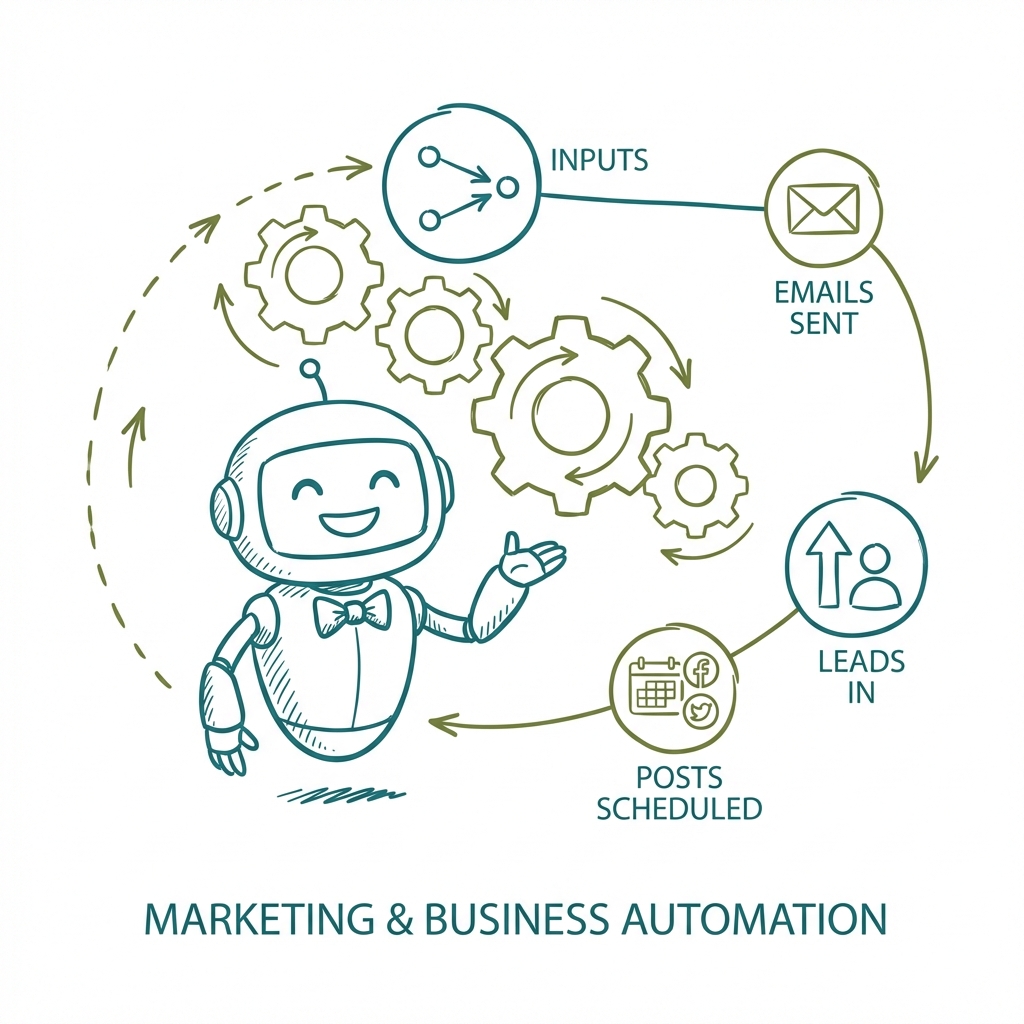
Compare the best email automation tools for small businesses and see why Dooza wins for inbox triage, smart replies, lead follow-up, pricing, and full business automation.
Start with a refundable pilot — 100% refund within 14 days. A Dooza engineer scopes it with you on a free 30-minute call. Pricing depends on the product; see pricing.
Refundable pilot · 100% refund within 14 days · No contracts