AI Automation
5 Proven Ways AI Employees Save Small Businesses 20+ Hours/Week
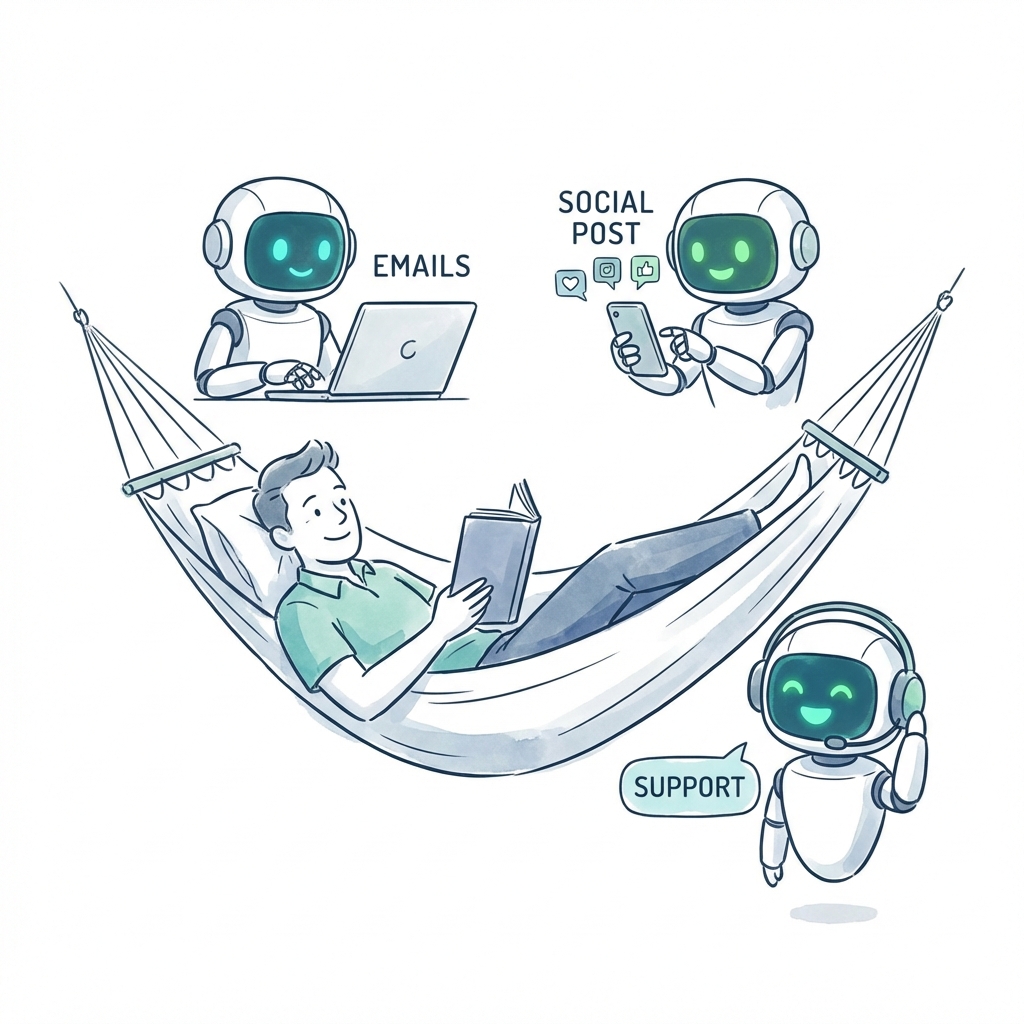
Discover how AI-powered employees are helping small businesses automate their daily operations, from email management to social media posting.
7 min read
ReadDiscover how chatbots in hr can automate hiring, streamline onboarding, and free your team to focus on strategic growth and employee experience.
Imagine an HR department that never sleeps, working tirelessly around the clock. Picture it fielding questions from a candidate in Tokyo at 2 AM, guiding a new hire through benefits enrollment at 6 AM, and instantly answering a current employee's question about PTO on a Saturday afternoon. This isn't a futuristic fantasy; it's the reality that chatbots in HR are creating for businesses right now, freeing your team to do their most important work.
Think of an HR chatbot as a powerful extension of your team, a new, always-on HR assistant that never gets tired or takes a day off. These intelligent bots are designed to master the routine, repetitive questions and tasks that bog down your human experts. By handling this administrative load, they provide instant, 24/7 support to candidates and employees, no human intervention required.
The real magic, the dream you've been sold about AI, is what happens next. When your team is freed from the constant barrage of administrative work, they can finally escape the quicksand of paperwork and predictable queries. Imagine your HR professionals shifting their focus to what truly matters: designing impactful career development programs, strengthening company culture, and creating strategic plans that drive the business forward. They get to be the human part of Human Resources again.
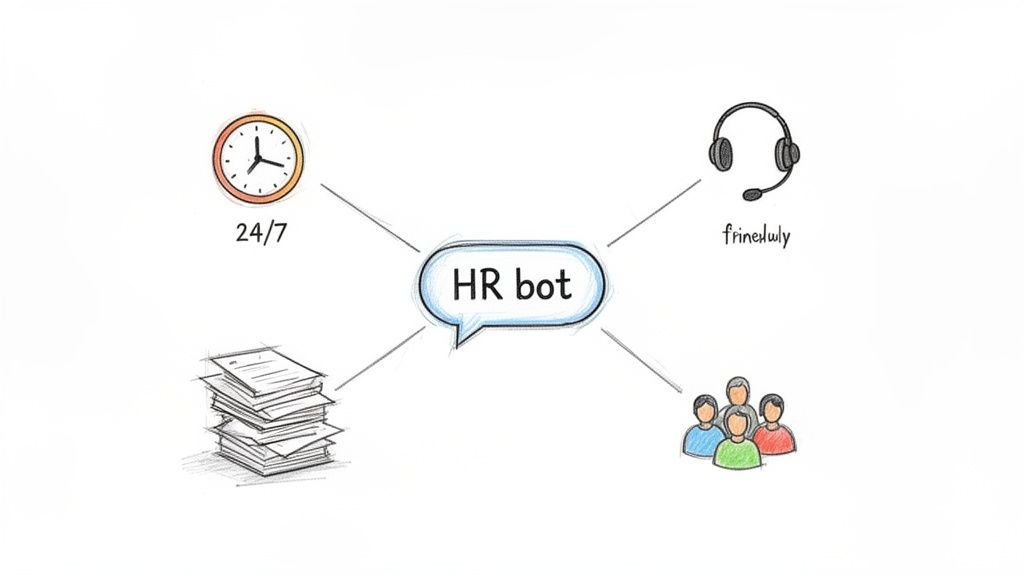
At its core, the promise of chatbots in HR is a dream of effortless efficiency. They are your intelligent digital assistants, tirelessly taking on the high-volume, predictable work, letting your team off the hook for good.
What does that look like in practice? A chatbot can:
By automating these foundational tasks, you're not just saving a few hours. You are building a scalable, responsive organization that delivers a superior experience for both candidates and employees from day one. You're creating the dream of a frictionless HR process.
The tedious, administrative tasks fade into the background, and your team is empowered to build a fantastic place to work. The technology handles the "what" and "how," freeing up your people to focus on the "who" and "why." You can see how this automated orchestration works in practice by learning more about how to hire AI employees to handle these tasks for you.
The hunt for top talent is fiercer than ever. Unfortunately, many HR teams are stuck in administrative quicksand—sifting through mountains of resumes, answering the same candidate questions over and over, and wrestling with interview schedules. These tasks eat up the day, leaving little time for the human-to-human connection that actually matters.
Now, let's paint a different picture. Imagine a top-tier candidate landing on your careers page at 10 p.m. on a Tuesday. Your office is dark, but they aren't met with silence. Instead, an intelligent chatbot greets them, acting as their personal guide through the first steps of the application process. This is how you gain an unfair advantage in the talent market.
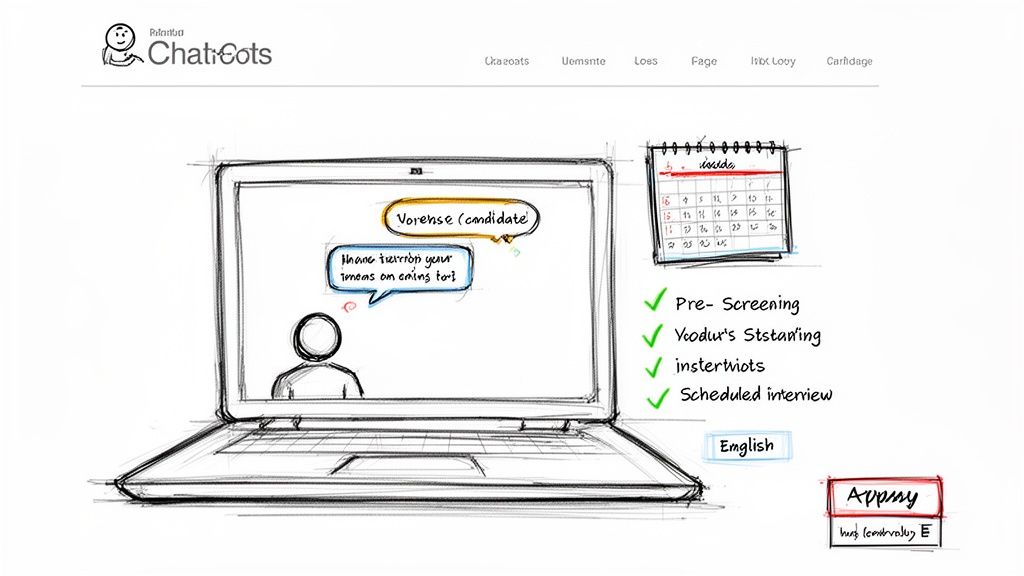
Think of a recruiting chatbot as your tireless, front-line screener that works 24/7, never needing a coffee break. It engages applicants the moment they show interest, asking key pre-qualifying questions you’ve set for the role. For example, for an engineering role, it might ask, "How many years of experience do you have with Python?" This simple step ensures that only the best-fit candidates make it to the next stage, saving your team from drowning in a sea of unqualified resumes.
The automation dream doesn't stop there. Once a candidate passes the initial check, the chatbot handles all the tedious logistics seamlessly. It can:
This glorious automation frees your recruiters from playing calendar Tetris. They can finally step away from the administrative grind and focus their energy where it counts: building genuine relationships with exceptional people. They transform from coordinators into true strategic partners.
In a tight job market, the candidate experience can make or break your hiring success. A clunky, slow, and impersonal process is a surefire way to lose great applicants to companies that move faster. Chatbots fix this by offering instant engagement and support, day or night.
This is the dream: a talent pipeline that practically runs itself. Your recruiting engine is always on, attracting and engaging the best candidates while your team focuses on high-value conversations and closing top talent.
The results speak for themselves. Career sites that use chatbots see 95% more leads, 13% more clicks on job postings, and a staggering 40% jump in completed applications. It’s clear these tools act like magnets for talent. By automating the very first steps of the journey, you create a positive impression from the get-go, positioning your company as modern and genuinely focused on the candidate. You can also integrate better application forms into this workflow to make data collection even smoother.
Let’s be honest: a new hire's first day can be a make-or-break moment. A disorganized, paper-shuffling mess leaves them wondering if they made the right choice. But a smooth, welcoming, and well-organized start? That builds confidence and loyalty from the get-go. HR chatbots are the secret to delivering that flawless first day, every single time.
Imagine your new team member's first interaction isn't a mountain of paperwork but a friendly digital welcome from their personal onboarding assistant. This bot is their go-to guide, ready 24/7 to answer any question without making them feel like they're interrupting someone. For example, at 9 PM the night before they start, they can ask, "What's the dress code?" and get an instant answer, easing their first-day jitters. It’s a frictionless transition from candidate to confident employee, powered by smart automation.
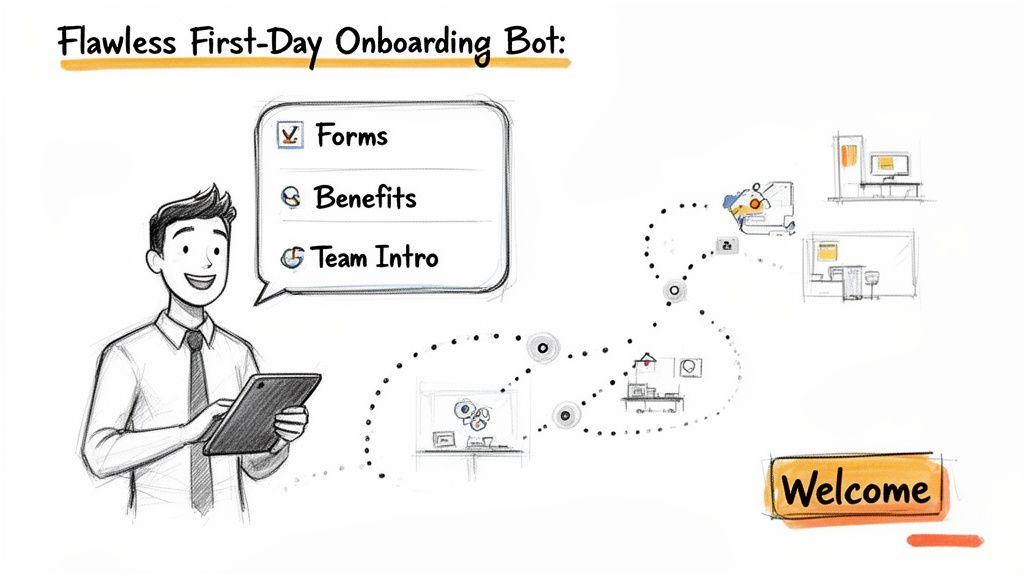
Think of an onboarding bot as a dedicated concierge for every new employee. Its entire job is to remove the friction and anxiety of starting a new role by proactively walking them through all the essential first steps. This frees up your HR team and hiring managers to focus on what really matters—building a genuine human connection and making the new person feel like part of the team.
This automated assistant can expertly handle tasks like:
This is the dream of perfect consistency. Every single new hire gets the same high-quality, welcoming experience. Human error is eliminated, no critical steps are missed, and you create a solid foundation for their long-term success.
Beyond just ticking off tasks, HR chatbots serve as an instant knowledge base. They empower new hires to find information on their own instead of feeling hesitant to bug a busy manager with what might feel like a silly question.
A chatbot can answer common queries in a heartbeat:
This immediate access to information helps new employees feel self-sufficient and capable from day one. By automating these routine questions, you give your managers and HR staff their most valuable resource back: time. They can reinvest that time in meaningful one-on-one check-ins, thoughtful team introductions, and strategic planning. Suddenly, onboarding is no longer a logistical headache. It’s a strategic tool for boosting retention and engagement.
Let's be honest, simple HR questions can bring productivity to a grinding halt. Seemingly small queries like, "How much vacation time do I have left?" or "Where do I submit my expense report?" add up fast. They create a constant stream of interruptions that pulls your HR team away from the work that really matters.
Imagine getting all that time back. A chatbot can become your ultimate internal helpdesk—an always-on, instant-answer engine that lives right where your team works, like Slack or Microsoft Teams. This one change can shift your HR function from a reactive service desk into a proactive, strategic force. This is the dream of a fully liberated HR team, freed from the shackles of repetitive support tickets to finally focus on building a better workplace, boosting employee engagement, and nurturing top talent.
The old way is painfully slow. An employee has a question, shoots an email to HR, and then… waits. On the other end, an HR team member has to drop what they're doing, dig up the information, and type out a reply. It's a bottleneck for everyone.
Now, picture this automated dream: an employee asks the bot a question directly in their chat app. The AI employee instantly pulls the correct information from your company's knowledge base and delivers a perfect answer in seconds.
This kind of instant self-service empowers your team and gets rid of frustrating delays. They get the information they need to get on with their day, and your HR team is no longer the gatekeeper for routine facts. If you're looking to apply similar automation to your customer support, our guide on the best Gorgias alternatives has some great ideas.
The dream is an HR department that scales effortlessly. By automating the internal helpdesk, you give every employee a personal HR assistant. They feel supported, and your human team can finally focus on the high-impact initiatives that move the company forward. This isn't just about efficiency; it's about building a better employee experience from the ground up.
Adopting new technology is one thing, but proving its worth is what really matters. When it comes to chatbots in HR, you need to look past the novelty and focus on concrete, measurable results. This is how you show that automation isn't just another line item on the budget—it's a powerful engine for efficiency and a smarter way to work.
Think about it. What if your recruiters could slash the time they spend on administrative busywork by 40%? That’s more time they can spend actually talking to top-tier candidates and building relationships. By tracking the right Key Performance Indicators (KPIs), you can draw a straight line from your chatbot implementation to real business outcomes. This data is what turns a cool new tool into an undeniable strategic asset.
To really nail down the success of your HR chatbot, you need to get into the numbers. These metrics tell a clear story about time saved, costs cut, and employee experiences made better.
Here are the critical areas to focus on:
Hard numbers are essential, but don't discount the less tangible benefits that can reshape your entire workplace culture. These are the improvements that boost morale, strengthen your employer brand, and create an environment where people want to work. When your HR team is free to focus on people instead of paperwork, everyone wins.
The impact of chatbots in HR is undeniable. Data shows that 62% of employees now rely on these tools, with AI slashing contract processing times by 88% and signature processing by 80%. These chatbot efficiency gains show just how much time automation is giving back to HR teams.
This shift empowers your HR professionals to step out of administrative roles and become true strategic partners in the business. And on a related note, if you're looking to attract top talent, you might also be interested in how AI can optimize your company's ranking signals.
Bringing automation into your HR department can feel like a massive undertaking, but it doesn't have to be. The key is to think smart, not big. Forget the idea of a massive, company-wide overhaul right out of the gate. The most successful teams start small, prove the value, and build from there.
This isn't about flipping a switch and changing everything overnight. It's a practical roadmap to free your team from the daily grind of repetitive questions and administrative busywork, allowing them to focus on what really matters: your people.
First things first, you need to find the biggest time sinks. Where are the administrative black holes that consume your team's day? The goal here is to find a quick win—a single, solvable problem that will deliver immediate and obvious value.
Think high-volume, low-complexity. These are the perfect candidates:
By focusing on one specific pain point, you can run a pilot program that shows a clear return on investment without disrupting the entire department. This initial success is the fuel you'll use to make the case for expanding automation.
The whole point is to connect your efforts to real business outcomes, which is what this flow illustrates.
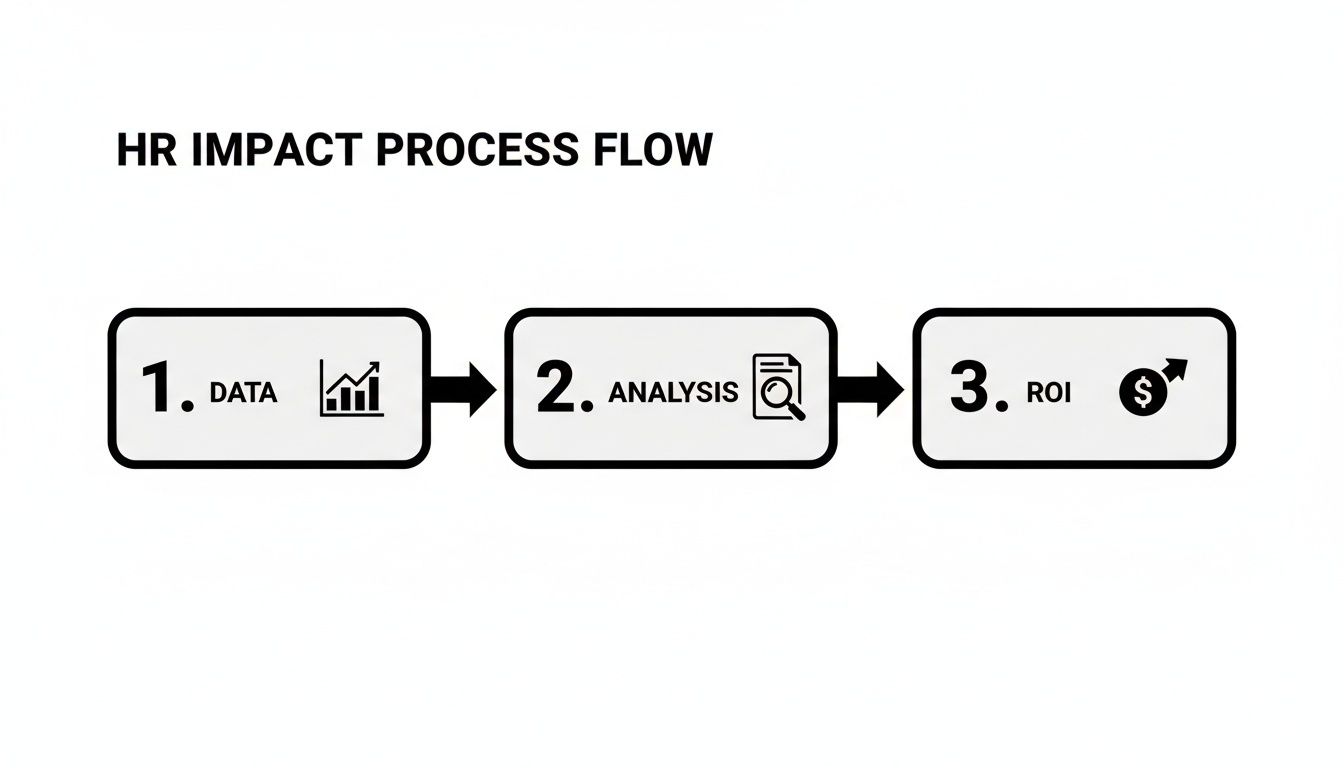
Following this model ensures you're not just adding tech for tech's sake; you're proving its value every step of the way.
Once you know where you’re starting, it’s time to find the right tool for the job. You'll want a platform that plays nice with the systems you already rely on, like your Human Resource Information System (HRIS) or Applicant Tracking System (ATS). Seamless integration is non-negotiable—it's what makes true automation possible.
This isn't some niche trend, either. In North America, 68% of HR departments are already using tools like chatbots in HR. This isn't just about big corporations; startups and scaling companies are getting on board to gain a competitive edge. In fact, 70% of mid-to-large enterprises have already seen a jump in their operational efficiency from these tools. You can dig deeper into this in an in-depth analysis of AI trends in HR.
With your technology selected, it's go-time. Launch your pilot program. The key here is to train the bot with your company's actual documents—the employee handbook, benefits guides, and policy PDFs. You want it to sound like it belongs to your company, not some generic robot.
Make sure you communicate the "why" to your team. Explain how this new tool will make their lives easier, and actively ask for their feedback.
Once you’ve nailed that first project and have the results to show for it, you can start to scale. Use what you've learned to expand automation across the entire employee lifecycle, from the very first contact with a recruit all the way through offboarding. This methodical, step-by-step approach is how you build a smarter, more efficient organization where HR gets to focus on people, not paperwork.
It’s completely normal to have questions when you start thinking about HR automation. This is a new way of working, after all, and it's smart to get a handle on the details before you jump in. Let's tackle some of the most common concerns we hear from businesses considering chatbots in HR.
The goal here isn't just about efficiency for its own sake. It’s about building a more responsive, supportive workplace and empowering your team to do their best work.
This is the big one, and the answer is a firm no. The point isn't to replace your HR professionals but to elevate them.
Think of a chatbot as the ultimate HR assistant—one that never sleeps and can handle the endless stream of repetitive questions that clog up your team's day. Imagine it handles 50 questions about your vacation policy in a single morning. This frees your human experts to focus on the complex, high-value work that truly requires their skills and empathy.
With the administrative load lifted, your team can finally dedicate their time to:
Chatbots don't replace your team; they amplify their impact, turning them from administrators into genuine strategic partners.
Security is non-negotiable, and any serious HR chatbot platform is built on that foundation. They come packed with enterprise-grade security features like end-to-end data encryption, strict access controls, and full compliance with major privacy laws like GDPR. When you're evaluating options, always make their security credentials a top priority.
A well-designed chatbot can actually create a more secure and auditable trail for sensitive information than old-school methods like scattered emails or paper forms.
You might be picturing a massive IT project, but modern chatbot platforms are surprisingly user-friendly. Most offer no-code or low-code interfaces, letting you build out conversations using simple drag-and-drop tools.
Training the bot is often as easy as uploading your existing employee handbooks and policy documents. For example, you can upload a 50-page benefits guide, and the bot can learn to answer specific questions from it in minutes. Ongoing maintenance usually just means updating its knowledge base as things change and checking in on its performance to see what you can improve. Yes, there's an initial setup, but the time it saves you down the road is enormous.
Ready to hire an AI employee to automate your HR tasks and free up your team for strategic work? Dooza provides AI employees that integrate with your tools, collaborate with each other, and work alongside your human colleagues. Start building your automated team today.
Automate your business with AI employees that work 24/7.
Discover how AI-powered employees are helping small businesses automate their daily operations, from email management to social media posting.
![AI Agents vs Agentic AI — What Nobody Tells You [2026]](/blog/ai-agents-vs-agentic-ai.png)
Confused by the jargon? We break down the differences between Generative AI, AI Agents, and Agentic AI in simple terms.
Join thousands of companies using Workforce to automate their work. Get started for free today.
No credit card required · 7-day money-back guarantee · Cancel anytime