Automation
Automate Business Processes: Save 25 Hours/Week (No Code)
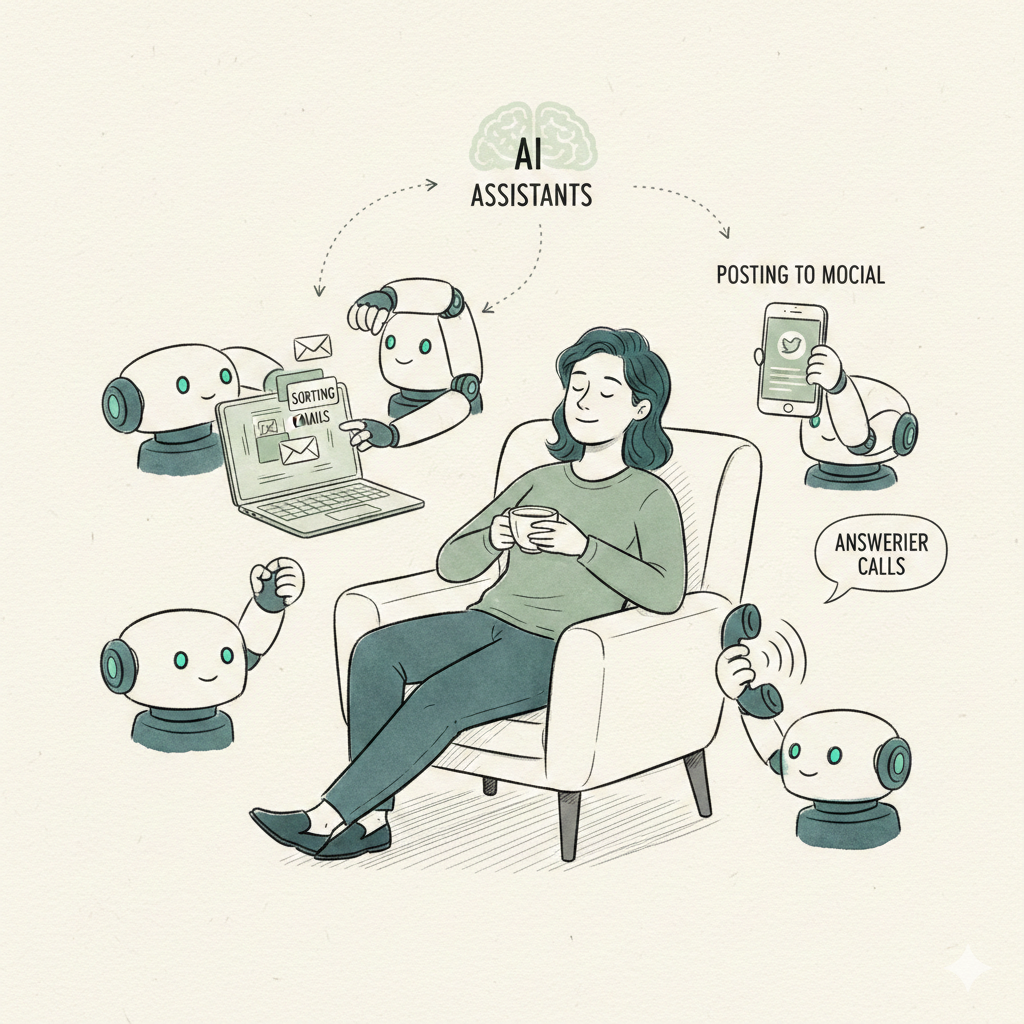
McKinsey says 60% of tasks are automatable. Learn how to automate email, social media, inbound calls, and lead follow-up without coding.
14 min read
ReadLearn how to scale your business without hiring staff. Use AI employees for outreach, lead gen, support, and more.
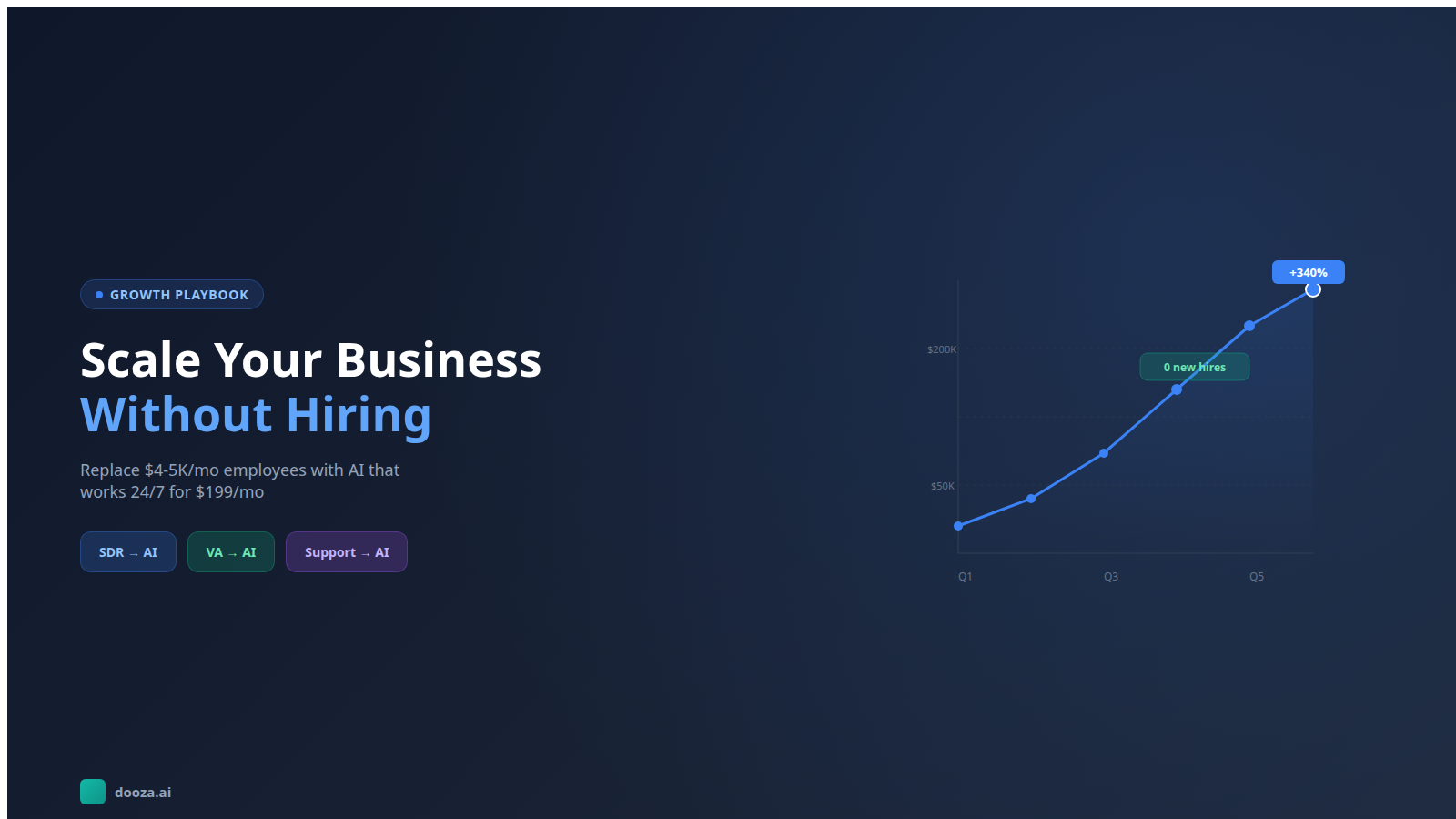
Every founder hits the same wall. Revenue is growing, the workload is doubling, and the instinct is to hire. Post the job listing, screen 200 applicants, run interviews, negotiate salary, onboard for six weeks, and hope the person works out. But there is another path. Learning how to scale a business without hiring has become one of the most valuable skills a founder can develop in 2026.
This is not about being cheap. It is about being strategic. The businesses growing fastest right now are not the ones with the biggest teams. They are the ones that figured out which work belongs to humans and which work belongs to AI employees. That distinction changes everything.
The old playbook was simple: more revenue means more people. Need more leads? Hire an SDR. Need faster support responses? Hire a support agent. Need someone to manage your inbox, post on social, update the CRM, and send follow-up emails? Hire a virtual assistant.
The problem is that every hire comes with a multiplication effect. One employee means payroll, benefits, management overhead, tools, training, sick days, turnover risk, and the emotional weight of being responsible for someone's livelihood. For a small business doing $20K-$50K per month, hiring three people suddenly adds a fixed monthly payroll cost that does not flex with revenue.
The new playbook flips this. Instead of hiring by default, you ask a different question: can AI do this task at 80% or better quality, with 100% consistency, at 5% of the cost? If the answer is yes, you deploy an AI employee. If the answer is no, you hire a human. That filter alone changes your scaling trajectory.
Consider what happened in the last three years. AI went from writing mediocre paragraphs to researching prospects, personalizing cold emails, qualifying leads, booking appointments, answering support tickets, posting content, and managing follow-up sequences. These are not experiments anymore. They are production-grade workflows running inside real businesses.
Founders often underestimate the true cost of a hire. Here is what an SDR actually costs when you count everything (a US SDR’s median base salary is about $55,000 a year before commission and benefits, Bridge Group, 2025):
The real cost is well above the base salary once you factor everything in. And that is for one role. If you need outreach, support, and admin, you are looking at several salaries in team costs before the business generates a single new dollar of revenue.
Virtual assistants can look cheaper than a full-time hire, but the hidden costs show up differently. Time zone challenges, communication overhead, training documentation, quality inconsistency, and the constant context-switching of managing someone asynchronously. The "cheap" hire often becomes the most expensive in terms of your attention.
An AI employee platform like Dooza Agents does not cost a salary plus benefits. It does not call in sick, does not need onboarding, does not churn after 14 months, and handles multiple roles simultaneously. Even if AI handles just three of the five roles you were planning to hire for, the savings compound:
Those savings are not theoretical. They are the difference between a business that is profitable at $30K/month in revenue and one that needs $60K/month just to break even.
The term "AI employee" sounds like marketing language until you see what it means in practice. An AI employee is a system that does a defined job, uses real tools, follows a process, and produces a measurable output. Here is what that looks like across the most common roles:
A human SDR spends their day finding prospects, writing emails, sending follow-ups, qualifying responses, and booking meetings. An AI SDR does the same thing:
A good human SDR sends 40-60 personalized emails per day. An AI SDR sends 500+ with equal or better personalization. See dooza.ai/pricing for what an AI SDR costs.
Virtual assistants handle the operational tasks that keep a business running: inbox management, scheduling, data entry, CRM updates, report compilation, and follow-up tracking. An AI VA handles:
Customer support is one of the most natural fits for AI employees. Most support volume is repetitive: order status, return policies, how-to questions, billing inquiries, and troubleshooting common issues. An AI support agent resolves 60-80% of tickets without human involvement, escalating only the complex cases that need a real person.
Not every role can be automated, but these five are ready right now. Businesses are already running them in production with measurable results.
This is the highest-ROI replacement. A single AI outreach employee can prospect, personalize, send, follow up, and book meetings across hundreds of leads per day. The output is meetings on your calendar. See dooza.ai/pricing for the cost.
Measure it by reply rate, meetings booked and cost per meeting, and compare that cost with your paid advertising.
Missed follow-ups are the silent revenue killer. Most sales take several follow-ups, yet many reps stop after one. AI never forgets to follow up. It sends the right message at the right time, every time.
If your support team answers the same 20 questions repeatedly, AI handles that volume instantly. Response times drop from hours to seconds. Customer satisfaction stays the same or improves because answers are faster and more consistent.
Consistency is the hardest part of content marketing for small businesses. AI employees create, schedule, and post content across platforms on a daily cadence. No more "I forgot to post this week" moments.
From welcome sequences to re-engagement campaigns, AI handles the entire email lifecycle. It writes, personalizes, schedules, and optimizes based on engagement data. This replaces both the VA who manages email and the copywriter who drafts it.
Scaling with AI employees is not an all-or-nothing move. The smart approach is phased. Start with one role, prove it works, then expand.
List every task in your business that happens more than once a week. Mark each one: does it require human creativity and judgment, or is it following a process? The process-driven tasks are your AI employee candidates.
For most small businesses, the first AI hire should be outreach or support. These roles have the clearest ROI and the most structured workflows.
Pick one role and set it up. Connect the tools (email, CRM, calendar), define the workflow, set approval rules for anything customer-facing, and let it run. Monitor the output closely for the first week. Adjust the instructions based on what you see.
Review the results. How many emails sent? How many replies? How many meetings booked? How many support tickets resolved? Compare the output and cost to what a human hire would have delivered. The numbers usually make the decision obvious.
Once the first workflow is stable, add another role. If you started with outreach, add support. If you started with support, add lead generation. Each AI employee you deploy is one human hire you do not need to make.
Dooza Agents is built specifically for businesses that want to scale without building a large team. Starting with a refundable pilot (100% refund within 14 days), you get AI employees that handle the roles most businesses hire for first:
The difference between Dooza and assembling your own AI tool stack: Dooza is done-for-you. You do not need to connect six different tools, write integration code, or become an automation expert. You describe what you need, connect your accounts, and the AI employees get to work.
Compare the cost: hiring an SDR, a VA and a support agent means three people paid for every hour they work. See Dooza Agents pricing for what handling those repeatable tasks with AI costs.
Start with Dooza Agents and scale your business without a single hire.
Yes. Many businesses scale to $500K+ in annual revenue without full-time employees by using AI employees for outreach, lead generation, customer support, scheduling, and follow-ups. The key is automating repeatable processes and only hiring humans for work that genuinely requires human judgment, creativity, or relationship depth.
AI employees can handle cold email outreach, lead list building, prospect research, appointment setting, customer support tickets, social media posting, email follow-ups, CRM updates, and reporting. These are the tasks that consume 70-80% of a typical SDR, VA, or support agent's day.
A US SDR’s median base salary is about $55,000 a year before commission and benefits (Bridge Group, 2025), plus tools. A virtual assistant is paid for every hour they work. AI employee platforms like Dooza Agents (see dooza.ai/pricing) handle multiple roles simultaneously, and every Dooza product starts with a refundable pilot (100% refund within 14 days).
For structured, repeatable tasks like email personalization, lead research, appointment scheduling, and data entry, AI employees often outperform humans in consistency and speed. They do not get tired, forget steps, or have off days. For complex negotiations, relationship building, and creative strategy, humans still hold an advantage.
Most businesses launch their first AI employee workflow within 1-2 hours. You connect your tools, define the process, set approval rules, and let the AI run. Full operational maturity across multiple workflows typically takes 2-4 weeks of tuning and expanding.
Automate your business with AI employees that work 24/7. Start with a refundable pilot: 100% refund within 14 days.
McKinsey says 60% of tasks are automatable. Learn how to automate email, social media, inbound calls, and lead follow-up without coding.

A founder's Slack team was secretly AI at 10 PM. The tweet went viral, and it shows how AI employees are changing small business work.
Start with a refundable pilot — 100% refund within 14 days. A Dooza engineer scopes it with you on a free 30-minute call. Pricing depends on the product; see pricing.
Refundable pilot · 100% refund within 14 days · No contracts