How to Build a One Person Business with AI: The Solopreneur's Guide to $1M+
How solopreneurs build million-dollar one person businesses using AI employees for outreach, support, and operations. The complete playbook.
14 min read
July 6, 2026
The one person business with AI is no longer a thought experiment. It is a business model that is producing real revenue for thousands of solopreneurs worldwide. Not side-hustle money. Real businesses doing $30K, $50K, $100K per month with a team of one human and a roster of AI employees.
How? By recognizing a simple truth that most business advice ignores: you do not need employees to do employee-level work. You need systems. And in 2026, the best systems are AI employees that prospect, write, send, follow up, support customers, and manage operations while you focus on the work that only a human founder can do.
This guide is the playbook. Not theory. Not motivation. The actual steps solopreneurs are using to build businesses that would have required 5-10 employees just three years ago.
The Solopreneur Revolution Is Not Coming. It Is Here.
The data tells the story. According to the U.S. Census Bureau, non-employer businesses (companies with no employees) generated over $1.6 trillion in revenue in 2023. That number has grown every year since, accelerated by AI tools that turned solo operators into full-stack businesses.
What changed is not ambition. Solopreneurs have always been ambitious. What changed is capability. A single person can now:
Find and contact 500+ qualified prospects per day using AI outreach
Handle 100+ customer support tickets per day with AI support agents
Publish daily content across multiple platforms with AI content employees
Run email nurture sequences for thousands of contacts automatically
Schedule and confirm appointments without touching a calendar
Generate weekly business reports without opening a spreadsheet
Three years ago, that list required an SDR, a VA, a content writer, an email marketer, an admin, and a support agent. Today, it requires one person and AI employees.
The AI Employee Framework: Thinking in Roles, Not Tools
The mistake most solopreneurs make is thinking about AI as tools. They ask, "What AI tool should I use for email?" That is the wrong question. The right question is: "What role do I need filled, and can an AI employee do that job?"
When you think in roles instead of tools, everything clicks:
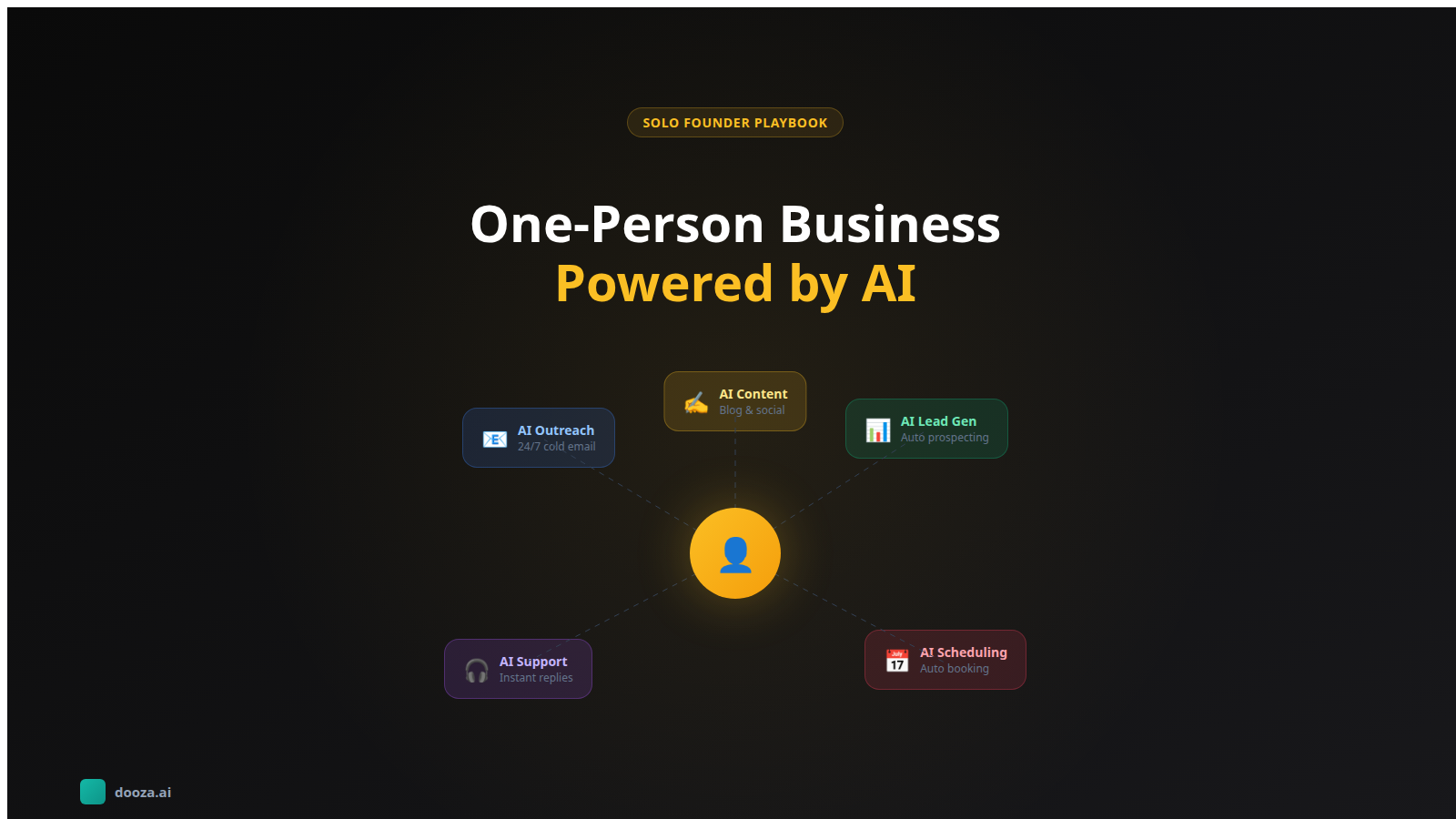
Role 1: Sales Development (AI SDR)
This AI employee finds prospects who match your ideal customer profile, researches their company and situation, writes personalized outreach emails, sends multi-step sequences, qualifies replies, and books meetings on your calendar. A human SDR is paid a salary plus benefits and sends about 50 emails per day. Your AI SDR sends 500; see dooza.ai/pricing.
Role 2: Customer Support (AI Support Agent)
Once you have customers, they have questions. Your AI support agent handles the repetitive ones instantly: pricing questions, how-to guides, account issues, common troubleshooting. It escalates complex issues to you with full context so you can respond in 2 minutes instead of 20.
Role 3: Follow-Up Manager (AI Follow-Up Employee)
This is the role most solopreneurs need but never hire for. Follow-ups are where deals die. Your AI follow-up employee tracks every open conversation, sends timely follow-ups, re-engages cold leads, and ensures nothing falls through the cracks. It is like having a chief of staff whose only job is making sure no opportunity is forgotten.
Role 4: Appointment Setter (AI Scheduler)
Scheduling is death by a thousand cuts for solopreneurs. The back-and-forth emails, the timezone confusion, the no-shows, the rescheduling. Your AI scheduler handles all of it: sends booking links, confirms appointments, sends reminders, follows up on no-shows, and reschedules when needed.
Role 5: Operations Manager (AI Admin)
CRM updates, daily reports, data entry, email triage, and process monitoring. This is the work that makes you feel busy but does not generate revenue. Your AI operations employee handles it in the background so your focus stays on high-value work.
The Million-Dollar Playbook: From Zero to $1M as a One Person Business
Getting to $1M in annual revenue as a solo operator requires three things: a high-value offer, an automated sales engine, and systematized delivery. Here is how to build each one.
Step 1: Choose a High-Margin Offer ($2,000-10,000 per client)
You cannot get to $1M selling $50 products one at a time as a solopreneur. The math does not work without a team to handle volume. Instead, choose an offer with enough value per client that you need 100-500 clients per year, not 20,000.
Examples that work well for one person businesses with AI:
Consulting/coaching: $3,000-10,000/engagement, 10-15 active clients at a time
Done-for-you services: $2,000-5,000/month retainer, AI handles 80% of delivery
SaaS or digital products: $100-500/month recurring, AI handles support and onboarding
Agency model: $2,000-8,000/month per client, AI employees do the fulfillment work
Step 2: Build an Automated Sales Engine
This is where AI employees make the one person business model viable. Your sales engine has three layers:
Layer 1: Prospecting. Your AI SDR finds 50-100 qualified prospects per day matching your ideal customer profile. It researches each one and builds personalized outreach angles.
Layer 2: Outreach. Personalized emails go out automatically. Multi-step sequences follow up on non-responses. Replies are classified and handled: positive replies get booking links, negative replies get removed, referrals get redirected.
Layer 3: Booking. Qualified prospects are routed to your calendar. You show up, have the conversation, and close the deal. The AI handled everything that came before the conversation.
This engine runs every day whether you are working or not. It fills your calendar with qualified conversations. Your only job in the sales process is the conversation itself, which is the part that actually requires a human.
Step 3: Systematize Delivery with AI
The delivery system depends on your offer, but the principle is the same: use AI employees for every repeatable step and reserve your personal time for the high-value, human-only parts.
For a consulting business: AI handles client onboarding, schedules calls, sends prep materials, delivers reports, and manages follow-ups. You do the strategic thinking and advising.
For an agency: AI employees handle research, first drafts, data analysis, reporting, and client communication. You do the strategy, quality review, and client relationships.
For SaaS: AI handles customer support, onboarding sequences, feature education, and churn prevention outreach. You do product development and strategic decisions.
A Day in the Life of a One Person AI Business
Here is what a typical Tuesday looks like for a solopreneur running a $50K/month consulting business with AI employees:
7:00 AM: Check overnight report from AI operations employee. 3 meetings booked, 12 support tickets resolved, 47 outreach emails sent, 6 replies received (2 positive). Two minutes of reading.
8:00 AM: First client call. AI prepared a briefing doc with their latest metrics, open questions from last session, and recommended talking points. You focus entirely on coaching.
9:30 AM: Review AI follow-up employee's draft messages for 4 warm leads. Approve 3, tweak 1. Five minutes.
10:00 AM: Strategy work. Product improvement, new offer design, partnership outreach. This is the work only you can do.
12:00 PM: Sales call with a prospect who booked through AI outreach. They have already seen your case studies (sent by AI) and reviewed pricing (sent by AI). The call is about fit and start date, not cold pitching.
1:00 PM: Lunch. The AI employees keep working.
2:00 PM: Second client call. Same setup: AI-prepared briefing, full context, recommended agenda.
3:30 PM: Review weekly performance dashboard generated by AI. Adjust outreach targeting for next week. Ten minutes.
4:00 PM: Done for the day. AI employees continue prospecting, following up, handling support, and booking meetings for the rest of the evening.
Total active work time: 5-6 hours. Revenue generated: on track for $50K this month. Employees on payroll: zero.
Five Mistakes That Kill One Person AI Businesses
1. Trying to Automate Everything at Once
Start with one AI employee in one role. Get it working, measure the results, and then add the next one. Founders who try to deploy five AI systems simultaneously end up configuring all of them and optimizing none of them.
2. Choosing Low-Value Offers
AI employees amplify your capacity, but they do not change the unit economics of your offer. If you sell a $50 product, you need 20,000 sales per year to hit $1M. Even with AI, that is hard for one person. Sell something worth $2,000-10,000 and you need 100-500 clients per year. That is achievable with AI outreach alone.
3. Not Setting Approval Gates
AI employees should not have unlimited autonomy from day one. Set approval gates for customer-facing actions: outreach messages, support responses, and content publishing. Review the output for the first 2 weeks, then gradually increase autonomy as you trust the quality.
4. Ignoring the Human Advantage
Your competitive advantage as a solopreneur is not that you use AI. Everyone will use AI. Your advantage is the combination of your expertise, your personality, your relationships, and AI leverage. Do not try to remove yourself from the business entirely. Show up for the conversations that matter.
5. Using Too Many Tools Instead of One Platform
Every tool you add is another login, another subscription, another integration to maintain, and another potential failure point. The solopreneurs scaling fastest are the ones who consolidate their AI employees on a single platform instead of stitching together 8 different apps.
Dooza Agents: Your AI Team, Built for You
Building a one person business with AI should not require a computer science degree or a $500/month tool stack. Dooza Agents gives you a complete AI employee team on one platform:
AI SDR: Finds prospects, personalizes outreach, sends sequences, handles replies, and books meetings on your calendar. Your automated sales engine.
AI Support Agent: Resolves customer questions 24/7, escalates complex issues with full context, and keeps satisfaction scores high without you answering the same question 50 times.
AI Follow-Up Manager: Tracks every open conversation and ensures no lead, client, or opportunity slips through the cracks.
AI Appointment Setter: Handles scheduling, confirmations, reminders, and rescheduling so you never lose a meeting to calendar logistics.
AI Email Automator: Runs nurture sequences, onboarding flows, and re-engagement campaigns while you sleep.
Pricing depends on the product, and every Dooza product starts with a refundable pilot — 100% refund within 14 days (see pricing). And unlike a VA, these AI employees work 24/7, never call in sick, and scale with your business without adding headcount or management overhead.
The solopreneurs building million-dollar businesses are not working harder. They are working with better leverage. Start with Dooza Agents and build the one person business you have been planning.
Frequently Asked Questions
Can one person really build a million-dollar business with AI?
Yes. Multiple solopreneurs have crossed the $1M annual revenue mark using AI to handle outreach, content creation, customer support, and operations. The key is choosing a high-value service or product, using AI employees to automate delivery and sales, and keeping overhead near zero. Examples include consulting, SaaS, digital products, and service agencies.
What are the best AI tools for a one person business?
The essential stack includes an AI employee platform like Dooza Agents for outreach, lead gen, support, and follow-ups. Beyond that, you need a payment processor (Stripe), a simple website (Framer or Carrd), and optionally a CRM. The goal is to minimize tools and maximize automation.
How many hours per week does a one person AI business require?
Most successful solopreneurs using AI report working 20-30 hours per week once systems are set up. The initial setup takes more time (40-50 hours over the first month), but once AI employees handle outreach, support, and operations, the founder focuses on strategy, high-value conversations, and product improvement.
What type of business works best as a one person AI business?
Service businesses with recurring revenue work best: consulting, coaching, agency services, and SaaS. These models have high margins, repeatable delivery, and sales processes that AI can automate. Product businesses with physical fulfillment are harder to run solo because logistics require human coordination.
How do I get my first customers as a solo AI business?
Start with AI-powered cold outreach. Define your ideal customer profile, let your AI SDR employee find and contact 200-500 prospects per day, and focus your personal time on the conversations that result in sales calls. Most solopreneurs book their first paying client within 2-3 weeks of launching AI outreach.
Ready to Start Your Pilot?
Automate your business with AI employees that work 24/7. Start with a refundable pilot: 100% refund within 14 days.
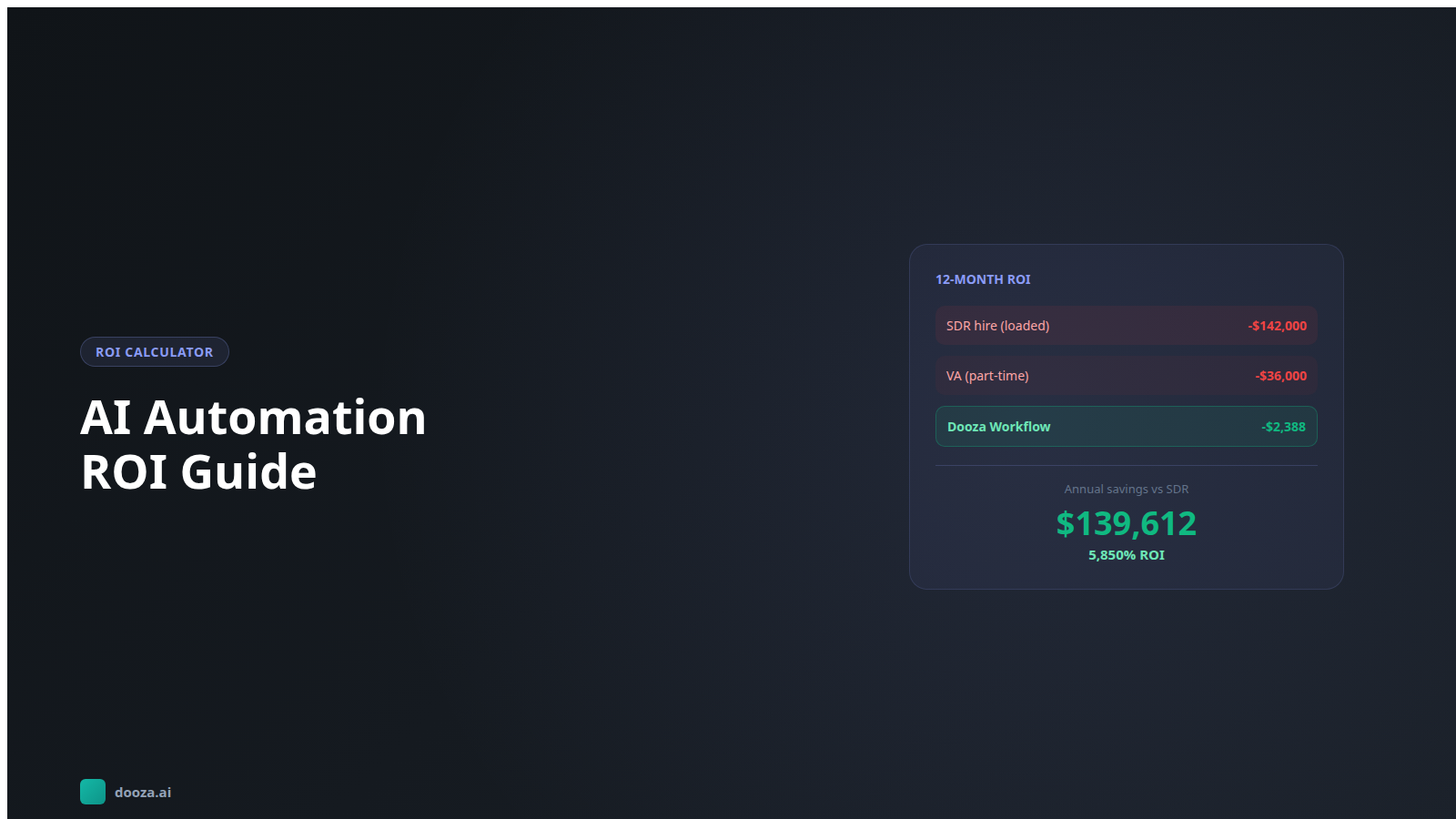
AI Business Automation ROI: How to Calculate the Real Return on Your AI Investment
Not sure if AI automation is worth the investment? Learn how to calculate AI business automation ROI with real numbers, frameworks, and comparisons so you can make a confident decision.
Start with a refundable pilot — 100% refund within 14 days. A Dooza engineer scopes it with you on a free 30-minute call. Pricing depends on the product; see pricing.