What Is Hyperautomation and How It Can Free Up Your Team
What is hyperautomation? Learn how this powerful strategy combines AI, RPA, and more to automate complex work and free your team for strategic growth.
23 min read
January 9, 2026
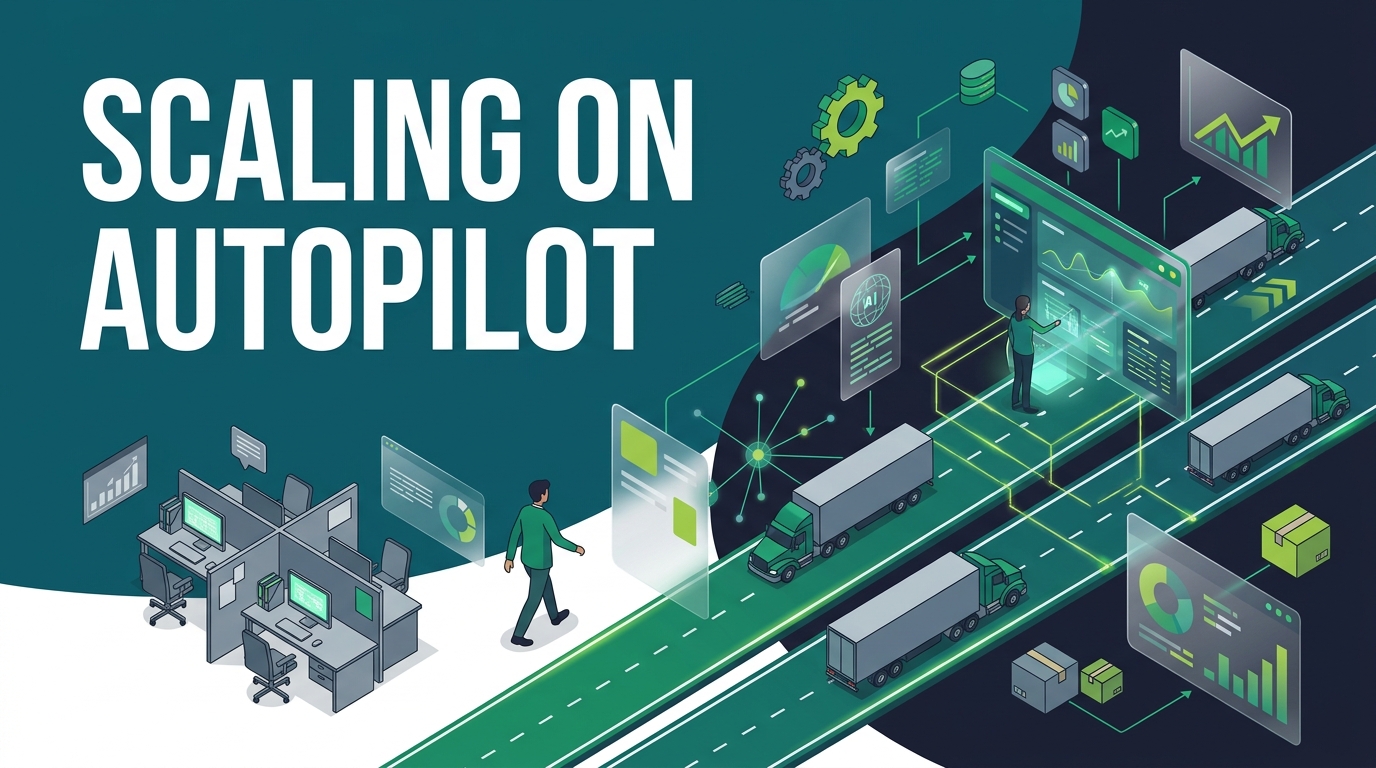
Ever wonder what it would be like if your business practically ran itself? Imagine waking up not to a mountain of emails, but to a summary of tasks your AI team already handled overnight. Invoices paid, customer questions answered instantly and intelligently, and a fresh, insightful report on your market position sitting in your inbox. This isn't a distant sci-fi fantasy; it's the reality made possible by hyperautomation.
At its heart, hyperautomation is a smart, business-focused strategy. It’s about methodically finding, checking, and automating as many business and IT processes as you possibly can by weaving together a whole suite of advanced technologies. It's the ultimate dream of delegation—handing off the grunt work to AI so you and your team can focus on the big picture.
From Simple Tasks to a Business Symphony
Hyperautomation isn't just about speeding up one or two simple tasks. It's a huge leap forward. It strategically combines powerful tools—like artificial intelligence (AI), machine learning (ML), and robotic process automation (RPA)—to handle entire, complex workflows from start to finish. We're not just making one part of a job faster; we're orchestrating the whole operation to run smarter and smoother.
Think of it like this: traditional automation, such as RPA, is like having a single musician—say, a violinist—who can play one simple, repetitive tune perfectly every single time. It's useful, but limited. Hyperautomation is the conductor bringing in the entire orchestra—the AI that reads the audience, the analytics that fine-tune the acoustics, the integrations that ensure every instrument is in sync—to create a complex, beautiful masterpiece of efficiency. The dream is a business that runs like a perfectly tuned symphony, even while you sleep.
More Than Just a Buzzword
This isn't just some passing trend; it's a serious shift that’s reshaping how industries work and generating real economic value. Hyperautomation is a fast-growing global market, blending different technologies into a unified automation fabric that stretches across an entire company.
In fact, market analysts predict the hyperautomation market will explode from USD 46.73 billion to a staggering USD 276.81 billion by 2035. That's a compound annual growth rate (CAGR) of 17.55%. You can dig into these numbers and see the full report over at Precedence Research. This kind of growth shows that intelligent automation is no longer a "nice-to-have"—it's a critical engine for future success.
Freeing Your Team for What Matters Most
Ultimately, the real goal of hyperautomation is to unlock human potential. Imagine giving your team their time, energy, and creativity back. When you empower AI employees to take over the tedious, rule-based, and data-heavy work, you're not just improving efficiency—you're investing in your people. This frees them up to focus on the uniquely human skills that actually drive growth.
The goal is to create a seamless partnership between human talent and digital workers. AI handles the 'how,' so your team can finally focus on the 'what' and the 'why'—creativity, strategy, and building the future of your company.
Instead of being bogged down by hours of manual data entry or pulling together reports, your people can finally dedicate their energy to what they do best:
Strategic Planning: Looking at the big picture, analyzing trends, and mapping out long-term growth.
Creative Problem-Solving: Tackling thorny challenges that demand human ingenuity and out-of-the-box thinking.
Customer Relationships: Building genuine connections and delivering the kind of service that creates loyal fans.
Innovation: Dreaming up new products, services, and better ways of doing business.
This shift doesn't just make your business more efficient. It makes it more agile, more innovative, and ready for whatever comes next. To see how other businesses are putting these ideas into action, check out our latest articles on the Dooza blog.
The Core Technologies That Power Hyperautomation
Hyperautomation isn't some single piece of software you just install and run. Think of it more like a powerful toolkit filled with specialized, interconnected technologies all working in concert. To really get what it can do for your business, you need to meet the key players. Each one has a specific job, but when they team up, they can automate entire business functions.
Let's use a real-world example: automating your lead follow-up. Manually, it's a soul-crushing grind of copying and pasting data, sending out email templates, and cluttering your calendar with reminders. Hyperautomation essentially builds a digital team to run this whole process for you, and that team is made up of some very clever tech.
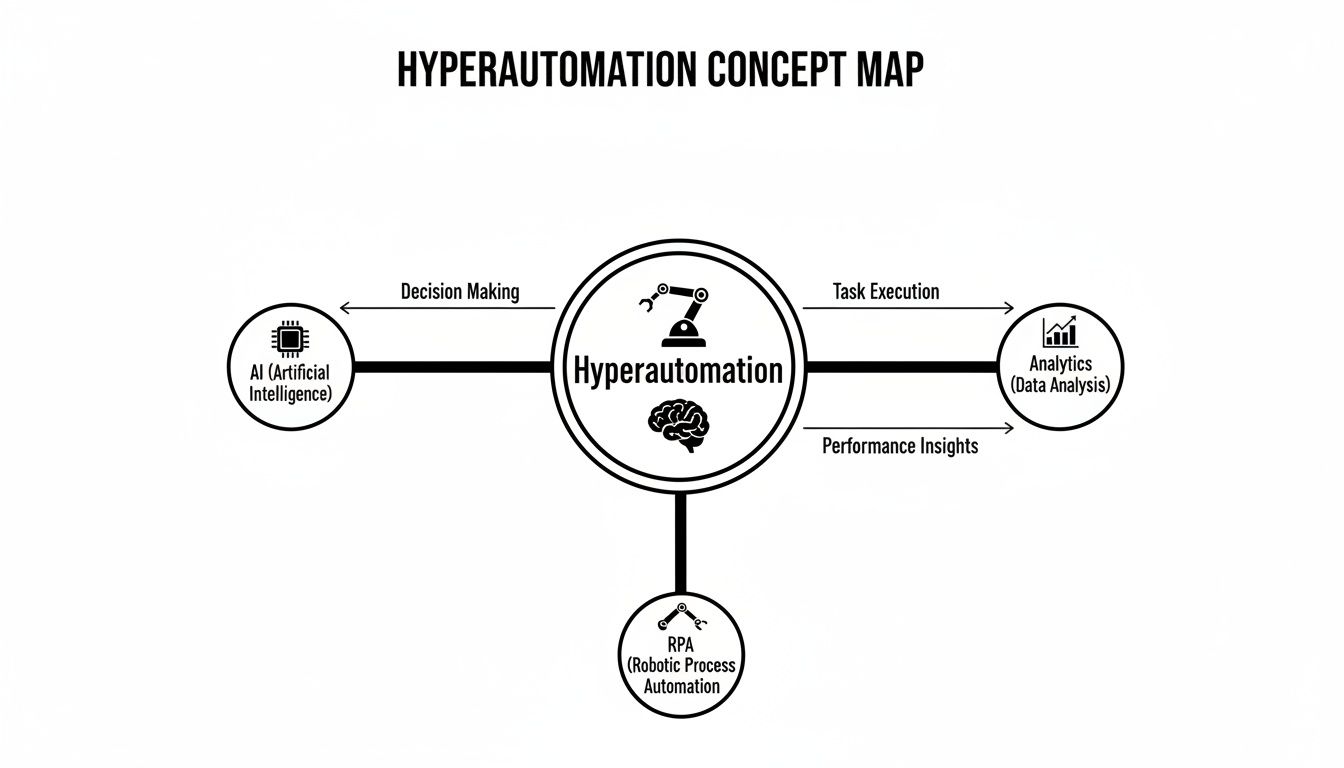
This map gives you a great visual of how these core components fit together.
As you can see, hyperautomation is the hub, the central intelligence directing AI, RPA, and Analytics to achieve a specific business goal. Let's break down who does what.
Robotic Process Automation (RPA): The Digital Hands
Meet the diligent, tireless "digital hands" of your operation: Robotic Process Automation (RPA). RPA bots are built to execute structured, rule-based tasks with perfect accuracy, 24/7. They absolutely excel at the kind of repetitive, predictable work that burns out your human team.
These bots follow a script, clicking, typing, and navigating software just like a person would. They can log into apps, copy-paste data between spreadsheets and your CRM, move files, and fill out forms.
Example in Action: Imagine an RPA bot that monitors your sales inbox. The moment an order confirmation arrives, the bot "reads" the PDF, extracts the customer name, order number, and amount, and then logs into your accounting software to create a new invoice. This happens instantly, flawlessly, every single time—freeing up your finance team from hours of mind-numbing data entry.
Artificial Intelligence (AI) and Machine Learning (ML): The Brain
If RPA gives you the hands, then Artificial Intelligence (AI) and Machine Learning (ML) provide the "brain." This is the part of the toolkit that allows your automations to think, learn, and make smart decisions. While RPA needs clear, rigid rules, AI is comfortable with ambiguity and can make sense of unstructured data like emails and documents.
This is where things get really interesting. AI can:
Understand Language: It can read an incoming customer email, figure out if the person is happy or frustrated, and determine what they need—a billing question, a technical issue, etc.
Recognize Patterns: AI can look at your historical data and predict which new sales leads are most likely to buy, helping your team focus on the warmest prospects.
Interpret Images: It can "read" a scanned invoice or receipt, pulling out the important details and turning a stack of paper into clean, usable data.
Example in Action: When a customer sends a support ticket, an AI model can instantly analyze the text. It understands the customer is frustrated about a late delivery. The AI then automatically flags the ticket as "urgent," assigns it to the right department, and kicks off an RPA bot to pull up the customer's order history so the human agent has all the information they need the second they open the ticket. The dream is to solve problems before your customer even knows they have them.
Process Mining: The Detective
Before you automate anything, you have to understand exactly how it works right now. Process Mining is the "detective" that gives you this crystal-clear view. It digs into the digital footprints your team leaves in your systems—like timestamps in your CRM or logs in your project management tool—to build a visual map of how work actually gets done.
This detective work often turns up some surprises. You might think a process has five simple steps, but process mining could reveal it actually has ten extra steps, a bunch of workarounds, and major bottlenecks you never even knew were there.
By uncovering these hidden snags, process mining shows you exactly where the best opportunities for automation are, making sure you don't just automate a broken process and make it faster.
Orchestration and Integrations: The Central Nervous System
Finally, you need a "central nervous system" to connect all these pieces and your existing software. This is where an orchestration platform like Dooza comes in. It's the conductor of the orchestra, making sure RPA, AI, and your other apps (like Slack, Google Workspace, and your CRM) all work together without a hitch.
Orchestration is what manages the entire end-to-end workflow. For example, after a customer fills out one of your Dooza forms, the orchestration engine can kick off a whole sequence of events: an RPA bot creates their profile, an AI agent sends a personalized welcome email, and a task gets assigned in your project tool. It's this seamless connection that turns a collection of individual automated tasks into a true hyperautomation engine.
See How Hyperautomation Transforms Your Business
Knowing the theory is one thing, but seeing hyperautomation in action is where the idea of a self-running business really starts to click. This isn’t about small, incremental tweaks. It’s about a fundamental shift in how work gets done, freeing your team from the daily grind to focus on what actually moves the needle: growth and innovation.
So, let's get practical and look at some tangible before-and-after scenarios. Picture hiring specialized AI employees from Dooza who don't just check off tasks but actually manage entire business functions on their own.
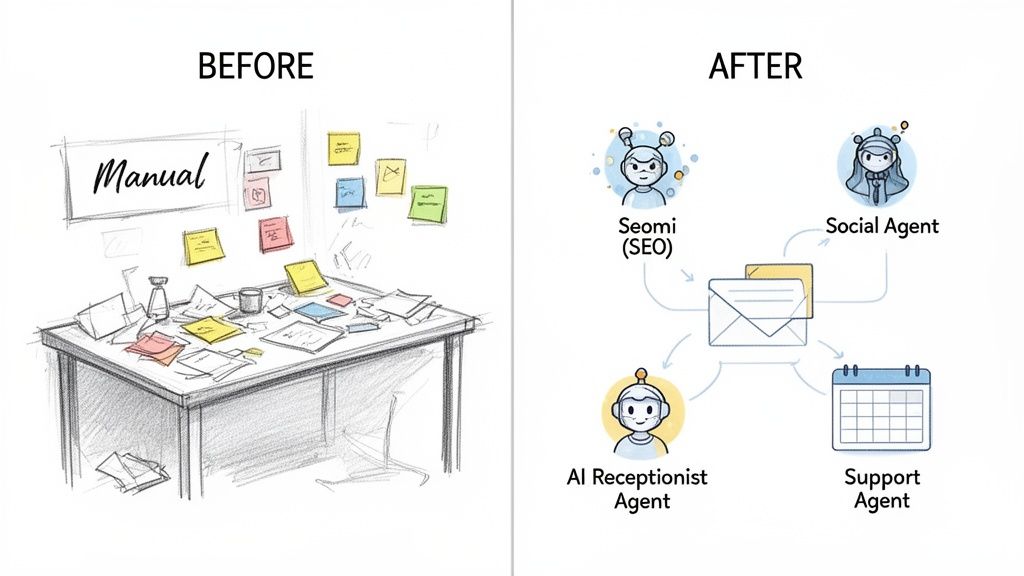
This image really captures the contrast between the chaos of manual work and the clean, organized power of a hyperautomated system.
On one side, you have the familiar stress of manual processes—the paperwork, the spreadsheets, the constant juggling. On the other, you see a system where AI agents work together to deliver results, turning that complexity into clarity. The dream is to move from the left side of this picture to the right, forever.
Meet Seomi: Your AI SEO Strategist
For any startup or agency, SEO is a relentless, time-sucking battle. The old way of doing things is a grind of keyword research, writing content briefs, tracking ranks, and sending countless outreach emails. It’s a full-time job that, let’s be honest, often gets pushed aside for more "urgent" fires.
Before Hyperautomation: Your team is buried in spreadsheets for hours every week. They're manually pulling keyword data, checking where competitors stand, and painstakingly drafting outreach emails one by one. Progress is slow, and scaling up feels impossible without throwing more bodies at the problem.
After Hyperautomation with Seomi: You hire Seomi, Dooza's SEO AI employee. She plugs right into your analytics and SEO tools, working tirelessly behind the scenes. Seomi doesn’t just spit out a list of keywords; she digs into their intent, pinpoints content gaps, and autonomously creates detailed outlines for your writers.
She also keeps an eye on your rankings 24/7, pinging your team on Slack the moment there’s a major shift. Seomi can even generate personalized backlink reports, flagging high-authority sites and drafting the initial contact emails for you to approve. This kind of AI-driven approach can boost productivity in marketing tasks by up to 30%. SEO stops being a manual chore and becomes a strategic, automated engine for growth. To see how AI can elevate your search rankings, check out our guide on using Dooza Rank.
Transforming Customer Support with an AI Agent
Great customer support is non-negotiable, but it’s also incredibly draining on your resources. Your team is likely buried under a mountain of repetitive tickets, answering the same questions about shipping, password resets, and product features all day long.
Before Hyperautomation: Support agents spend most of their time dealing with simple, predictable questions. This means longer waits for customers with serious problems, a real risk of agent burnout, and a bottleneck that keeps you from giving proactive, high-touch service to your best customers.
After Hyperautomation with an AI Support Agent: Imagine this: a customer writes in at 2 AM asking "where is my order?". Instead of that ticket sitting in a queue until morning, a Dooza AI support agent instantly reads the ticket, understands the request, pulls the tracking information from your shipping software, and replies to the customer with a direct link to their tracking page—all within seconds.
It can resolve over 80% of routine inquiries like this without any human intervention. This frees up your human support team to focus entirely on the complex, high-stakes issues that require real empathy and critical thinking.
The results? Your customers get instant gratification, and you have a support team that feels empowered, not overwhelmed. That's the dream of truly scalable customer service.
Automating Operations and HR Onboarding
Think about the operational headache of bringing on a new employee. It's a flurry of paperwork, setting up accounts, scheduling training, and sending welcome emails. Every step is important, but manually coordinating it all is a massive time sink for your ops or HR team.
Before Hyperautomation: Onboarding is a manual checklist. Someone has to create accounts in a dozen different systems, send templated emails, and hunt down managers to schedule intro meetings. It’s inefficient, ripe for error, and often creates a choppy experience for the new hire.
After Hyperautomation with AI Employees: A candidate is marked as "hired" in your HR system. That one action kicks off a Dooza workflow orchestrated by an AI operations agent.
Account Creation: An RPA bot gets to work creating accounts in Slack, Google Workspace, and your project management tool.
Welcome Sequence: An AI agent sends a personalized welcome email series to the new hire, dripping out key information over their first week.
Calendar Management: An AI receptionist automatically schedules onboarding meetings with key people, finding open slots in everyone’s calendars.
This smooth, end-to-end process guarantees a flawless, professional onboarding every single time. It saves your team countless hours and lets them focus on the human side of welcoming a new colleague—which is where they should be focused anyway. These examples show you what hyperautomation is really about: creating a smarter, more scalable business where your team's true talents are finally put to good use.
The Strategic Benefits of Embracing Hyperautomation
Jumping into hyperautomation is so much more than a simple efficiency boost. It's a foundational decision to build a smarter, more resilient organization. This is where the idea of a business that practically runs itself stops being a dream and starts becoming a reality, pushing past basic cost-cutting and into true strategic advantage.
The real magic of hyperautomation is in creating an environment where your team is free to innovate, not just grind through daily operations. It’s about building a business model that doesn’t just keep up with growth but actually fuels it.
Achieve Exponential Productivity
Picture your small startup or agency delivering the output of a team three times its size. That's the new reality hyperautomation makes possible. It directly addresses the productivity puzzle by handing off entire workflows—not just single tasks—to a digital workforce.
Instead of your marketing specialist burning half their day pulling data for reports, an AI employee like Dooza’s Seomi handles it automatically. This shift frees up your human talent to concentrate entirely on high-value strategic work, massively amplifying their impact and creativity.
The goal is to create a force multiplier for your team. When AI agents handle the repetitive, process-driven work, your people are free to solve complex problems and build customer relationships—the activities that truly define your success.
This approach transforms your business from a place where people are just busy to a place where they are truly productive. The dream isn't to work harder; it's to work smarter by letting AI handle the grind.
Near-Perfect Accuracy and Enhanced Quality
Let's be honest, human error is a fact of life in manual work, especially with data entry, invoice processing, or report generation. These tiny mistakes can snowball into major headaches, costing you both time and money. Hyperautomation methodically roots out these risks.
By assigning rule-based and data-heavy processes to AI employees, you ensure tasks are performed with near-perfect accuracy, every single time. This precision creates a positive ripple effect across the entire business:
Cleaner Data: Your CRM and analytics tools get filled with reliable information, which leads to much smarter decision-making.
Financial Integrity: Invoicing, payroll, and financial reporting become practically error-free, building trust with clients and ensuring compliance.
Consistent Service: Automated customer responses are always on-brand and accurate, strengthening your company's reputation.
This level of quality control is especially vital for your customer-facing teams. For instance, when you automate parts of customer support, AI can handle initial questions with perfect consistency. You can see how this stacks up against traditional helpdesks in our guide on the top Gorgias alternatives.
Effortless Scalability and Agility
Every founder dreams of handling explosive growth without the usual spike in headcount and operational chaos that comes with it. Hyperautomation makes that dream achievable. Dooza’s AI employees work 24/7 without getting tired, taking sick days, or hitting a capacity limit.
So, when your order volume doubles overnight or customer support tickets triple, your automated systems just scale to meet the demand. This creates an incredibly agile business that can jump on new opportunities without buckling under the pressure.
This isn't just a niche trend; it's becoming a core part of business strategy around the world. For instance, North America accounted for 37% of global hyperautomation revenue in 2022, and that figure is expected to hold steady at around 36% in 2025. This massive adoption is driven by the need to slash costs while building tougher, more resilient operations. Meanwhile, the Asia-Pacific region is the fastest-growing market, with a projected CAGR of around 17%. You can explore more on this global shift in the full research on hyperautomation market trends.
Ultimately, embracing hyperautomation means you're not just automating tasks—you're future-proofing your business. You're building an intelligent, adaptable organization that can thrive in any market, freeing you up to focus on the big-picture vision.
Your Practical Roadmap to Implementing Hyperautomation
Getting excited about hyperautomation is the easy part. Turning that vision into reality? That can feel like trying to climb a mountain. Where do you even start?
The good news is you don’t need a team of data scientists or a Silicon Valley budget to get going. The key is a clear, phased approach that lets you bring this power into your business confidently, one strategic step at a time. This isn't about boiling the ocean; it's about starting a ripple that grows into a wave of efficiency.
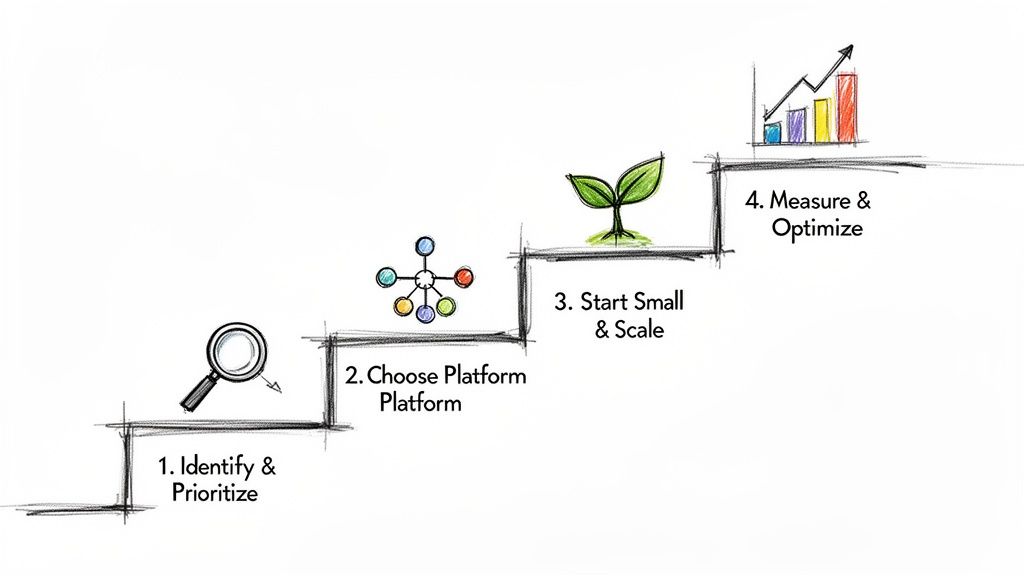
Phase 1: Identify and Prioritize Your Targets
First things first: you have to find the right processes to automate. Don't go hunting for the most complex, hair-on-fire problem in your business. Instead, look for the most annoying, repetitive, and mind-numbing tasks that drain your team's energy day after day.
Those are your perfect starting points. The best candidates for your first automation project usually share a few key traits:
High Volume: They happen over and over again, like processing new sales leads or answering the same five support questions.
Rule-Based: They follow a predictable, logical sequence of steps. If you can write it down in a checklist, you can probably automate it.
Prone to Human Error: They involve manual data entry or copying and pasting, where a slip of the finger can cause real problems.
Example: Think about creating a weekly social media performance report. It's a manual grind—logging into 3 different platforms, pulling data, plugging it into a spreadsheet, and formatting a summary. That’s a prime target. It’s repetitive, time-consuming, and practically begging for an AI employee to take over so your social media manager can spend that time creating amazing content instead.
Phase 2: Choose the Right Platform
Once you’ve got a target in your sights, you need the right tool for the job. This is where a lot of businesses get stuck, intimidated by complex software and the fear of a long, painful setup. The trick is to find an all-in-one orchestration platform built for both simplicity and power, like Dooza.
Instead of trying to stitch together a dozen different tools, an orchestrator gives you a central hub where you can hire pre-built AI employees. These agents are already trained for specific roles—like SEO, social media management, or customer support—and come ready with the integrations needed to connect to your existing software.
This approach massively lowers the barrier to entry. This shift is powered by the boom in low-code and no-code platforms, which let non-technical teams deploy serious AI without needing an enterprise-level engineering budget. The market for these tools is projected to skyrocket from USD 28.75 billion to USD 264.40 billion by 2032. In fact, analysts predict that by 2025, 70% of new applications will be built using these technologies. You can learn more about how low-code is fueling the hyperautomation market from recent industry reports.
Phase 3: Start Small and Scale Intelligently
With your target process identified and your platform chosen, it's time to launch your first pilot project. The whole point here is to score a quick, tangible win. This proves the value of hyperautomation to your team and builds the confidence to go after bigger challenges.
Seriously, don't try to automate your entire finance department on day one. Start with something manageable but meaningful.
Example Pilot Project: Automate Social Media Scheduling
Hire a Dooza AI employee and connect it to your content library (like a Google Drive folder) and your social media accounts. Task it with a simple job: schedule one approved post per day. This one workflow can save your team hours every month and perfectly demonstrates the power of having an AI colleague working quietly in the background, freeing up creative energy.
Once you see the results—the time saved, the improved consistency—you can start layering on more complexity. That same social media agent could then be tasked with analyzing post-performance and suggesting new content ideas. This "start small, scale smart" method is the secret to a smooth and successful journey.
Phase 4: Measure and Optimize for Success
The final phase isn't really an end—it's a continuous loop of measurement and refinement. To truly understand the impact of your efforts, you have to track the right metrics. This isn't about vanity numbers; it's about proving a clear return on investment (ROI).
Key metrics to keep an eye on include:
Hours Saved: Calculate the raw number of manual hours your team gets back each week.
Error Rate Reduction: Track the decrease in mistakes that used to happen with manual data entry.
Process Speed: Measure how long it takes to complete a workflow from start to finish.
Tracking these metrics doesn't just prove the value of what you've done—it helps you pinpoint the next best opportunity for automation. This data-driven approach is what turns hyperautomation from a one-off project into a core business strategy for continuous improvement. For those also looking to grow through collaboration, exploring our guide on how to build strong business partnerships can offer more strategic insights.
Answering Your Top Questions About Hyperautomation
Jumping into a powerful new strategy like hyperautomation is exciting, but it's completely normal to have a few questions. Concerns about the cost, the complexity, or the impact on your team often come up. Let's tackle some of the most common ones head-on so you can move forward with confidence.
The idea here is to pull back the curtain and show you that this isn't some abstract concept reserved for mega-corporations. It's a practical, accessible approach that can help you build the business you've always dreamed of.
Is Hyperautomation Only for Large Enterprises?
This is probably the biggest myth out there. While it’s true that big companies were the first to jump on board, the game has completely changed. Modern, easy-to-use platforms have brought the power of hyperautomation to startups, agencies, and small businesses everywhere.
Not even close. Tools like Dooza, for example, are built to be both accessible and affordable. You can now hire powerful AI employees to run entire workflows across marketing, operations, and customer success without needing a huge budget or a dedicated team of developers.
In fact, smaller, more nimble companies often have an edge. You can implement these kinds of solutions much faster than a huge corporation and see a more dramatic, immediate impact on your ability to scale and compete.
What's the Difference Between Automation and Hyperautomation?
It’s easy to mix these two up, but understanding the distinction is key to unlocking the dream of a business that truly runs itself.
Here’s a simple way to think about it: traditional automation is like a programmable coffee maker. You set it up once, and it performs one specific task—brewing coffee—perfectly every time. It's useful, but its job is singular and strictly rule-based.
Hyperautomation, on the other hand, is the fully integrated smart home system. It doesn’t just make your coffee. It also checks the weather to adjust your thermostat, raises the blinds, reads you your daily schedule, and cues up your morning playlist. It orchestrates multiple smart devices and AI assistants to manage your entire morning routine from start to finish.
Automation is about getting a single task done. Hyperautomation is about intelligently orchestrating an entire business process by combining multiple advanced tools like AI, RPA, and integrations.
This strategic approach takes you from merely speeding up a task to building a genuinely intelligent, self-sufficient operation.
How Do I Start if I’m Not Technical?
You don’t need to be a coder to be a conductor. The best way to begin is by focusing on the business problem, not the technology itself. Forget the jargon for a moment and just ask yourself: What's the single most repetitive, time-sucking task my team has to deal with?
Maybe it’s manually compiling weekly reports, answering the same five customer questions all day, or walking new clients through the onboarding process. Once you’ve pinpointed that specific pain point, you can start exploring a user-friendly orchestration platform.
Here's a simple, non-technical path to get you started:
Identify one manual process that drives your team crazy.
Explore a no-code platform like Dooza that offers pre-built AI employees.
Hire your first AI agent for a small pilot project, like scheduling your social media posts.
Watch the results and see how many hours your team gets back.
This "start small" approach lets you see the benefits firsthand, build momentum, and expand your automations with confidence.
Will Hyperautomation Replace Human Jobs?
This question gets to the heart of the matter: what happens when AI takes over the work? The answer is that hyperautomation is designed to augment human talent, not replace it. It’s here to give your team a promotion, not a pink slip.
AI employees are brilliant at the very work that people find tedious, boring, and prone to error—the data entry, the report pulling, the endless follow-ups. By handing off these tasks, you free your team to focus on the uniquely human skills that no AI can ever replicate.
These are the skills that actually grow a business:
Strategic Thinking: Analyzing the market and planning your next big move.
Creative Problem-Solving: Coming up with brilliant solutions for complex challenges.
Building Relationships: Connecting with customers and partners on a human level.
Innovation: Dreaming up the future of your products and services.
The real goal is to create a powerful partnership. Imagine your human experts and AI employees working side-by-side, each playing to their strengths to achieve incredible results. This is the future of work—smarter, more fulfilling, and more focused on what truly matters.
Ready to stop dreaming and start building your automated future? With Dooza, you can hire your first AI employee in minutes and reclaim your team's time for good. Explore our pre-built AI agents and see how simple it is to put your business on autopilot.
From Corporate Escape to SaaS Success: How One Founder Built a Freight Scheduling Empire (And What It Teaches Us About AI Automation)
Discover how a former Apple and Amazon employee left corporate life to build a freight company, then created a SaaS tool to solve his own scheduling nightmare. This post breaks down the key lessons from the viral video and shows how AI employees from Dooza can automate your business today.
Google’s Gemini Era: What It Means for Business Automation and Why You Need AI Employees Now
Google’s Gemini demo reveals a future where AI understands context, images, and voice seamlessly. But for businesses, the real revolution is in deploying specialized AI employees that work 24/7. Discover how Dooza’s AI workforce can turn this vision into practical automation.