AI Automation
5 Proven Ways AI Employees Save Small Businesses 20+ Hours/Week
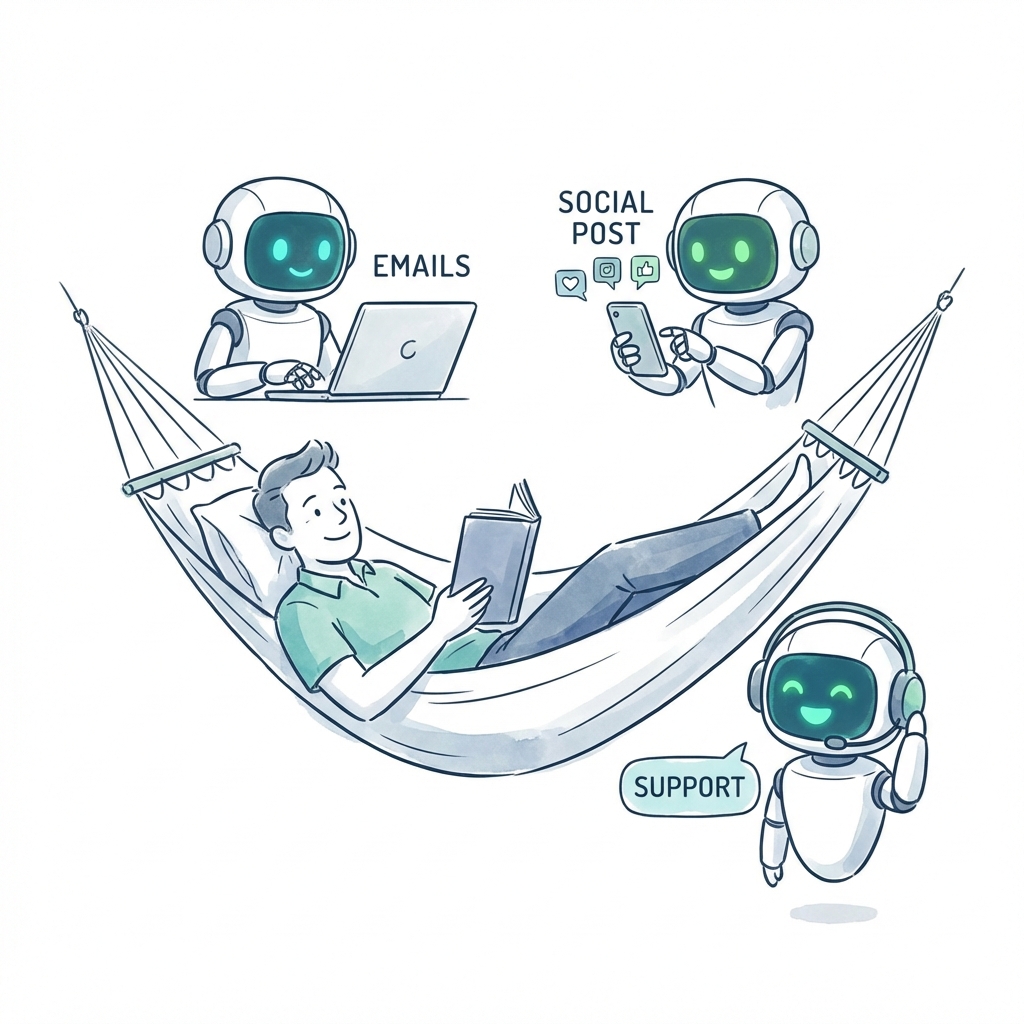
Discover how AI-powered employees are helping small businesses automate their daily operations, from email management to social media posting.
7 min read
ReadCut through the noise around AI agent development service options in 2026. See real pricing, security checklists, and how to pick a vendor that ships.

You probably don't need another glossy vendor deck. You need an answer to a mess that looks familiar: a support queue that keeps growing, leads that rot in a spreadsheet, sales reps doing repetitive follow-up, and someone asking whether an AI agent is worth the money before they sign anything. That is the buying moment for an ai agent development service, and most pages never touch it.
The market is already too big to treat this like a science project. One estimate puts the global AI agents market at $3.6 billion in 2023 with a 31.2% CAGR from 2024 to 2030. Another projects $7.63 billion in 2025 and $182.97 billion by 2033, while a separate industry summary projects $52.62 billion by 2030. Those are not brochure numbers, they're a signal that buyers are already moving from curiosity to procurement, especially in enterprise software and workflow automation. World Metrics industry statistics on AI agents
Most vendor pages sell capabilities, but SMBs and agencies buy outcomes, risk control, and cost certainty. That mismatch is why so many procurement conversations stall. Buyers do not want a parade of adjectives. They want to know whether the agent will get work done, how fast it can go live, what it touches, and what breaks if it drifts.
The category itself has moved past toy demos. A serious ai agent development service should be judged like a production system, not a chatbot pitch. If a vendor cannot explain the build path, the integration surface, the approval gates, and the post-launch monitoring plan, they are selling vibes, not software.
Practical rule: If the vendor's homepage sounds impressive but can't answer how the agent logs actions, escalates exceptions, and handles sensitive tools, keep walking.
The rest of this guide is built for operators who need buying logic, not marketing gloss. It focuses on build-versus-buy math, realistic delivery models, security posture, and how ROI gets measured after launch. It also cuts through a common lie in this space, that the hard part is “training the model.” It isn't. The hard part is shipping a controlled system that can act inside your business without creating a new pile of manual cleanup.
For a clean baseline on the difference between an agent and a chatbot, see this direct comparison from Dooza. That distinction matters because chat interfaces answer questions, while agents are supposed to complete work. The vendors who blur that line are usually the ones with the weakest delivery model.
A real ai agent development service ships a machine-addressable agent with defined inputs, outputs, business rules, and acceptance criteria. The system is built to be invoked, logged, routed, and verified, not just prompted. That matters because buyers need to test what the agent does before it touches live operations, and trace every action after launch.

The deliverable is a system that accepts a task, reads context, applies business rules, and returns a controlled action or decision. A vendor should define what data can enter, what tools the agent can call, what counts as success, and what gets escalated to a human. The build guide from Dooza matches this model, because the work sits in scope, routing, approvals, and logging.
Inputs are the triggers, user requests, ticket text, CRM fields, call transcripts, or webhook events. Business rules are the guardrails. Outputs are the actions, replies, updates, or escalations. If a vendor cannot describe all three, they are not selling production delivery.
Dooza Agents are positioned as AI employees, not chatbots or SaaS tools. That framing is correct because the agent should reply, take action, escalate, and log everything with human-in-the-loop controls. If a support agent can answer a Gmail thread, update a CRM field, and hand off a sensitive case without losing context, that is real work output. If a lead-gen agent can qualify inbound interest and route it properly, that is an employee-style function.
The same pattern shows up in content workflows. If your team wants to improve content quality with automation, the gain comes from structured actions and review paths, not from a prettier interface. Production agents need contracts, not charisma.
A vendor should be able to show the schema, the approval points, and the audit trail before it talks about “intelligence.”
The category already has enough demand to stop treating it like a side experiment. Gartner-based reporting says the share of enterprise applications embedding at least one AI agent rose from 33% in 2024 to 58% in 2025, and is expected to reach 80% in 2026. Another estimate says 40% of enterprise applications will include AI agents by 2026, up from less than 5% in 2025. Those numbers point to procurement, not curiosity.
Customer service is moving just as hard. One industry source reports 66% of organizations now use agentic AI, up from 39% a year earlier, and says the average return is $3.50 for every $1 spent on AI customer service. That is the kind of signal that changes budget meetings, especially for support teams under pressure to cut handle time without hiring more people. Digital Applied enterprise adoption data

Buyers should stop asking whether agents are real. The key question is which vendor can ship one safely, connect it to the right systems, and prove it pays back. That is why an ai agent development service belongs in the same decision bucket as any other deployment that can affect revenue, support load, or operational risk.
Judging vendors by demo polish is a mistake. Use the AI agent evaluation metrics guide to pressure-test claims about performance and accuracy, then ask harder questions about task completion, exception handling, and logging. If a vendor cannot show how the agent works under failure, the pitch is fluff.
If the agent cannot show work, it is not ready for business use.
The market is also large enough to justify stricter vendor screening. A quick pass through top automation companies in 2026 is only useful if it goes beyond feature lists and names the stack that delivers controlled outcomes across support, sales, and ops. That is the standard now.
A production build is not one thing. It is a chain of decisions that either gives you control or gives you cleanup work. The best partners break the job into seven layers, because that is how you keep scope, risk, and delivery sane.

A reliable build process also follows a phased motion, specify, plan, execute, verify. That aligns with guidance on writing specs for AI coding agents, where bounded work units and concrete test commands reduce failure cascades. Practical specs guidance for AI coding agents is useful if you want to compare a vendor's process to a stricter standard.
The fastest sanity check is the qualification rule. If a task happens fewer than 50 times per month, the ROI usually does not justify agent development, and the task should require reasoning, not simple lookup. That rule is especially useful for SMBs that want automation but don't yet have enough repeat volume to support a real deployment. AI agents development guide
Buyer question: Which of these seven layers do you own, and which does the vendor own?
A practical pilot can be done fast when the scope is narrow. A one-week pilot is enough to prove routing, logging, and approval flow on a single workflow, while larger enterprise builds obviously take longer because they involve more systems, more governance, and more testing. The point is not speed for its own sake, it's proving control before you scale.
For context on how to think about the knowledge layer, this practical 2026 guide to agent context from Mallary.ai is a solid companion read. It will help you separate a clean context design from a bloated prompt dump.
The first mistake buyers make is assuming agents only “chat.” That is weak thinking. A production agent should handle a task, take an action, log what it did, and escalate when it hits a boundary. That is the four-step behavior that separates AI employees from chatbots.
A support agent can read inbound email, classify urgency, reply with the right answer, update the ticket, and hand off the edge cases to a human. In WhatsApp, it can do the same thing with faster turnaround and cleaner routing. The value is not just speed, it is consistency, because every action gets recorded.
For lead generation, the pattern is similar. The agent can capture an inbound inquiry, qualify it against your rules, push the record into a CRM, and flag it for sales if the fit is strong. That saves reps from wasting time on low-value replies and keeps good leads from going stale.
Outbound sales is where a lot of vendors overpromise and underdeliver. A real agent should personalize a sequence, send the right follow-up, stop when a prospect opts out, and escalate anything sensitive. It should not blast generic copy and pretend that counts as autonomy.
Voice is the hardest channel and the most revealing one. A voice agent can answer calls, collect basic intent, route the call, and escalate when the conversation turns complex or high-risk. The issue is not whether it can talk. The issue is whether it knows when to stop talking and hand off.
| Dooza Agents Use Case Coverage | Primary Channels | Key Integrations | HITL Trigger |
|---|---|---|---|
| Customer support | Gmail, WhatsApp | CRMs, custom APIs, Zapier | Refunds, complaints, account changes |
| Lead generation | Forms, email, WhatsApp | CRMs, Zapier | Qualification uncertainty, high-value leads |
| Outbound sales | Email, CRM, messaging | Gmail, Outlook, CRMs | Opt-outs, legal or pricing exceptions |
| Voice calls | Phone workflows | Custom APIs, CRM sync | Escalation, identity checks, sensitive requests |
That table is the whole point. If a vendor cannot map use case to channel, integration, and escalation rule, they are not selling an employee. They are selling a script with a logo on it.
The market is full of pricing theater. Cut through it. You need a model that shows what you pay, when you pay, and what failure costs if the project stalls. Three structures show up again and again.

Custom build. Neutral industry guidance puts a simple workflow agent at about $15K to $40K, while an enterprise multi-agent system can run $120K to $400K+ with $500 to $15K/month in ongoing operations. Use this model when you need deep customization and are willing to own delivery risk. Techsy AI agent development services pricing
Paid pilot. Use this when you want proof before you commit. The vendor launches the first agent, connects live systems, and proves the workflow before any broader rollout. The strong version of this model keeps upfront risk low and forces the buyer to focus on results instead of sunk cost.
Subscription or pay-on-ROI. This is the cleanest buyer story when the vendor is confident in the use case. You pay for access or only when results are verified. That structure puts pressure on the service provider to deliver real deployment quality, because they only win if the agent moves work.
If you want a fast payback frame, start with the customer service benchmark. If the agent returns $3.50 for every $1 spent on AI customer service, then a support workflow with repeated tickets and clear escalation rules can pay for itself quickly. As noted in Digital Applied enterprise adoption data earlier, the ratio is the starting point. Your job is to plug in your own ticket volume and labor cost.
A clean ROI discussion belongs in any serious AI business automation ROI guide. Without it, vendors hide behind “efficiency” language and hope nobody asks for a payback period.
If the vendor won't discuss total cost of ownership, assume the quote is missing something.
The right question is not whether it can be built. The right question is whether it can be built, monitored, and scaled at a cost that beats the manual process. That is the buying lens that keeps you from paying enterprise prices for a half-useful workflow toy.
Use a scorecard, not vibes. If a vendor cannot clear these five buckets, don't sign. This is the point where great demos get rejected and boring, competent operators win.
The cleanest procurement question is simple. What happens when the agent is wrong? If the vendor doesn't have a crisp answer, they are not an operator. They are a slide deck.
If you want the lowest-friction path, start with a pilot on one real workflow, not a strategy workshop. Dooza Agents, built by Adam Laboratory Inc., is set up to deploy an AI employee on live work with human-in-the-loop controls, real integrations, and ROI-based payment terms. Founder Sibi Narendran built it for teams that want an actual production agent, not another tool to babysit.
The point is simple. You validate one use case, see the logs, and decide whether the agent deserves a wider rollout. That is a smarter move than buying a big package and hoping the economics work out later.
If you need an ai agent development service that behaves like an employee, not a chatbot, start with a live pilot and judge it on real work. Dooza gives you that path without the usual sales circus, and you can book directly at Dooza or go straight to dooza.ai/book to get the first workflow in motion.
Automate your business with AI employees that work 24/7.
Discover how AI-powered employees are helping small businesses automate their daily operations, from email management to social media posting.
![AI Agents vs Agentic AI — What Nobody Tells You [2026]](/blog/ai-agents-vs-agentic-ai.png)
Confused by the jargon? We break down the differences between Generative AI, AI Agents, and Agentic AI in simple terms.
Join thousands of companies using Workforce to automate their work. Get started for free today.
No credit card required · 7-day money-back guarantee · Cancel anytime