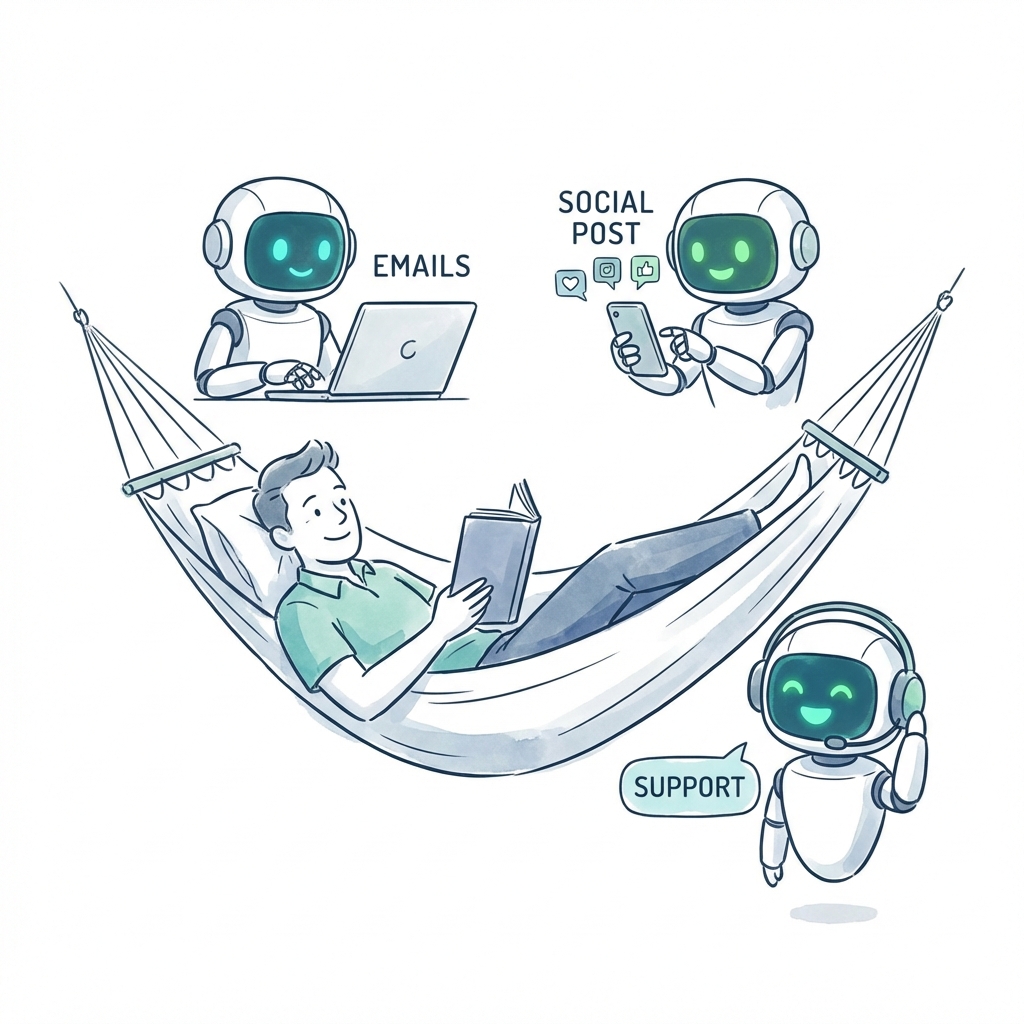
AI Automation
5 Proven Ways AI Employees Save Small Businesses 20+ Hours/Week
Discover how AI-powered employees are helping small businesses automate their daily operations, from email management to social media posting.
7 min read
ReadDiscover how an AI agent orchestration platform can automate complex workflows, scale your operations, and free up your team to focus on strategic growth.
Imagine you have a team of highly specialized experts working for you. One is a brilliant market researcher, another a savvy social media manager, and a third is a customer service pro. Now, imagine this team was made of AI, worked 24/7 without ever needing a coffee break, and was perfectly coordinated by a master conductor to grow your business while you sleep. That, in a nutshell, is an AI agent orchestration platform.
It's a system designed to manage a whole crew of specialized AI agents, making sure they work together seamlessly to handle complex business workflows from start to finish. Think of it less as a single tool and more as a digital central command for your autonomous AI workforce—the key to unlocking a future where your business runs on autopilot and you finally have the freedom to focus on the big picture.
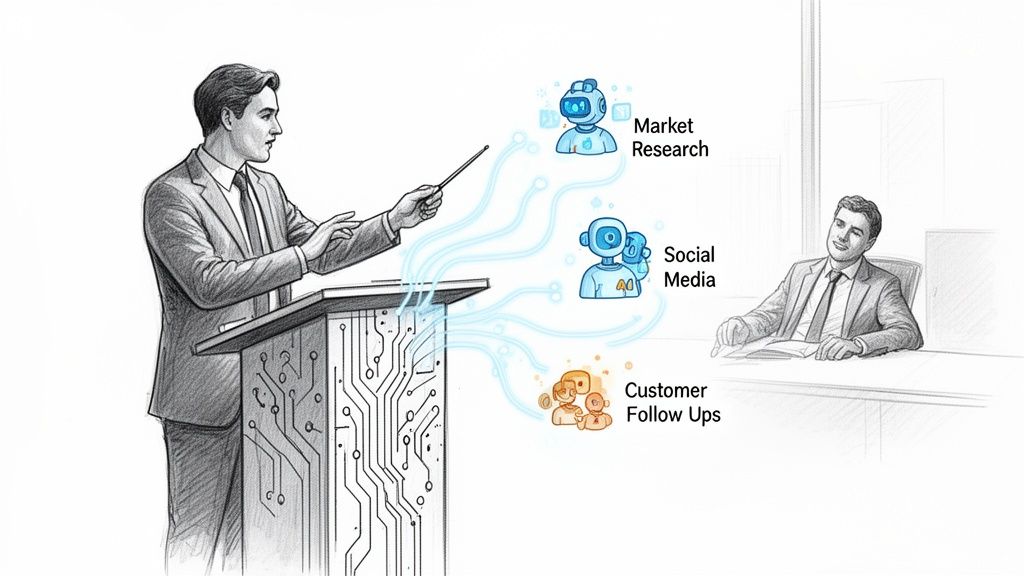
We've all dreamt of it: a business where the tedious, repetitive tasks just... get done. A system that runs smoothly in the background, freeing you up to think bigger, innovate, and maybe even take a real vacation. This isn't science fiction anymore. It's exactly what an AI agent orchestration platform brings to the table, and it's a huge leap beyond simple chatbots or basic automation scripts.
What we're talking about here is a workforce of digital "employees." Each AI agent is a specialist. One might be an expert at digging up market research, while another excels at writing and scheduling social media posts or handling customer follow-up emails. The platform is the manager, assigning tasks, coordinating their efforts, and ensuring the final outcome aligns perfectly with your business goals.
The core promise is beautifully simple: stop wasting your team's talent on manual, low-value work. When you have AI agents handling the operational grind, you get back your most valuable resources—time and brainpower. Imagine what you could achieve if you reclaimed 10, 20, or even 30 hours every week.
This shift allows you to focus on what humans do best: strategy, creative thinking, and building the relationships that actually drive growth.
Just think about what becomes possible:
An AI agent orchestration platform doesn't just automate tasks; it automates entire workflows. It's the difference between having a calculator and having an entire accounting department working for you around the clock.
This guide is all about pulling back the curtain on how this technology works and why it’s quickly becoming a must-have for any business that wants to stay competitive. We’ll show you how to start building your own AI workforce. Platforms like Dooza are designed to make this accessible to everyone, from solo founders to entire marketing departments. The era of hiring individual AI "employees" to run your business on autopilot is officially here.
So, what exactly is this technology that's powering true business automation? Think of an AI agent orchestration platform as the project manager for a team of digital employees. It's the conductor that makes sure every specialized AI agent—your writers, researchers, and analysts—all work together to get a complex job done from start to finish.
Let's say you're launching a new product. You need to research the market, analyze what competitors are doing, draft a blog post, create a bunch of social media content, and then schedule it all. A single AI tool, like a simple chatbot or a content generator, just can't handle that entire process. It’s like asking a drummer to play an entire symphony alone; they’re a master of their instrument, but they can't cover the violins and trumpets.
This is where orchestration changes the game. It doesn’t just automate a single task. It automates an entire workflow by coordinating multiple, specialized agents. Each agent is a master of its own craft, and the platform is the brilliant manager making sure they all collaborate flawlessly.
To really get a feel for how these platforms can automate your work and give you back your time, it helps to break them down into their three key parts.
AI Agents (The Specialists): These are your individual digital workers. Each agent is a purpose-built AI designed to be an expert at a specific task. For example, you might have a 'Lead Researcher' agent that scours LinkedIn for new prospects, a 'Content Writer' agent that drafts blog posts, and an 'SEO Analyst' agent that optimizes them for Google. Just like building a human team, you pick the right agents for the right jobs.
The Orchestration Engine (The Director): This is the brains behind the whole operation. The orchestration engine takes your high-level goal, figures out all the steps needed to get there, and then assigns those tasks to the right AI agents. It manages the entire process from start to finish, ensuring everything happens in the correct order and that agents pass information between each other without a hitch.
Integrations (The Connectors): For these agents to do any real work, they need access to the same tools your team uses every day. Integrations act as the bridges connecting your AI agents to your CRM, email platform, social media accounts, and project management software. This is what allows them to move from just thinking and planning to actually doing things in your business ecosystem. For example, an agent can't just write an email; it needs to connect to your Gmail or Outlook to actually send it.
The real magic of an AI agent orchestration platform isn't just having smart agents; it's getting them to work together as a powerful, cohesive team. It turns a collection of separate tools into a unified, autonomous workforce ready to execute complex strategies for you.
For example, you could give the platform a simple command like, "Launch a promotional campaign for our new feature."
The orchestration engine would immediately kick off a coordinated sequence of actions:
This entire multi-step process runs on its own, turning what used to be a week of manual effort into an automated workflow that you barely have to touch.
Before we dive deeper, let's look at a quick comparison to see just how different this approach is.
| Business Goal | Manual / Disconnected AI Approach | Orchestrated AI Workflow |
|---|---|---|
| Launch a Blog Post | 1. Manually research keywords. 2. Use a separate AI writer for a draft. 3. Edit and optimize for SEO yourself. 4. Manually upload and format in your CMS. |
Give one command: "Write an SEO-optimized blog post about [topic]." The platform handles research, writing, optimization, and even drafting it in your CMS. |
| Run a Social Media Campaign | 1. Brainstorm ideas. 2. Use one AI to generate text posts. 3. Use another AI to create images. 4. Log into multiple platforms to schedule each post. |
Tell the orchestrator: "Create and schedule a 5-day social campaign for our new ebook." Agents generate all text and images and schedule them across all channels. |
| Onboard a New Customer | 1. Manually send a welcome email. 2. Create a task in your CRM to follow up. 3. Add their info to your newsletter list. 4. Forget a step and look unprofessional. |
The workflow triggers automatically when a customer signs up. An agent sends a personalized email, creates CRM tasks, and adds them to the correct lists—instantly. |
The difference is clear. Instead of you having to manage a dozen different tabs and manually copy-paste information between tools, an orchestration platform handles all the connections and handoffs for you. It’s this collaborative power that sets it apart, giving even the smallest teams the operational might of a much larger company.
The move towards autonomous AI assistants isn't just a fleeting trend. It's a fundamental shift in how businesses get work done. We're on the cusp of a new economy where digital employees, managed by an ai agent orchestration platform, take over critical operations. This frees up your human team to focus on what they do best: strategy, creativity, and growth. This isn't science fiction—it's happening right now, fueled by clear ROI and the promise of incredible efficiency.
Imagine getting hundreds of hours back every single month. Picture your marketing campaigns, customer support queues, and even your SEO efforts running on their own, flawlessly executing your strategy while you focus on your next big idea. This is the reality that platforms like Dooza are creating for startups and small businesses. You’re not just buying another piece of software; you're building a new operational model that gives you a serious competitive edge.
For any growing team, this wave of technology is a game-changer. It gives a small startup the operational muscle of a huge corporation, but without the crippling overhead. The power to deploy a team of AI agents that work 24/7 turns scaling from a massive headache into something you can manage with a click.
This simple diagram breaks down the hierarchy. Think of the platform as the conductor, the engine as the orchestra, and the agents as the individual musicians, all working in harmony.
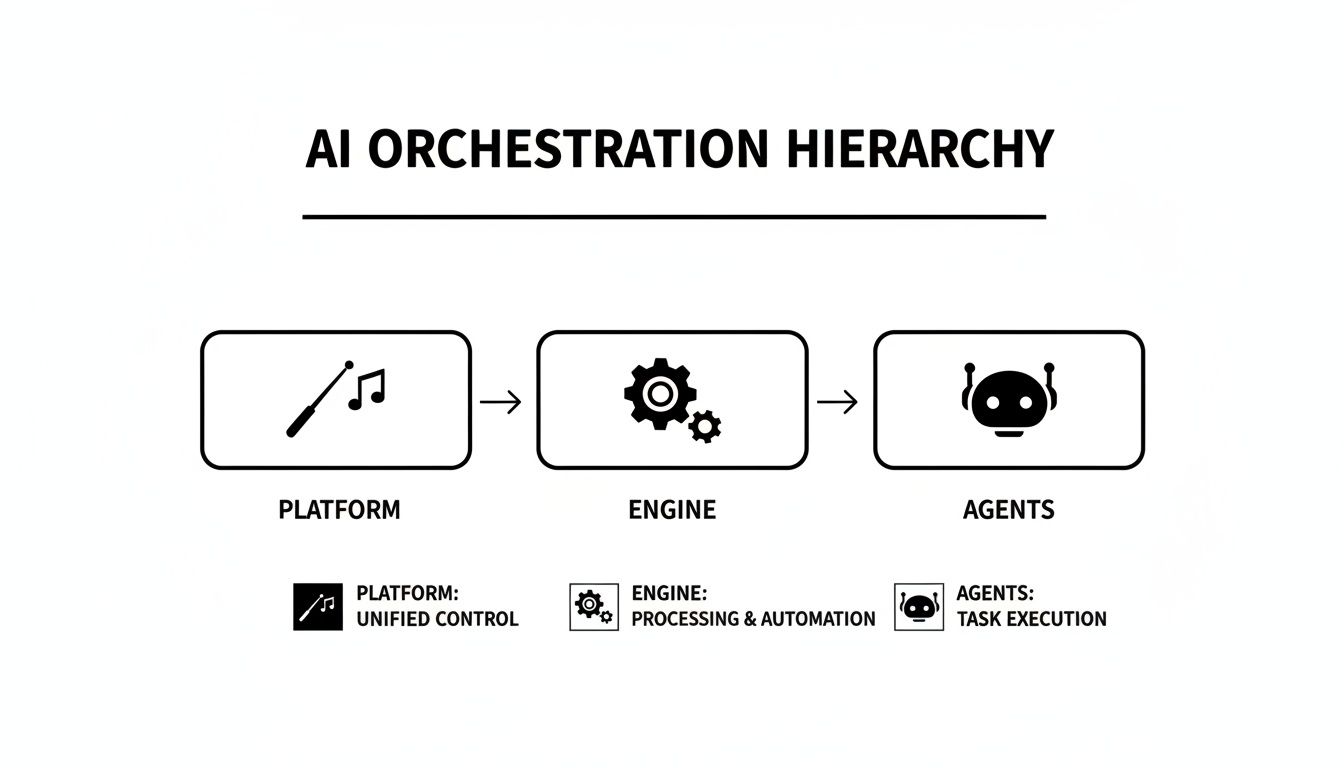
This setup is what allows a single command to kick off a complex series of tasks that ripple across your entire business. For example, you can tell it, "Find me 10 new leads in the SaaS industry in California," and a team of agents will autonomously research, qualify, and add those leads to your CRM without you lifting a finger.
The financial world is paying close attention, and the market forecasts confirm this is a multi-billion-dollar shift. Between now and 2030, we're seeing value move away from standalone chatbots and toward orchestrated "AI employees" that manage everything from social media posts to complex customer inquiries.
Deloitte’s research suggests the autonomous AI agent market could hit $35 billion by 2030. With smart orchestration, that potential could climb closer to $45 billion. Zooming in on the platforms themselves, the AI orchestration market is already valued at over $11 billion in 2025 and is expected to triple before the decade is out.
For a startup or a small business, these numbers point to one simple truth: platforms like Dooza aren't just a neat experiment. They are becoming essential for any company that wants to compete.
This explosive growth comes from moving beyond isolated AI tools to create coordinated AI teams. For example, instead of using one tool just for support tickets, businesses are looking for solutions that can automate the entire customer service journey. If you're currently reviewing your own support tools, our guide on Gorgias alternatives highlights this very shift. The real magic happens when individual agents start collaborating, sharing context, and tapping into your existing tools to hit major business goals.
Theory is one thing, but seeing how this all works in the real world is what really matters. An AI agent orchestration platform isn't just an abstract idea; it’s a hands-on engine for automating your business so you can get back to what you do best.
Think of it as hiring a team of digital employees. They work around the clock to grow your company, while you get to focus on strategy and the big picture.
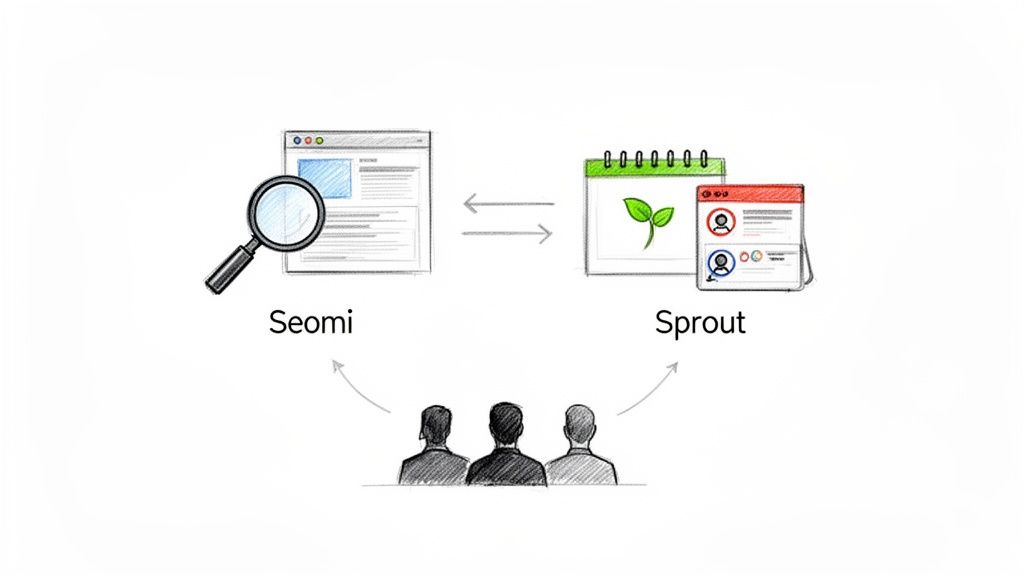
This is where the dream of automation stops being a dream and becomes your daily reality. Let’s meet a few of these AI employees and see how they turn chaotic, manual workflows into smooth, autonomous operations.
Marketing teams are always juggling a dozen things at once—content creation, lead nurturing, social media, campaign analysis. For a small team trying to make a big impact, the workload can feel overwhelming.
The Problem: Your marketing lead is sinking 20+ hours a week just researching blog ideas, writing social posts, and then scheduling everything across different platforms. There's barely any time left for high-level strategy or digging into what’s actually working.
The Agent Solution: This is where 'Sprout,' your autonomous social media manager, steps in. You give Sprout a clear goal: "Increase engagement on LinkedIn and Twitter by 15% this quarter." The platform’s orchestration engine then assembles a specialized team of agents to get the job done.
The Outcome: Sprout puts your entire content pipeline on autopilot. What used to take up half the week now runs itself, saving hundreds of hours a year. This frees your marketing lead to focus on building partnerships, refining your brand's voice, and other tasks that truly move the needle. To see exactly how this works, you can learn more about AI-powered social media automation and see how it's changing the game.
Operations and HR teams are often buried in repetitive administrative work. Think client onboarding, managing internal reports, and processing paperwork. These manual tasks are not only slow but are also prone to human error, creating bottlenecks that stunt growth.
The Problem: Onboarding a new client is a chaotic, multi-step dance of sending welcome emails, updating the CRM, and trying to schedule a kickoff call. If just one step is missed, it can create a terrible first impression and put the entire relationship at risk.
The Agent Solution: You can deploy an 'Onboarding Specialist' agent. As soon as a new client signs up, the platform automatically kicks off a precise workflow.
The Outcome: Client onboarding becomes immediate, consistent, and completely error-free. Your operations team is no longer a bottleneck. Instead, they become supervisors of an incredibly efficient system, capable of handling 5x the client volume without needing to hire more staff. This gives a small team the operational horsepower of a much larger company.
An AI agent orchestration platform transforms your team from 'doers' into 'directors.' You set the strategy, and your AI workforce executes it flawlessly, day and night.
Great customer support is non-negotiable, but staffing a team around the clock is incredibly expensive. In today's world, customers expect instant answers, and making them wait can be costly.
The Problem: A small support team can only answer so many tickets during business hours. Any questions that come in overnight or on the weekend just sit in a queue, leading to frustrated customers and damaging reviews.
The Agent Solution: Introduce a 'Support Resolution' agent. This AI employee connects to your helpdesk and is trained on your company’s entire knowledge base. It can instantly handle over 80% of common customer questions.
The Outcome: Your customers get instant support 24/7, which dramatically improves satisfaction and keeps them coming back. Your human support team is no longer bogged down by repetitive questions. Instead, they can focus their expertise on solving the most complex and valuable customer problems—a simple shift that delivers a massive ROI.
The world of AI agent orchestration platforms is blowing up, and frankly, trying to pick the right one can make your head spin. You’ve got this vision of automating your work and winning back your time, but that dream depends entirely on picking the right tool for the job.
Let's cut through the hype. A good choice will rocket your growth, while a bad one will just become another frustrating piece of software you have to manage. This guide will help you focus on what really matters, so you can find a platform that solves today's problems and is ready to grow with you tomorrow.
What's the quickest way to get a return on your investment? Use agents that are ready to go, right out of the box. A solid AI agent orchestration platform should come with a whole crew of pre-built "AI employees" for the tasks you’re already doing every day. Think of it as your shortcut to instant results.
Before you even think about signing up, get answers to these questions:
Platforms like Dooza are built on this very idea, offering a roster of hireable AI agents for specific roles. This approach alone can save you hundreds of hours you’d otherwise waste trying to build and train these agents from scratch.
The depth and quality of a platform's pre-built agent library tells you a lot about its maturity. A big library shows the company actually understands real business problems and has already solved them.
Okay, pre-built agents are great for the common stuff, but your business isn't common. It's unique. The real magic of an AI agent orchestration platform happens when you can build custom agents that perfectly match your unique workflows. This is how you create a real competitive edge.
The best platforms make this easy. You shouldn’t need a PhD in engineering to build a useful AI assistant. Look for a no-code or low-code builder that lets you tell an agent what to do in plain English. For example, creating a 'Lead Qualification Agent' should be as simple as describing its tasks: "When a new lead comes in, research their company on LinkedIn, check their title, and if they're a manager or above, update their record in our CRM and tag them as 'High Priority'." It's that simple.
Here’s a hard truth: an AI agent is useless if it can't connect to your other tools. Without smooth integrations, your new AI team is trapped on an island, unable to actually do anything important. You absolutely have to dig into how well the platform plays with your existing tech stack.
Make a checklist of your must-have integrations:
Beyond just connecting to apps, the best platforms understand that humans and AI need to work together. They make it incredibly easy for your team members to collaborate with their AI counterparts. For instance, can an AI agent draft an email and then automatically send it to you in Slack for a quick one-click approval before it goes out? This is key for those complex jobs where an agent does 90% of the heavy lifting before passing it to a person for final approval. The platform should feel less like a tool and more like a shared digital office for your entire team—both human and AI.
You might be surprised at how affordable this can be. It's worth exploring the pricing of AI agent platforms to see how a system like this can fit into your budget.
The term AI agent orchestration platform might sound a bit intimidating, but getting started is surprisingly straightforward. You don’t need a crew of developers or a month of training to see a real impact. Modern platforms like Dooza are built to be intuitive, letting you assemble an autonomous workforce and start winning back your time in about a week.
This isn’t about a massive, technical overhaul. It’s about taking small, deliberate steps each day to put your business on autopilot. Let's walk through a simple, day-by-day plan that shows how anyone can start automating their work almost immediately.
The first move is to give your new AI team the keys to your digital workspace. This is as simple as connecting the tools you’re already using every single day.
This is what a simple, automated workflow looks like inside a user-friendly platform.
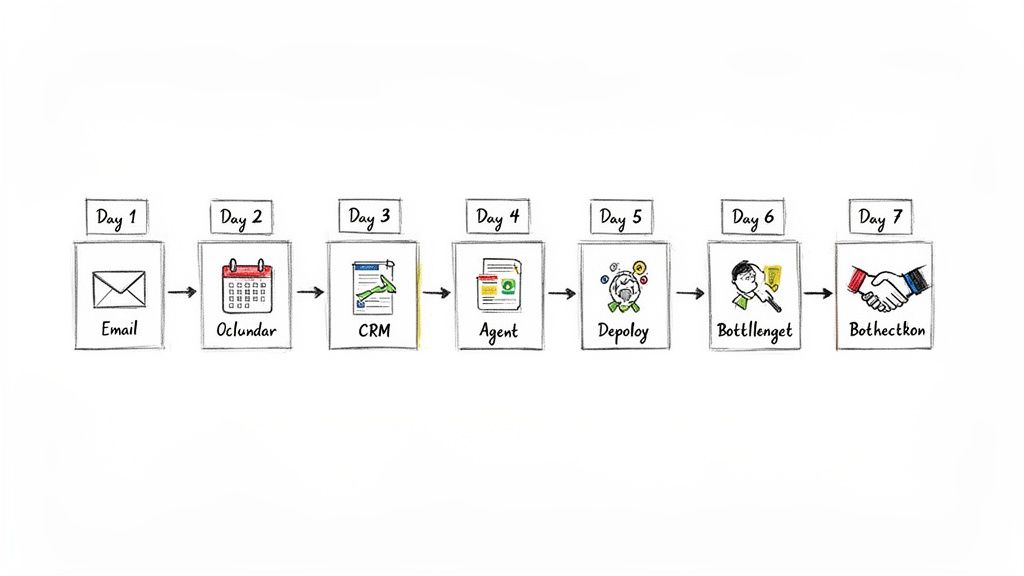
The image here shows how you can visually link different tools and AI agents to build a powerful process without touching a single line of code.
With the basics connected, it’s time to tackle a real business problem. Think about that one task that absolutely drains your week—the one you wish you could hand off forever.
The true power of an AI workforce isn’t just in handling small tasks; it’s in systematically eliminating your biggest operational headaches, one by one.
On Days 3 and 4, pinpoint that major bottleneck. Is it qualifying new leads? Managing your social media channels? Or maybe it's the constant research required to create content. Once you’ve picked your target, assign a specialized AI agent to solve it. For instance, you could deploy a "Lead Qualification Agent" that researches new sign-ups and updates your CRM on its own.
By Day 5, you'll be watching this agent work, freeing up hours of your team’s time. You've just turned a manual grind into an autonomous workflow in a matter of days. For more ideas on organizing these new workflows, check out our guide on how to build an AI-powered database.
The final step is to create a seamless handoff between your AI and human teams. On Day 6, bring a team member into the loop to collaborate directly with the new AI agent. Have them supervise its work, give it feedback, and see firsthand how a hybrid workforce functions. For example, have the agent draft a sales outreach email and send it to your sales rep for a one-click approval.
On Day 7, it’s time to review the results. You’ll have a fully deployed AI agent, a team member who is comfortable with the new process, and tangible hours saved. You’ve successfully launched your first AI employee, proving that the dream of a more automated, efficient business isn't some far-off goal—it’s something you can achieve this week.
Jumping into the world of AI employees can feel like a huge step. You see the vision—a business that practically runs itself, leaving you free to focus on the big picture—but you've got questions. Totally normal. Here are some straight answers to the things we hear most often from business leaders.
Great question. Tools like Zapier are fantastic for connecting apps with simple, trigger-based rules. Think "if this happens, then do that." For example, "When I get a new lead in my CRM, send a Slack notification." It's linear and incredibly useful for specific tasks.
But an AI agent orchestration platform is playing a different game entirely. It’s not about just connecting two apps; it’s about deploying autonomous agents that can think, reason, and manage complex, multi-step projects.
Think of Zapier as a set of dominoes—you push one and it reliably knocks over the next. An orchestrator, on the other hand, is like a general contractor managing a whole crew of specialists (plumbers, electricians, painters) to build a house. It coordinates multiple AI agents, each with its own skills, to achieve a single, high-level business goal like, "Find 10 qualified leads, research them, and draft personalized outreach emails for each one."
This is a deal-breaker, and it should be. Any platform worth its salt makes security its absolute top priority. Look for solutions built with enterprise-grade security, including things like end-to-end data encryption and strict access controls. When you're vetting a platform, dig into their policies on data privacy and see if they comply with standards like GDPR.
A trustworthy provider will treat your data like a vault. Your confidential business information should always remain secure within your own workspace and never be used to train outside models without your direct permission.
This is the only way you can confidently automate important parts of your business without putting your data at risk.
Not anymore, and that's the real breakthrough here. The best modern platforms are designed specifically for business users—the founders, marketers, and operations pros who are actually doing the work. The goal is to make automation accessible to everyone, not just engineers.
For instance, you can often "hire" pre-built AI employees for roles like social media management or customer support in just a few clicks. If you want something custom, you can usually just describe the workflow you need in plain English. The idea is to empower you to build your own AI workforce without ever having to write a single line of code.
Ready to stop managing tasks and start directing a workforce? With Dooza, you can hire your first AI employee today and see your business run on autopilot. Start building your AI team now.
Article created using Outrank
Automate your business with AI employees that work 24/7.
Discover how AI-powered employees are helping small businesses automate their daily operations, from email management to social media posting.
![AI Agents vs Agentic AI — What Nobody Tells You [2026]](/blog/ai-agents-vs-agentic-ai.png)
Confused by the jargon? We break down the differences between Generative AI, AI Agents, and Agentic AI in simple terms.
Join thousands of companies using Workforce to automate their work. Get started for free today.
No credit card required · 7-day money-back guarantee · Cancel anytime