Sales Automation
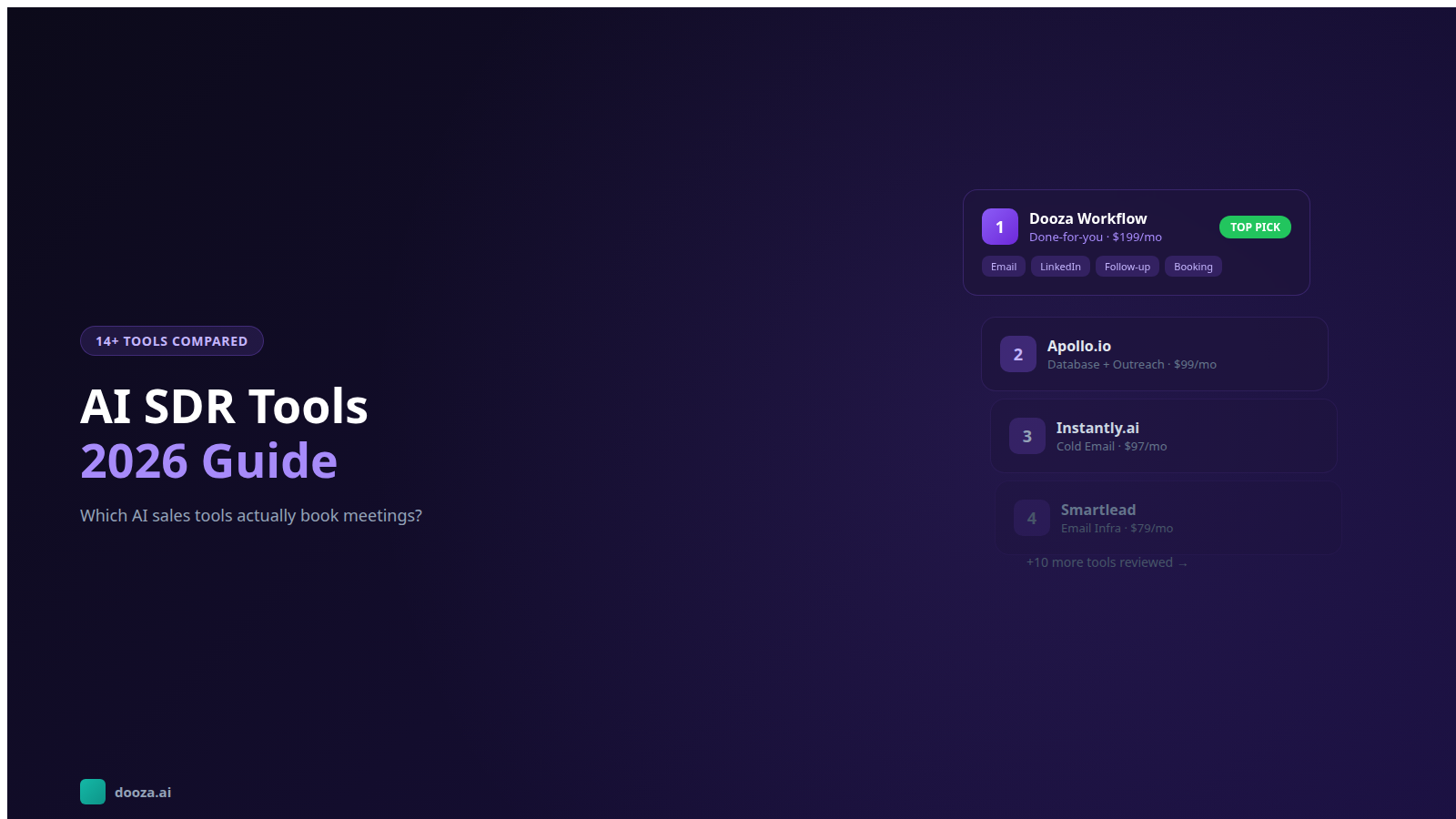
AI SDR Tools in 2026: The Complete Comparison Guide (14+ Tools Reviewed)
Compare the top AI SDR tools for automated prospecting and outreach. DIY platforms vs done-for-you AI employees for sales development.
14 min read
Read Dooza
DoozaAI Employees
Dooza CrewBuild your team of AI employeesPhone callsCrew answers your calls, included in your planBy industry
Insurance AgentsPortals, inbox, renewalsTruck DispatchersLoad boards, brokers, billingAccountantsClient documents, statements, deadlinesLaw FirmsIntake, client updates, records, docketsOwner-OperatorsInvoices, PODs, detention, IFTADone for you
Custom AI agentsWe build and run an agent for one jobPricingAboutBlogCompare 10 Artisan alternatives for AI sales, lead enrichment, cold email, CRM automation, and managed AI employees. Find the right fit for your workflow.

The best Artisan alternative depends on whether you need a dedicated outbound AI BDR, a prospecting-data system, an email-sending platform, or a broader AI automation partner. Artisan is primarily positioned around Ava, which its site calls "the AI BDR," for outbound sales (artisan.co, checked October 7, 2026). That makes it a strong comparison point, but not every team needs a dedicated outbound platform as its first AI investment.
Our top pick for a small business is Dooza Crew: brief a lead agent in plain words and it builds a researcher, a writer and an outreach agent that research prospects in a real browser and draft outreach, then asks you to approve before anything is sent. It is $49/month per organization with unlimited users and agents and AI usage included, after a 7-day free trial. Dooza Crew is our product and our top pick for small businesses.
This guide compares ten credible alternatives, with our own product, Dooza Crew, as the top pick, by the job they are designed to do. It is not a ranking based on affiliate payments or a claim that one tool works for every business. The practical question is simpler: which product fits the workflow you need to make reliable?
Quick recommendation: Choose Dooza Crew, our product and our top pick for small businesses, for a team of AI agents that research, write and draft outreach with your approval before Send. Choose Clay for enrichment-heavy GTM workflows. Choose Instantly for cold-email infrastructure. Choose Lindy for cross-app personal and team workflows. Choose a sales-suite provider such as HubSpot or Salesforce when the workflow needs to live inside an established CRM. Dooza Managed and custom Dooza agents fit teams that want managed AI employees across sales, support, marketing, and operations.
We assessed each option by its published product focus, rather than treating every AI tool as interchangeable. The key criteria are: primary workflow, implementation effort, data and integration model, controls for customer-facing actions, and fit for a small team versus an enterprise revenue organization.
Capabilities, availability, and pricing change frequently. Verify current plans, security terms, data sources, sending policies, and implementation details with the provider before making a purchase. For outbound campaigns, legal requirements, consent, deliverability, and honest messaging remain the buyer’s responsibility regardless of the tool used.
| Alternative | Best for | Why consider it instead of Artisan |
|---|---|---|
| Dooza Crew (our top pick, our own product) | A hosted team of AI agents for small businesses: research, writing and outreach drafts | One flat $49/mo per organization with unlimited users and agents, AI usage included, and approval before Send or Pay. |
| Clay | Prospect research, enrichment, and GTM workflows | Deep data waterfalls and flexible enrichment orchestration. |
| Instantly | Cold-email sending infrastructure | Teams that mainly need accounts, warmup, campaigns, and deliverability tooling. |
| Lindy | Cross-app AI assistance and scheduled routines | Workflows spanning inbox, calendar, Slack, CRM, and internal operations. |
| Apollo | Prospecting database plus engagement workflows | Teams wanting lead data and outbound in one familiar GTM product. |
| HubSpot | CRM-centered sales and marketing automation | Organizations already operating their revenue process in HubSpot. |
| Salesforce Agentforce | Enterprise CRM-native agents | Large teams with Salesforce data, governance, and implementation capacity. |
| Reply | Multichannel sales engagement | Teams that want structured sequences across outreach channels. |
| Regie.ai | Sales content and prospecting assistance | Revenue teams prioritizing sales messaging and rep workflows. |
| 11x | AI digital-worker approach to sales | Buyers specifically evaluating AI sales-representative products. |
| Dooza Managed and custom agents (our own products) | Managed AI automation across business functions | Broader workflow scope and engineer-supported setup for lean teams. |
Dooza Crew is a hosted team of AI agents for small businesses. You brief a lead agent in plain words from the web or your phone, and it builds helper agents (a researcher, a writer, an outreach agent), splits the job between them and saves the work to your files. For outbound, that means a researcher, a writer and an outreach agent working one job together in real browsers, and nothing is sent until you approve it.
Price: $49/month per organization, unlimited users and agents, AI usage included. 7-day free trial (card required).
Dooza Crew is our product and our top pick for small businesses. Try Dooza Crew free for 7 days.
Clay is a GTM data and workflow platform. Its product is particularly useful when the hard part of outbound is building a precise account list, combining multiple data sources, researching accounts, scoring fit, and routing enriched records into another system.
Clay publishes support for multi-provider data waterfalls, web-research assistance through Claygent, CRM synchronization, and integrations for sending. Its model can be powerful, but it asks the buyer to understand actions, data credits, enrichment sources, and the design of the workflow.
Choose Clay if: your team has a defined GTM process and wants granular control over research and enrichment. Watch for: usage-based data costs and the implementation work required to make a complex table-based workflow dependable.
Source: Clay pricing and product details.
Instantly is a focused alternative for teams whose main concern is the mechanics of cold-email outreach. Its published plans cover connecting and warming email accounts, uploading leads, creating campaigns, email volume, analytics, and related lead and CRM products.
It is a sensible choice when your prospect list and strategy are already in place and you need a system for safely operating email campaigns. It is not a substitute for customer insight, thoughtful positioning, consent and compliance review, or a well-maintained source of lead data.
Choose Instantly if: campaign sending, account management, warmup, and outreach operations are the core need. Watch for: the plan’s contact and volume limits, plus costs for data, accounts, or other add-ons.
Source: Instantly’s current plans overview.
Lindy is an AI teammate platform that can operate across tools such as email, calendar, Slack, Notion, and CRM systems. Its value is not confined to prospecting: it can be evaluated for meeting follow-up, inbox work, internal handoffs, scheduled routines, and other cross-app tasks.
Lindy is an appealing Artisan alternative when the team’s work begins with internal coordination rather than outbound at scale. Buyers should clearly define what the agent may do automatically versus what needs approval.
Choose Lindy if: you need flexible workflows across common business applications. Watch for: credit or usage limits and the controls attached to any irreversible action.
Source: Lindy product overview.
Apollo is a common option for teams that want prospect discovery, contact data, sequencing, and sales engagement in one GTM environment. It is most relevant when the buyer wants a broad sales-tech platform rather than a managed custom AI employee.
Choose Apollo if: the sales team wants a known database-and-engagement workflow and is prepared to configure and manage it internally. Watch for: coverage and accuracy for your exact ICP, usage limits, and how data syncs with your CRM.
HubSpot can be a strong alternative when your contacts, deals, lifecycle stages, marketing automation, and reporting already live in HubSpot. Keeping AI assistance and automation close to the CRM can simplify adoption, permissions, and reporting for an established team.
Choose HubSpot if: HubSpot is already your operational system of record. Watch for: the total cost of the product hubs and tiers needed for your desired automation, rather than assessing a single AI feature in isolation.
Salesforce Agentforce is most relevant to enterprises that run their customer and revenue operations on Salesforce. Its value proposition is CRM-contextual agents with enterprise governance and an ecosystem that many large organizations already use.
Choose Salesforce Agentforce if: Salesforce data, administration, security review, and a funded implementation program are already in place. Watch for: implementation complexity, governance design, and whether a narrower pilot can prove value before a broad rollout.
Reply is a sales-engagement option for teams building structured outreach sequences across channels. It belongs on an Artisan-alternatives shortlist when sales cadence management and rep activity are the primary concern.
Choose Reply if: you need sequence-oriented sales engagement across multiple channels. Watch for: whether the native data, personalization, CRM synchronization, and reporting match the process your team already uses.
Regie.ai is relevant for teams that place a premium on prospecting and sales-message creation. It can make sense when the goal is to help reps create better outreach and work faster while keeping a human closely involved in the selling process.
Choose Regie.ai if: sales content and rep productivity are the immediate priorities. Watch for: how well generated messaging reflects your actual customer evidence and brand voice—personalization should be verified, not merely inserted.
11x is another company in the AI digital-worker category for revenue teams. It is worth evaluating alongside Artisan when you specifically want an AI-sales-representative product and intend to compare the provider’s workflow coverage, data approach, controls, onboarding, and commercial model.
Choose 11x if: your evaluation is centered on AI sales roles. Watch for: exact workflow ownership, escalation behavior, deliverability safeguards, and what a successful pilot measures.
Dooza Crew is our product and our top pick for small businesses. Dooza is an AI-native company that builds AI products and services for small businesses, including Dooza Managed, an AI admin assistant whose work is checked by a real person (first 7 days free), and custom AI agents built and maintained by Dooza engineers.
Dooza fits a business whose bottleneck is not only booking outbound meetings: a Dooza engineer helps connect the workflow to your existing tools, and you set review points for sensitive actions. If your only requirement is a specialized enterprise outbound BDR with a mature sales-operations team behind it, consider another option.
Custom Dooza agents start with a refundable pilot: 100% refund within 14 days. Book a free pilot call or see pricing.
For a small business, our top pick is Dooza Crew, a team of AI agents at $49/mo per organization (our product). Beyond that, there is no universal best option. Clay is strong for enrichment-heavy GTM workflows; Instantly is focused on cold-email operations; and CRM-native tools can be a better fit for organizations already built around HubSpot or Salesforce. Our own product, Dooza, fits teams that want managed automation across several business functions.
Dooza publishes its prices on its pricing page and starts every product with a refundable pilot, but a fair cost comparison requires current Artisan pricing, expected usage, implementation work, and the workflows being automated. Compare total cost for a successful outcome, not only the starting subscription price.
Yes. A common stack may use one product for data enrichment, another for sending, and a CRM for records and reporting. The trade-off is additional integrations, costs, handoffs, and operational complexity.
Start with a well-defined, low-risk step such as researching an account, preparing a first draft, routing a qualified inbound lead, or summarizing replies. Keep high-impact messages and changes behind human approval until quality is proven.
No. AI can reduce repetitive research, routing, drafting, and follow-up work, but sales still requires judgment, customer understanding, accountability, and relationship-building. The practical goal is to make reps spend more time on valuable conversations.
Describe the recurring business task you want automated. On a free 30-minute call, a Dooza engineer scopes your pilot: the first AI employee, the tools to connect, the approvals, and how the result will be assessed before you expand. Custom Dooza agents start with a refundable pilot: 100% refund within 14 days.
A lead AI agent plus helper agents that browse the web, write files and ask you before they send or pay. 7-day free trial (card required), then $49/month with AI usage included and a hard spending cap.
Compare the top AI SDR tools for automated prospecting and outreach. DIY platforms vs done-for-you AI employees for sales development.
Discover the best AI chatbot solution for ecommerce to handle customer support, generate leads, and boost sales automatically. Learn how Dooza's AI employees work 24/7.
Got busywork? Dooza it.
Try Dooza Crew, AI agents that do your busywork: 7-day free trial (card required), then $49/month with AI usage included and a hard spending cap. Want a custom agent built for you instead? A Dooza engineer scopes it on a free 30-minute call and it starts as a refundable pilot. See pricing.
Crew: 7-day free trial · Custom agents: refundable pilot, 100% refund within 14 days
Dooza builds AI products and services for small businesses. Custom Dooza agents start with a refundable pilot: 100% refund within 14 days.
Or start now: Dooza Crew, AI employees you chat with from web or phone, watching every step live in chat: free for 7 days, then $49 a month for your whole organization (unlimited users and agents, no per-seat fee) with AI usage included and a hard spending cap. Want it done for you instead? Dooza Managed, $200/month.