AI Agents for Small Business: Your New Digital Workforce
Discover how AI agents for small business can automate operations, marketing, and sales, freeing up your time to focus on growth and innovation.
23 min read
January 9, 2026
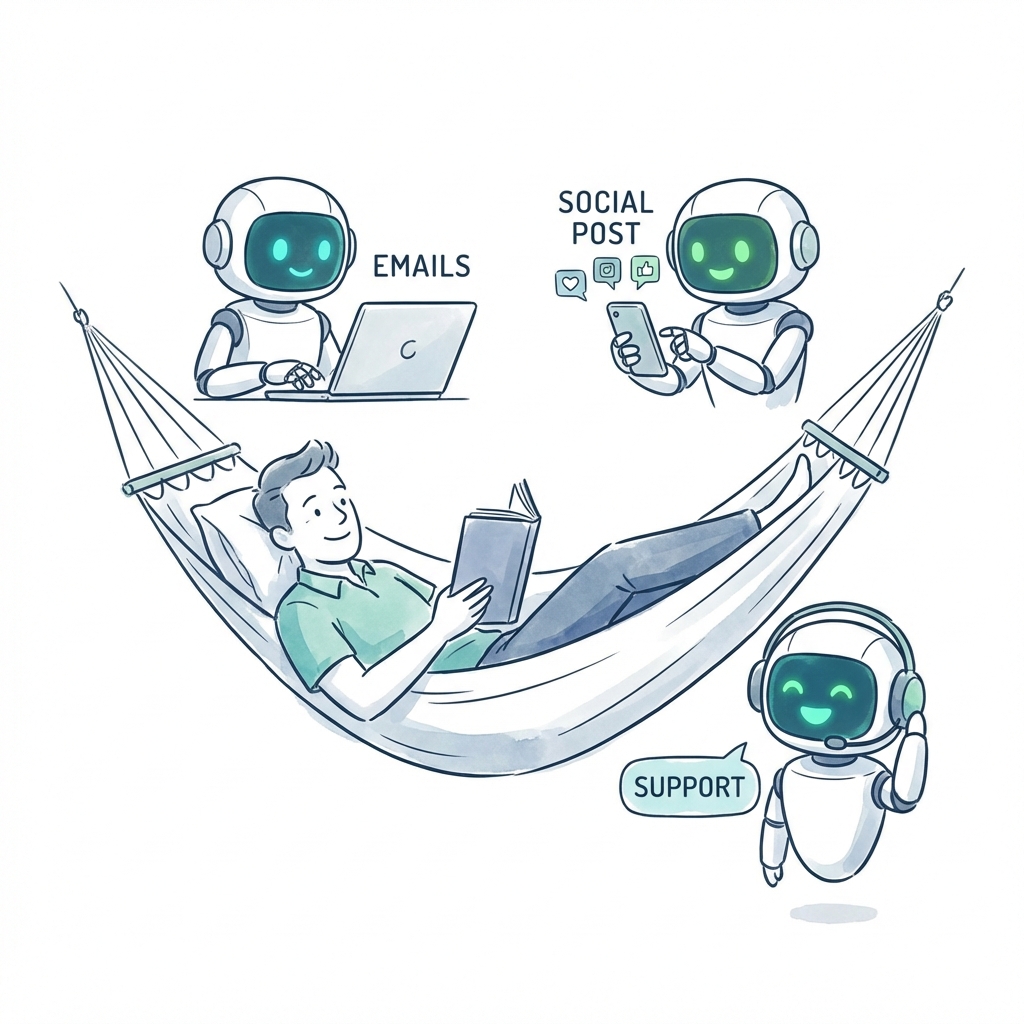
Imagine a team that works 24/7, tirelessly tackling your most repetitive tasks without ever needing a coffee break. Picture your marketing campaigns running on autopilot, your sales leads being qualified while you sleep, and your customer questions answered instantly. This isn't a sci-fi fantasy; it’s the reality that AI agents for small business are delivering right now. The best way to think about them isn't as software, but as digital employees you can hire for specific jobs, freeing you to do what you do best: grow your business.
Your New 24/7 Digital Workforce Has Arrived
What if you could clone yourself? Seriously, picture a version of you that never gets tired of sending follow-up emails, scheduling meetings, or keeping your CRM updated. This would free you up to finally focus on the big-picture strategy that actually grows your business. This is the dream of AI agents, powered by a concept called agentic AI.
Unlike the software we're all used to—which just follows a strict, pre-programmed script—these agents can reason, plan, and execute complex workflows on their own. They aren’t just completing single tasks; they’re managing entire business functions from start to finish. For example, instead of just sending an email, an AI agent can run the entire process of identifying a new lead, enriching their data, drafting a personalized outreach sequence, and scheduling a meeting—all autonomously.
From Passive Tools to Proactive Teammates
This is a huge shift in how we think about work. We're moving from just using tools to actually building autonomous teams. An AI agent is a proactive member of your staff—a digital employee that learns your processes and figures out how to handle new challenges without you having to hold its hand.
The core promise of AI agents is liberation. They liberate you from the endless cycle of repetitive administrative work, allowing you to reclaim your time and energy for innovation, client relationships, and strategic planning—the activities that only you can do.
To really grasp this change, it helps to see how different AI agents are from the apps and software we use every day.
How AI Agents Differ From Traditional Software
This table shows the fundamental shift from using passive software tools to deploying proactive AI agents for your business.
Characteristic
Traditional Software Tools
AI Agents (Your Digital Workforce)
Initiative
Reactive. Waits for your command.
Proactive. Takes initiative based on goals.
Function
Performs a single, specific task (e.g., send email).
Manages an entire workflow (e.g., run an email campaign).
Adaptability
Follows a rigid, pre-defined script.
Learns and adapts to new information and situations.
Collaboration
Works in isolation.
Collaborates with other agents and human team members.
Decision-Making
Makes no decisions; it's just a tool.
Makes autonomous decisions to achieve an objective.
This isn't just a simple upgrade; it's a completely new category of technology. We’re finally at a point where you can assemble a team of digital workers to run parts of your business for you.
The New Normal for Small Business Operations
This transition from passive software to a proactive digital workforce is no longer an experiment. It's quickly becoming the standard for any small business that wants to compete.
A recent survey of thousands of US small businesses revealed that 64.7% are already using or piloting AI. Even more telling, 76% of those adopters rated it as "very" or "extremely" valuable in their day-to-day work. The data points to one clear conclusion: treating AI agents as a scalable workforce is becoming the new normal. You can learn more about the latest small business AI trends and see how companies are adapting.
This is exactly where orchestrator platforms come into the picture. They act as a central hub where you can:
Hire specialized AI employees for roles like an SEO Specialist, a Social Media Coordinator, or an Inbox Manager.
Connect them to your existing tools, like your CRM or calendar, so they can work right inside your current ecosystem.
Enable collaboration between your AI agents and your human team, creating a powerful, blended workforce.
At the end of the day, these systems are designed to automate the grind. They handle the busywork so you can get back to building your vision.
Meet the AI Team Ready to Grow Your Business
So, this whole idea of a "digital workforce" is pretty exciting, but what does it actually look like day-to-day? Imagine walking in on a Monday morning to find a full month of social media content already written, approved, and scheduled, while a list of qualified sales leads waits in your inbox. That’s not some far-off dream—it’s just another day at the office with an AI team. Let's introduce you to the specialized AI employees you can bring on board right now.
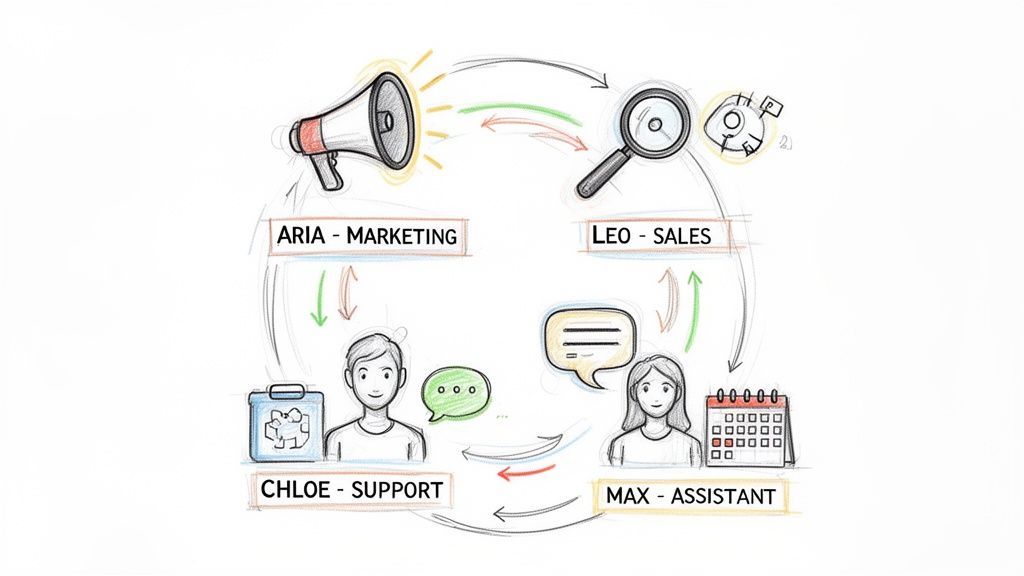
Aria The Autonomous Marketing Strategist
First up, meet Aria, your new marketing powerhouse. Her entire mission is to build your brand and generate leads, even while you sleep. You no longer have to stare at a blank page wondering what to post. Aria plugs directly into your marketing platforms, crunches the performance data, and runs campaigns from start to finish.
Here’s what Aria handles:
Content Creation: She’ll write genuinely engaging blog posts, social media updates, and email newsletters, all tailored to your brand’s voice. For example, a real estate agent could ask Aria to create a weekly newsletter featuring new listings and market trends, and she'll automatically draft and schedule it every Friday.
Campaign Management: Aria can schedule a whole month's worth of content across Instagram, LinkedIn, and Twitter, making sure you always have a consistent and professional presence.
Performance Analysis: She constantly tracks key metrics like engagement rates and click-throughs to figure out what’s resonating with your audience and then uses that insight to make future content even better.
With Aria on the team, you’re liberated from the daily grind of content creation. You get a consistent, data-driven marketing engine working around the clock to grow your audience and fill your pipeline.
Leo The Tireless Sales Development Rep
Next is Leo, your dedicated Sales Development Representative (SDR). We all know that finding and qualifying good leads is one of the most draining parts of sales. Leo automates that whole front-end process, freeing up your human sales team to do what they do best: build relationships and close deals.
Leo’s daily routine looks something like this:
Lead Prospecting: He scours the web and professional networks like LinkedIn to identify potential customers that perfectly match your ideal client profile. For instance, a B2B software company can tell Leo to find marketing managers at tech companies with 50-200 employees, and he'll build a targeted list overnight.
Data Enrichment: Once he finds a prospect, he finds and verifies their contact info, company details, and other relevant insights that help with personalization.
Personalized Outreach: Leo drafts compelling, personalized cold emails that don’t feel cold at all. He can reference a prospect’s specific pain points or recent company news to dramatically increase the chance of a reply.
Instead of your team spending hours on manual research, you get a steady stream of qualified, sales-ready leads delivered right to your inbox. You could even connect Leo to an AI employee who can run your SEO on autopilot, giving him an even bigger pipeline of warm, inbound leads to work with.
Chloe The Instant Customer Support Specialist
Customer expectations are sky-high these days—people want answers, and they want them now. That’s where Chloe comes in. She's your 24/7 customer support agent who makes sure no question goes unanswered, whether it’s at 2 PM or 2 AM.
Research shows that 82% of consumers expect an immediate response to their questions. Chloe makes this possible for any small business, turning support from a cost center into a real competitive advantage.
Chloe is designed to:
Resolve Common Issues: She can instantly answer all the frequently asked questions about pricing, features, or shipping. For an e-commerce store, Chloe can handle "Where is my order?" or "What is your return policy?" questions in real-time, 24/7.
Triage Complex Tickets: She’s smart enough to know when a problem needs a human touch. When that happens, she automatically routes the ticket to the right person on your team, complete with all the necessary context.
Gather Customer Feedback: After an interaction, Chloe can proactively follow up with customers to get feedback, helping you spot areas for improvement.
The reality is, Chloe can resolve up to 80% of routine inquiries without any human help. This frees your team to focus on the more complex, high-value customer relationships, all while ensuring every single customer feels heard and valued.
Max The Flawless Executive Assistant
Finally, say hello to Max, your AI Executive Assistant. His job is simple: to eliminate the administrative chaos that eats up so much of a founder’s day. Imagine a world with zero scheduling headaches and an inbox that only shows you what truly needs your attention. Max makes that a reality.
Max’s core functions include:
Intelligent Calendar Management: He seamlessly schedules meetings by coordinating with everyone’s calendars to find a time that works, then sends out the invites. No more back-and-forth emails. Just tell Max, "Find a 30-minute slot for me and Sarah next week," and he'll handle the rest.
Inbox Triage: Max sorts through your emails, flags urgent messages, drafts replies to common questions, and can even summarize long, rambling email threads into a few key bullet points.
Meeting Preparation: He automatically creates briefing documents for your upcoming meetings, pulling in attendee profiles from LinkedIn, notes from past conversations, and a clear agenda.
With Max handling the admin work, you get countless hours back each week. That’s more time for vision, strategy, and leading your business forward. That’s the promise of AI agents for small business, and it’s here today.
How AI Agents Run Your Workflows on Autopilot
What really sets AI agents for small business apart from basic automation tools is one game-changing skill: decision-making. Standard automation is like a robot on an assembly line—it follows a strict, pre-programmed script. An AI agent, on the other hand, is like a skilled project manager who can think, adapt, and solve problems to reach the goal you’ve set.
Let’s use a real-world example. If you asked a human assistant to plan a business trip, you wouldn't list every website they need to check. You’d just give them the objective: “Book me a trip to the conference in Dallas next month, and keep it under budget.”
Your assistant then gets to work, researching flights, comparing hotels based on location and reviews, and managing the budget. If a flight gets cancelled, they figure out a new plan. That’s exactly how an agentic AI thinks and acts inside your business.
From a Single Goal to a Finished Project
When you give your AI Marketing Agent a goal like, "Launch a new campaign for our summer sale," it doesn't just sit there waiting for the next instruction. It immediately starts a complete workflow, making its own decisions at every turn to get the job done.
Here’s what that might look like in practice:
Drafting Content: The agent writes a few different versions of ad copy, social media posts, and an email announcement, making sure everything sounds like your brand.
Sourcing Visuals: It then digs through stock photo sites or your company’s image library to find eye-catching visuals that fit the campaign's vibe.
Scheduling and Publishing: The agent schedules all the content to go live at the best possible times, based on when your audience is most active.
Monitoring and Adapting: Once the campaign is live, it keeps an eye on performance. If one ad is flopping, the agent can pause it and shift the budget to one that's working better—all without you lifting a finger.
This is what true automation feels like. You're not just handing off a single task; you're delegating an entire project to a digital employee that can manage all the moving parts from start to finish. You can discover more about the specific AI agents that automate these workflows and see how they can completely reshape your operations.
The Digital Office Where Your AI Team Collaborates
The real power kicks in when you have multiple AI agents working together as a team. Platforms like Dooza create a kind of "digital office" where these specialized agents can collaborate, pass information back and forth, and coordinate their efforts. They all tap into the same data from your CRM, project management tools, and other business software.
Think of it as having your own automated project team. Your Sales Agent spots a new lead, and your Marketing Agent instantly adds them to a personalized email sequence. Meanwhile, your Support Agent has all that context ready if the lead ever reaches out with a question.
This collaborative model used to be something only big corporations could afford, but it's now available to small businesses in a simple, ready-to-use format. This isn’t just some theoretical shift; it’s already changing how companies build teams and design their day-to-day operations.
In fact, experts predict that by 2028, at least 15% of day‑to‑day work decisions will be made by agentic AI, a massive leap from basically 0% today. The number of business apps with these kinds of agents built-in is also expected to grow by 33 times over the same period. For a small business, having a team of AI agents that share information isn’t a sci-fi dream anymore—it’s quickly becoming a must-have to stay competitive. You can learn more about these AI agent statistics and see the writing on the wall.
The Real-World ROI of Your AI Team
Hiring a digital workforce is a powerful idea, but let's talk about what it actually means for your bottom line. The results you get from putting AI agents to work aren't just theoretical—they're real, measurable, and have a direct impact on your revenue and efficiency. This is where the cool concept of automation turns into tangible business growth.
For small businesses, the return on investment often starts with your most valuable asset: time. What would you do with an extra 15 hours of your work week back? That’s 15 hours you’re no longer stuck managing schedules, doing mind-numbing data entry, or answering the same emails over and over again. Over the course of a year, that's a staggering 780 hours reclaimed—time you can pour back into big-picture strategy, building relationships with clients, or just finally getting ahead.
From Hours Saved to Dollars Earned
The financial benefit of using AI agents for small business is becoming incredibly clear, especially in the areas that actually drive growth. It's not just a hunch; recent research from McKinsey highlights that marketing, sales, and customer service operations generate roughly 75% of the total annual value from generative AI applications. For a startup or a growing agency, that’s a massive opportunity. You can dig into the specifics in McKinsey's comprehensive state of AI report.
When you start replacing 10–20 hours of manual tasks per person each week with specialized AI employees, the results start to compound. An SEO agent can be fine-tuning your website's performance around the clock while a social media agent engages your audience, freeing up hundreds of hours every quarter. This isn't just about trimming costs; it’s about unlocking new avenues for growth that were previously too time-consuming or expensive to pursue.
How Specific AI Agents Drive Key Business Metrics
To really grasp the ROI, you have to connect the dots between an AI agent's role and the key performance indicators (KPIs) you track every day. It's one thing to say an AI agent saves time, but it’s far more powerful to see exactly how it boosts the metrics that define your success.
This chart connects specific AI agent roles directly to the key performance indicators (KPIs) that matter most for business growth.
AI Agent Role
Tasks Automated
Business KPI Impacted
Marketing Agent
Content creation, campaign scheduling, ad management
Increased Lead Generation, Lower Cost Per Acquisition
This direct link between automation and business outcomes is what makes building an AI team such a compelling investment. Each agent has a clear job that contributes directly to a healthier bottom line.
The true ROI isn't just in cost savings. It’s in achieving a level of scale and personalization that was once impossible for a small team, allowing you to compete and win against much larger competitors.
This approach lets you build a business that is not only more efficient but also more resilient and ready to scale. The cost of hiring an AI employee is just a fraction of a full-time salary, yet the impact it can have on your core metrics is enormous. You can see just how affordable this investment can be by exploring the different pricing plans available.
Ultimately, the ROI of an AI-powered team is measured in faster growth, stronger customer loyalty, and the personal freedom you gain when your business starts running itself.
Your Guide to Building a Digital Workforce
Getting started with AI agents is a lot more intuitive than you might think. Forget about needing to code or hiring pricey consultants. Building your first digital employee is a practical, step-by-step process designed to deliver real value from day one, freeing you up to be the visionary your business needs.
Think of it just like hiring your first person. You'd figure out what you need help with, define their role, give them the right tools, and set some goals. It’s the exact same logic here—except your new team member works 24/7 and never needs a coffee break.
Step 1: Pinpoint Your Automation Starting Point
This first step is the most important: identifying the perfect task for your first AI employee. Don't try to automate your entire business at once. That's a recipe for frustration. Instead, look for the real bottlenecks—the repetitive, soul-crushing tasks that drain your time and energy.
Ask yourself a few honest questions:
What’s that one task I absolutely dread doing every day? Is it sorting through a mountain of emails, manually updating your CRM, or trying to keep up with social media posts?
Where do I waste the most time? Think about those processes that require constant manual input but very little creative or strategic thinking.
If I could offload one thing, what would free me up for high-impact work? Maybe it's lead generation, or maybe it's just having more time to talk to your best clients.
For example, if you spend the first hour of every day just clearing out junk email and sorting inquiries, that's a perfect target. Automating your inbox triage can instantly give you back five hours a week. These pain points are your starting line.
Step 2: Choose and Deploy Your First AI Agent
Once you know the job you need done, it’s time to "hire" your first agent. Modern platforms like Dooza make this as simple as picking a pre-built AI employee designed for a specific role. You don't have to build anything from the ground up.
For instance, if your biggest headache is a chaotic inbox, you’d hire an Email Management Agent. If you're struggling to keep your social media presence consistent, a Social Media Coordinator Agent is the perfect first hire.
The key is to start small and stay focused. Deploying one agent to solve one specific problem lets you see immediate results. It builds your confidence in the system and helps you understand the workflow before you even think about expanding your digital team.
This focused approach almost guarantees a quick win, proving just how much value AI agents for small business can provide right out of the gate.
Step 3: Connect Your Agents to Your Existing Tools
Your new AI employee shouldn't be stuck on an island. The real magic happens when they plug directly into the software and tools you already rely on every single day. This integration is what turns an AI agent from a handy gadget into a core part of your operations.
Usually, this is a simple, click-to-connect setup:
Link your Email Agent to your Google Workspace or Outlook.
Connect your Sales Agent to your HubSpot or Salesforce CRM.
Integrate your Executive Assistant Agent with your calendar and Slack.
This interconnectedness lets your digital workforce pull data, perform tasks, and collaborate with your human team members inside the ecosystem you've already built. It enhances your current workflows instead of forcing you to adopt new ones. For businesses ready to scale, you can even find partners who can help you with these integrations to build a completely cohesive system.
Step 4: Set Goals and Keep an Eye on Performance
Finally, just like any employee, you need to set clear goals and monitor their performance. Your AI agents need to know what a "good job" looks like. Give them a clear objective, like "clear all non-urgent emails from my inbox by 9 AM daily" or "generate 10 qualified leads per week."
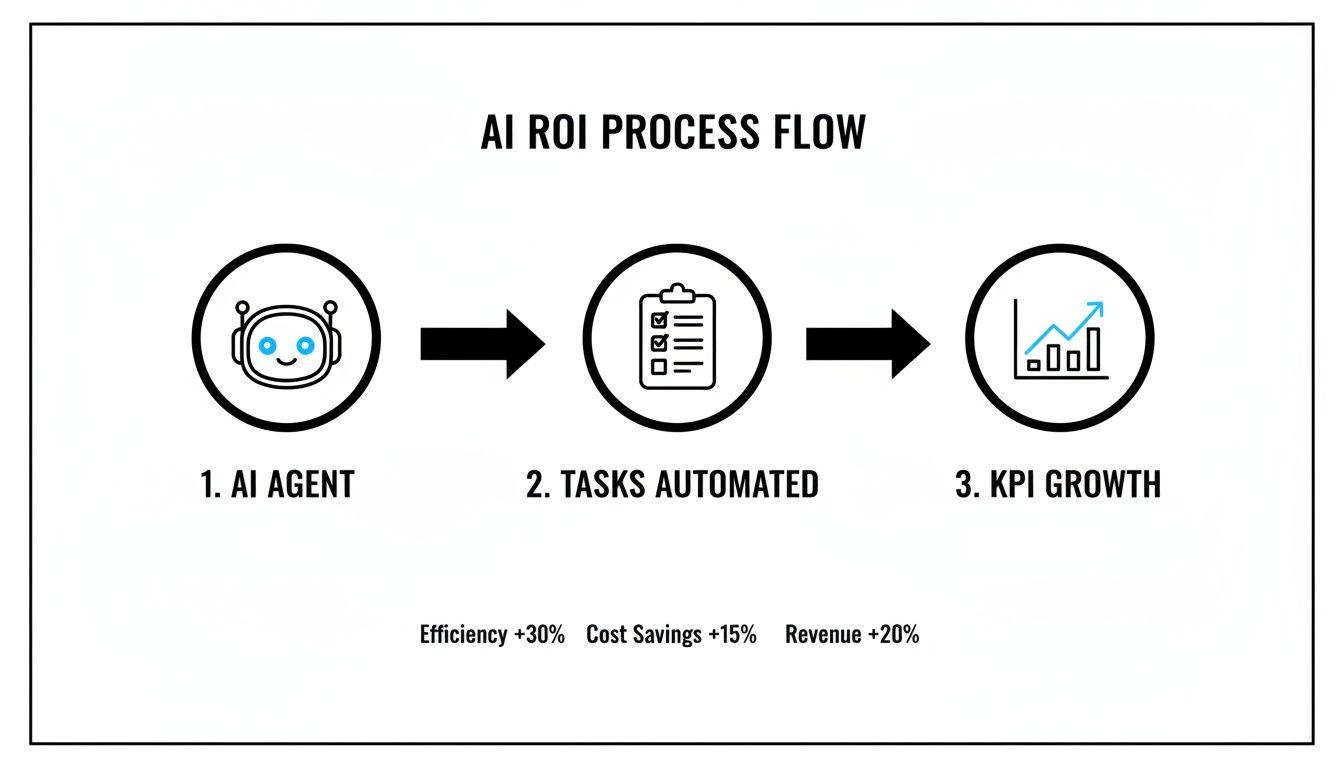
The path from hiring an agent to seeing a real return on your investment is a straight line: automate the task, watch your KPIs grow.
Most platforms give you a dashboard where you can see exactly what your agents are up to in real-time. You can review their work, offer feedback, and tweak their instructions. This isn’t some "set it and forget it" black box. It’s a transparent system where you’re always in the driver's seat, guiding your digital workforce to deliver incredible results.
The Automated Future of Small Business Starts Now
We've covered a lot of ground—from what AI agents actually are, to the real-world roles they can play, and even the practical steps to bring them into your operations. The future of work isn't about replacing your team; it's about giving them superpowers.
The small businesses that jump on this now are the ones building a serious competitive edge for the years to come. This is your chance to get out of the weeds and finally ditch the repetitive, low-impact tasks that drain your day.
By hiring AI agents for your small business, you free up your team (and yourself) to focus on what truly matters: big-picture strategy, creative problem-solving, and building real relationships with your customers.
Stop Being an Employee in Your Own Business
Think about it: a business that runs like clockwork, grabbing new leads and helping customers around the clock, even when you're not there. This isn't science fiction anymore. It's what autonomous AI employees make possible right now. The dream of a self-operating business is finally here, giving you back the freedom you were after when you first started.
The real takeaway is simple: Stop working in your business and start working on it. Get back to being the visionary leader your company needs you to be.
The technology is mature, the roadmap is clear, and the impact is undeniable. When you build your AI workforce, you’re doing more than just automating tasks—you’re buying back your time, unlocking your team's hidden potential, and building a more profitable, scalable, and frankly, more enjoyable business.
Your automated future is waiting. The time to start building it is now.
Frequently Asked Questions About AI Agents
Jumping into the world of AI agents might feel like a big step, but it's more accessible than you think. Let's clear up some of the common questions and concerns we hear from small business owners who are thinking about building their own digital workforce.
Will AI Agents Replace My Human Employees?
Not a chance. The goal here isn't replacement, it's augmentation. Think of AI agents as your team's new superpower. They're built to handle the monotonous, time-sucking tasks that bog everyone down—like manual data entry, endless scheduling emails, or answering the same five customer questions all day long.
When the AI handles the repetitive stuff, your people are free to focus on the work that truly requires a human touch. For example, your salesperson is no longer digging for leads; they're spending their entire day on calls closing deals that the AI found. Your team gets to do more of what they're best at, and your business reaps the rewards.
Is This Going to Be Difficult or Expensive to Set Up?
That’s probably the biggest misconception out there. Modern platforms are built for business owners, not developers, with simple, no-code setups. You can connect the tools you already use in just a few clicks and have your first AI agent up and running in minutes.
When you stack up the low monthly cost of an AI agent against the salary, benefits, and overhead of a full-time hire, the ROI is a no-brainer. You're getting hundreds of hours of work done automatically for a tiny fraction of the cost, making it one of the smartest financial moves a small business can make.
How Can I Trust an AI Agent with Important Tasks?
You build trust the same way you would with a new hire: through clear direction and oversight. You are always in control. You start by giving an agent a very specific goal and setting clear boundaries on what it can and can't do. You can watch its work in real-time, check its performance, and give it feedback so it gets better over time.
It's just like training a new employee. You'd start them with smaller, supervised tasks first, right? You do the same with an AI agent—for instance, have it draft emails for your approval before you let it send them automatically. You give it more responsibility as it proves it can handle the job and earns your confidence.
Can AI Agents Work with the Software I Already Use?
Absolutely. In fact, that's what makes them so powerful. Great AI agent platforms are designed to plug right into the tools your business depends on every day. You can learn more about how these connections create powerful, automated systems on the Dooza blog.
Whether you run on Google Workspace, Slack, HubSpot, or Salesforce, these AI employees connect directly to your existing setup. They can pull information and get things done without forcing you to change how you work, becoming a natural extension of your team from the get-go.
Ready to stop being an employee in your own business and start building your autonomous team? With Dooza, you can hire specialized AI employees to run your marketing, sales, support, and operations on autopilot. Start building your digital workforce today.
Ready to Get Started?
Automate your business with AI employees that work 24/7.
ChatGPT Work Is Here: What OpenAI’s Latest Launch Means for Business Automation (And How Dooza.ai Already Does It Better)
OpenAI just unveiled ChatGPT Work, a powerful new tool for complex business tasks. But is it ready for prime time? We break down the demo, the hype, and why Dooza.ai’s dedicated AI employees already deliver the same — and more — without the waitlist.