AI Automation For Small Business A Guide To Working Smarter
Discover how AI automation for small business can streamline tasks, save 20+ hours a month, and scale your growth. Get practical steps and tools.
25 min read
February 7, 2026
What if you could reclaim 20 hours every single month? Imagine what that would mean. For a small business owner, that isn't just extra time—it's a lifeline. It’s the freedom to finally think, to create, to connect with your customers on a deeper level instead of being buried in an avalanche of busywork. It’s the dream of leaving the office at 5 p.m. without a single worry.
This is the very real promise of AI automation for small business.
Stop Drowning in Repetitive Tasks and Start Growing Your Business
Let's be honest, your day is probably packed with a never-ending to-do list. Answering the same five questions from customers, manually posting on social media, sorting through an overflowing inbox, and chasing down appointment confirmations. These tasks are necessary, but they’re not the work that sparks joy or grows your business.
This is the classic entrepreneur's trap. You spend so much time in the business that you have no energy left to work on the business. Instead of steering the ship toward your vision, you're stuck in the engine room, endlessly shoveling coal.
Hire Your First Digital Employees
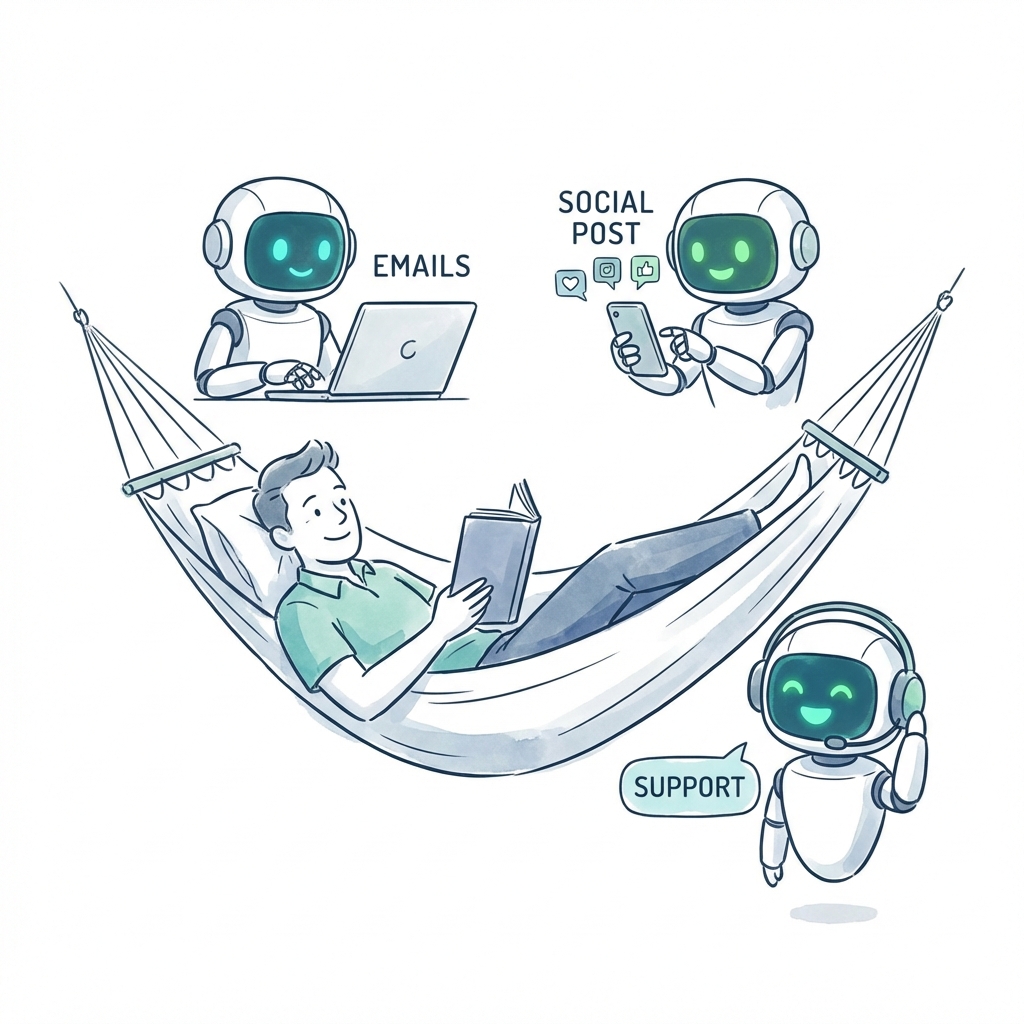
Think of AI automation as hiring a team of incredibly efficient digital employees who live to do the boring work. These aren't just simple tools; they are intelligent agents that can handle complex workflows around the clock, no coffee breaks, sick days, or salaries required.
This is about creating a system where different AI agents collaborate seamlessly. For instance, imagine one AI agent spots a trending topic in your industry on a Tuesday morning. By Tuesday afternoon, another has drafted a sharp, insightful blog post on it, and a third has scheduled and promoted it across all your social channels for the entire week. All of this happens while you’re out meeting a client—or even while you’re asleep.
This isn't some far-off future. It's happening right now. Recent data shows that 57% of U.S. small businesses are already investing in AI. The payoff is huge: 58% of them are getting back over 20 hours a month. You can read more about these AI adoption trends to see the full picture.
Imagine your most tedious, soul-crushing task—maybe it’s compiling weekly sales reports or manually updating your CRM—just getting done on its own, perfectly, every single time. That’s what AI automation delivers. It’s not here to replace you; it’s here to liberate you.
From Manual Grind To AI-Powered Growth
To truly grasp the impact, let's look at a direct comparison of how much time common business tasks consume and the immediate time-saving power of AI automation.
Common Manual Task
Average Time Spent Weekly
AI Automated Solution
Time Reclaimed Per Week
Answering Routine Customer Emails
5-7 hours
AI-powered chatbot & email auto-responder
5-7 hours
Managing Social Media Scheduling
3-5 hours
AI content scheduler & post generator
3-4 hours
Generating First Drafts of Content
4-6 hours
AI writing assistant for blogs & ads
4-5 hours
Appointment & Meeting Scheduling
2-3 hours
Intelligent scheduling assistant
2-3 hours
This table shows just a fraction of the possibilities. By delegating the mundane to machines, you finally get the headspace to focus on what only a human—the visionary leader—can do.
Embracing this technology helps you achieve:
More Time for Strategy: Step away from the daily grind to plan your next big move, design a new product, or simply take a well-deserved break.
Reduced Operational Costs: Automate tasks for a fraction of what manual labor would cost, freeing up capital to reinvest in growth.
Better Customer Experiences: Provide instant, consistent support that builds real loyalty and makes your customers feel heard, 24/7.
Let's dive into how you can start building your own team of digital employees and transform your business from the ground up.
So, How Does This AI Automation Stuff Actually Work?
Let's cut through the buzzwords. Forget the complex code and impenetrable jargon for a second. At its heart, AI automation is about giving the tools you already use a "brain" to handle tasks that used to need a human—someone with creativity, judgment, and the ability to make smart decisions.
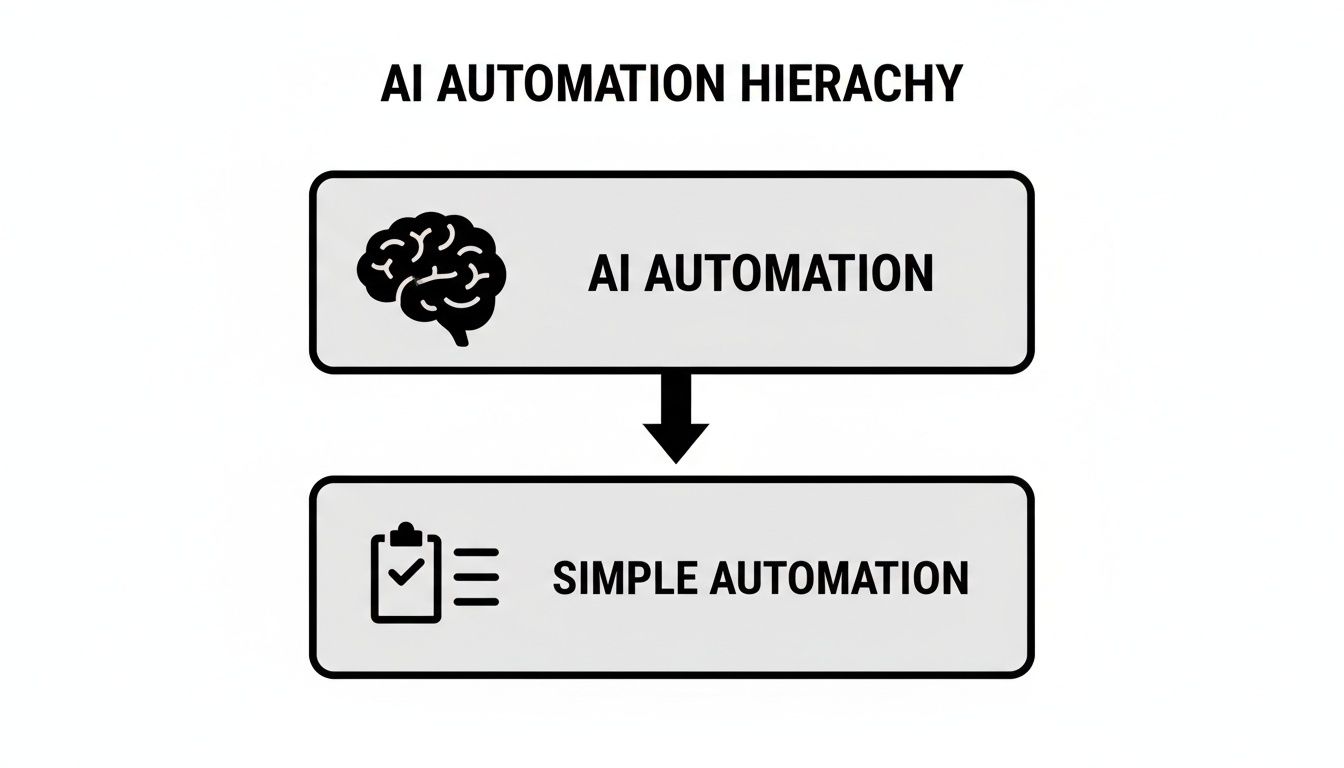
Think of it this way. You’ve probably used simple automation before. It’s like giving a new assistant a very strict checklist: if a customer fills out a form, send them a standard welcome email. It’s useful, but it’s rigid. It can't think for itself or handle anything unexpected.
AI automation, on the other hand, is like hiring a genuinely smart, proactive expert. This isn't just someone who follows a checklist; it's a team member who learns, strategizes, and actually gets better over time. It turns your disconnected software into a smart, collaborative workforce that anticipates your needs before you even voice them.
The Real Game-Changer: Moving from Rules to Reasoning
The magic of AI automation for small business isn't just about doing things faster. It's about its ability to navigate complex, multi-step processes that require real judgment. Instead of just ticking off one pre-programmed task, an AI agent can manage an entire sequence of actions, adapting on the fly.
A classic automation tool can schedule a social media post for you. That's a simple, rule-based task.
An AI agent, however, can run the entire campaign. Imagine this: it starts by analyzing what your audience is talking about online, then writes a witty, engaging caption that sounds exactly like you. It designs a sharp graphic to go with it and then posts it at the precise moment it’s most likely to get a flood of likes and comments. See the difference? One is a tool, the other is a teammate.
This is how you finally get your time back—not by offloading one tiny action, but by delegating a whole chunk of work to a smart system that learns and improves with every task it completes. This is the dream of a business that runs itself.
Building Your Digital Workforce
Imagine your business operations as a team of people. You’ve got roles for marketing, sales, customer support, and all the admin work that keeps things running. AI automation lets you "hire" digital experts for these roles, and the best part is, they work together perfectly, 24/7.
Your AI Marketing Assistant: You’re busy, so it spots a competitor's ad that's getting a lot of buzz. It instantly drafts a counter-campaign for you to review—complete with compelling ad copy and smart audience targeting ideas, ready for your one-click approval.
Your AI Sales Coordinator: A potential client just finished a demo call. Your AI listens to the recording, pulls out the customer's main concerns, and instantly drafts a personalized follow-up email that speaks directly to those pain points. Your sales team can now handle twice as many leads without working longer hours.
Your AI Operations Manager: It notices a sudden spike in support tickets all mentioning a confusing checkout step. It flags the pattern for you and even suggests an update for your website's FAQ to get ahead of the issue, preventing dozens more frustrated emails.
These AI agents don't operate in a vacuum. They plug right into the tools you already rely on—your email, calendar, CRM—and can even work with each other. For example, when a potential customer fills out a contact form, an AI assistant can instantly qualify the lead based on their responses. You can start exploring how this works by creating smart, automated workflows with tools like Dooza's dynamic forms.
This interconnected system is what elevates automation from a simple time-saver into a true engine for growth, freeing you up to do what only you can do: lead your business to its next chapter.
Where To Automate for Maximum Impact
You see the potential of AI, but the million-dollar question is: where do you actually start? Trying to automate everything at once is a classic recipe for disaster. The real key to getting AI automation right is to pick your battles—focus on the areas that will give you the biggest, most immediate wins.
Think of it as finding the heaviest weights on your shoulders and letting AI do the lifting. This isn't just about doing things a little faster. It's about creating systems that run themselves, buying back your most valuable asset: your time and your sanity. Forget manually chasing leads or spending your weekend drafting social media posts. Imagine waking up Monday morning to qualified leads already in your inbox, a week of brilliant content waiting for your final nod, and a support system that handled customer questions while you were enjoying your time off.
This isn’t about simple, repetitive tasks anymore. We’ve moved beyond that.
As you can see, basic automation is great for predictable checklists. But AI automation is what takes on the complex jobs that require actual thought and learning. That’s where the magic happens.
So, where should you point this magic first? Let's break down the three most strategic areas.
1. Marketing and Sales: Your 24/7 Growth Engine
For most small businesses, marketing is a black hole of time and energy. Content creation, SEO, social media, lead nurturing—it's a full-time job in itself. This is where AI automation can completely change the game, turning your marketing from a daily grind into a powerful, self-running machine that generates leads while you sleep.
Imagine an AI agent like Dooza's 'Seomi.' You give it a simple goal—say, "rank my website for 'local artisan coffee'"—and it gets to work. It handles the keyword research, writes SEO-optimized blog posts that sound like a human expert wrote them, and even builds out a backlink strategy, all without needing you to micromanage every single step.
Real-World Example:
An e-commerce store selling handmade jewelry was losing customers at checkout. They set up an AI agent to tackle cart abandonment. The AI would detect when a shopper left, wait two hours, then send a friendly, personalized email with the customer's name, the exact items they left behind, and a small, time-sensitive discount. This one simple automation recovered 15% of otherwise lost sales in the very first month—pure profit, with zero extra effort.
Great customer service is non-negotiable, but it’s also incredibly time-consuming. Answering the same questions over and over again—"What are your hours?" "What's your return policy?"—is a perfect task to hand off to AI. In fact, AI chatbots can successfully handle up to 70% of initial customer inquiries, giving your customers the instant gratification they crave.
This doesn't mean replacing your support team. It means elevating them. Let the AI provide instant, 24/7 answers to routine questions. This frees up your human experts to focus on the complex, high-value conversations that build real loyalty and solve the unique problems that turn a frustrated customer into a lifelong fan.
Your customers get immediate help whenever they need it, and your team gets to focus on the work that actually moves the needle. It's a win-win that can turn your support from a cost center into a powerful retention tool.
3. Daily Operations: The Autopilot for Your Admin Work
Finally, think about all the little administrative tasks that clog up your day and drain your creative energy. Scheduling meetings, qualifying new leads, managing invoices, and drafting internal memos are all critical but repetitive. An AI operational assistant can act as the central hub for your business, keeping everything running smoothly in the background while you focus on the big picture.
Consider what this looks like in practice:
Smarter Scheduling: An AI assistant syncs with your calendar and handles all the back-and-forth emails to get a meeting booked. A task that used to take six emails now takes zero. You just wake up to a perfectly organized schedule.
Lead Qualification: A new lead fills out your contact form. An AI-powered chatbot immediately engages them, asks a few qualifying questions, and automatically adds the high-potential leads directly to your CRM, complete with notes for your sales team.
Content Multiplication: You record one video. An AI agent takes it from there—transcribing it, writing a blog post from the transcript, creating a dozen social media snippets with clever captions, and drafting an email newsletter to promote it. One piece of content becomes ten, automatically.
By targeting these high-impact areas, you’re not just saving a few hours. You’re building a more resilient, efficient, and scalable business that can grow without burning you out.
Your AI Automation Priority Matrix
To help you pinpoint exactly where to start, we've put together a simple matrix. It breaks down the most common time-draining problems in key business areas and maps them to high-impact AI solutions.
Business Area
Time-Draining Problem
High-Impact AI Solution
Expected Business Outcome
Marketing
Inconsistent content creation and manual SEO.
AI-driven content generation and SEO optimization.
Increased organic traffic and a consistent flow of new leads.
Sales
Manually following up with every single lead.
Automated lead nurturing and personalized follow-up sequences.
Higher conversion rates and a shorter, more profitable sales cycle.
Customer Support
Answering the same repetitive questions all day.
24/7 AI chatbot for FAQs and initial inquiries.
Faster response times and dramatically improved customer satisfaction.
Operations
Endless back-and-forth emails to schedule meetings.
AI assistant for automated calendar management.
Frees up hours of administrative time each week for strategic work.
Content
Creating one piece of content takes a whole day.
AI-powered content repurposing tools.
A single asset generates multiple posts, emails, and articles in minutes.
Use this table as your guide. Pick one problem from the list that makes you groan just thinking about it, and make it your first automation project. The momentum from that one win will fuel your next one.
Your Step-By-Step AI Implementation Roadmap
So, you're ready to build your digital workforce. The idea of freeing up your time is exciting, but turning that vision into tangible results requires a smart, structured approach. Bringing AI automation for small business into your world isn't about flipping a single switch; it's about methodically building a new kind of system, piece by piece, that works for you.
This practical, four-step roadmap will walk you through a smooth transition, helping you get it right from the very beginning. We'll go from pinpointing your biggest headaches to celebrating your first real automation win.
Step 1: Identify Your Bottlenecks
Before you can automate anything, you have to know what to automate. The best place to start is by looking at the tasks that drain the most time and energy from your day. These are your bottlenecks—the repetitive, low-value activities that stop you from focusing on what actually grows the business.
Grab a notepad and list the top 3-5 tasks that feel like a grind. For a local plumber, this might be answering calls about service areas. For a marketing consultant, it’s the hours spent creating weekly reports. What are yours? Is it manually crafting and scheduling social media posts? Are you spending hours answering the same customer questions over and over?
Those are the perfect jobs to hand over to your first AI employee.
Step 2: Pilot Your First AI Project
With your list of bottlenecks in hand, it’s time to get a quick win on the board. The biggest mistake you can make is trying to automate your entire business overnight. The key is to start with one small, low-risk project to build confidence and see an immediate, exhilarating return.
Pick one task from your list—maybe the easiest one to delegate. Next, find a user-friendly tool built for that specific job. For instance, if scheduling meetings is your biggest time-sink, a tool like Calendly can be an absolute game-changer. Imagine sending one link and having meetings magically appear on your calendar, perfectly booked.
The goal here is simple: prove the concept to yourself and your team. When you see an AI tool save you five hours in the first week, the momentum becomes unstoppable. It makes the dream of automation real and tangible.
Step 3: Integrate and Empower Your Team
Once you've tasted that first success, the next move is to weave AI into your existing workflow. This is where you connect your new tools with the software you already rely on, like your CRM, email, or project management platform. This integration is what turns a simple tool into a true digital assistant that works for you.
This is also the moment to get your team on board. It's crucial to frame AI not as a replacement, but as a powerful collaborator that's here to liberate them from tedious work.
Provide Clear Training: Walk your team through how the new AI tools work and, more importantly, how they will make their jobs easier and more enjoyable.
Highlight the Benefits: Explain that by automating the boring stuff, they get to focus on more creative, strategic, and fulfilling work—the work they were hired to do.
Establish New Workflows: Define how people and AI will work together. For example, an AI might draft the initial social media posts, and a team member then reviews, refines, and adds their unique human touch. Our guide on automating social media has some great ideas on this.
Step 4: Measure and Scale Your Success
The final piece of the puzzle is tracking your results and building the case for expanding your AI workforce. You can't improve what you don't measure. Focus on clear, simple metrics that show the real-world return on your investment (ROI).
Start tracking a few key performance indicators (KPIs), such as:
Time Saved: How many hours per week are you and your team getting back?
Cost Reduction: Are you seeing savings on operational or freelance costs?
Leads Generated: Is automation helping you capture and qualify more leads while you focus elsewhere?
Customer Satisfaction: Are response times faster? Is customer feedback more positive?
When you can point to hard numbers showing that AI saved 15 hours last month or boosted lead conversions by 10%, it's no longer just an experiment—it's a core part of your growth strategy. Use these wins to justify automating the next bottleneck on your list, and the one after that, until your business runs like a well-oiled machine, with or without you.
Avoiding Common Pitfalls on Your AI Journey
The idea of AI is exciting—more time, smarter growth, and a business that seems to run itself. But the road to getting there isn't always a straight shot. By knowing what to look out for, you can sidestep the usual headaches and get right to the good stuff.
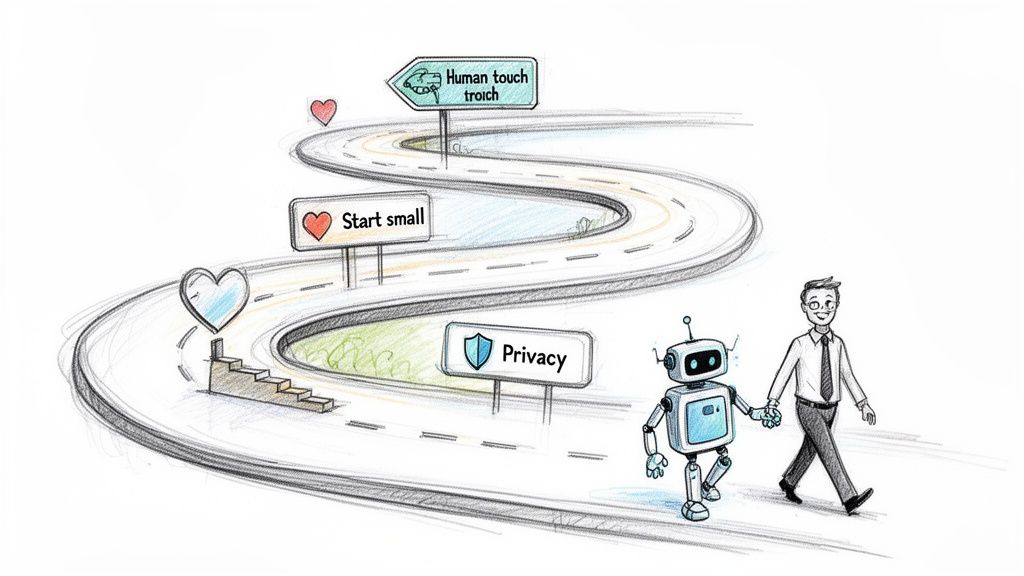
One of the biggest hang-ups I hear from business owners is the fear of losing their "human touch." They worry that bringing in automation will make their brand feel cold, robotic, or distant. But when you do it right, the reality is the complete opposite.
The goal isn’t to replace your team's unique ability to connect with people. It’s about amplifying it. Let AI handle the repetitive stuff—the password resets, the "where's my order?" questions, and the appointment reminders. This simple shift frees up your team to focus on the conversations that actually matter, the ones that build real loyalty and solve complex problems with empathy and care.
Start Smart, Not Big
Another common mistake is the "all-or-nothing" mindset. People get so fired up about the potential of AI automation for small business that they try to change everything at once. This almost always leads to feeling overwhelmed and watching the entire project grind to a halt.
The real secret is to start small, get a quick win, and then build on that success.
Pick one nagging problem. What's the single most annoying, time-sucking task you deal with every week? Start there. For example, a bakery owner might automate her online order confirmation emails first.
Find a focused tool. Look for a simple platform designed to solve that one problem really well.
Celebrate the win. When the bakery owner sees those emails go out perfectly without her lifting a finger, saving her an hour a day, she’ll have all the motivation she needs to automate her social media next.
This step-by-step approach keeps things manageable and proves the value of automation at every turn.
Choosing the Right Tools and Protecting Your Data
Worries about data privacy and getting bogged down in complex software are totally understandable. The market is packed with options, and it’s easy to feel like you need a computer science degree to figure it all out. Luckily, the best new AI tools are built for business owners, not engineers.
Look for platforms with simple, intuitive dashboards that make data security a top priority. Your customer data is your most valuable asset, so picking a trustworthy and secure tool is non-negotiable. If you're exploring options for customer service, our guide on Gorgias alternatives is a great place to see what makes a platform stand out.
The right AI tool should feel like a capable new team member, not a confusing piece of software. It should make your work easier from day one and give you back your time and mental space.
And it's clear this is where things are headed. As we move toward 2026, 75% of small businesses have already put money into AI. While most are seeing better customer relationships, 43% are concerned about relying too much on tech and 35% worry about skill gaps. Learning how to work with these tools is quickly becoming the new competitive advantage. You can discover more insights about predictions for AI in small business.
By facing these challenges head-on, you can bring AI into your business with confidence, reclaim your time, and build a much smarter, more resilient company.
It’s Time to Build the Business You Dreamed Of
We’ve laid out the roadmap. You’ve seen how AI automation can genuinely help a small business, where it makes the biggest impact, and the exact steps to get started. The old story of the overworked entrepreneur doesn't have to be yours. The dream of focusing on what you love, not just what needs to get done, is right within your grasp.
All that’s left is to take that first step.
From Drained to In Control
Take a moment and think about your week. What’s that one task that just sucks the life out of you? Is it the endless cycle of crafting social media posts? Or maybe it's fielding the same handful of customer questions, day in and day out. For some, it's the tedious back-and-forth of just trying to schedule one meeting.
Now, picture handing that single task off to a hyper-efficient assistant who gets it right every time, without you ever having to lift a finger. That's the power of starting small with automation. This isn't about tearing down your business and rebuilding it overnight. It’s about making one strategic move that gives you back your most valuable asset: your time and your passion.
This is about more than just being efficient. It’s about carving out the headspace you need to think bigger, to innovate, and to lead with the clarity your business deserves. It's about getting back to the work that actually excites you and reminds you why you started this journey in the first place.
Your First AI "Hire" Is Ready to Clock In
Getting started is far less complicated—and much more affordable—than most people realize. Modern AI tools are built for small business owners, not engineers. If you can write a clear email, you have all the skills you need to direct an AI agent.
Think about a local bakery owner. She could "hire" an AI to manage her social media. All she has to do is give it a simple instruction: "Draft three Instagram posts each week featuring our daily specials. Keep the tone warm and friendly and mention the fresh ingredients." The AI gets to work, creating the captions, finding the right hashtags, and scheduling the posts for when her customers are most active online.
Or consider a consultant who’s drowning in emails. He can use an AI assistant to take over his calendar. No more endless email tag. He just shares a link, and the AI handles the entire scheduling conversation to find a time that works for everyone, sending reminders automatically. These aren't massive, sweeping changes, but they add up, freeing up hours every single week. The baker can now perfect a new recipe, and the consultant can spend that time on high-value client strategy.
The tools are here, and they're ready to go. They're designed to plug right into the software you already know and love, delivering results from day one. Don't let your business be defined by the grind. Don't wait for the future to happen to you—start building it.
The only question left is, what will you automate first?
Common Questions About AI Automation
Even with the exciting promise of getting your time back, diving into AI automation can feel like a big step. You're probably wondering about the cost, the learning curve, or how it will fit with the team you've already built. That’s completely normal.
Let’s tackle some of the most common questions and concerns we hear from small business owners. Getting clear, honest answers is the best way to move forward with confidence and turn those "what ifs" into a solid plan.
Isn't AI Automation Too Expensive for a Small Business?
This is one of the biggest myths holding people back. The truth is, AI automation for small businesses has never been more accessible. Forget the old days of needing a massive budget and a team of developers for custom software. Today's best AI platforms are built on flexible, subscription-based models designed specifically for smaller budgets.
Think of it less as an expense and more like your most productive—and affordable—hire. For a fraction of what you'd pay a part-time employee, you can get an AI assistant that handles crucial tasks 24/7 without ever needing a coffee break. When you add up the hours you get back and the new growth you can chase, the return on investment often becomes obvious within the first month.
The question really isn't, "Can I afford AI automation?" It's, "Can I afford to keep spending hours on tasks that an AI can do for a few dollars a day?"
Will AI Replace My Employees?
Not at all. The real goal here is to supercharge your team, not replace it. Your people are your most valuable asset. Their creativity, strategic insights, and ability to forge genuine human connections are things AI simply can't replicate. AI is brilliant at handling the repetitive, data-heavy work that frankly, most people find tedious and draining.
By handing those tasks over to AI, you're actually empowering your team.
Free them from the grind: Let AI take care of the boring stuff like data entry, scheduling, and routine follow-ups.
Elevate their work: Your team can finally focus on higher-value projects, like brainstorming new marketing campaigns, improving the customer experience, and deepening client relationships.
Boost morale and growth: When people are engaged in meaningful work, their job satisfaction skyrockets, and their contributions have a much bigger impact on the business. It’s a recipe for a happier, more innovative team.
Do I Need to Be a Tech Expert to Use AI Tools?
Absolutely not. The new generation of AI tools is built for everyone, not just coders. You don't need to know a single line of code. The best platforms use simple, visual interfaces where you can set up powerful automations using plain English commands.
If you can write a to-do list for a human assistant, you have all the technical skill you need to manage your first AI employee. Many tools also come with pre-built templates for common business tasks—like "follow up on abandoned carts" or "schedule social media posts"—so you can get started and see real results in minutes. To get a feel for how straightforward this can be, you can learn more about building smart workflows on the Dooza blog.
How Do I Make Sure the AI Sounds Like My Brand?
This is a fantastic question and a key feature of modern, intelligent systems. You essentially "train" your AI by showing it what good looks like. You can feed it your best marketing copy, examples of great customer emails, and your brand style guide. The AI learns your specific tone—whether you're professional and authoritative, fun and witty, or warm and empathetic—and applies it consistently across all its work.
Best of all, you always have the final say. Many workflows can be set up with a simple approval step. The AI can draft a social media post or an email, then ping you or a team member for a quick final review before it goes live. This gives you the perfect mix of AI-powered speed and human-led quality control, ensuring your brand's voice is always perfect.
Ready to stop just dreaming about a more efficient business and actually build one? The power to automate your operations and take back your time is already here. With Dooza, you can hire a team of AI employees to run your SEO, manage social media, and handle customer support—all on autopilot. These AI agents work together and with your human team, creating a seamless workflow that drives real growth.
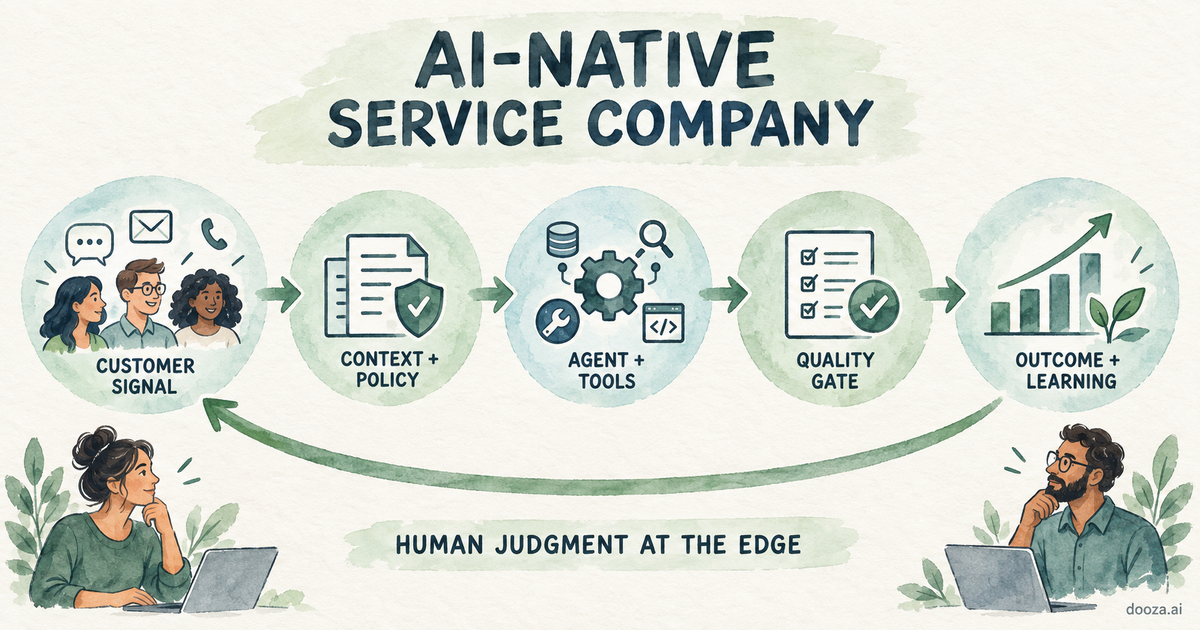
What Is an AI-Native Service Company? What Dooza Does—and How to Build One
An AI-native service company sells a completed outcome while agents run the repeatable work. See how the model works, where Dooza fits, and how to build one.