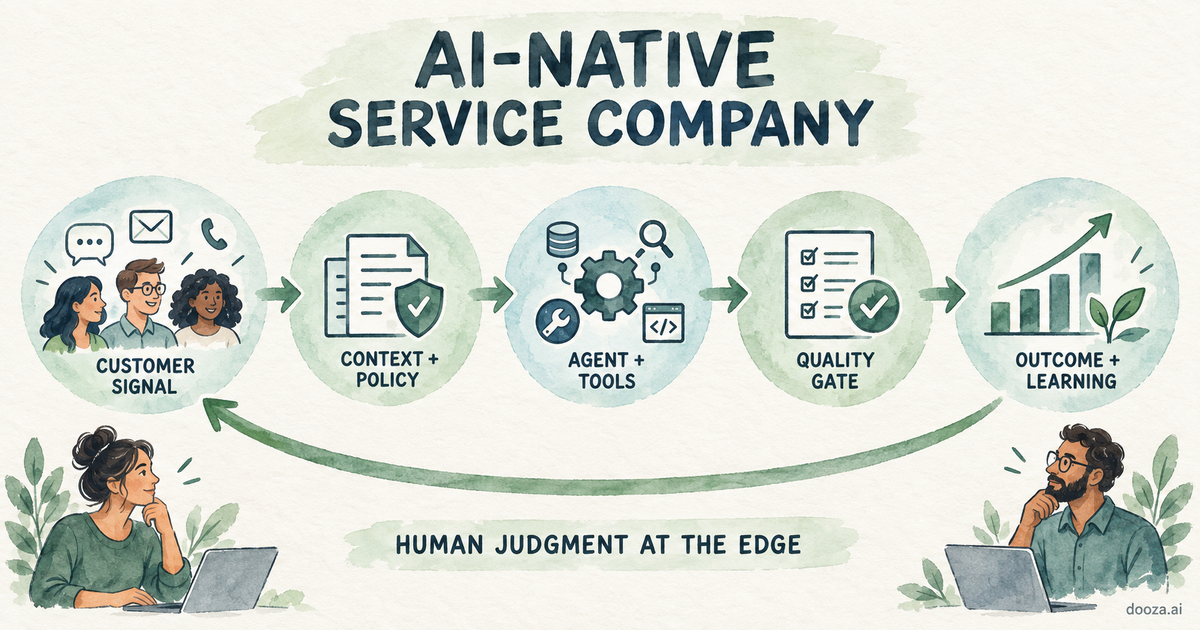
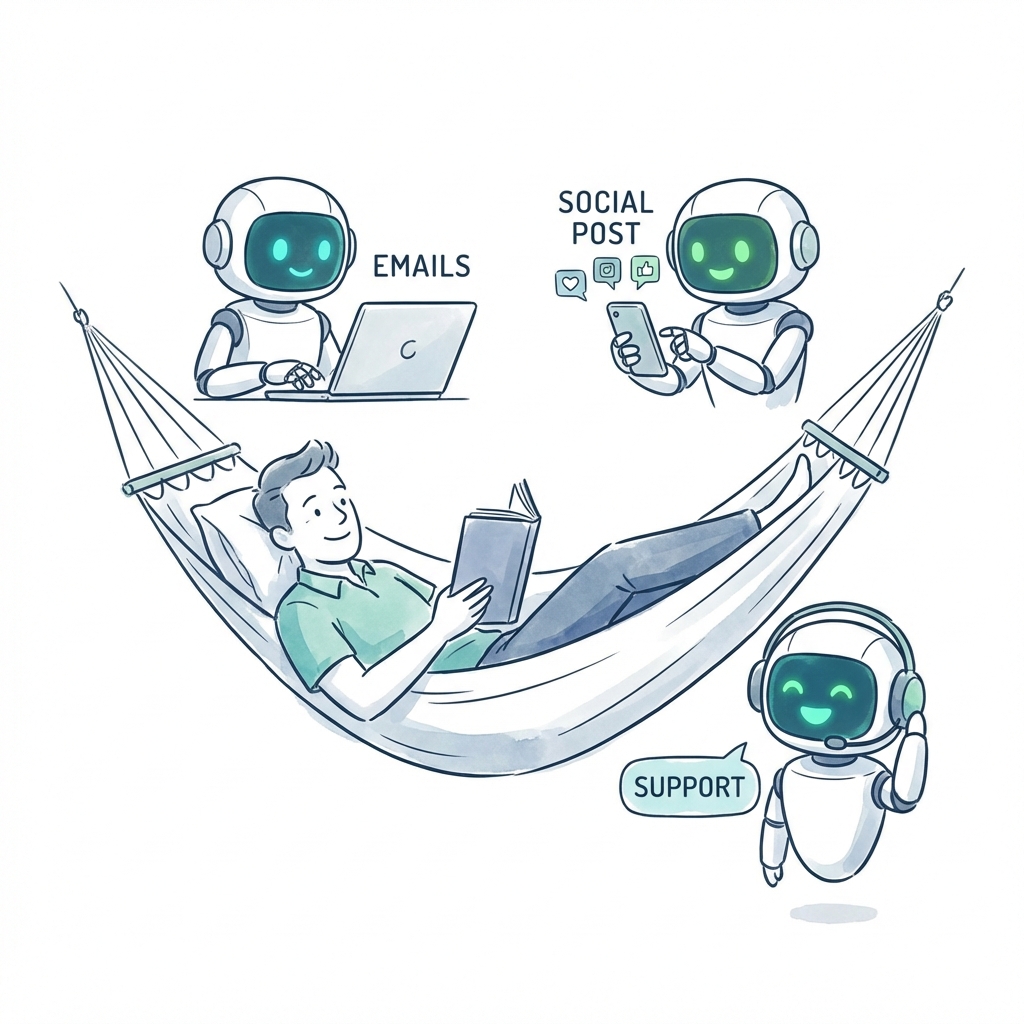
Delegating work sounds simple, but doing it effectively is a superpower. Imagine a future where the repetitive, time-draining tasks that bog you down simply vanish from your to-do list, handled flawlessly in the background. This isn't a distant dream; it's the reality you build when you master the art of delegation, empowering the right person—or even the right AI—to truly own the outcome.
Get this right, and you'll unlock the time and mental space to concentrate on the high-level work that actually grows your business.
Why Delegation Is Your Ultimate Growth Engine
What would your week look like if you weren't constantly buried in email chains, pulling the same reports, and wrestling with routine administrative tasks? Imagine having entire days free for innovation, for big-picture strategy, for building the relationships that truly matter. This is the incredible freedom that effective delegation delivers.
Too many leaders think of delegation as just getting stuff off their plate. The real shift happens when you see it as multiplying your impact. When you learn how to delegate tasks effectively, you stop being the bottleneck and start building a smart, automated system that runs without your constant intervention.
The True Cost of Doing It All Yourself
It's tempting to hold onto every task. It feels productive, right? But in reality, it's a trap. You're limiting your company's growth potential to your own personal bandwidth, and that's a ceiling you'll hit fast.
The numbers don't lie. CEOs who are great at delegating drive 33% higher revenue than those who cling to every task. A Gallup survey of 500 CEOs revealed that leaders with strong delegation skills saw an incredible average three-year growth rate of 1,751%. That just blows their less-delegating peers out of the water. If you want to dive deeper, Employers Council has some great insights on building empowered teams.
This data paints a stark picture. Delegation isn't about laziness; it’s a strategic investment in growth. Every task you keep that someone else could do is a lost opportunity to work on your business instead of just in it.
The Future of Work: Human and AI Collaboration
Here's where the dream becomes reality. Today, delegation has a powerful new dimension: AI. The long-held vision of automating away the tedious parts of your job is no longer a sci-fi concept. It’s here, right now, ready to free up your time.
You can now delegate tasks to specialized AI employees that work tirelessly alongside your human team. This isn't just about saving a few minutes; it's about fundamentally redesigning your workday. Picture this:
- SEO Analysis on Autopilot: Instead of losing a full day to keyword research and SERP analysis, you delegate it to an AI employee like Dooza's Seomi. You wake up to a prioritized list of content opportunities, your SEO strategy already in motion.
- A Perfectly Managed Calendar: Imagine a world where you never again have to deal with the back-and-forth of scheduling. An AI assistant can handle all of it, protecting your deep work time and booking meetings based on rules you set once. Your calendar becomes a fortress of productivity, managed for you.
- Effortless Customer Support: Let AI handle 80% of initial customer responses and ticket routing. This frees up your human support team to apply their genius to the most complex, high-value customer issues, turning them into heroes instead of ticket-closers.
Blending human talent with AI employees creates an incredibly efficient, automated operation. This is how you reclaim your time and energy for the kind of strategic thinking that only a human leader can provide.
This approach completely shatters your previous limits on capacity. You're no longer just delegating to people; you're orchestrating a powerful engine where AI handles the predictable, repetitive work, and your team is freed up to focus on creativity, strategy, and problem-solving. You can explore how hiring AI employees with Dooza creates this powerful synergy.
Deciding What to Delegate and What to Keep
The first and toughest rule of delegation is figuring out what to let go of. So many leaders get bogged down here, holding onto tasks because "it's just faster if I do it myself." I get it, but that mindset is the biggest roadblock to scaling. It keeps you stuck in the weeds while the truly important, big-picture work gets ignored.
Breaking that habit starts with a simple, honest audit of your time. You don't need a complicated system. Just look at your to-do list and ask yourself where every single task belongs.
The Four Buckets of Task Management
I've found the easiest way to do this is to sort every task into one of four buckets. This framework forces you to see what really needs your unique expertise and what's just noise.
- Do: These are the things in your zone of genius—the high-stakes, strategic activities only you should be doing. Think setting the company vision, nurturing key partnerships, or closing your biggest deals.
- Delegate: These are important tasks, but they don't require your specific touch. A team member or a specialized AI employee could probably handle them just as well, if not better. For example, drafting the initial version of a quarterly business review.
- Automate: Look for the rinse-and-repeat work. We're talking about scheduling social media, sending templated follow-up emails, or pulling standard weekly reports. These are perfect for automation. Imagine a bot pulling your sales data into a spreadsheet every Monday at 9 AM, without you lifting a finger. That's the dream.
- Delete: It's time to be ruthless. What are you doing out of habit that adds zero real value? Kill these tasks and feel your focus return almost instantly.
The goal is to live almost exclusively in that "Do" bucket. Picture your calendar free from administrative tasks and routine data entry because an AI employee has it covered. That's how you get your headspace back for the work that actually moves the needle.
This simple decision tree is a great place to start.
As the flowchart shows, the first question is always: "Is this task repetitive?" If the answer is yes, you've found a prime candidate to hand off, freeing you up for the unique, strategic stuff.
Find Your Delegation Sweet Spot
A good starting point is to identify tasks that are both time-sucking and not your core strength. Are you spending way too many hours wrestling with your calendar or fiddling with social media graphics? Those are perfect first tasks to delegate.
Key Takeaway: The aim isn't just to get work off your plate. It's about strategically reinvesting your time into innovation, strategy, and leadership. Making this a habit is what allows you to scale effectively.
For instance, I worked with a marketing agency owner who was drowning in routine SEO audits and weekly client reports. By delegating that work to an AI employee, she instantly saved 10-15 hours a week. More importantly, she could finally focus on high-level client strategy and bringing in new business, effectively giving herself a promotion.
If you're looking for specialized help, Dooza can connect you with AI employees and partners who excel at these kinds of repetitive, high-volume tasks. Find out more about our network of AI-powered specialists.
Task Delegation Decision Matrix
To make this even easier, use this matrix to quickly decide the best course of action for any task on your plate.
| Task Type |
Description & Examples |
Best Action |
Dooza Solution Example |
| High-Strategy, Low-Frequency |
Developing a new product roadmap, negotiating a major partnership, setting quarterly OKRs. |
Do It Yourself |
N/A - This is your core work. |
| Low-Strategy, High-Frequency |
Processing invoices, daily social media monitoring, scheduling meetings, generating standard reports. |
Delegate / Automate |
An AI employee for data entry or report generation. |
| High-Strategy, High-Frequency |
Weekly team check-ins, pipeline review meetings, content creation for core channels. |
Do or Delegate |
Keep the strategic part (planning), delegate the execution (drafting, posting). |
| Low-Strategy, Low-Frequency |
One-off administrative tasks, organizing old files, tasks with unclear ROI. |
Delete or Delegate |
Question its value. If necessary, delegate it as a low-priority item. |
This matrix isn't just a one-time tool; it's a mental model. Running your to-do list through this filter regularly keeps your focus sharp and your time dedicated to what truly matters.
How to Write Briefs That Actually Guarantee Results
A delegated task is only as good as the brief you write. I've learned this the hard way. Vague directions lead to botched work, wasted time, and that sinking feeling that you should've just done it yourself. A crystal-clear brief is your secret weapon, whether you're handing work to a team member or a smart AI agent.
The old way was to spell out every single step, which is just micromanagement in disguise. The better, more modern approach is to focus on the outcome. Instead of dictating the how, you need to clearly define the what and, crucially, the why. This small shift empowers people (and AI) to take ownership, apply their own expertise, and often deliver results that are better than you imagined.
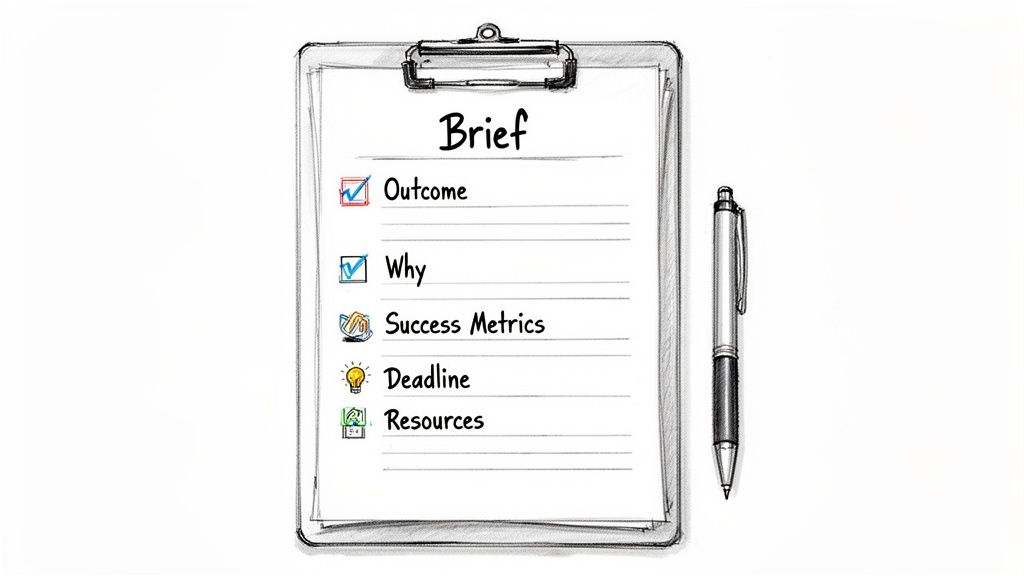
The Anatomy of a Perfect Brief
A powerful brief doesn’t have to be a ten-page novel. It just needs to answer the right questions upfront, leaving zero room for guesswork. Think of it as a contract for success.
Every great brief I've seen, whether for a person or a bot, covers these essentials:
- The Desired Outcome: What does "done" actually look like? Get specific. "Create a social media report" is fuzzy. "Create a one-page report showing our Q3 engagement metrics (likes, shares, comments) for Instagram and LinkedIn, highlighting our top three performing posts" is actionable.
- The "Why": Context is everything. Explaining how a task fits into the bigger picture is a game-changer. Knowing that a report is for a critical investor meeting gives it a sense of urgency and importance that you can't get from just a deadline.
- Success Metrics: How will you know if the job was done well? This could be a hard number (e.g., "increase landing page conversions by 5%") or a qualitative goal (e.g., "ensure all support tickets are closed with a positive CSAT score").
- Deadlines and Milestones: A final due date is a must. For bigger projects, add a few key check-in dates. This creates accountability without you having to constantly ping for updates.
- Resources and Budget: Give them everything they need to succeed. Include links to files, access to software, brand guidelines, or any budget constraints. Don't make them hunt for it.
Getting this right is a huge time-saver. A recent SHL survey found that managers waste an incredible 14% of their time redoing tasks because of poor delegation. Just think about reclaiming all that time.
Briefing a Human vs. an AI Employee
The core principles are the same, but how you apply them can differ slightly.
Example 1: Briefing a Marketing Assistant
- Outcome: Launch a promotional email campaign for our new webinar.
- Why: We need to drive at least 200 sign-ups to hit our Q4 lead generation goals.
- Metrics: A 15% open rate and a 3% click-through rate.
- Deadline: Draft ready for review by Wednesday EOD; final email sent by Friday at 10 AM.
Example 2: Configuring a Dooza AI for Calendar Management
Now, imagine never having to schedule a meeting again. You can set up an AI agent with a one-time, permanent brief that acts as its operating system:
- Outcome: Manage my calendar to protect my focus time.
- Rules:
- Book client calls only on Tuesdays and Thursdays between 1 PM and 4 PM.
- Always leave a 30-minute buffer between meetings.
- Automatically decline any internal meeting requests that don't have an agenda attached.
This is what real automation feels like. You set the rules once, and your AI employee executes them flawlessly, forever. You’re not just delegating a single task; you're building an automated system that frees up your mental energy for what really matters.
By mastering the art of the brief, you stop being a manager of tasks and become an orchestrator of outcomes. If you want to streamline this even further, you can build your own intake briefs using Dooza's customizable forms.
Matching the Task to the Right Person or AI
Okay, so you've pinpointed the tasks you need to get off your plate. Now comes the make-or-break decision: who gets the job?
Giving a complex, creative project to your most data-driven analyst isn't a great fit. Neither is handing a pile of mind-numbing admin work to your top strategist. You’ll just end up with so-so results and a frustrated team. The real art of delegation is playing matchmaker between the work and the worker.
This goes way beyond just looking at who has a gap in their calendar. You need to think about your team's unique talents, their weak spots, and even what they want to be doing. Got someone eager to sharpen their project management skills? Handing them a small, low-risk project is a brilliant way to help them grow. But piling more onto your already swamped superstar? That's just a fast-track to burnout.
The Rise of the AI Employee
Here’s the thing, though. Your team isn't just human anymore.
Imagine hiring a specialist who is laser-focused on one single thing and does it flawlessly, 24/7, without ever needing a coffee break. That's not science fiction; it's what you can do right now with AI.
You can essentially "hire" a digital employee from Dooza to take over almost any repetitive, process-heavy role you can think of.
- SEO Specialist: An AI like Seomi can churn through keyword research, keep an eye on your backlink profile, and pull performance reports all day long.
- Social Media Manager: Let an AI handle the grunt work of scheduling posts, monitoring comments, and tracking engagement metrics around the clock. Imagine your entire content calendar queued up and posted perfectly without you ever logging in.
- Customer Support Agent: An AI can instantly field initial questions, sort support tickets, and answer FAQs. We actually dive deep into how AI is changing the game in our guide on Gorgias alternatives.
The real magic happens when you stop seeing AI as just another tool and start treating it like a genuine member of your team. This is the ultimate freedom—automating the mundane so you and your people can focus on doing exceptional work.
Building a Hybrid Team That Wins
The future of work is a hybrid model where people and AI work together, plain and simple. Dooza's AI employees are built for exactly this. They plug right into the tools you’re already using—like Slack or your CRM—and can collaborate with your human colleagues, passing information back and forth.
For instance, your AI support agent can spot a really tricky customer issue and automatically flag it for a human team member, complete with the entire chat history. You're not just offloading a task; you're creating a smarter, more connected workflow that feels like magic.
This approach lets you put the perfect "employee" on every single task. Let your team's creativity and strategic genius shine on high-value work, while your AI employees nail the repetitive, high-volume stuff with perfect precision. That's how you build an operation that can actually scale.
How to Monitor Progress Without Micromanaging
Once you’ve handed off a task, the temptation to hover can be overwhelming. We’ve all felt it. But breathing down someone's neck isn't leadership; it's micromanagement, and it absolutely kills morale and results. The real trick to effective delegation is finding that delicate balance—staying informed without stifling the very autonomy you’re trying to build.
What you need is a system. A system that offers transparency and accountability, not anxiety and constant interruptions. The goal is to create a rhythm of communication that feels supportive, not suspicious. This means ditching the random "just checking in" pings for a clear, predictable cadence for updates.
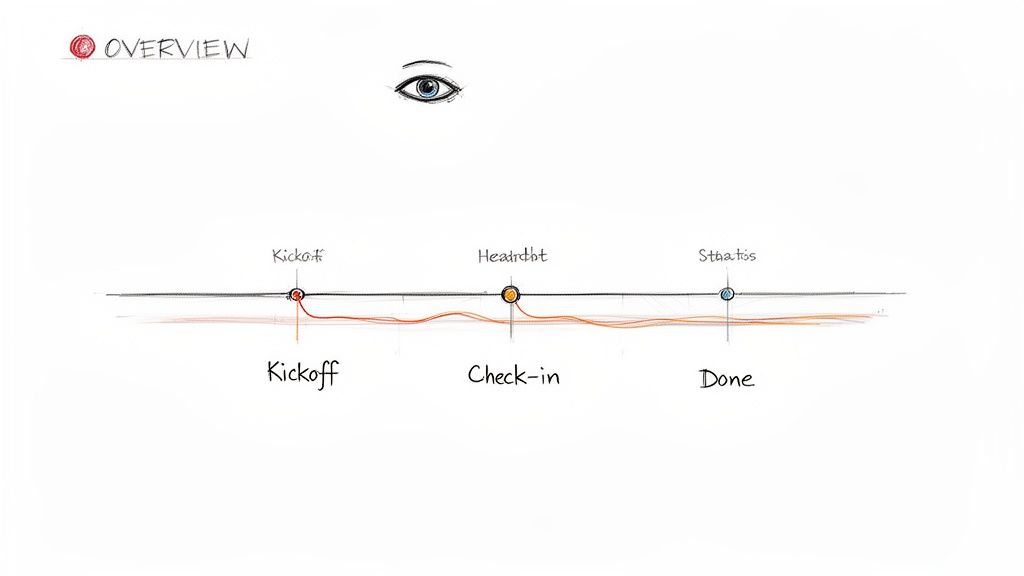
Establish a Clear Communication Rhythm
The simplest way to avoid micromanaging is to agree on check-in points from the very beginning. It's a small step that builds a huge amount of trust and sets crystal-clear expectations, whether you're working with a human teammate or an AI agent.
With a colleague, this might look like a quick 15-minute sync at the start of the week or a shared project board in a tool like Asana or Trello. For example, "Let's touch base every Wednesday morning for 10 minutes to review progress on the Q3 report." The specific format matters less than the consistency. When people know exactly when and how they're expected to report progress, they can work independently between those check-ins without worrying about a surprise interruption.
This gets even easier with AI employees. Imagine you've delegated your social media scheduling to a Dooza agent. You don't have to "check in" at all. Instead, you can just glance at its built-in dashboard, which shows you exactly what’s been scheduled, what's been posted, and the engagement it’s getting. You get 100% visibility with zero nagging. It’s the dream of being completely informed with zero effort.
Use Technology to Your Advantage
Modern tools have made it incredibly easy to see what's happening without ever having to ask, "How's it going?" The right setup creates a single source of truth that keeps everyone on the same page, automatically.
- Shared Project Management Tools: For team projects, platforms like Trello, Asana, or Monday.com are non-negotiable. You can see task statuses, comments, and roadblocks in real-time.
- AI Employee Dashboards: When you delegate to a Dooza AI employee, it comes with its own transparent reporting system. Your AI for calendar management, for instance, can send you a weekly summary of meetings booked, declined, and rescheduled—no prompting required.
- Dedicated Communication Channels: Set up a specific Slack channel or email thread for a project. This keeps all communication organized, searchable, and out of your direct messages.
The ultimate dream is a system where you have full visibility into delegated work while giving your team—both human and AI—the space they need to excel. Technology makes this dream a reality, automating the follow-up so you can focus on the results.
This kind of structured oversight builds incredibly capable teams. In fact, leaders who delegate well build teams that are 52% more resilient under pressure because they model trust and strength. Those same leaders also generate 33% higher revenue, a clear testament to the power of empowering your team. You can dive deeper into how leadership impacts business outcomes by exploring these workplace statistics.
Conduct Productive Feedback Sessions
Check-ins are not just for status updates. They are prime opportunities for coaching and course correction. When you meet, focus your questions on empowerment, not interrogation.
Instead of asking, "Is it done yet?" try these on for size:
- "What progress have you made since we last spoke?"
- "Are you facing any roadblocks I can help clear?"
- "Do you have all the resources you need to succeed?"
This simple shift reframes the entire conversation from one of inspection to one of support. You become a resource, not a taskmaster. By focusing on removing obstacles, you empower your team to truly own the outcome.
You can see how the Dooza table can be used to track progress and share this kind of feedback seamlessly. This approach to monitoring is how you effectively scale your leadership and your business.
Answering Your Biggest Delegation Questions
Even when you know you should delegate, actually letting go can feel… tricky. It often brings up a ton of "what if" scenarios. Let's be honest about these common hang-ups and walk through how to handle them.
What If They Make a Mistake?
This is the big one, isn't it? The honest answer is: they might. But here's a mindset shift that helped me immensely: mistakes aren't failures, they're data. A mistake usually points to something specific—a gap in the brief, a missing resource, or just a chance for a quick coaching session.
Instead of trying to create a world where no one ever makes a mistake (spoiler: it doesn't exist), build a process that anticipates them. For lower-stakes tasks, a small error is a cheap lesson. For mission-critical projects, you just need to build in checkpoints. Simple review stages or key milestones let you catch any potential issues early, long before they snowball into a real problem. For example, asking for a report outline before the full draft is written.
How Much Detail Is Too Much Detail in a Brief?
You're looking for the sweet spot between clarity and micromanagement. The key is to be absolutely crystal clear on the outcome but flexible on the process. Define what success looks like, give them the "why" behind the task, and set non-negotiable deadlines and metrics. After that, you have to resist the urge to dictate every single mouse click.
When you're working with a person, you're trusting their expertise to figure out the "how." It's the same principle with an AI employee. You give it a rock-solid set of rules and parameters, then you trust its programming to execute. The goal is always empowerment, not hand-holding.
The dream scenario is this: you delegate a task, like social media scheduling, to an AI employee with one perfect, permanent brief. It then runs that task flawlessly, forever. You've freed up not just your time, but your mental space. You're no longer a task manager; you're an orchestrator.
Isn't It Just Faster If I Do It Myself?
In the short term? Maybe. But that thinking is a trap, and it's what keeps so many talented people stuck doing low-value work. Every time you do a task someone else could do, you're trading a few minutes saved today for hours of lost opportunity down the road.
Think of that first delegation as an investment. You put in a little extra time on the front end to write a great brief, train a team member, or configure an AI agent. That initial time-spend pays you back over and over—often for years—as that task is permanently off your plate.
Imagine automating your calendar management. It might take an hour to get the rules just right for your AI assistant. But in exchange, you claw back all the time you would have spent on scheduling back-and-forth for the rest of your career. It’s a no-brainer.
How Do I Delegate Without Seeming Lazy or Overloading My Team?
This all comes down to how you frame it. You're not just offloading work; you're creating opportunities. When you hand a project to someone, explain why you chose them. Highlight their unique skills or point out how this project will help them grow. People are much more receptive when they feel seen and valued. For instance: "Sarah, I'd love for you to lead the client presentation prep; your eye for detail is exactly what this needs."
And for all that repetitive, soul-crushing work that nobody really wants to do? Don't just dump it on your team. That’s a classic sign of a manager who isn't thinking strategically. Instead, that's the perfect job for an AI employee. By automating the grunt work, you’re actively protecting your team's energy so they can focus on bigger, more interesting challenges. It shows you respect their talent, not just their capacity to check boxes.
Ready to stop managing tasks and start orchestrating your business? The future of delegation is here. With Dooza, you can hire specialized AI employees to run your SEO, manage your calendar, handle customer support, and more—all on autopilot. Let AI handle the repetitive work so you and your team can focus on what you do best.
Start building your AI-powered team today at Dooza.co