Discover how a modern SEO AI agent automates your strategy, saves you time, and drives massive growth. Learn how to hire your own autonomous AI employee.
23 min read
February 8, 2026
Let's be honest, SEO often feels like a never-ending cycle of manual tasks. Keyword research, content tweaks, backlink analysis—it's a grind. But what if you could have a dedicated team member handling all of it, 24/7, without needing a single coffee break? What if you could finally step away from the spreadsheets and focus on the parts of your business you actually love?
That's the dream of an SEO AI agent. It's not just another tool in your marketing stack; it's an autonomous system designed to manage and execute your entire search engine optimization strategy, freeing up your time and mental energy.
The Future of SEO Is Autonomous
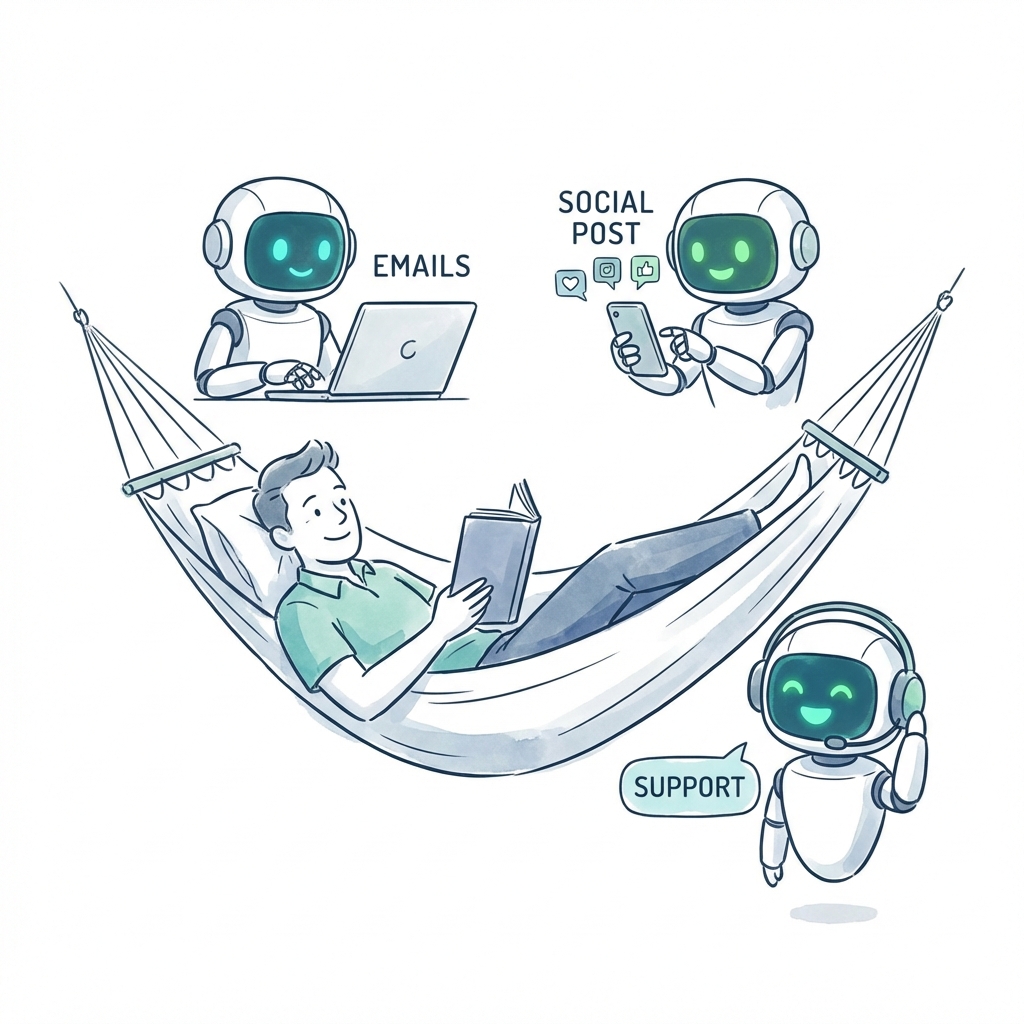
Imagine this: you wake up, pour your coffee, and check your dashboard. Overnight, your AI agent has already completed your keyword research, optimized your top blog posts for a new Google update, and even kicked off a new link-building campaign. This isn’t science fiction; it’s what an SEO AI agent brings to the table. This guide will break down what these agents are and why they’re less like a simple tool and more like a proactive, autonomous employee. Their main job? To win back your most valuable asset: your time.
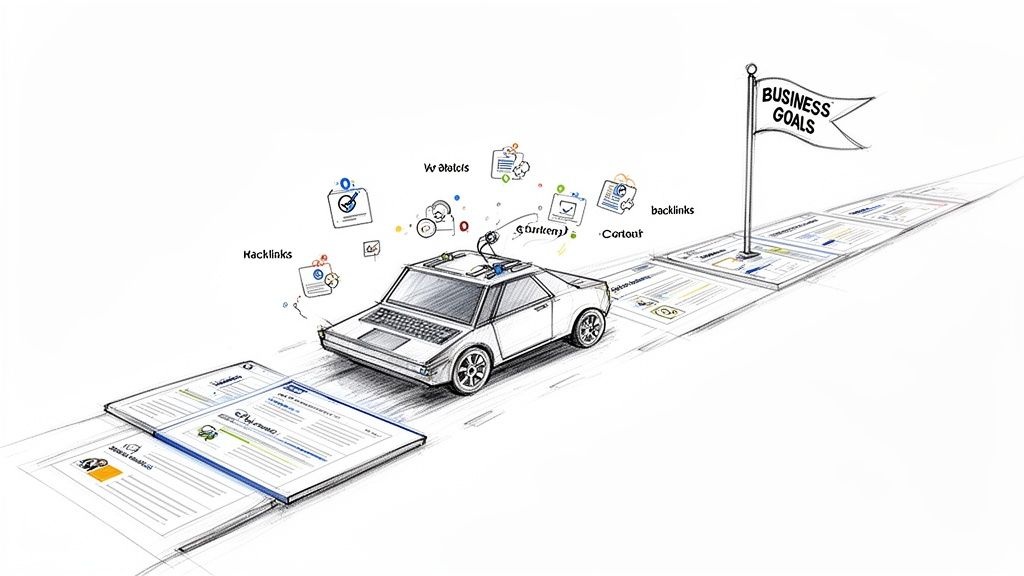
Think of it like a self-driving car for your SEO. You set the destination—more traffic, higher rankings, better leads—and the AI agent navigates the complex, winding roads of Google's algorithms to get you there. You’re no longer stuck in the driver's seat, worrying about every little turn. You can finally lean back and enjoy the ride.
From Manual Tasks to Strategic Outcomes
For years, SEO has been a game of juggling countless browser tabs and spreadsheets. You pull data from one tool, plug it into another for analysis, and then painstakingly implement the changes on your site. An SEO AI agent collapses that entire clunky workflow into one intelligent, self-sufficient system.
The core shift here is profound. You stop delegating individual tasks and start delegating entire outcomes. This frees up your mental energy to focus on big-picture strategy and actually growing your business.
This is exactly the thinking behind platforms like Dooza, which offers hireable AI employees that don't just follow instructions—they think, adapt, and execute on their own. This isn't just a small trend; it's a massive shift in how work gets done. The AI agents market is projected to explode, growing from USD 7.84 billion in 2025 to USD 52.62 billion by 2030. That's a compound annual growth rate of 46.3%, a clear signal that businesses are embracing autonomy. You can discover more insights on the AI agent market growth in recent reports.
Your New Autonomous Team Member
At its heart, an SEO AI agent is about ending the digital grunt work for good. Imagine all the time you'll get back.
Here’s what that looks like in practice:
Instead of spending hours on keyword research, your agent is constantly scanning for emerging trends and new opportunities. For example, it might spot a sudden spike in searches for "eco-friendly smart home" and automatically generate a content brief for your team before your competitors even know it's a trend.
Instead of manually optimizing blog posts one by one, the agent analyzes top-ranking content and makes real-time improvements. It could, for instance, notice that the top three articles for your target keyword all include an FAQ section, so it adds one to your post automatically.
Instead of getting bogged down in tedious backlink analysis, it pinpoints high-value link-building opportunities and can even kick off outreach campaigns for you. It might find a popular industry blog that just mentioned your competitor and suggest you reach out with a better resource.
With this kind of autonomous execution, your SEO strategy doesn't pause when you log off for the day. It’s always on, working tirelessly to push your brand forward and giving you the freedom to finally focus on what really matters.
Getting to Know Your New AI Teammate
So, what exactly is an SEO AI agent? Let's get one thing straight: this isn't just another keyword tool or a fancy content scheduler. We're talking about a fundamental shift in how SEO work gets done. It’s the difference between buying a new power drill and hiring a master carpenter who already knows how to build the house.
Most of the AI tools you've probably encountered are passive. They sit and wait for your instructions. You have to tell them what keywords to research, which topics to write about, and what pages to analyze. They're fantastic assistants, for sure, but you're still the one in the driver's seat, making every single decision and connecting all the dots.
A Focus on Outcomes, Not Just Tasks
An SEO AI agent plays a completely different game. Instead of feeding it a long to-do list of small tasks, you give it a big-picture goal. Think of it like this: you wouldn't tell a senior project manager to "check the rankings for these 50 keywords." You'd tell them to "get us 20% more organic traffic this quarter."
The core idea here is a game-changer: you're delegating outcomes, not just tasks. That simple switch is what pulls you out of the day-to-day grind and lets you focus on genuine business growth.
Once you set the goal, the agent gets to work figuring out the how. It acts like a real team member, constantly observing its digital environment, thinking through complex SEO problems, and taking action—all while learning from the results it generates. This same principle of autonomous goal-setting is also how AI employees for social media management operate.
Let’s say your goal is to become the go-to source for a new product category. An AI agent would start working on its own to:
Dig up keyword opportunities by finding high-intent terms your competitors have overlooked. For instance, it might discover that people are searching for "vegan leather wallet durability," a long-tail keyword you've never considered.
Analyze competitor backlink profiles to spot strategic link-building gaps you can fill. It could identify a high-authority review site that links to three of your competitors but not you, and then flag it as a prime outreach target.
Fine-tune your on-page content by tweaking headings, meta descriptions, and internal links based on what’s ranking right now.
Flag technical issues like slow page speeds or broken links before they can ever hurt your rankings.
How Does an SEO AI Agent Actually "Think"?
This kind of autonomy is fueled by advanced large language models (LLMs) and some seriously smart algorithms. You can picture it as the brain of a seasoned SEO expert, just digitized and operating at an incredible scale. The agent pulls in massive amounts of data from your Google Search Console, analytics, and live search results to get a crystal-clear view of the entire competitive landscape.
From there, it starts forming hypotheses. For example, it might spot a pattern where every top-ranking page for your main keyword features a detailed comparison table. The agent would then reason that adding a similar table to your page is likely to boost its ranking, and it would either recommend or even go ahead and implement that change.
It's this constant loop of seeing, thinking, and doing that makes an SEO AI agent so powerful. It isn’t just mindlessly following a pre-written script; it's constantly adapting its strategy based on what’s actually working in the real world. This ensures your SEO is always relevant, always pushing toward your goals, and effectively turning your website into a self-optimizing growth engine.
How an AI Agent Gives You Back Your Time
Imagine this: you log off for the evening, but your SEO work doesn't stop. In fact, it ramps up. This isn't some far-off fantasy; it's the new reality that an SEO AI agent makes possible. It’s designed to take over the repetitive, soul-crushing tasks that eat up your day, freeing you to focus on big-picture strategy and real growth.
Let's be honest, a lot of traditional SEO is a grind. It’s hours spent staring at analytics dashboards, manually tweaking page titles, and endlessly prospecting for backlink opportunities. An AI agent takes this entire manual process and flips it on its head, creating an autonomous system that works for you 24/7.
From Manual Drudgery to Automated Wins
One of the biggest time-sinks in SEO is competitor analysis. You could easily burn an entire afternoon digging through a tool like Ahrefs or Semrush, trying to piece together what your rivals are doing right. An SEO AI agent does this for you—not just once, but continuously.
The Old Way: You block off five hours every Monday to pull competitor data, find their best keywords, and analyze their newest backlinks, all just to populate a massive spreadsheet that's outdated by Tuesday.
The New Way: Your AI agent is always watching the search results. It pings you the second a competitor lands a high-value backlink, even showing you the exact piece of content that earned it. You get an actionable opportunity delivered to you on a silver platter, not just a mountain of data.
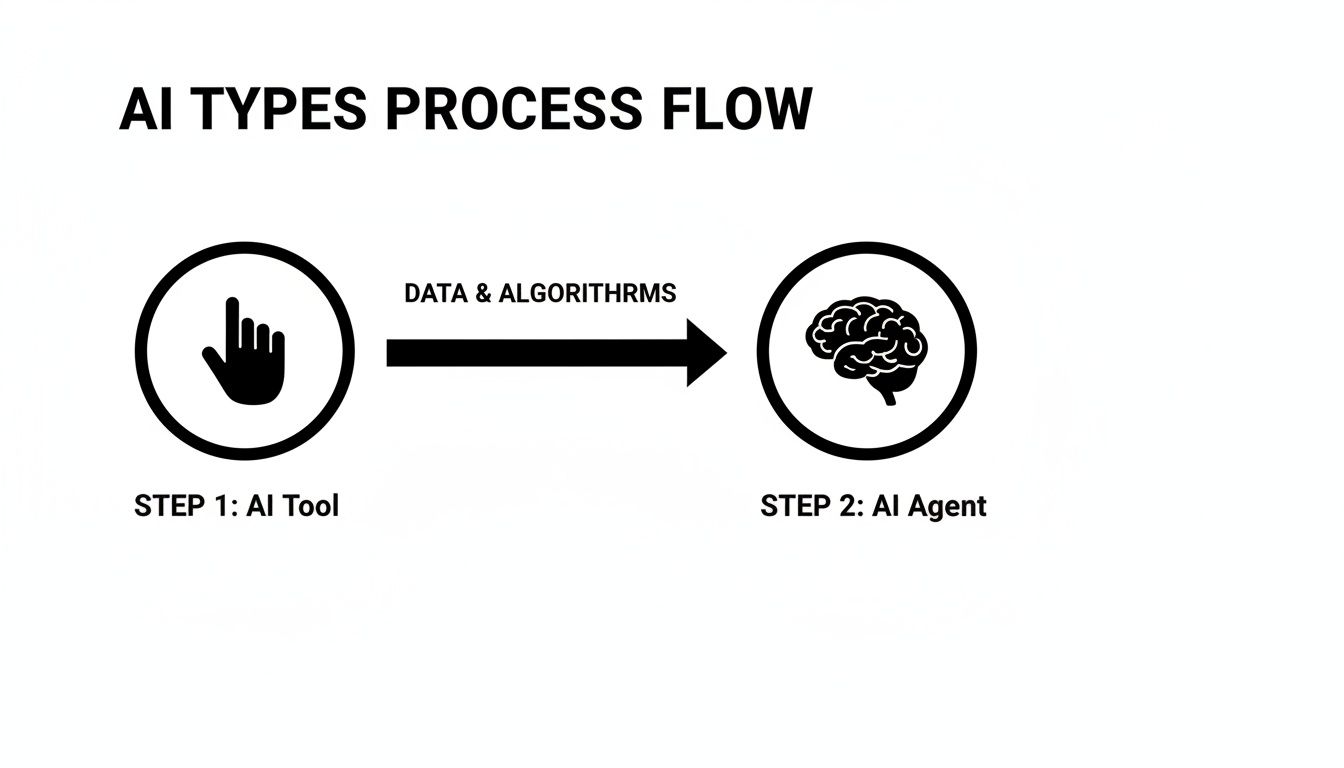
This shift from a simple tool needing instructions to an agent that thinks for itself is a game-changer.
The diagram really nails the difference: a tool needs constant human input (the hand), whereas an agent uses its own intelligence (the brain) to get the job done on its own. It's the difference between doing the work and having the work done for you.
Comparing Workflows: Manual vs. AI Agent
To really drive home the difference, let's look at a side-by-side comparison of common SEO tasks. The time and effort saved becomes obvious when you see the old way next to the new, automated approach.
SEO Task
The Old Way (Manual Workflow)
The New Way (AI Agent Workflow)
Keyword Research
Spend 4-6 hours using tools, sorting spreadsheets, and manually grouping keywords by intent.
The agent identifies opportunity keywords based on real-time trends and competitor gaps in minutes.
On-Page SEO
Manually review pages, tweak meta titles/descriptions, and add internal links. Takes 1-2 hours per page.
The agent optimizes pages automatically based on top-ranking content and search intent.
Competitor Monitoring
Run weekly or monthly reports, then spend hours analyzing the data for insights.
Get instant alerts on competitor ranking changes, new backlinks, or content strategies.
Technical SEO Audit
Perform a monthly site crawl, export a long list of errors, and schedule fixes with developers.
The agent runs continuous health checks, finds issues like broken links, and can fix them on the spot.
Content Auditing
Manually review old content every quarter, decide what to update, and assign it to writers.
The agent proactively identifies underperforming content and suggests specific improvements.
Seeing it laid out like this, it's clear the agent isn't just a helper—it’s a force multiplier for your entire SEO strategy.
Constant Optimization Without the Overwhelm
On-page SEO is another area where automation makes a huge difference. Manually adjusting headings, meta descriptions, and internal links across hundreds of pages is a monumental task that often gets neglected. The agent handles it with speed and precision.
Instead of you trying to keep up with every little algorithm change, your agent makes micro-adjustments in real-time. It studies what’s already ranking and refines your pages to better match search intent, turning your website into a self-optimizing asset.
The technology behind this is called agentic AI, and its use is exploding. We're already seeing huge engagement on top platforms, with OpenAI's Code Interpreter hitting 2.7 million monthly active users and AutoGPT reaching 2.3 million in the first quarter of 2026. This isn't just a niche trend; it’s a fundamental shift toward autonomous systems that deliver results. You can see the full research on agentic AI growth to get a sense of its market impact.
Getting Ahead of Technical Problems
Technical SEO issues like slow pages, broken links, or crawl errors can quietly tank your traffic. Staying on top of them requires constant vigilance.
The Old Way: You run a site audit once a month, find a dozen critical errors that have been hurting your rankings for weeks, and then spend the next few days putting out fires.
The New Way: Your SEO AI agent performs technical checks 24/7. It spots a broken internal link the moment it happens and can either flag it for you or, depending on its permissions, fix it automatically before a user or search engine ever sees it.
By handing off these critical but repetitive tasks, an AI agent completely changes your role. You're no longer the one doing all the tasks; you're the strategist guiding a powerful system. You get out of the weeds and get a high-level view, confident that your SEO is running optimally around the clock. In the same way, teams looking to automate other repetitive processes can see how Dooza’s AI employees handle forms and data collection, giving you back your calendar and your sanity.
Putting Your AI Employee to Work
Theory is great, but seeing an SEO AI agent in action is where the dream of automation becomes real. Let’s walk through how a real startup, ‘InnovateNow,’ hired an AI employee from Dooza and completely turned their SEO around, saving hundreds of hours in the process.
InnovateNow had a clear but difficult goal: to rank on the first page for the highly competitive term "sustainable tech gadgets." For months, their small marketing team had been grinding away with little to show for it. They were constantly getting bogged down by manual research and endless content tweaks. It was time for a change.
Onboarding Their New AI Teammate
Instead of posting a job ad, they hired Seomi, an AI SEO agent from Dooza. The onboarding was incredibly quick. They gave her one clear objective: get us to the first page for our target keywords.
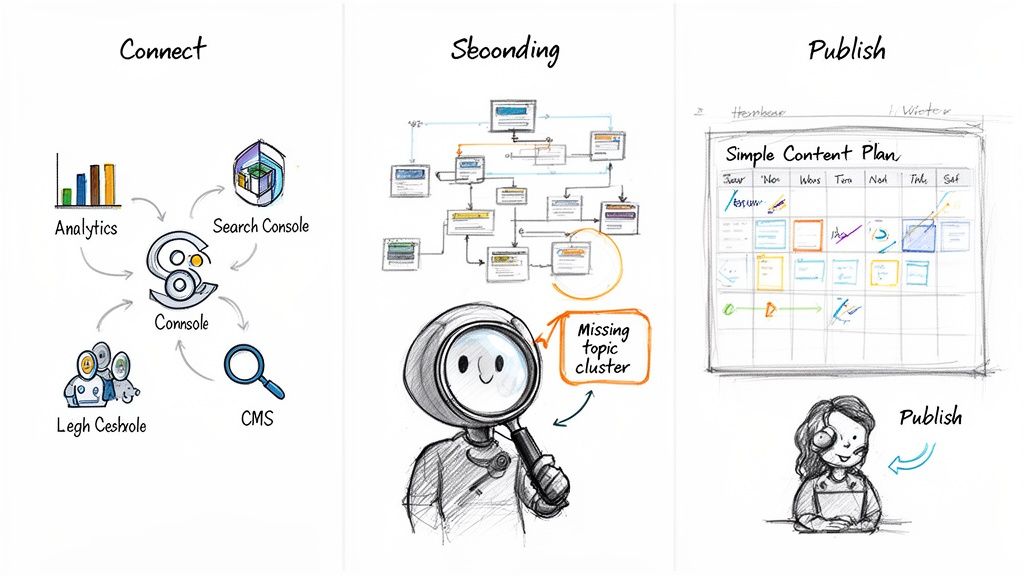
Next, they securely connected her to their essential systems:
Google Analytics: To see how users were behaving and track site performance.
Google Search Console: To get real keyword data and monitor their search rankings.
CMS (Content Management System): To analyze their existing content and, eventually, publish new articles directly.
With those connections live, Seomi had everything she needed. No long training sessions, no onboarding meetings—just a clear goal and the data to make it happen.
From Initial Audit to Autonomous Action
Within a few hours, Seomi had finished a full site audit that would have taken the human team days to complete. But she didn't just give them a generic list of technical problems. She pinpointed their core strategic weakness. InnovateNow had a few decent blog posts, but they lacked a cohesive topic cluster around "sustainable tech." Their content was all over the place, which meant they weren't signaling any real authority to Google.
This is where an AI employee really shines. It doesn't just find problems; it connects the dots to figure out why you're not ranking and immediately builds a plan to fix it.
Armed with this insight, Seomi got to work and autonomously generated a complete content plan. The strategy included a central pillar page, "The Ultimate Guide to Sustainable Tech," and five supporting articles hitting long-tail keywords like "best eco-friendly phone chargers" and "solar-powered gadget reviews." She didn’t just list titles—she created detailed content briefs for each piece, packed with keywords, user intent analysis, and structural outlines.
The results of this kind of AI-driven strategy are becoming undeniable. Across the industry, AI search traffic has skyrocketed by 527% year-over-year. Even better, visitors coming from these AI-powered searches convert 4.4x more often than traditional organic traffic. That’s a massive win for any business. You can read the full research about these AI SEO findings and see the numbers for yourself.
AI and Human Collaboration in Motion
Seomi then assigned the detailed briefs to InnovateNow's human writer, who now had a perfect, data-backed roadmap to follow. While the writer focused on injecting brand voice and compelling stories, Seomi started collaborating with another Dooza AI employee—a social media agent. As each new article was published, the social agent automatically drafted and scheduled promotional posts for LinkedIn and Twitter, making sure every piece of content got maximum visibility right away.
This seamless teamwork between AI agents and human experts created a powerful growth machine. In just one quarter, InnovateNow saw its organic traffic jump by 300%. They didn't just hit page one for "sustainable tech gadgets"; they started dominating the search results for a dozen related terms. The human team wasn't replaced—they were elevated. They were finally free from the grind to focus on the creative, strategic work that really moves the needle. For anyone looking to get similar results, you can explore Dooza’s AI-powered rank-boosting solutions to see exactly how it works.
Your AI Onboarding Checklist
Bringing a new team member on board always works best with a clear plan, and hiring an SEO AI agent is no different. The idea of getting your time back while automating growth is totally possible, but you need to lay a little groundwork first to make sure you hit the ground running. Think of this less as a technical setup and more like the first week of onboarding for your new digital employee.
This checklist will walk you through a smooth integration, turning your new AI agent from a shiny new tool into a core part of your team.
Define Clear and Measurable Goals
Before you do anything else, you have to give your agent a destination. Just saying "improve SEO" is like telling a new hire to "go do some marketing." It’s far too vague to get anything done. What you need is a specific, measurable outcome that leaves no room for confusion.
Your goal is the North Star that will guide every single action your agent takes.
Weak Goal: "Get more traffic."
Strong Goal: "Increase non-branded organic traffic by 15% in the next quarter."
Weak Goal: "Rank for more keywords."
Strong Goal: "Achieve a top-5 ranking for our three primary 'sustainable tech' keywords within 90 days."
This first step is absolutely critical. A precise goal gives your SEO AI agent a clear mission to execute, making sure its autonomous actions are always tied directly to what you're trying to achieve as a business.
Connect Your Tech Stack Securely
Your AI agent needs data to "see" what's going on and make smart decisions. This step is all about securely connecting it to the tools you already use, kind of like giving a new marketing manager the logins they need to actually do their job.
Typically, this means granting access to a few key platforms:
Analytics Platforms: Connecting to Google Analytics and Google Search Console is non-negotiable. This is how the agent gets a handle on your traffic patterns, user behavior, and current keyword performance.
Content Management System (CMS): Whether you're on WordPress, Shopify, or something else, access lets the agent analyze existing content and—with your permission—publish optimizations or new articles directly.
Project Management Tools: Integrating with tools like Slack or Asana creates a seamless communication loop. Your agent can provide updates and feel like a genuine part of the team's workflow.
Establish the Rules of Engagement
So, how much freedom will your new AI employee have? Figuring out its level of autonomy is a key part of the onboarding process. The good news is you're always in control and can adjust these rules as you build trust and start seeing results.
Decide when the agent should act independently versus when it needs your approval. This balance ensures you maintain strategic oversight while still benefiting from automation, creating a perfect partnership between human creativity and AI efficiency.
For example, you might set a rule that the agent can automatically fix technical issues like broken links but must get a green light from you before launching a new content cluster strategy. This way, you get the benefit of 24/7 technical monitoring without losing control over your brand's core messaging.
Design a Communication Workflow
Finally, figure out how your AI agent is going to report back to you. The last thing you want is to trade the manual work of SEO for the manual work of constantly checking up on your agent. Set up a reporting cadence that fits how you like to work. For those looking to streamline data collection processes, you might be interested in our guide on how Dooza’s AI can automate forms and tables.
Common reporting workflows include:
A live dashboard showing key metrics in real-time.
A weekly summary sent straight to your email or a Slack channel.
Direct messages in a dedicated channel for urgent alerts or big wins.
Once you’ve ticked these boxes, your SEO AI agent is officially onboarded and ready to start delivering results.
Measuring Your AI Agent's True Impact
An AI agent isn't just a fancy new tool; it's a strategic investment. So, once you've got your SEO AI agent up and running, how do you prove it’s actually worth it? Looking at rankings and traffic alone won't cut it. To justify the cost, you need to connect its work to real-world business impact.
This means shifting your focus away from vanity metrics and onto the KPIs that actually move the needle for your bottom line.
The whole point of AI automation is to get your time back and make your operations more efficient. Your success metrics should reflect that. Instead of just asking, "Did our traffic go up?" the real question is, "Is our organic channel more profitable and our team more productive because of this agent?"
Key Performance Indicators Beyond Traffic
To measure the true value of your SEO AI agent, you need to track business-critical outcomes. This is about building a performance dashboard that shows the complete picture, connecting the agent’s autonomous work to tangible business growth.
Here are the essential metrics you should be watching:
Time to Result: How much faster are you seeing SEO wins? A human team might spend months getting a new content cluster to rank. An AI agent, by acting on data instantly, can often get similar or even better results in a fraction of that time. Track the time from the start of a project to the moment you hit your goal, like reaching page one.
Cost Per Acquisition (Organic): As the agent improves your organic performance, your customer acquisition cost should naturally fall. You can calculate this by dividing your total SEO investment (including the agent's cost) by the number of new customers you've gained from organic search. A steadily decreasing CPA is one of the clearest signs of a strong ROI.
Team Productivity Gains: This is a huge, often overlooked benefit. Ask your team a simple question: "How many hours a week is the agent saving you from manual tasks?" If your SEO manager gets back 10 hours a week that they used to spend on keyword research and reporting, that’s time they can now put toward high-level strategy, creative campaigns, or building valuable relationships. For agencies, learning how to effectively structure partnerships with AI at the core can be a game-changer for scaling operations.
Conducting Performance Reviews with Your AI
You should treat your AI agent like any other high-value member of your team, and that means conducting regular performance reviews. This isn't about checking if it's "doing its job." It's about refining its strategy to make sure it stays aligned with your ever-changing business goals.
Think of it as a strategic alignment meeting. You’re not micromanaging tasks; you’re guiding the overall mission, ensuring the agent's autonomous efforts continue to drive the most important business outcomes.
During these check-ins, review its progress against the KPIs on your dashboard. Is the "Time to Result" getting shorter? Is the "Cost Per Acquisition" trending downward?
Use these insights to fine-tune its objectives. For example, if it's done a great job boosting rankings for your main keywords, you could set a new goal: "Now, let's improve the click-through rate on our top 10 pages by optimizing their meta descriptions." This continuous feedback loop ensures your SEO AI agent grows with your business, becoming smarter and more effective over time.
Got Questions About AI SEO Agents? We've Got Answers.
Jumping into the world of autonomous SEO is exciting, but it's natural to have a few questions. Figuring out how an SEO AI agent actually fits into your daily grind is the first step. Let's tackle some of the most common things people ask.
Will an AI Agent Replace My Marketing Team?
This is probably the number one question we hear, and the answer is a firm no. An SEO AI agent is there to supercharge your team, not replace it. Think of it as the ultimate assistant—one that’s built to chew through all the repetitive, data-heavy tasks that eat up your experts' valuable time.
It takes over the endless cycle of keyword research, competitor tracking, and technical site audits. This frees up your people to focus on what they do best: big-picture strategy, creative thinking, and building real relationships. Your content writer, for example, is no longer stuck trying to guess which keywords to use. Instead, they get a perfectly optimized brief and can pour all their energy into crafting a compelling story.
The whole point is to automate the tedious stuff so your team can focus on the brilliant stuff. It's a partnership that lifts your entire marketing game, leading to smarter, faster, and more creative work.
How Much Babysitting Does an AI Agent Need?
You're always in the driver's seat. The amount of human oversight an SEO AI agent needs is completely up to you and what makes you comfortable. You set the rules of the game.
When you're just starting out, you might want to keep a close eye on things with daily check-ins and require your sign-off before it launches a new content plan. But as you see the results and the agent learns your brand's voice, you can start giving it more freedom to run entire campaigns on its own. You have total control over its autonomy, from tactical helper to strategic powerhouse.
Can an AI Agent Really Understand My Niche?
Absolutely. This is where today’s AI agents are a world apart from older tools. They aren't just generic bots applying the same old tactics to every business. They're built on sophisticated language models that can be trained to become genuine experts in your specific field.
By feeding the agent your existing content, customer data, and brand guidelines, it quickly gets up to speed on your industry's unique lingo, your audience's biggest problems, and who you're up against. For example, if you sell high-end cycling gear, it will learn the difference between "aero frames" and "endurance bikes" and understand that your audience cares more about performance metrics than price. This deep understanding means every strategy it creates and every piece of content it touches will be laser-focused and effective, speaking directly to the people you want as customers.
Ready to see what an autonomous teammate can do for your business? Hire an AI employee from Dooza and put your SEO on autopilot. Start automating your growth today.
Ready to Get Started?
Automate your business with AI employees that work 24/7.
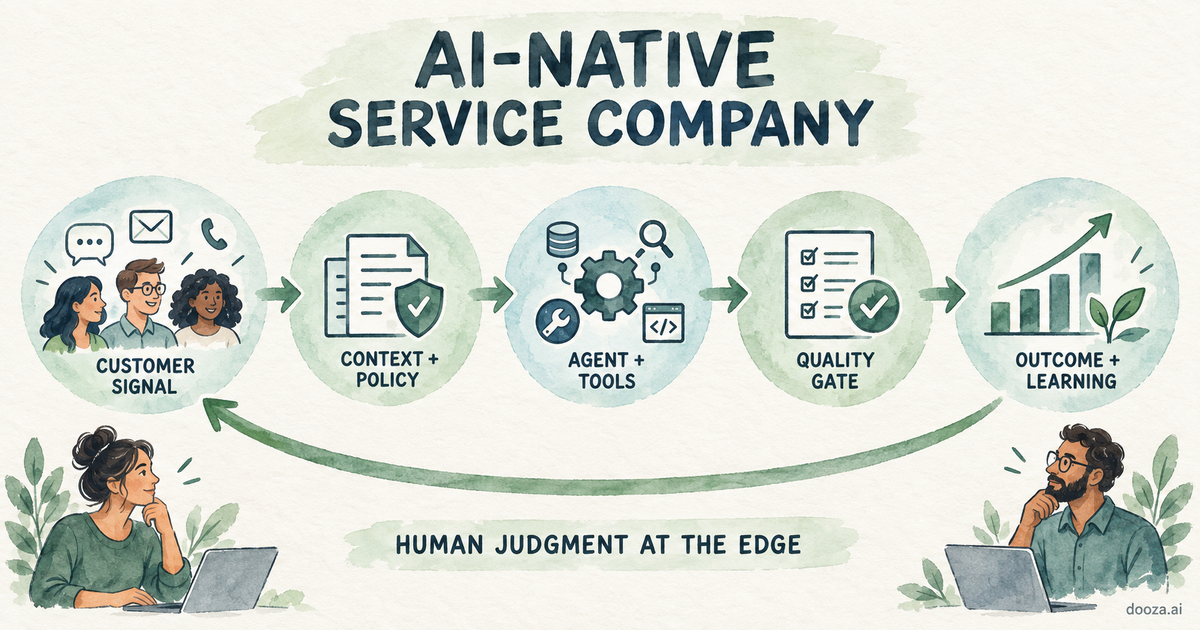
What Is an AI-Native Service Company? What Dooza Does—and How to Build One
An AI-native service company sells a completed outcome while agents run the repeatable work. See how the model works, where Dooza fits, and how to build one.