AI Automation
Top AI Automation Companies to Watch in 2026
Discover the leading AI automation companies transforming business workflows in 2026. Learn how agentic AI and digital workers can boost your efficiency.
10 min read
ReadExplore what is intelligent automation and how AI-powered workflows can boost efficiency, cut stress, and reclaim your time.
When you hear the term Intelligent Automation, it’s easy to get lost in the buzzwords. At its core, it’s about bringing artificial intelligence into the world of business process automation. Imagine hiring a team of digital employees that don't just do tasks, but can think, learn, and adapt on the fly.
This is the dream of automation realized: a system designed to tackle the complex, messy, non-repetitive work that usually requires human judgment, freeing you up to focus on what truly matters—growing your business.
Let’s cut through the tech-speak. Imagine you have a basic calculator. It’s a perfect example of traditional automation—it follows its programmed rules flawlessly but can’t do a single thing beyond that.
Now, picture a savvy financial advisor. They don't just crunch the numbers; they analyze market trends, interpret complex data, and offer strategic advice. That's Intelligent Automation (IA). It’s not just about doing things faster; it’s about creating the freedom to stop working in your business and start working on it.
Think of it as hiring your first team of ‘digital colleagues’—AI agents that take over the repetitive, energy-draining work that bogs you and your team down. Imagine an AI that manages your entire client onboarding process, from sending the initial contract to scheduling the kickoff call, all while you sleep. This shift is what allows you to finally focus on strategy, creativity, and the big-picture growth you've been aiming for.
Intelligent Automation is about more than just efficiency. It’s about creating a smarter way of working where technology handles the tedious tasks, freeing up human talent for the work that truly matters.
While the idea of IA isn’t brand new, its capabilities have evolved dramatically. It grew from the combination of classic workflow automation, Robotic Process Automation (RPA), and recent breakthroughs in AI. This evolution is fueling some serious growth. The business process automation market, valued at $9.8 billion in 2020, is on track to nearly double by 2026. You can explore more insights about this market's growth and see what it means for businesses trying to stay ahead.
This rapid expansion points to a fundamental change in how we work. We’ve moved past simple, scripted bots into a new era of orchestration, where intelligent agents, critical data, and human oversight all work together in a coordinated, seamless flow. It's the difference between automating a single task and automating an entire job function.
So, what does intelligent automation look like in the real world? Imagine the possibilities.
It’s an AI social media manager that doesn’t just schedule posts but actually analyzes engagement data to come up with better content ideas and writes the copy for you. It's a digital assistant that triages your inbox, flags urgent requests, drafts responses, and even manages your calendar so you can start your day with a clear view of your priorities.
These aren't just tools; they're collaborators, working 24/7 to push your business forward and give you back your most valuable asset: your time.
To really get what intelligent automation is, you have to look under the hood. It’s not a single piece of tech. Think of it as a dream team of four core components working in perfect sync, all with one goal: to get the busywork off your plate so you can focus on growing the business. Let's break down how this team operates.
The image below shows how we got here. Intelligent automation isn't something that appeared out of thin air; it’s the next logical step in a long line of process improvements, building on what came before to create something much more capable.
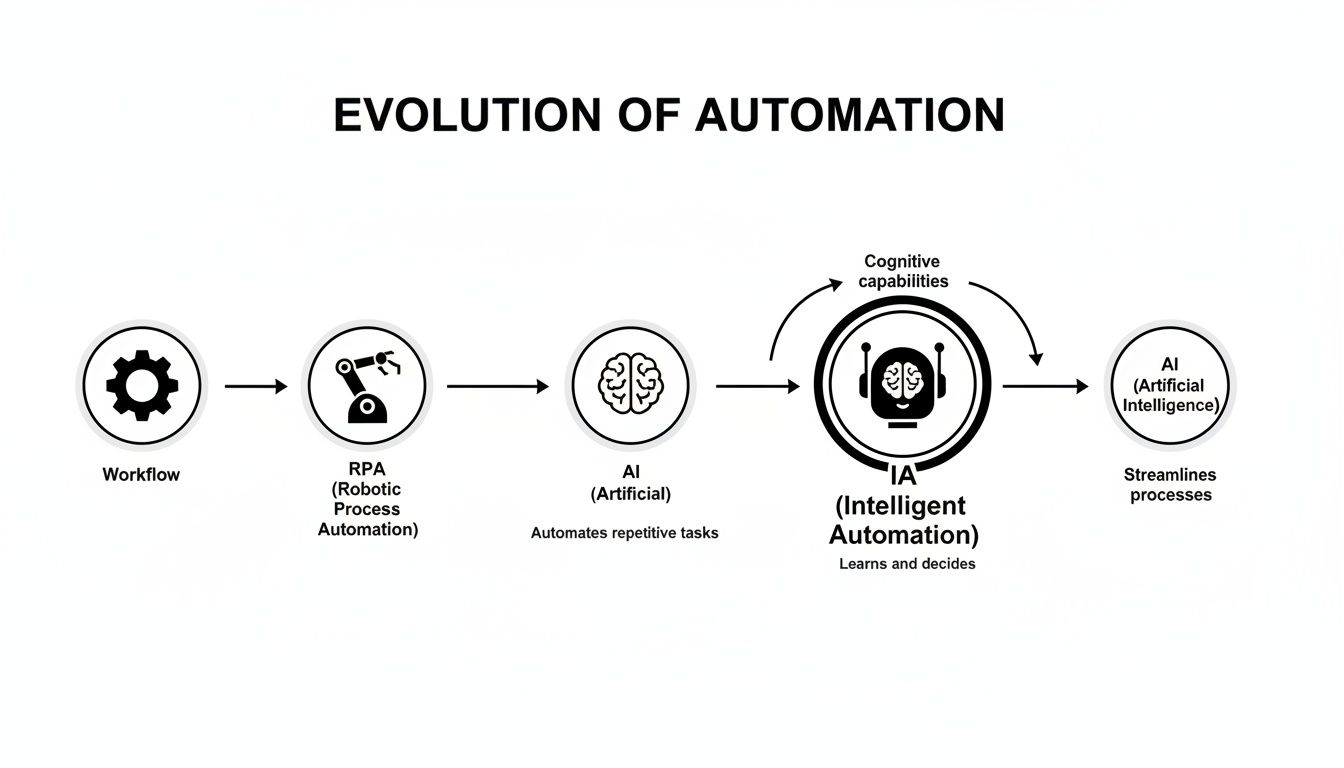
You can see the clear path from basic task-doing to systems that can genuinely think, act, and even collaborate.
At the very core of intelligent automation is Artificial Intelligence (AI). This is the "brain" of your digital workforce. We're not talking about simple, rule-based bots that just follow a script. This is about technology that can interpret unstructured data, spot patterns, and make real judgments.
For example, an AI agent can scan an incoming customer support email, understand the customer is frustrated about a late delivery, and automatically draft a compassionate response offering a discount on their next order—all before a human even sees the message. This cognitive skill is the difference between a dumb bot and a smart system that actually learns on the job.
If AI is the brain, then Process Orchestration is the central nervous system connecting everything. It's the conductor making sure all your different AI agents, software tools, and human employees are playing from the same sheet music.
Imagine you hire an AI employee to handle your marketing. Orchestration allows it to research keywords, then pass that research to another AI agent to write a blog post. That agent then hands the finished post to a social media AI to create promotional content, which finally pings a real person for the final thumbs-up on the new campaign. This smooth coordination is what turns a bunch of separate tasks into a seamless, automated business process that runs from start to finish.
Orchestration is the secret sauce. It transforms a collection of smart tools into a cohesive, goal-oriented team that executes complex workflows on your behalf, 24/7.
Your business already runs on a whole host of apps—your CRM, project management software, email platforms, you name it. Seamless Integrations are the hands and feet of your AI team, giving them the ability to connect to and work within these tools just like a person would.
For instance, when a new lead comes through a website form, an integrated AI agent can instantly create a new contact in your CRM, add them to the right email sequence, and even assign a task to a sales rep. No more manual data entry. No more switching between ten different tabs. Just pure, effortless efficiency. You can see how we manage this kind of data flow in the Dooza.co Table, which is built to structure and automate information.
Finally, and this is crucial, Human-in-the-Loop Collaboration keeps you in the driver’s seat. Intelligent automation was never about replacing people; it’s about making them better at their jobs. You provide the strategy, and your AI team handles the execution.
This means you can review a report drafted by an AI before it goes out, approve a social media post it created, or jump in to handle a tricky customer situation that the AI has flagged for you. It’s a partnership where you delegate the grunt work and keep your focus on the big picture, blending machine efficiency with human creativity. Imagine freeing your team from mundane tasks so they can spend their time innovating and delighting customers.
Forget the buzzwords for a second. The real reason entrepreneurs and small teams should care about intelligent automation isn't some abstract concept like 'efficiency.' It's about something far more valuable: getting your time back.
Think about what it would mean to delegate entire business functions, not just individual tasks. Imagine launching a full marketing campaign with a single click, which then kicks off a team of AI employees. One agent crunches the SEO data, another drafts social media posts, and a third handles the initial wave of customer questions—all while you're focused on the big picture. This is the dream of scaling without the stress.
This isn't science fiction anymore. It’s about growing your business without needing to hire an army, sidestepping the burnout that comes from wearing a dozen different hats, and finally creating the space to work on your business instead of just in it.
When you bring intelligent automation into your workflow, you fundamentally shift your role from doing the work to directing it. Instead of losing hours every day to manual spreadsheet updates, inbox management, or scheduling chaos, you empower your digital workforce to handle it all for you.
For example, an AI can manage your entire invoicing process. It generates invoices from project data, sends them to clients, and follows up on late payments, freeing your team from chasing paperwork. By handing off the predictable, repetitive parts of their jobs, you free them up for work that actually requires a human touch—building client relationships, creative problem-solving, and strategic planning. You get a massive boost in output without piling more onto anyone's plate.
The numbers back this up. Companies that combine AI with end-to-end automation report up to a 70% drop in process errors and see customer satisfaction jump by around 7%. In a single industry like healthcare, automation already handles over 30 billion tasks every year, from scheduling to claims processing. For a small business, that's a clear signal: AI agents are a proven way to scale.
Happy customers stick around, and intelligent automation is a powerful tool for creating the kind of experience that builds loyalty. It lets you deliver service that's faster, more accurate, and more personal, 24/7. Imagine a world where no customer ever has to wait.
This kind of responsive, always-on support used to be reserved for giant corporations with massive call centers. Now, any business can offer it and create fiercely loyal customers. For a closer look at how automation is changing customer service, check out our guide on finding the best Gorgias alternatives for your support team.
It’s one thing to talk about intelligent automation in theory, but seeing it in action is where it really clicks. Let's move past the definitions and dive into a few "day-in-the-life" scenarios. This is how a connected team of AI employees can turn your daily grind into a seamless, automated workflow, giving you back hours of your day.
Think about hiring digital teammates who work right alongside your human staff, handling entire job functions so you can get back to the work that truly matters. This is where the dream becomes a practical reality.
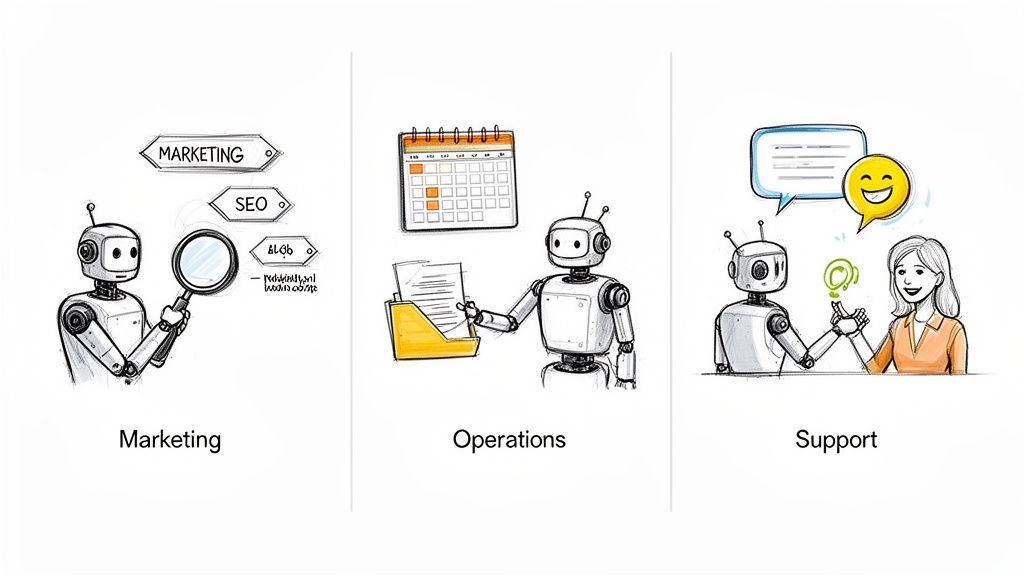
Let’s introduce Seomi, your new AI SEO Specialist. Her day kicks off by reviewing your latest blog post. She isn’t just scanning for keywords; she’s comparing it against top-ranking articles, recommending structural changes to improve readability, and crafting compelling metadata to boost click-through rates.
Once the post is good to go, Seomi hands it off to another AI employee—your Social Media Manager. This AI agent pulls the key takeaways from the blog, writes a full week of engaging social media posts tailored for LinkedIn, Twitter, and Facebook, and schedules them to go live when your audience is most active. All you have to do is approve the campaign with a single click, and your entire content promotion is set in motion while you focus on your next big idea.
Now, let's turn to your AI Operations Assistant. You start your day with a perfectly managed calendar. The AI has already sorted through your emails, accepted meeting invites that align with your schedule, and politely declined those that don't, all based on the priorities you set. You walk into your day with clarity, not chaos.
Later that afternoon, a new client signs up. Instead of you manually creating folders, writing welcome emails, and drafting contracts, your AI assistant handles it all. It instantly generates the necessary onboarding documents, sends them for an e-signature, and once signed, it files the contract away, sets up a new profile in your CRM, and assigns the first project task to the right person on your team. That's a week's worth of admin work done in minutes.
The goal isn’t just to automate a single task; it's to automate an entire outcome. Intelligent automation connects every step, from lead capture to client onboarding, so you can deliver a stellar experience without all the manual legwork.
For many businesses, a great starting point is automating information intake. You can save a massive amount of time by automating how you handle new client data with tools like Dooza Forms.
Finally, imagine an AI Support Agent on your front line. It works 24/7, fielding customer questions. When a common query like "How do I reset my password?" comes through, the AI delivers an immediate, accurate answer, no human needed. Your customers get help instantly, and your team is freed from answering the same questions over and over.
But it gets smarter. When a trickier issue comes up—say, a customer is upset about a billing mistake—the AI detects the negative sentiment and urgency. It instantly pulls the customer's account history, creates a summary of the problem, and escalates the ticket to a human agent with all the context they need to jump right in and save the day.
This completely changes the game. Your human team can now focus their energy on solving complex, high-value problems and building real customer relationships. They step in precisely where their expertise makes a difference.
To make these examples even more concrete, here's a quick look at how specific AI employees can be deployed across different departments.
This table shows a few practical applications, mapping specific AI tasks to the business outcomes they drive.
| Department | AI Employee Task | Business Outcome |
|---|---|---|
| Marketing | Draft blog posts, create social media calendars, and generate ad copy based on top-performing content. | Accelerated content production and more consistent brand messaging across all channels. |
| Operations | Onboard new clients, process invoices, schedule meetings, and manage project timelines automatically. | Reduced administrative overhead and faster, error-free client and project management. |
| Customer Support | Provide instant answers to common questions, escalate complex issues with full context, and gather feedback. | 24/7 support availability, improved customer satisfaction, and a more empowered human support team. |
| Human Resources | Screen resumes for qualified candidates, schedule interviews, and manage employee onboarding paperwork. | Faster hiring cycles and a smoother, more organized experience for new hires. |
As you can see, the impact goes far beyond just saving a few minutes here and there. It's about fundamentally changing how work gets done, freeing up your team to be more strategic and creative.
Ready to get some time back in your day? The thought of setting up intelligent automation can feel intimidating, but jumping in is a lot easier than you might imagine. You don't need a huge budget or a squad of developers to get going—just a straightforward plan to score your first big automation win.
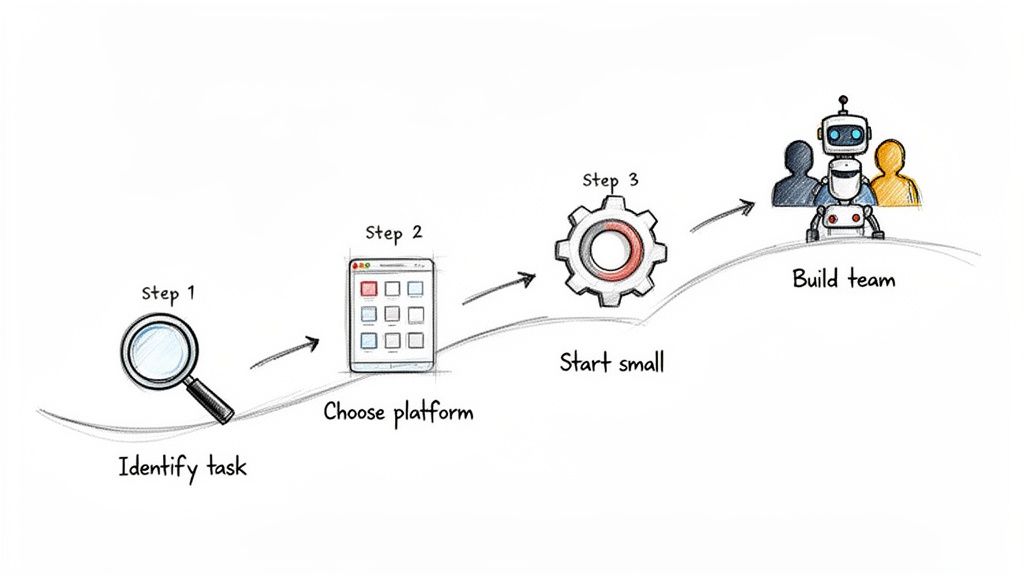
This isn't about flipping a switch and changing your whole business at once. It’s about making smart, targeted moves that deliver value right away, freeing you from tedious work from the very first day.
The best place to start is with the small, repetitive tasks that chip away at your focus every day. Forget trying to automate some massive, tangled workflow right out of the gate. Look for the quick wins.
Ask yourself this: What’s the one task that, if you never had to do it again, would give you back an hour of your day?
Pick a simple, high-frequency task like one of these, and you'll feel the impact of intelligent automation almost immediately. It’s a great way to build momentum and see the dream of automation in action.
To bring this to life, you need a system that can act as a conductor for all your different AIs and apps. This is where an all-in-one platform is a game-changer. You’ll want a solution that’s built for orchestration—the magic of getting different AI agents to collaborate with each other and with the tools you already use.
An orchestration platform is the difference between having a collection of disconnected tools and having a true digital workforce. It acts as the central hub where your human and AI teams can work together seamlessly.
This approach saves you from the nightmare of trying to duct-tape a dozen different apps together. It gives you one central command center to manage your AI employees and the work they do, making the dream of an automated business a manageable reality.
Now for the fun part: hiring your first AI employee. Start with just one. Assign it to that single task you identified back in step one. For example, you could bring on an AI assistant whose sole job is to manage your calendar.
Let it get that one job down perfectly. Once you get comfortable delegating, you can start expanding its duties or even "hiring" other specialized AI agents for different roles. This "start small, dream big" approach makes the whole process feel manageable and exciting, not overwhelming. You can discover more about building an AI workforce and see how https://dooza.co/ provides a platform for your first digital hire.
The final piece of the puzzle is bringing your human colleagues into the loop. Invite them to collaborate with their new AI teammates. Show them how an AI assistant can take meeting notes for them, draft follow-up emails, or handle project updates.
When your team sees firsthand how intelligent automation frees them up from the grind to focus on creative and strategic work, they’ll see it as a powerful partner, not a threat. This collaborative spirit is key. It ensures the technology truly enhances your team's capabilities, leading to a more productive and fulfilling workplace for everyone involved.
Starting with intelligent automation is an exciting step, one that promises to give you back your time so you can focus on the work you actually enjoy. But like any new venture, there are a few common tripwires. Knowing what they are ahead of time will help you build a smarter, more efficient way of working without the headaches.
The single biggest mistake we see is trying to automate a broken process. If a workflow is already confusing, inefficient, or just plain clunky for a human, making an AI do it just means you’ll get bad results much, much faster. Think of automation as an amplifier—it magnifies whatever you give it, for better or for worse.
Before you even think about hiring an AI employee, take a step back and map out the process you want to automate. Is it logical? Are there steps you can cut out entirely? For example, if your current invoicing process involves five manual checks, simplify it to two essential ones before handing it to an AI. Get the human workflow clean and simple first. This gives your AI agents a solid foundation to build on.
Another classic pitfall is setting fuzzy, undefined goals. Saying you want to "be more productive" is a nice thought, but it’s not a target. If you don't have clear objectives, you’ll never really know if your automation is actually paying off.
Vague goals lead to vague results. Success with intelligent automation comes from defining exactly what you want your AI team to accomplish and how you'll measure that success.
Give your AI team specific, measurable goals. For instance:
Finally, a common misconception is to view automation purely as a replacement for people. This mindset misses the incredible power of a human-AI partnership. Intelligent automation isn't about sidelining your talented team; it’s about supercharging their abilities and freeing them from burnout.
Modern platforms are designed for exactly this kind of collaboration. Your team sets the strategy and handles the creative, complex decisions, while AI employees execute the repetitive tasks. Humans can step in for approvals or to solve unique problems, creating a perfect blend of machine speed and human ingenuity. This approach creates a business that’s truly greater than the sum of its parts.
By sidestepping these common mistakes, you set your business up to achieve the real promise of automation: more freedom, less grind, and a clear path to smarter growth.
Let's tackle some of the common questions that pop up when people first hear about intelligent automation. Think of this as clearing the final bit of fog before you can see the path ahead.
You're probably already using AI in some form, maybe for writing content with a language model or creating images. The big leap with intelligent automation is orchestration.
Those standalone tools are great, but they work in isolation. An intelligent automation platform acts as the conductor, getting all those individual AI tools to work together on complex, multi-step projects.
Think about it like this: one AI agent drafts a detailed blog post. Once it's done, it automatically hands that post off to another AI agent, which pulls out the key points to create a week's worth of social media content. Then, that content is scheduled automatically. That seamless teamwork is what turns a collection of handy tools into a fully functional digital workforce, saving you hours of manual copy-pasting and context-switching.
For more examples of how these connected processes can transform your work, you'll find a ton of ideas on the Dooza blog.
Not at all. That used to be the case—you needed huge budgets and a team of developers to even think about it. But things have changed.
Modern platforms have made intelligent automation accessible to absolutely everyone, from solo founders to growing small businesses. The entire model has shifted away from building clunky, custom systems. Now, it’s about "hiring" pre-built AI employees that are ready to go.
This means you can start incredibly small. Imagine automating just one thing, like managing your calendar or triaging customer support tickets. As your business grows, you can scale your digital team without needing a massive upfront investment. The dream of having a large, efficient team is now within reach for businesses of any size.
Almost immediately, if you start smart. The trick is to not try and boil the ocean. Pick one small, repetitive task that eats up your time every single day.
By automating just one simple process—like sorting your inbox or scheduling all your meetings—you can genuinely free up hours in your very first week. Imagine finishing your Friday with a clean inbox and a fully scheduled next week, all handled automatically.
That initial quick win is powerful. It proves the concept and builds momentum. From there, you can start layering on more complex automations, creating a compounding effect that gives you more and more of your time back to focus on what you love.
Ready to build your own digital workforce? With Dooza, you can hire AI employees to manage your SEO, social media, operations, and more, all from one central platform. Start automating today at Dooza.co.
Automate your business with AI employees that work 24/7.
Discover the leading AI automation companies transforming business workflows in 2026. Learn how agentic AI and digital workers can boost your efficiency.
Discover 7 practical AI automation examples that save time, reduce costs, and boost productivity. Learn how to implement these workflows in your business today.
Join thousands of companies using Workforce to automate their work. Get started for free today.
No credit card required · 7-day money-back guarantee · Cancel anytime