Explore 10 powerful AI agent use cases for SMEs and agencies. Automate support, sales, and more with Dooza Agents to drive ROI. See examples for 2026.
18 min read
August 5, 2026
Stop hiring for repetitive tasks. Deploy AI employees.
Businesses are no longer using software just to assist humans, they're assigning work to digital workers that act, route, escalate, and close loops. That shift is already happening in the market. McKinsey's 2025 Global Survey found 23% of respondents said their organizations are already scaling an agentic AI system in at least one business function, while another 39% said they had started experimenting with AI agents, and the most common use cases cluster in IT and knowledge management, plus customer service automation (McKinsey's State of AI 2025). G2's 2025 research points the same way, with leading builder use cases led by customer service at 28%, research and BI at 26%, and process automation at 18% (G2 AI Agents 2025 report).
That's the story behind ai agent use cases. The winners are not chasing abstract automation. They're deploying Dooza Agents as AI employees in the workflows that already burn time, create backlog, and block revenue. If you want the fastest path to ROI, start with the jobs that are repetitive, high-volume, and rules-based, then let the agents handle the handoffs, logging, and follow-up. For background on automation economics in another operational function, see this financial automation statistics guide.
Customer support is the cleanest place to start because the work is repetitive, high-volume, and easy to route. G2's 2025 research put customer service at 28% of leading agent-builder use cases, and McKinsey also found contact-center and customer service automation among the most common deployments (G2 AI Agents 2025 report, McKinsey's State of AI 2025). That tells you exactly where the ROI is obvious first.
Dooza Agents take incoming questions across email, chat, and messaging, answer FAQs, process routine refunds, and escalate edge cases to a human. They're not a chatbot sitting in a corner. They act like an AI employee that owns the ticket until it's resolved or handed off with context. That matters because support teams lose the most time on shipping questions, return status, billing fixes, password resets, and account changes.
Practical rule: automate the top 20 support issues first, then build the escalation logic around the exceptions.
For e-commerce, that means shipping inquiries, return labels, and product-fit questions. For SaaS, it's password resets, plan changes, and billing support. For subscriptions, it's cancellations, pauses, and account updates. Dooza Agents can cover all of that while your team focuses on angry customers, policy exceptions, and retention plays.
If you want the process design straight, start with the internal workflow for automated customer support at Dooza's support automation page. Then document the exact handoff points. Oracle's agent guidance on ticket triage and routing is the right model, classify the issue, understand urgency, respond to common cases, and escalate what needs human judgment.
2. Lead Generation AI Employee
Lead gen is where many teams waste the most time on manual research. A good AI employee doesn't just collect names, it finds fit, enriches records, and decides who's worth a sales rep's attention. G2's 2025 research shows research and BI at 26%, which tells you that prospect research is already a mainstream buyer priority (G2 AI Agents 2025 report).
Dooza Agents scan websites, profiles, directories, and industry sources to identify prospects that match your ideal customer profile. They can capture inbound interest, enrich fields, score responses, and route the warmest leads first. That's why this use case pays off fast. Sales teams stop chasing every inquiry and start working the deals that matter.
The best deployments are practical, not flashy. Agencies use Dooza Agents to uncover new client targets across niches. B2B SaaS teams use them to qualify inbound demand before a rep ever touches the lead. Staffing teams use them to identify likely fits faster and organize outreach by priority.
For a deeper playbook on the workflow, use Dooza's lead generation guide. Then lock in your rules before launch. If your ICP isn't crisp, the agent will just produce a better version of noise.
Direct advice: start with warm lists, test outreach angles, and only then expand into colder prospecting.
That's how Dooza Agents become AI employees instead of another dashboard your team ignores. They do the grunt work, so your sales team can spend its time on calls, objections, and closing.
3. Outbound Sales AI Employee
Outbound sales is where AI employees earn their keep because the workflow is long, repetitive, and easy to standardize. McKinsey found contact-center and customer service automation leading agent use, and that same logic applies to sales outreach when the process is structured, tracked, and repeatable (McKinsey's State of AI 2025). The agent does the work humans hate, the team keeps control of the deal.
Dooza Agents can run full outbound sequences, send follow-ups, respond to objections, book meetings, and log activity back into your pipeline. They don't wait for a rep to remember the next touch. They keep the sequence moving. That's a real operational advantage for consulting firms, agencies, and insurance teams that need consistent outbound volume without hiring another coordinator for every stage.
Here's the point. A good sales agent doesn't pretend to be clever. It follows your pitch, handles common objections, and knows exactly when to hand off to a human closer. If the prospect asks for pricing exceptions, custom terms, or deeper technical detail, the AI employee escalates. If the reply is simple, it keeps the momentum alive.
Watch the outbound motion in action through this embedded walkthrough.
The strongest teams use voice for high-value accounts and written follow-up for the rest. Train the agent on your exact positioning. Give it approved responses. Then let it work while your reps focus on live conversations, not list management.
4. Voice Call AI Employee
Voice is where AI agents stop looking like software and start operating like staff. AWS defines an AI agent as a software program that can interact with its environment, collect data, and use that data to perform self-directed tasks that meet predetermined goals, which is exactly what happens when the agent makes and receives calls instead of just answering chat prompts (AWS on AI agents). That distinction matters. A voice AI employee can schedule, confirm, qualify, and escalate in real time.
Dooza Agents handle customer service calls, appointment booking, reminders, lead qualification, and feedback collection. Clinics use them to keep schedules full. Dental offices use them for cancellations and reminders. Real estate teams use them for first-touch lead qualification. Call centers use them to absorb overflow when volume spikes. This is not a gimmick. It's a practical way to stop letting phone traffic control your staffing plan.
There's also a strong enterprise proof point outside the Dooza platform. In banking, Erica handled over 1 billion customer conversations, while call-center traffic went down 17% and customer engagement with banking services went up 30% (Erica case study summary). That's the shape of the opportunity when voice agents are embedded in real workflows.
Use voice first for structured conversations. Scheduling, confirmations, reminders, and basic intake are the best starting points. Then widen the scope once you've tested the tone and escalation paths. For a focused implementation guide, see Dooza's AI call assistant article.
Direct advice: don't automate open-ended phone conversations first. Automate the calls with clear rules, then expand.
5. Social Media Management AI Employee
Social media looks creative on the surface, but the operating work is mostly repetitive. Posting, responding, categorizing DMs, routing inquiries, and maintaining a brand voice are all tasks an AI employee can handle without burning out. G2's research showing process automation at 18% of leading builder use cases fits here too, because social management is really process work wrapped in public-facing language (G2 AI Agents 2025 report).
Dooza Agents can keep a brand active across channels, reply to comments, manage inboxes, and help maintain consistency when your team is busy. E-commerce brands use that for fast-response Instagram DMs. SaaS teams use it to stay active on X without posting manually every day. Personal brands use it to keep momentum across multiple platforms without letting audience engagement slip.
The value is not “more posts.” It's response speed, consistency, and clean routing. When an AI employee handles routine comments and inbound messages, your team gets time back for campaigns, partnerships, and content that needs judgment.
If you want the mechanics, review Dooza's social automation guide. Then define the brand voice with precision. Decide what the agent can answer, what it can acknowledge, and what it must escalate. Controversial messages, legal issues, and customer complaints need a human review path.
A good social AI employee should make your brand more responsive, not more generic. That's the difference between automation that helps and automation that damages trust.
6. Email Inbox Management AI Employee
Email is still where work gets stuck. Teams drown in routing, sorting, drafting, and follow-up, then act surprised when important messages get missed. An AI employee solves that by treating the inbox like an operations queue instead of a personal archive.
Dooza Agents categorize incoming mail, draft replies, and route messages to the right person. Routine questions get handled without human forwarding. Complex threads get summarized and sent to the correct team member. That's how you clear clutter without losing control. Consulting firms with heavy client traffic, agencies with many inbound requests, and support teams with ticket queues all benefit because the inbox stops being a bottleneck.
Use Dooza's email automation guide to map the workflow. Then build your routing rules with discipline. Decide which senders get automatic replies, which subjects should trigger drafting only, and which messages must always go to a person.
Rule of thumb: automate certainty, not ambiguity.
That single rule keeps the system useful. If the message is routine, the agent can answer. If the content is sensitive, legal, or commercially risky, it should draft and hand off. The win is not that no one ever sees the inbox. The win is that people only see the emails that need real judgment.
This is one of the easiest ai agent use cases to deploy because the work is already digital, already repetitive, and already measured by response time.
7. BPO and Call Center Automation
BPO operations and call centers are built on volume, repetition, and process compliance. That makes them ideal for AI employees. The right agent doesn't replace your whole team, it absorbs the repetitive load so human staff can handle exceptions, escalations, and relationship work.
McKinsey found the most common agentic use cases are concentrated in IT and knowledge management, plus customer service automation (McKinsey's State of AI 2025). That lines up with call center reality. The work is often structured, rules-based, and governed by repeatable scripts. Dooza Agents can handle order processing, data entry, appointment scheduling, and callbacks while the human team manages overflow and complex cases.
Boomi's example is useful because it shows agents going beyond a standalone chat layer. Lexitas used Boomi AgentStudio for agent-powered processing for 46% of its payments, which is exactly the kind of embedded operational deployment serious buyers want (Boomi agentic use cases). That is not a toy demo. That is revenue-critical workflow automation.
For a strong rollout, document every step first. Start with the highest-volume repetitive tasks. Put quality checks in place. Then monitor against SLA performance every week. That is how you avoid chaos while still cutting manual load.
The best BPO leaders won't ask whether AI employees can work. They'll ask which queues should be automated first. That's the right question.
8. White-Label AI Customer Experience for Agencies
Agencies should be packaging AI employees, not just reselling hours. White-label deployment lets you rebrand Dooza Agents as part of your own service offer, then deliver support, lead gen, outbound sales, and voice automation for clients without building a platform from scratch.
This model works because the agency already owns the client relationship. The agent becomes a managed operating layer under the agency's name. Digital marketing firms can sell AI customer support as an add-on. Sales consultancies can deploy outbound AI employees for prospecting. Customer experience agencies can manage voice agents for multiple accounts and keep each client's workflow separate.
Dooza Agents fit this model because they're built to act like employees, not passive tools. They can reply, escalate, and log work, which makes them easier to productize inside a recurring service package. That's how agencies create a new revenue stream without adding a pile of custom engineering.
The right packaging matters. Bundle AI employees with your existing services. Use tiered plans for small, mid-market, and larger clients. Train your delivery team before launch so they know how to monitor responses, tune the workflows, and improve outcomes.
The agencies that move first will win the easiest upsell in the market. They'll stop selling “AI strategy” and start selling outcomes their clients can actually feel.
9. HR and Recruiting AI Employee
HR teams lose time to repetitive coordination, not just recruiting. Screening resumes, scheduling interviews, answering common questions, sending offer letters, and managing onboarding all eat hours that should go to actual people work. Dooza Agents handle that administrative burden without dropping the ball.
The best part is that the workflows are cleanly separable. The agent can manage initial candidate communication, screen against a defined rubric, coordinate interviews, answer basic HR questions, and support offboarding steps. Human recruiters and HR leaders keep control of final decisions. That makes the process faster without making it reckless.
For implementation guidance, use Dooza's talent workflow resources. Then build the role profiles before you automate. If your job criteria are vague, the agent will only accelerate confusion. Legal review should cover offer letters and policy-sensitive documents.
The broader market is already pointing to this use case. Sema4.ai identifies HR automation among the core enterprise agent applications, alongside customer support, finance, and workflow orchestration (Sema4.ai enterprise use cases). The signal is clear. AI employees are becoming part of how teams hire, onboard, and answer routine employee questions.
If you run recruiting, use the agent to remove admin drag. If you run operations, use it to keep hiring moving. If you run HR, use it to protect your team's time.
10. Invoice Processing and AP Automation
Accounts payable is one of the most underrated ai agent use cases because it is so obviously operational. Invoices arrive. Data has to be extracted. Purchase orders need verification. Approvals need routing. Payments need to move on time. Every one of those steps is ripe for an AI employee.
Dooza Agents can extract invoice data, match records, route exceptions, and push approvals through the proper workflow. That cuts down on manual entry, reduces mistakes, and gives finance teams better visibility into what's waiting. Manufacturing firms, retail groups, and professional services companies all feel the pain here because invoice volume changes, but the process stays stubbornly repetitive.
The reason this works is simple. The agent doesn't need to “understand finance” in the abstract. It needs access, rules, and a clear approval chain. Once those are in place, it can process the routine cases and flag the outliers. That's how you reduce delay without sacrificing auditability.
Use Dooza's AP automation workflow as your starting point. Map your current approval structure, define exception handling, and connect the system to your ERP or accounting stack. Then watch the queue instead of the inbox.
A good AP agent doesn't try to be smarter than finance. It just keeps the process moving and makes every step visible.
That is why finance teams adopt these systems. Not because they are flashy, but because they save time on work nobody wants to do manually.
10 AI Agent Use Cases, Side-by-Side Comparison
Solution
Implementation 🔄
Resources / Setup 💡
Expected outcomes ⭐📊
Ideal use cases
Key advantages ⚡
24/7 Customer Support AI Employee
Moderate, pilot live in ~1 week; needs escalation flows
CRM & multi-channel integrations, process docs, weekly monitoring
Automated data extraction, three‑way matching, compliance logs ⚡
Your First AI Employee Is Ready to Start
The strongest ai agent use cases all share the same traits. The work is repetitive. The inputs are messy but bounded. The outcome can be measured. That is why customer support, lead gen, outbound sales, voice, inbox management, HR, and AP are the first places serious teams deploy Dooza Agents. These are not theoretical automation ideas. They're operating functions that already consume payroll and delay growth.
McKinsey's 2025 survey showed 23% of organizations are already scaling agentic AI in at least one function, with another 39% experimenting (McKinsey's State of AI 2025). That's the early majority moving into production. G2's 2025 breakdown shows the market is focusing on customer service, research, and process automation first (G2 AI Agents 2025 report). Oracle's support routing guidance, AWS's definition of agentic behavior, and real-world deployments like Erica and Lexitas all point in the same direction. AI agents are becoming operational workers, not novelty software.
Dooza Agents from Adam Laboratory Inc., a Delaware C-Corp founded by Sibi Narendran, fit that shift. They're built to act like AI employees, not chatbots. They reply, take action, escalate when needed, and log the work. That's exactly what small teams, agencies, BPOs, and operators need when the goal is clear ROI, not another tool to manage.
If you want the first deployment done right, start with one workflow that already hurts. Support. Lead capture. Outbound follow-up. Voice scheduling. Inbox triage. Pick the bottleneck and let Dooza handle it end to end. Then expand once the process is stable and the handoffs are clear.
Dooza builds AI employees that handle customer support, lead generation, outbound sales, voice calls, and other repetitive workflows with full escalation and logging. If you want to see how this applies to your team, visit Dooza and book a deployment at dooza.ai/book.
Ready to Get Started?
Automate your business with AI employees that work 24/7.
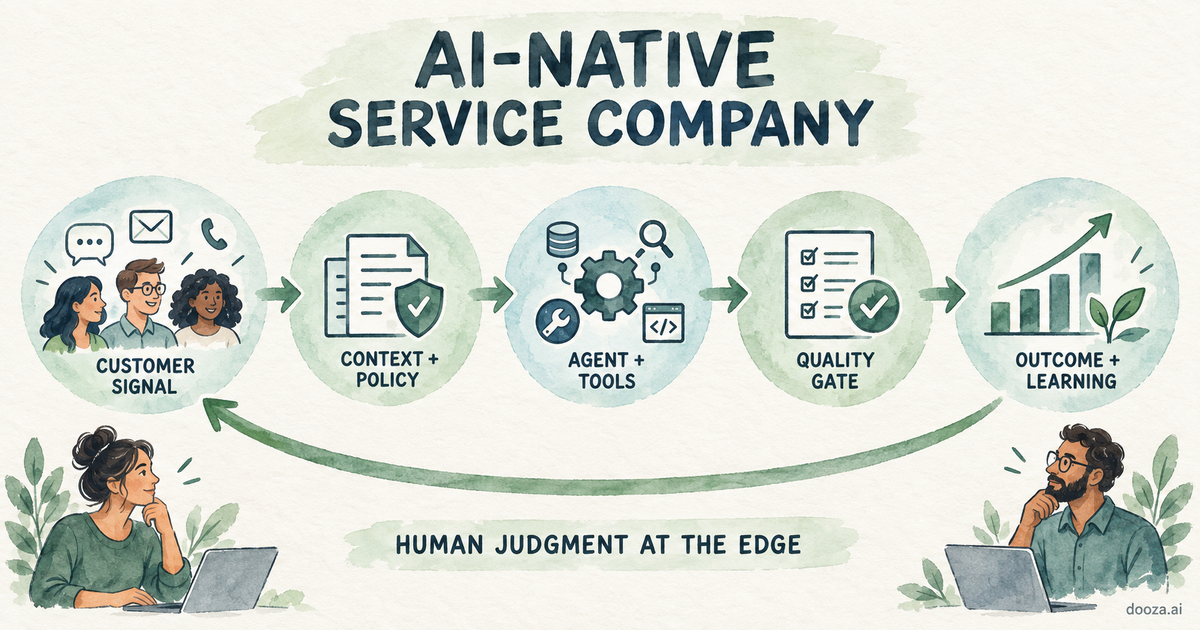
AI-Native Service Company: How It Works and How to Build One
An AI-native service company sells a completed outcome while agents run the repeatable work. See how the model works, where Dooza fits, and how to build one.