AI Visibility Tools in 2026: How to Choose a Platform That Tracks and Improves Your Brand in AI Search
AI visibility tools show how ChatGPT, Perplexity, Gemini, and Google AI Overviews talk about your brand. This guide explains the metrics, how to run a free manual audit first, and how to pick a platform that turns the numbers into fixes.
11 min read
September 29, 2026
What is an AI visibility tool?
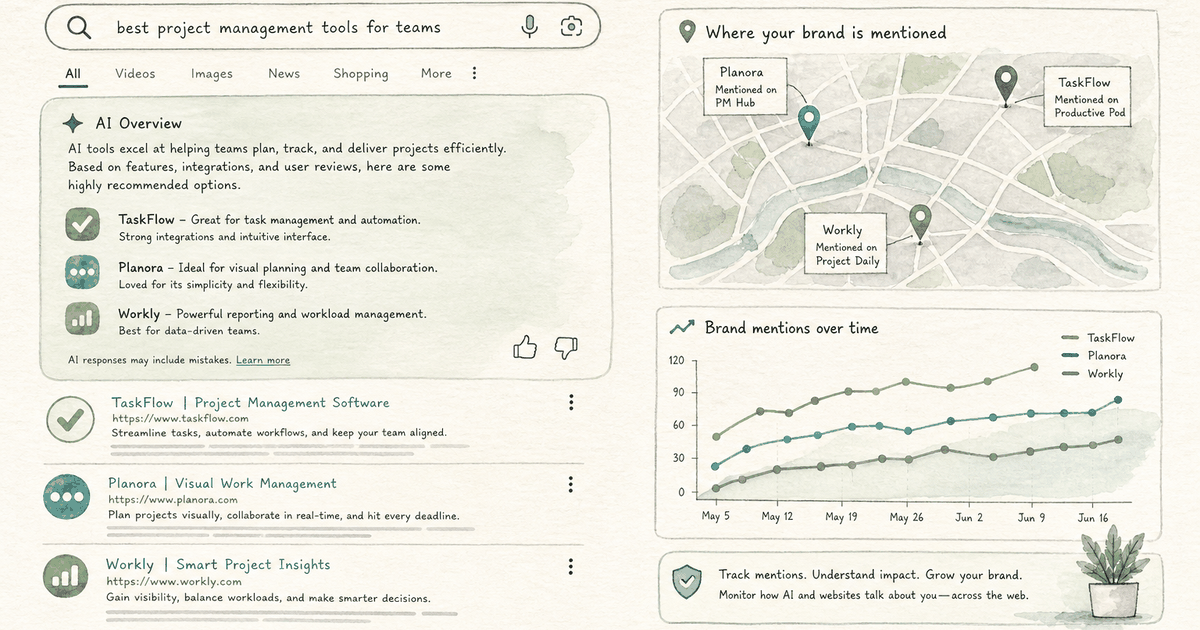
An AI visibility tool measures how often and how favorably AI answer engines mention and cite your brand. It runs a fixed set of prompts through ChatGPT, Perplexity, Gemini, Claude, Microsoft Copilot, and Google AI Overviews, records who gets named and which URLs get cited, and reports your share of voice against competitors.
The best AI visibility platforms go one step further: they turn gaps into work, such as new answer pages, schema fixes, and third-party mentions, and then re-measure. That is the difference between knowing you are invisible and becoming visible.
Start with a free manual audit of 10–20 prompts to learn the metrics.
Buy a tracker if you have people ready to act on the data.
Buy a tracking-plus-execution platform, like Dooza, if you do not.
What do AI visibility tools measure?
Metric
Definition
Why it matters
Mention rate
% of tracked prompts where your brand is named
The core visibility number
Citation rate
% of answers that link to your URLs
Drives AI referral traffic
Share of voice
Your mentions ÷ all brand mentions for the prompt set
Shows competitive position
Average position
Where you appear in lists and recommendations
First-named brands get chosen more
Sentiment
How positively the answer describes you
Catches wrong or negative framing
Cited sources
Domains and URLs the engine relies on
Tells you where to earn mentions
AI crawler access
Whether search bots like OAI-SearchBot can reach you
Blocked bots cannot cite you
AI referral traffic
Sessions from chatgpt.com, perplexity.ai, and others
Connects visibility to revenue
How do you track AI visibility for free first?
Before buying any tool, run the audit by hand once. Backlinko's Matt Kenyon makes the case directly:
Before you go spending money on an automated AI visibility tracker, you should understand how large language models think, work, and what makes them valuable lead generation channels.
But even better is getting your brand mentioned by name in the actual answer. And if you can get both a direct mention and a citation, that’s perfection.
Write at least five unbranded discovery prompts and five branded prompts. Pull ideas from sales and support.
Run them in temporary or incognito mode in ChatGPT, Perplexity, Claude, and Google.
Log mentions, sentiment, recurring sources, and competitors in a spreadsheet.
Have two different LLMs analyze the sheet, and verify the results.
Re-run the audit about a month after you make changes.
The manual audit is the right first step. It stops working when you need 50+ prompts, several engines, weekly re-runs, and a record over time. That is when a platform pays for itself.
What types of AI visibility tools are there?
Type
Examples
What you get
What you still need
Enterprise AI marketing platforms
Profound
Deep multi-engine data, prompt volumes, agent analytics, drafting
Budget, an AEO team, time to roll out
Standalone trackers
Peec AI, Otterly.ai, Scrunch AI, AthenaHQ
Share of voice, sources, sentiment
Writers, SEO, outreach
SEO-suite add-ons
Semrush AI Visibility Toolkit, Ahrefs Brand Radar
AI mentions next to SEO data
Same as trackers
Tracking + execution platforms
Dooza
Tracking, citation map, and published fixes
Approvals from you
How do you score AI visibility platforms?
Score each tool 1–5 on these criteria and weight them to your situation:
Engine coverage for the assistants your buyers use.
Prompt quality: can you build prompts from real demand and sales questions?
Citation detail: do you see exact URLs, not just domains?
Actionability: does the tool tell you what to do, draft it, or publish it?
Re-measurement: fixed prompt sets, history, and trend lines.
Traffic tie-in: AI referral traffic and conversions.
Price transparency at your prompt count.
A team with no writers should weight actionability at 3x. A team with an agency already producing content can weight coverage and history higher.
How much do AI visibility tools cost?
Budget trackers: reported from about $29/mo (Otterly.ai).
Mid-market trackers: reported about $95–$495/mo (Peec AI self-serve tiers).
Enterprise platforms: custom; Profound offers a 7-day Trial, then Enterprise pricing.
Tracking + execution: Dooza, starting with a refundable pilot (100% refund within 14 days); see /pricing.
Prices are third-party reported unless noted. Always price your exact prompt count and engine list.
How does Dooza track and improve AI visibility?
Dooza is an AI-native company that builds AI products and services for small businesses. For AI search, Ranky does the work. Ranky tracks how ChatGPT, Perplexity, Gemini, Claude, Microsoft Copilot, and Google AI Overviews answer the prompts your buyers ask, maps which sources those answers cite, and then does the fixes: it drafts and publishes answer-ready pages, fixes schema, and flags the third-party threads worth joining, all behind your approval. Every Dooza product starts with a refundable pilot — 100% refund within 14 days.
In practice, a Dooza month looks like this:
Week 1: build the prompt set from search data and your sales questions; record the baseline and citation map.
Week 2: fix crawler access and schema; publish the first answer pages Ranky drafted and you approved.
Week 3: join the community threads and pitch the listicles the engines already cite.
Week 4: re-run the prompt set and report what changed, including AI referral traffic.
Book a free pilot call. We will scope a pilot that builds your prompt set and baseline and ships the first fixes, with a 100% refund within 14 days.
Frequently Asked Questions
What is an AI visibility tool?
An AI visibility tool tracks how often and how favorably AI answer engines such as ChatGPT, Perplexity, Gemini, Claude, and Google AI Overviews mention and cite your brand, usually by running a fixed set of prompts on a schedule.
Can I track AI visibility for free?
Yes. Run 10 to 20 prompts manually in ChatGPT, Perplexity, Claude, and Google using temporary or incognito mode, log mentions, sources, and sentiment in a spreadsheet, and re-run the audit monthly.
What metrics matter most for AI visibility?
Mention rate, citation rate, share of voice against competitors, average position, sentiment, cited sources, AI crawler access, and AI referral traffic.
How many prompts should I track?
Most growing brands should start with 30 to 100 unbranded, buying-intent prompts close to revenue, plus a small set of branded prompts to check accuracy.
What is the difference between an AI visibility tracker and platform?
A tracker reports where you appear. A platform like Dooza also turns gaps into work, drafting and publishing answer pages, fixing schema, and earning mentions, then re-measures.
How much do AI visibility tools cost?
Reported prices range from about $29 per month for budget trackers to custom enterprise contracts. Dooza pricing depends on the product, and every Dooza product starts with a refundable pilot (100% refund within 14 days).
Ready to Start Your Pilot?
Automate your business with AI employees that work 24/7. Start with a refundable pilot: 100% refund within 14 days.
AEO Agency vs AEO Platform: What Should You Hire in 2026?
AEO agencies sell expertise and hours. AEO platforms sell tracking. Most growing brands need both the measurement and the work. Here is how to decide, what to ask, and what it should cost.
AI Overviews Tracking: How to Track Your Brand in Google AI Overviews and AI Mode (2026)
Google counts AI Overviews and AI Mode traffic inside normal Search Console data, so you cannot see AI visibility there directly. Here is how to track AI Overviews properly, by prompt and by citation.
Start with a refundable pilot — 100% refund within 14 days. A Dooza engineer scopes it with you on a free 30-minute call. Pricing depends on the product; see pricing.