A Guide to Digital Transformation for Small Business
Discover how digital transformation for small business using AI and automation can unlock growth. This guide offers practical steps to streamline operations.
24 min read
January 17, 2026
Picture this: You wake up not to a frantic inbox, but to a summary of new, qualified leads booked on your calendar. Your social media is already posted for the day, and your most common customer questions have been answered while you slept. This isn't a fantasy; it's the dream of an automated business, and it’s the reality that digital transformation for small business delivers. It’s about getting out from under the mountain of manual work and stepping into the role of a true visionary, orchestrating a team of tireless digital assistants that work for you 24/7.
End Busywork and Welcome Your Automated Business
Think about the life of a typical small business owner. You’re the CEO, the marketer, the accountant, and the customer service rep all rolled into one. Every hour you spend manually entering data into a spreadsheet or chasing down invoices is an hour you can't spend brainstorming new products, talking to your best customers, or finally taking that well-deserved vacation.
Now, imagine an entrepreneur who has handed off those soul-crushing tasks to a team of tireless AI employees. That’s the real promise of digital transformation. It's not just about buying new software; it’s a complete shift that lets you build a business that runs like a well-oiled machine, freeing up your time so you can live your life.
The Shift From Manual Labor to Automated Workflows
For so many small businesses, the daily reality is a grind of repetitive work. Mornings are lost to sorting customer emails, afternoons to drafting social media posts, and evenings to updating sales figures. Each task seems small on its own, but together, they steal your most precious resource: time.
This is where AI automation comes in to give you that time back. Imagine a customer fills out a form on your website. Instead of you manually copying their details into your CRM and then drafting a welcome email, an AI assistant does it all in a split second. The contact is created, tagged, and a personalized welcome email is sent before you’ve even finished your morning coffee. This isn’t just faster—it’s a perfect, error-free system that nurtures every lead, every time.
By automating the mundane, you unlock the capacity for the exceptional. You finally stop working in your business and start working on it—focusing on the vision and strategy that only you can provide.
A great way to see the difference is to compare the old way with the new.
Manual Tasks vs Automated Workflows
Manual Task (The Old Way)
Automated Solution (The New Way)
Key Benefit
Manually entering lead info from a contact form into a CRM.
An online form automatically creates a new contact in your CRM.
Instant lead capture, no data entry errors.
Sending individual welcome emails to new subscribers.
An email marketing platform sends a pre-written welcome series.
Consistent and immediate engagement.
Answering the same customer questions repeatedly via email.
A chatbot on your website provides 24/7 answers to FAQs.
Frees up your team, improves customer experience.
Creating and posting social media content daily.
A scheduling tool publishes approved content at optimal times.
Saves hours of daily work and ensures consistency.
Manually creating invoices and sending payment reminders.
Accounting software generates and sends invoices automatically.
Faster payments, improved cash flow.
Seeing the tasks side-by-side really highlights how much time and energy gets tied up in things that a system could be doing for you.
Reclaiming Your Time With AI Assistants
This automated future isn't just for big corporations anymore. AI has made it incredibly accessible. Imagine running your business with AI “employees” that handle customer emails, schedule your meetings, and even collaborate with your human team members. This is the ultimate competitive advantage, allowing you to achieve more with less stress.
In fact, the numbers back it up. Nearly 60% of U.S. small businesses are already using some form of artificial intelligence, a huge jump driven by tools that take routine operations off their plate. The reason is simple: AI assistants give owners their time back. It's no wonder that nearly 9 in 10 small business leaders say their digital investments help them compete and stay afloat.
The payoff is immediate and clear:
More Time for Strategy: When daily tasks run on their own, you can finally focus on the big picture.
Reduced Operational Costs: Automation means less time and money spent on manual labor, cutting down your overhead.
Enhanced Customer Service: AI-powered tools can offer your customers instant support, anytime they need it.
For example, a simple first step is to use digital tools to handle new client information and feedback. You can see how easy it is by checking out our guide on creating effective forms. This isn’t about replacing your people—it's about empowering them to do their absolute best work.
What Digital Transformation Really Means for You
Let's cut through the jargon. Digital transformation for a small business isn’t about buying every flashy new gadget or overhauling your entire company overnight. It’s simply about rethinking how you work—using smart, accessible tools to serve your customers better and make life easier for you and your team.
Think of it like this: you could navigate a new city with a folded paper map, and you’d probably get there eventually. Or, you could use a live GPS. The GPS doesn’t just show you the roads; it sees traffic jams ahead, finds a quicker route, and points out the nearest coffee shop when you need a break. It gives you the real-time information you need to make better decisions, right now.
That’s what digital transformation does for your business. It equips you to be more responsive, more efficient, and ultimately, more competitive.
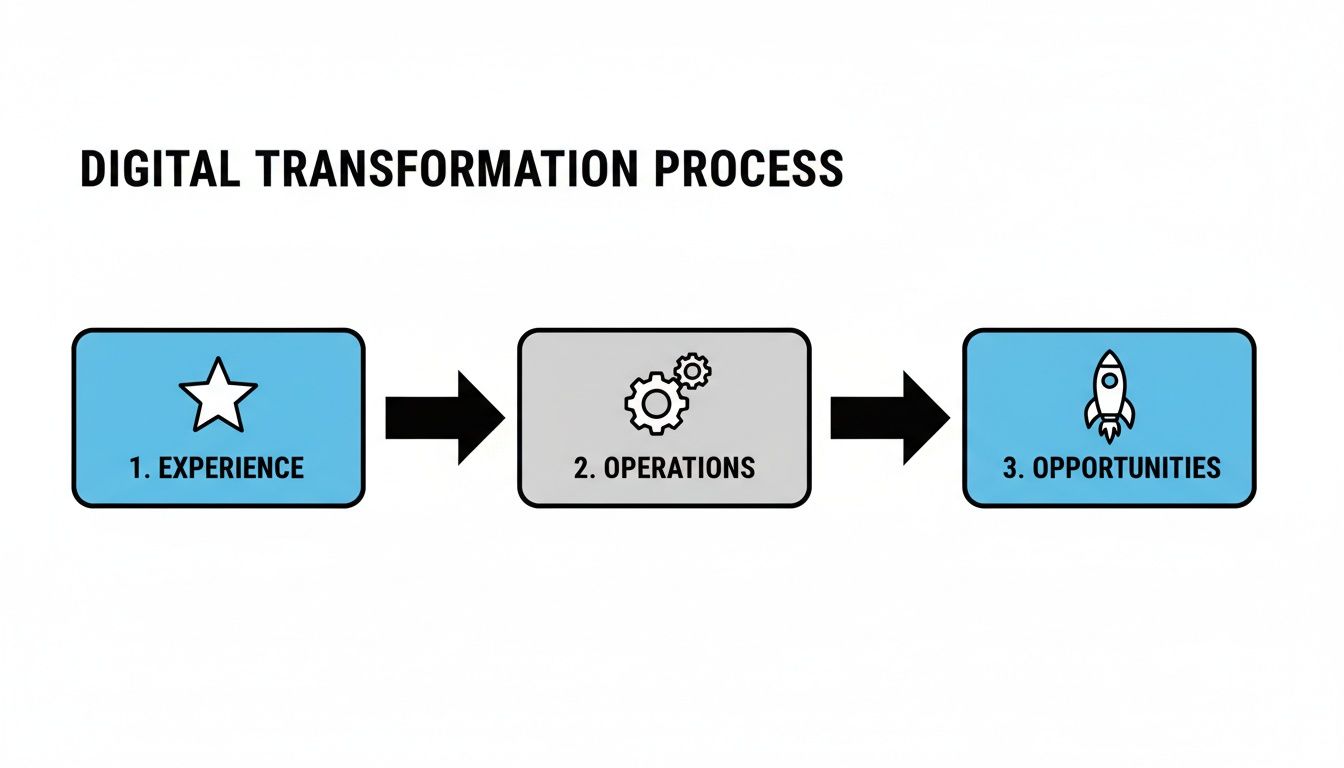
The Three Pillars of Real Transformation
A successful transformation isn’t a single project; it’s a mindset built on three core pillars. Each one supports a critical part of your business, and when they work together, they create a serious engine for growth.
Enhancing the Customer Experience: This is all about making every interaction with your business—from the first click to the final purchase—feel smooth, personal, and genuinely helpful.
Optimizing Internal Processes: Here, the focus is on squashing those time-sucking manual tasks and bottlenecks that drain your team's energy and slow everything down.
Unlocking New Business Opportunities: This is the exciting part—using technology to discover new ways to make money, whether it's reaching new customers or creating entirely new products.
Imagine an AI agent handling your front-line customer chats. It can answer common questions instantly, 24/7, which means your customers get help immediately. This frees up your human team to focus on the tricky, high-value problems where their expertise really shines. That one simple change elevates the customer experience and boosts your team’s efficiency at the same time.
See It in Action: Practical Examples
This isn't just theory; let's ground these ideas in what real small businesses are doing every day.
1. Enhancing the Customer Experience
Instead of giving every customer the same generic treatment, a simple Customer Relationship Management (CRM) tool can track their history. The next time a customer calls, you can instantly see their past orders and preferences. It’s the difference between saying "How can I help you?" and "Hi Sarah, ready to reorder the usual?"
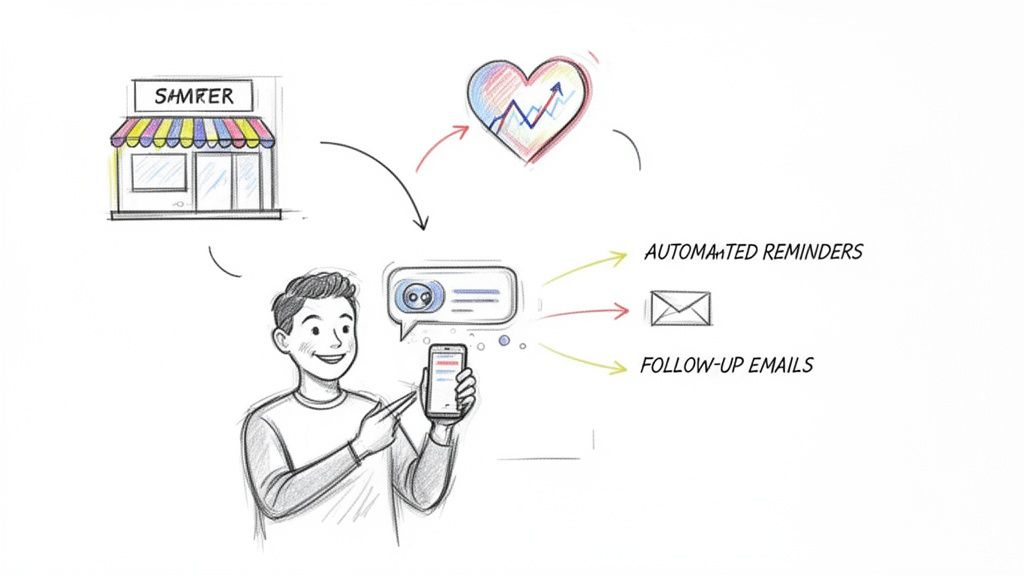
A great example is using an AI assistant to send automated appointment reminders. For a hair salon, this small touch drastically cuts down on no-shows, keeps the schedule packed, and gives customers a polished, professional experience—all without the receptionist lifting a finger.
2. Optimizing Internal Processes
Stop chasing down invoices manually. Modern accounting software can automatically create and send an invoice the moment a job is done. Better yet, it can send polite payment reminders for you, directly improving your cash flow and saving you hours of tedious admin work. For more tips on using technology to reclaim your time, you can find a ton of ideas on the Dooza blog.
3. Unlocking New Opportunities
A local bakery that once only served its neighborhood can use an e-commerce platform to sell specialty cookie boxes nationwide. Suddenly, their market isn't just a few city blocks; it's the entire country.
Similarly, a business consultant can package their expertise into an online course. This creates a brand new revenue stream that isn't tied to their billable hours. That’s the real power of digital transformation for a small business—it opens doors you didn’t even know were there.
How to Build Your Digital Transformation Roadmap
Trying to tackle a digital transformation for a small business without a clear plan is a recipe for frustration. It's like heading out on a road trip with no map—you'll burn a lot of fuel and probably end up lost. A solid, practical roadmap breaks this massive idea down into small, manageable steps. This isn't about a huge, costly overhaul; it's about smart, targeted changes that get you real results, fast.
The trick is to build momentum. Don't try to boil the ocean. Instead, focus on "quick wins"—small, high-impact changes that show everyone the value of the new tech and get your team on board. This makes the whole process feel less like a mountain to climb and more like a series of small, satisfying victories.
Step 1: Identify Your Biggest Time Sinks
Before you can fix anything, you have to know where the problems are. Take a week and just observe. Where is your team's time really going? Track the repetitive, mind-numbing tasks you all do day in and day out.
Is someone manually copying and pasting customer info from one system to another? Are you spending an hour every morning answering the exact same five questions in your inbox? These administrative black holes are where you start. They’re the low-hanging fruit where a little bit of automation can free up a shocking amount of time.
For instance, a small marketing agency might find they’re burning 10 hours a week just creating and scheduling social media posts by hand. That's a huge bottleneck and a perfect target for automation.
Step 2: Set Clear and Achievable Goals
Once you've pinpointed the time sinks, you need to define what success actually looks like. A fuzzy goal like "improve efficiency" is useless because you can't measure it. You need to get specific with SMART goals (Specific, Measurable, Achievable, Relevant, and Time-bound).
A bad goal: "We want to get better at customer service."
A good goal: "We will cut our average customer email response time from 24 hours to 4 hours within the next 60 days by setting up an AI-powered email assistant."
This kind of clarity gives you a real target to aim for. It tells you exactly what you're trying to do and lets you know, without a doubt, when you've succeeded. It also makes it much easier to explain the "why" to your team, showing them how their work is about to get a whole lot easier.
As you can see, these changes tend to flow from one area to the next—improving the customer experience often leads to optimizing how you operate, which then opens up new doors for growth. The key is that each step builds on the last, creating a powerful compounding effect across your business.
Step 3: Choose the Right Technology for Your Problems
With your problems mapped out and your goals locked in, it’s time to find the right tools. The market is flooded with options, but don't get distracted by shiny objects. The goal is to pick technology that solves your specific problem, not the one with the longest feature list. You don't need a bulldozer when a shovel will do the job perfectly.
The best tool is almost always the one your team will actually use. Look for user-friendly platforms, especially those with "no-code" interfaces that let you build powerful automations without needing a degree in computer science.
For example, if your goal is to automate that social media scheduling mess, a tool like Buffer or Hootsuite is a no-brainer. If you need to automate email follow-ups, an email marketing platform with built-in workflows is what you're after. And if you're looking for guidance, teaming up with technology experts can be a game-changer. You can find out more about how the right Dooza partners can steer your implementation.
Step 4: Implement, Measure, and Scale What Works
Okay, time to make it happen. Pick one "quick win" project to start. Get the tool set up, show your team how to use it, and dive in. This is where the rubber meets the road.
After a set time—say, 30 days—check your progress against the goal you set back in step two. Did you actually cut down your email response time? Did you claw back those 10 hours from social media management? This data is gold. It proves the investment was worth it and gives you the fuel to fund your next project.
Once you’ve got a win under your belt, it’s time to scale. Take what you learned and move on to the next biggest time sink on your list. This simple cycle—identify, plan, do, measure—is the engine of a successful transformation. It builds a culture where getting better is just part of the daily routine, turning your business into a smarter, more efficient operation one step at a time.
Unlocking the Power of AI Employees in Your Business
The road to digital transformation ultimately leads to a pretty exciting place: a business where you're not just automating small tasks, but entire job roles. This is where you move beyond simple workflows and start building a real team of AI assistants. Honestly, this is a cornerstone of any successful digital transformation for a small business.
Imagine hiring a team of specialists who work 24/7, never get tired, and handle tasks with absolute precision—all without the hefty payroll. These aren't just lines of code; they are intelligent AI agents built to take on complex responsibilities that would normally eat up your entire day.
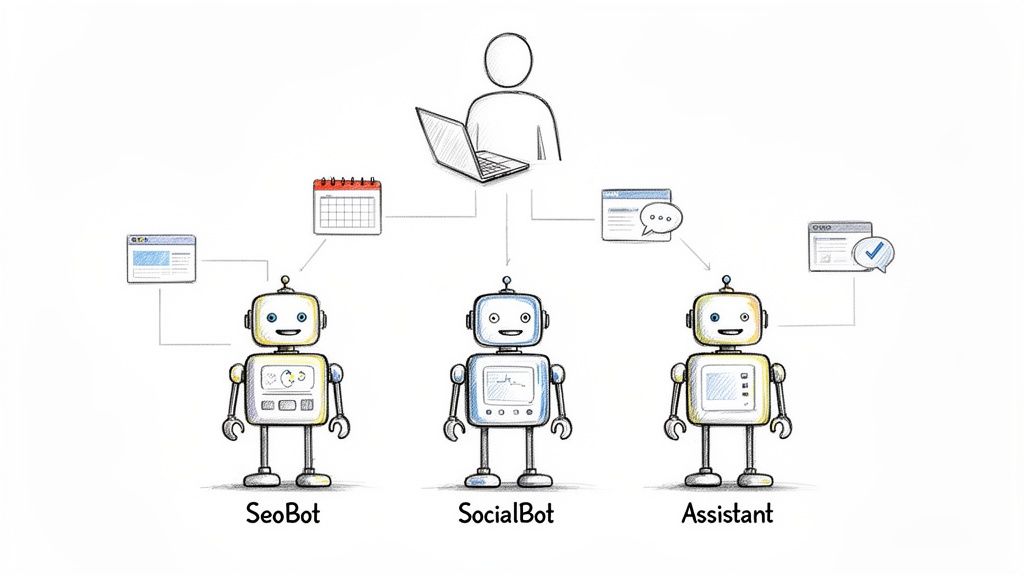
Meet Your New Digital Workforce
The best way to think about these AI agents is as specialized employees you can "hire" to run different parts of your business. They're more than just another app; they become collaborators who learn your processes and work on their own to hit your goals.
For example, you could bring on 'SeoBot,' your dedicated AI SEO specialist. While you sleep, it's busy analyzing your website's traffic, digging up new keyword opportunities, tweaking your on-page content for better rankings, and even putting together a progress report. You wake up to a business that’s more visible online, all handled on autopilot.
Or, you could have 'SocialBot' take over as your social media manager. It can draft compelling posts that match your brand's voice, lay out a full content calendar, schedule everything to post at the perfect time, and monitor your channels for comments. That leaves you free to focus on strategy.
Your First AI Hires and What They Can Do for You
So, what does this look like in practice? Here are a few AI "employees" you could hire today and the real-world value they bring to the table.
AI Employee Role
Example Tasks Automated
Measurable Business Impact
Marketing Coordinator
Drafts blog posts, schedules social media updates, creates email newsletters, and pulls basic analytics reports.
20+ hours saved per week; consistent brand messaging across all channels; increased lead generation.
SEO Specialist
Performs keyword research, optimizes meta descriptions, runs technical site audits, and tracks ranking improvements.
15% increase in organic traffic in 90 days; higher search engine visibility without a costly agency.
Customer Support Rep
Answers common questions 24/7, routes tickets to the right person, and follows up on customer inquiries instantly.
30% reduction in support ticket volume for human agents; improved customer satisfaction scores.
Sales Development Rep
Identifies and qualifies leads from your CRM, sends personalized outreach emails, and books meetings on your calendar.
25% more qualified leads in the pipeline; faster sales cycle; more time for sales team to close deals.
These aren't just fancy automations; they are functional roles that deliver clear, measurable results, letting a small team accomplish what once required a much larger staff.
Creating a Connected and Automated Ecosystem
The real magic happens when these AI employees start talking to the tools you already use every single day. They aren’t siloed workers; they plug right into your operational hub, creating a single, connected ecosystem.
This means your AI receptionist can check your Google Calendar for an open slot and book a meeting for a new lead. Your AI project manager can create new tasks in Asana and ping your team about it in Slack. They become central players, collaborating with you, your tools, and even each other.
The result is a business that runs with the efficiency of a much larger company. This allows a small team—or even a solopreneur—to punch far above their weight, achieving a level of productivity that was once impossible without a massive staff.
This tight integration turns all your separate apps into one intelligent, self-running system. Information flows where it needs to, tasks are handed off without you lifting a finger, and your business just… works. It’s the ultimate dream of automation made real.
The Tangible Outcomes of AI Integration
When you start bringing on AI employees, you see concrete benefits that directly impact your bottom line and, frankly, your sanity. You're not just buying another piece of software; you're buying back your time and scaling your own expertise.
Massive Time Savings: Imagine getting back 10, 15, or even 20 hours every single week. That's what happens when repetitive jobs like customer support follow-ups or manual data entry are completely off your plate. This is time you can reinvest into growth, family, or yourself.
Expert-Level Execution: You get access to specialized skills without the high price tag. Your SEO, marketing, and customer service get handled with a level of detail and consistency that rivals a seasoned professional.
Scalability on Demand: As your business grows, your AI team scales right along with you—instantly. No need for a painful hiring process; you just assign more work to your digital workforce.
A great example is an AI customer support agent. It can handle all the initial questions, answer FAQs from your knowledge base, and smartly escalate the tricky issues to a human. This ensures every customer gets an instant, helpful response. You can see how this stacks up against older helpdesk models by checking out our guide on Gorgias alternatives that are built around this kind of advanced automation.
This ability to automate and integrate is what truly defines a modern, digitally transformed business. By delegating entire roles to capable AI, you’re not just making your business more efficient—you’re fundamentally changing how you work, giving yourself the freedom to lead, innovate, and grow.
How to Transform Your Customer Experience
In a crowded market, the one thing that truly sets you apart is how you treat your customers. It's not just about what you sell anymore; it’s about making every single interaction feel effortless, personal, and genuinely helpful. This is where a smart digital transformation for small business can really shine, turning first-time buyers into lifelong fans.
You don't need a huge budget to make a massive impact. The right digital tools can automate the small, thoughtful touchpoints that build loyalty, creating a customer journey that feels premium without the premium price tag.
Provide Instant Support Around the Clock
Think about it. A customer has a simple question at 10 PM. In the old days, they'd send an email and wait. Now, an AI-powered chatbot on your website can give them an answer on the spot, 24/7. This simple addition handles all the repetitive questions, which frees up your team to tackle the more complex, high-value conversations that require a human touch.
This isn’t just a nice-to-have; it’s what people expect now. When customers get immediate help, they're happier, and your team isn't stuck answering the same questions over and over again.
Automate the Details So No One Slips Through
A great customer experience is built on consistency, and automation is your best friend for that. By setting up automated communications, you create a seamless flow that keeps customers in the loop without you lifting a finger.
Appointment Reminders: An automated text the day before an appointment can dramatically cut down on no-shows.
Order Confirmations: Instant confirmations give customers peace of mind and set clear expectations right away.
Follow-Up Emails: A quick email asking for a review a week after a purchase shows you care about their opinion and helps you get vital feedback.
These little automations work tirelessly behind the scenes, making your business look incredibly organised and customer-focused. It frees your people to do what they do best: build real relationships.
The dream is a system where your business nurtures customer relationships on autopilot. While you’re focused on the big picture, your digital tools are making sure every single customer feels seen and valued.
This isn't just about making people happy; it directly impacts your bottom line. Companies that put the customer at the center of their digital strategy see 20-30% higher satisfaction and 20-50% economic gains. In a world driven by online sales, a smooth digital journey is essential.
Personalize Every Interaction with Data
The best customer experiences always feel personal. A simple Customer Relationship Management (CRM) system can be your secret weapon here. It tracks a customer’s history, what they like, and how they’ve interacted with you before, giving you the power to tailor your communications. Instead of a generic email blast, you can send targeted offers they’ll actually care about.
This becomes even more powerful when you connect it with direct messaging platforms. For example, automation can handle common questions or send personalized follow-ups right where your customers are. To see how this works in practice, you can explore our guide on automating your Instagram Direct messages. It’s the digital version of a barista remembering a regular's favorite coffee order—it just builds loyalty.
How to Secure Your Digital Future
As you move more of your business online, protecting your digital assets becomes just as important as locking up the shop at night. A digital transformation for small business isn't just about new tools and slicker processes; it's about building a secure foundation that protects both you and your customers. This isn't about becoming a cybersecurity guru—it's about taking practical steps to build trust.
Think of it this way: good security isn't a roadblock to growth, it's a runway. When customers feel their information is safe with you, they're not just buying a product or service. They're buying peace of mind, which makes them far more likely to stick around.
Start with Secure Foundations
The simplest path to better security is choosing tools and platforms that already have it baked in. You don't need to build a fortress from scratch; just pick services that come with strong walls.
Look for cloud providers that make data protection a priority. They handle the heavy lifting so you don't have to.
Choose Secure Cloud Services: Big, reputable platforms spend millions on security, giving you enterprise-level protection without the hefty price tag.
Enable Multi-Factor Authentication (MFA): Honestly, if you do one thing, do this. Requiring a second code from a phone or app makes it dramatically harder for the wrong people to get in.
Establish Clear Data Protocols: Get your team on the same page with simple, clear rules. Where does customer data go? Who has access? How is it shared?
These first few steps create a solid baseline defense, making your business far more resilient against the most common online threats.
From Human Error to Automated Defense
Let's be real: one of the biggest security risks in any business is us. People. We accidentally click on shady links, reuse weak passwords, or attach the wrong file to an email. It happens. This is where automation platforms like Dooza can be a game-changer for your security.
When you automate a process, you standardize it, which strips out the potential for human mistakes. Instead of manually emailing a sensitive contract, an automated workflow can share it through a secure portal with controlled access. It's faster, more reliable, and automatically enforces your security rules every single time.
The real promise of AI automation isn't just getting time back in your day. It's about building a smarter, safer business. By letting AI manage routine data tasks, you take human error out of the equation and free up your team to focus on what really matters.
This shift isn't just a "nice-to-have." Cybersecurity is a serious battleground for small businesses. A shocking 81% of SMBs experienced a security or data breach in the last year alone, and over 40% of those were fueled by AI-driven attacks. As digital investment grows, strengthening your defenses is no longer optional—it's essential for survival. You can get more insights on these tech trends for small businesses on BizTech Magazine.
Frequently Asked Questions
Stepping into digital transformation for your small business can feel like a huge undertaking, but it’s more achievable than you might think. It’s normal to have a few questions, so let’s get you some clear, straightforward answers.
Is Digital Transformation Too Expensive for My Small Business?
Not anymore. The idea that automation is only for big corporations with deep pockets is completely outdated. The trick is to start small with high-impact, low-cost tools that give you an immediate return.
Many of the best AI automation platforms run on a simple subscription model, so you can forget about a massive upfront investment. You just need to pick tools that pay for themselves, either by saving you hours of work or by directly helping you make more sales. Frankly, the biggest cost is standing still and letting your competitors get ahead.
I'm Not a Tech Expert. How Can I Implement These Changes?
You definitely don't need a computer science degree to make this happen. Today's digital tools are built for business owners like you, not for developers. Platforms like Dooza are "no-code," which means you can set up incredibly powerful automations using simple drag-and-drop menus.
It's a bit like hiring a specialist for a job. You don’t need to know the technical ins and outs of how they work; you just need to tell them what you need done. The platform takes care of the technical side, leaving you to focus on the results.
How Do I Measure the Success of My Digital Transformation?
Success is all about hitting the goals you laid out in your initial roadmap. The great thing about digital tools is that pretty much everything can be measured, so you can see your return on investment in plain numbers.
A few key things to watch are:
Time Saved: How many hours a week are you or your team getting back from tedious admin work?
Customer Response Time: Are inquiries being answered faster?
Lead Generation: Is automation bringing in more good leads from your website or social media?
Customer Satisfaction: Are your support ratings, reviews, and customer feedback getting better?
Just take a snapshot of where you are now, track the changes as you bring in new tools, and let the data show you what to do next.
Will AI and Automation Replace My Human Employees?
This is a common worry, but the answer is a firm no. The real purpose is to make your team better, not to replace it. AI excels at the repetitive, predictable tasks that tend to bog people down and stifle creativity.
By automating the routine stuff, you free up your people to do what they do best: think strategically, solve complex problems, and build real relationships with customers. These are the human skills that actually drive business growth.
Think of it as giving your team a set of superpowers. AI handles the grunt work, letting your people focus on the meaningful tasks that make them more productive and their jobs more rewarding.
Ready to stop managing tasks and start leading your business? Discover how Dooza.co can provide you with a team of AI employees to automate your operations and give you back your time. Start building your automated business today at https://dooza.co.
Ready to Get Started?
Automate your business with AI employees that work 24/7.
The Harsh Truth About Selling AI Automations: What the Gurus Won't Tell You
A seasoned AI agency owner reveals the real numbers behind selling AI automations—and why most viral claims are lies. Learn how to build a sustainable automation business with honest strategies and tools like Dooza.ai.