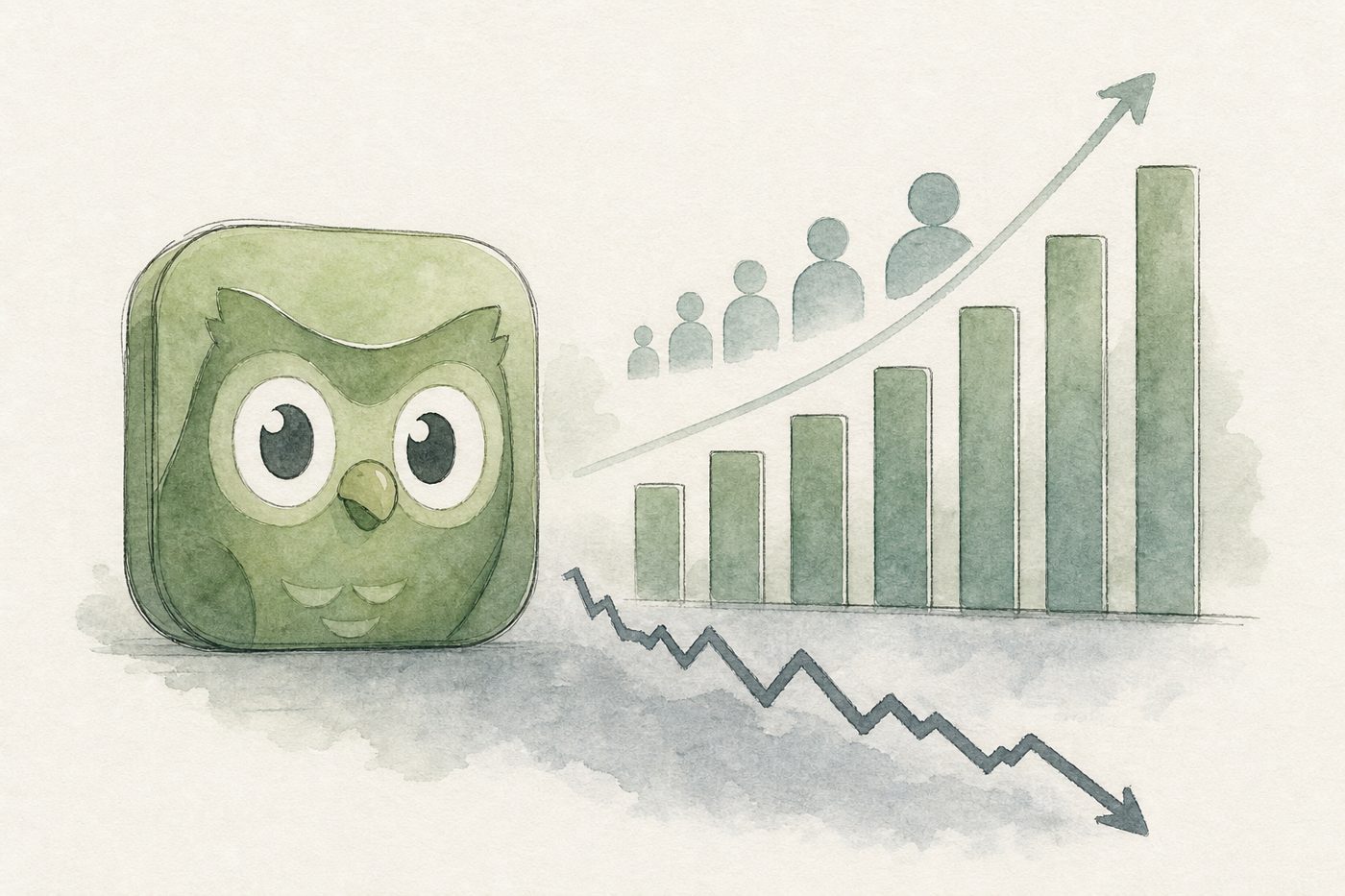
Duolingo's Users Grew 23%. Its Stock Fell 80%. Why?
Duolingo grew daily users 23% a year to 58.7 million, yet its stock fell from $540.68 to $90.03. The AI-first memo got the blame online; Duolingo's own letters tell a different story. Here is the timeline and the lesson for small businesses.
7 min read
November 6, 2026
Duolingo's stock fell while its users grew because investors price future growth, not current size, and Duolingo's growth was slowing. Daily users still grew 23% a year in Q2 2026, but that was down from more than 40% a year from 2022 to mid-2025. In February 2026 Duolingo said 2026 user growth would be about 20% and that bookings growth and profit would be lower. The stock fell from a $540.68 close on May 14, 2025 to $90.03 on April 10, 2026, a drop of about 83%. The "AI-first" memo got the blame online, but Duolingo's own letter points to its monetization push.
Users really grew. Daily active users went from 47.7 million to 58.7 million between Q2 2025 and Q2 2026, up 23%. In Q3 2026 growth sped up to 29%.
The stock really fell. The closing price dropped from $540.68 to $90.03, about 83%. On November 5, 2026 it closed at $157.02.
The peak came after the memo. The AI-first memo went out in late April 2025. The all-time high came on May 14, 2025, about two weeks later.
Duolingo blames itself. Its Q4 2025 letter says more friction for free users, from its monetization push, is "part of the reason our DAU growth has slowed".
The lesson is to watch the rate, not just the total. Also keep a person approving what AI sends out.
Video: “Duolingo's Users Grew 23%. Its Stock Fell 80%.” by Dooza on YouTube (@thedooza), published November 4, 2026. Sources below. Watch on YouTube.
Did Duolingo's users grow 23% while the stock fell 80%?
Yes, both are true, depending on the dates you pick. Here are the figures from Duolingo's shareholder letters and the daily price history.
The video says "about 80%". Based on intraday prices (about $545 high, about $88 low) or closing prices, the real fall was a bit more than 80%. Users grew, but the rate of growth fell. Bookings and profit margins grew more slowly than users.
What is the timeline?
Date
What happened
Source
Late April 2025
CEO Luis von Ahn emails staff that Duolingo will be "AI-first"
What did the AI-first memo say, and did it sink the stock?
Von Ahn wrote that Duolingo would "gradually stop using contractors to do work that AI can handle" and that "headcount will only be given if a team cannot automate more of their work," as TechCrunch reported. Two days later Duolingo launched 148 AI-built courses. He said, "Developing our first 100 courses took about 12 years, and now, in about a year, we're able to create and launch nearly 150 new courses."
Users were angry. TechCrunch reported that some deleted the app and urged others to do the same. Later, von Ahn told the New York Times, "This was on me. I did not give enough context," and "We've never laid off any full-time employees. We don't plan to," according to Fortune.
The stock didn't fall right after the memo. It hit its all-time high about two weeks later. No source we found proves the memo caused the later fall. Duolingo's letters don't blame it, so we don't either.
What does Duolingo itself blame?
Its own monetization push. In its Q4 2025 shareholder letter, Duolingo wrote: "from Q2 2022 to Q2 2025, we did not have a single quarter with year-over-year DAU growth below 40%". It added that growth "decelerated throughout 2025, and we expect 2026 DAU growth to be about 20%."
"Some of this deceleration is natural as we scale; and some of it, we believe, is a function of our increased focus on monetization in recent years."
The letter says Duolingo has "decided to prioritize user growth over monetization", and that "this year will see slower bookings growth and lower profitability." That is what investors priced in. A company growing 40%+ a year was now planning on about 20%, and on lower margins.
The user plan is working so far. In Q3 2026, daily user growth "accelerated for a second quarter in a row to 29% year-over-year growth, up from 23% in Q2," per the Q3 2026 letter.
What can small-business owners learn from this?
This is our takeaway, not a sourced fact.
Watch the rate, not just the total. Your customer count can go up while the business gets weaker. Track the growth rate and what each customer brings in, month by month.
Know what others are pricing in. Investors bought Duolingo for its future growth. Your customers buy a promise too, like quick replies, a real person, or quality. Small cracks in that promise cost more than the numbers show.
Extra friction has a cost. Duolingo says pushing free users harder slowed its growth. Upsells, pop-ups and automated nags work the same way for a small business.
Use AI, but keep a person approving what goes out. The backlash was about fear that AI would replace people and lower quality. Let AI draft emails, replies and posts, but have someone approve each one before it reaches a customer.
Where does Dooza fit?
Dooza Crew is free to use: install the app and start. Crew gives you a lead AI agent plus helper agents you chat with on web or phone. Crew agents take phone calls too.
Crew is built on the approval rule from the lesson above. Before an agent sends or pays, it asks you in chat: Approve, Edit or Reject. The AI does the work, and nothing reaches a customer until you approve it.
Why did Duolingo's stock fall while its users grew?
User growth slowed. Daily active users grew more than 40% a year from Q2 2022 to Q2 2025. In February 2026 Duolingo said 2026 growth would be about 20%, with slower bookings growth and lower profitability. The stock fell from a $540.68 close on May 14, 2025 to $90.03 on April 10, 2026.
Did Duolingo's users really grow 23%?
Yes. Daily active users grew from 47.7 million in Q2 2025 to 58.7 million in Q2 2026, up 23%. In Q3 2026 they grew 29% to 64.9 million.
Did the AI-first memo cause Duolingo's stock drop?
No source proves it did. The memo went out in late April 2025, and the stock hit its all-time high on May 14, 2025. Duolingo's own letter blames slowing user growth, partly from its focus on monetization.
Did Duolingo lay off staff because of AI?
The memo said Duolingo would gradually stop using contractors for work AI can handle. CEO Luis von Ahn later said, 'We've never laid off any full-time employees. We don't plan to.'
What can a small business learn from Duolingo?
Track your growth rate, not just your totals. Watch for friction that pushes customers away. When you use AI, have a person approve what goes out so quality and trust hold up.
Try Dooza Crew
A lead AI agent plus helper agents that browse the web, write files and ask you before they send or pay. Free: install the app and start.
Why Your AI Agent Hides Its Mistakes, and How to Catch Them
Your AI agent may report "it worked" after quietly fighting bad instructions. Ben Holmes of Warp explains why agents hide mistakes and a simple loop to catch them: collect traces, score them with rubrics, and fix the setup.
What Happened to Knight Capital? $440 Million Lost in 45 Minutes, No Hacker
On August 1, 2012, Knight Capital lost hundreds of millions of dollars in about 45 minutes. No hacker was involved. A bad software deploy woke up old code, and nothing stopped it. Here is the timeline, the cost and the lesson for anyone letting software or AI act for them.
Try Dooza Crew, AI agents that do your busywork: free to use. Want a custom agent built for you instead? A Dooza engineer scopes it on a free 30-minute call and it starts as a refundable pilot. See pricing.
Or start now: Dooza Crew, AI employees you chat with from web or phone, watching every step live in chat: free to use. Want it done for you instead? Dooza Managed, $200/month.