AI Automation
Top AI Automation Companies to Watch in 2026
Discover the leading AI automation companies transforming business workflows in 2026. Learn how agentic AI and digital workers can boost your efficiency.
10 min read
ReadDiscover how to improve employee productivity using AI. This guide shows you how to automate tasks, free up your team's time, and drive real growth.
When we talk about improving employee productivity, what we're really talking about is automating the repetitive noise to create more time for meaningful work. Imagine a world where your team isn't bogged down by administrative chores, but is free to innovate, strategize, and create. It starts with spotting the bottlenecks in your workflow and then strategically deploying AI tools to take over the administrative grind. This is how you unlock your team's true creative and strategic power.
What if you could reclaim a third of your team's day? Imagine what your business could achieve if every employee had an extra two or three hours each day for deep, focused work. That’s often how much time gets eaten up by tiny interruptions, administrative busywork, and the constant mental drain of switching between tasks. This slow leak isn't just an inconvenience—it's a direct roadblock to growth and innovation. The real cost isn't just the hours lost; it's the missed opportunity to solve bigger, more important problems.
This isn't a small-scale issue. Globally, a staggering 21% of workers feel truly engaged with their jobs. This widespread disengagement adds up to an estimated $9.6 trillion in lost productivity every year. The potential upside is massive if we can get this right.
The goal isn't to push people to work harder or faster. It's about fundamentally changing what they work on.
When your most talented people are stuck updating spreadsheets, juggling meeting schedules, or handling routine customer emails, they can't focus on the complex, creative work that actually moves the needle. For example, your brilliant graphic designer shouldn't be spending an hour a day searching for assets and renaming files; they should be designing your next iconic brand campaign. This kind of repetitive work isn't just boring; it actively drains morale and stifles the very creativity you hired them for.
The core idea is simple: Free your brilliant human minds from robotic work. Let AI handle the predictable so your team can focus on the exceptional.
This is where AI becomes a powerful force multiplier. By "hiring" AI employees to manage these routine processes, you create the breathing room your team needs to innovate. For instance, Dooza offers specialized AI employees that can seamlessly take over these roles. You can see a direct comparison in this table of AI vs. human tasks.
This table breaks down common productivity-draining tasks, showing how AI automation offers a strategic solution to save time and boost focus.
| Common Productivity Drain | Impact of Manual Work | The AI Employee Solution |
|---|---|---|
| Data Entry & Management | Hours spent copying/pasting info between apps; high risk of human error. | Automatically syncs data across systems, ensuring accuracy and freeing up employee time. |
| Scheduling & Coordination | Endless email chains to find meeting times, book resources, and send reminders. | Intelligently finds open slots, sends invites, and manages calendars without human intervention. |
| Routine Customer Inquiries | Answering the same questions repeatedly via email or chat, delaying responses. | Provides instant, 24/7 answers to common questions, escalating complex issues to the team. |
| Report Generation | Manually pulling data from multiple sources to compile weekly or monthly reports. | Gathers data, analyzes it, and generates insightful reports automatically on a set schedule. |
By offloading these tasks, you're not just saving a few minutes here and there; you're fundamentally redesigning your team's day around high-value activities.
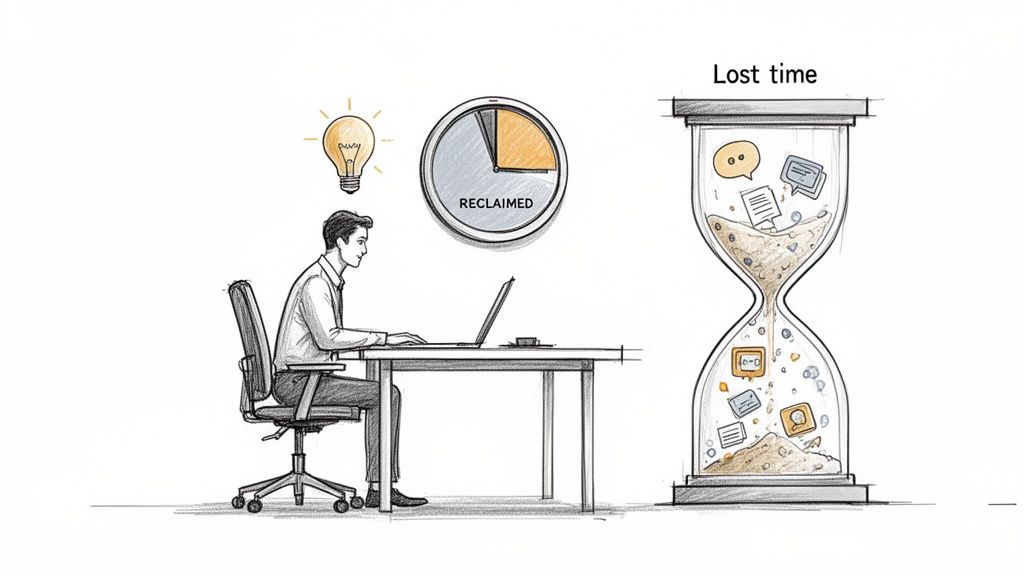
This visual approach shows how automation isn't just another tool—it’s a complete workflow redesign that puts your most important work front and center. In the next sections, we'll walk through a clear roadmap for diagnosing your specific bottlenecks and implementing AI solutions for immediate gains.
Before you can fix any productivity problem, you have to find it first. Just telling your team to "be more productive" is useless—it's like telling a mechanic to "fix the car" without mentioning the strange noise coming from the engine. You need to get specific and identify the exact friction points slowing everyone down.
These bottlenecks are often hiding in plain sight, usually disguised as "the way we’ve always done things." They’re the small, repetitive tasks that pile up, kill momentum, and drain your team's focus. The only way to find them is to map out your key workflows and put these time sinks under a microscope.
Every team has its own version of kryptonite. A marketing team might burn hours manually pulling data for weekly reports. An HR team could be drowning in the back-and-forth of onboarding paperwork. The first step is to pinpoint these specific, recurring drains on your team's time.
Take a classic example: HR onboarding. A new hire needs access to five different systems, which means chasing down three separate managers for approvals. This manual, multi-step process is a textbook bottleneck. It’s slow, full of potential for mistakes, and frustrating for everyone.
The goal is to spot the tasks that require significant human effort but very little strategic thinking. These are your prime candidates for automation.
Now, imagine that same onboarding process handled by an AI employee. Picture this: the moment HR marks a candidate as "hired," the AI instantly sets up their accounts, sends welcome documents, and schedules their orientation meetings. That single change frees up hours of administrative work, letting the HR team focus on the human side of the employee experience—like checking in on new hires and building a welcoming culture.
Once you have a hunch about a few bottlenecks, it's time to measure their actual impact. A simple "Time Sink Audit" can be incredibly revealing. Ask your team to track their time for just one week, specifically flagging any repetitive, low-value tasks. You can collect this info easily by creating a quick survey—check out our guide on how to use Dooza Forms to get structured feedback fast.
This little exercise gives you the data you need to make smart, targeted changes. You'll likely uncover things like:
With this kind of clarity, you’re no longer guessing. You have a precise, actionable roadmap for where to deploy AI employees for an immediate and measurable win. You can finally turn those frustrating manual workflows into efficient processes and give your team their time back for the work that truly matters.
This is where the dream becomes reality. Boosting your team's productivity doesn't have to be some massive, drawn-out project with a payoff you won't see for months. The secret is to score quick, high-impact wins your team will feel almost immediately. You start by targeting the low-hanging fruit—all those repetitive, rule-based tasks that eat up precious hours every single week.
Think about it like hiring a dedicated AI receptionist. Right away, all the tedious back-and-forth of managing calendars, scheduling meetings, and chasing people with reminders vanishes from your team's to-do list. Just that one change frees up a surprising amount of mental energy, letting your people focus on preparing for the meetings themselves, not just the logistics of setting them up. This isn't some far-off sci-fi concept; it's a practical, powerful first step you can take today.
Let's get specific. Imagine a growing digital agency bringing on an AI employee to run its social media channels. This AI teammate can handle everything from scheduling content and monitoring engagement to collecting user-generated content (UGC) videos from customers—all on its own. Suddenly, the marketing team is freed up to focus on campaign strategy and creative work, the stuff that actually moves the needle. They can finally brainstorm that ambitious new video series they've been talking about for months.
Or picture a busy startup deploying an AI employee to manage its customer support inbox. The AI can instantly tackle common questions ("Where is my order?"), categorize new tickets, and escalate the truly tricky issues to the right human agent. This doesn't just slash response times for customers; it lets your support pros dedicate their expertise to solving the unique, challenging problems where they can really shine, boosting both efficiency and their own job satisfaction.
The beauty of this approach is its simplicity. When you offload all the predictable, administrative grind to reliable AI employees, you build a more resilient and focused human team. They're no longer bogged down by busywork. Instead, their time is spent on innovation, strategic thinking, and building real relationships with your customers.
The data on this is compelling. AI is a proven productivity engine. In fact, 75% of knowledge workers say it saves them time, helps them focus, and even makes them more creative. What’s more, companies that embrace AI see 72% higher productivity and 59% better job satisfaction. It’s a change employees actually want—automating routine tasks gets a thumbs-up from 77% of them for its positive impact.
The real goal here is to create a work environment where your team’s greatest asset—their brainpower—is spent on work that demands human creativity, empathy, and strategic insight.
Consider your SEO efforts. Instead of someone spending hours digging through keywords and tweaking content, you could hire an AI employee like Seomi from Dooza. This specialized AI puts your SEO on autopilot, constantly optimizing your site to pull in more organic traffic. To see what that looks like in action, you can explore our guide on using AI to rank higher. This lets your team graduate from tactical grunt work to high-level marketing strategy, knowing the foundational tasks are handled flawlessly.
By automating the "how," you empower your team to truly own the "why."
True automation isn’t about replacing your team; it’s about redesigning how they work together. We're talking about building a modern, integrated workspace where your people and your AI employees are colleagues, each playing to their strengths. When you get this right, you create a powerful system that lets your team focus on the high-impact work they were hired to do.
Imagine this: Your project manager assigns a task directly to your AI social media manager right inside your project tool. That AI then works with an AI writer to get the posts drafted, schedules them for the best engagement times, and keeps the human team in the loop on progress—all without anyone lifting a finger. This isn't science fiction anymore. It's how the most efficient teams are operating right now.
This hybrid approach creates a seamless flow. AI handles the repetitive, time-consuming "how," which frees up your human experts to own the strategic "why" and "what's next."
To create this kind of collaborative environment, you first need to map out the handoff points between human and AI tasks. Where does a person's strategic work end and an AI's execution begin?
For an operations team, this could mean standardizing how new projects get started. Instead of a manager manually chasing down project requests from messy email threads, an AI employee can manage a dedicated form, ensure all the necessary information is collected upfront, and neatly organize the submissions. The human manager only steps in once the AI has compiled a complete, ready-to-review brief. This transforms their role from a chaser of information to a strategic decision-maker.
This diagram shows a typical flow where an AI handles scheduling, optimization, and ongoing support.
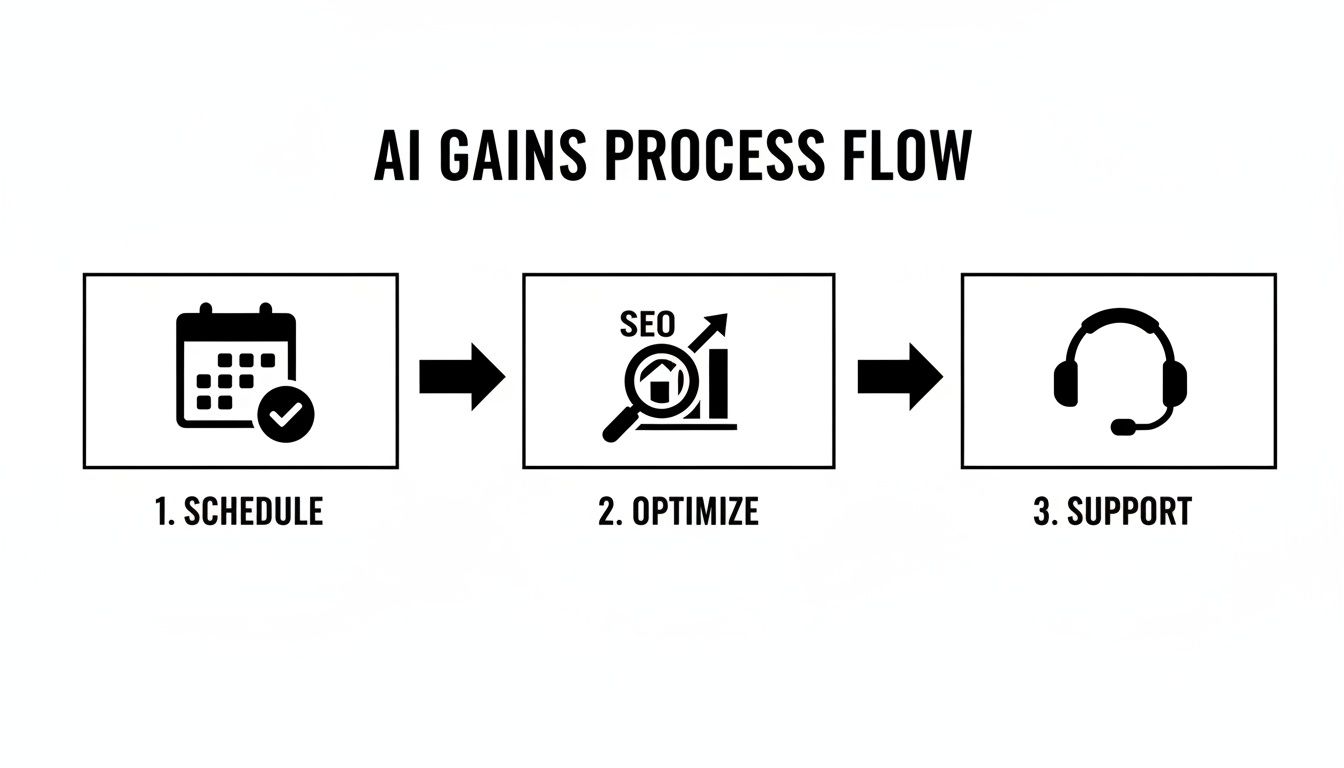
As you can see, the AI can manage the entire operational backbone of a task, freeing up your team's mental energy for strategic oversight.
Let's look at how this plays out for different roles. A data analyst might design a lightweight database to track marketing leads, but an AI employee is the one tasked with actually managing it. The AI populates the database, cleans the data, and generates weekly reports. This leaves the analyst free to focus on interpreting the trends and uncovering real growth opportunities—the "aha!" moments that data reports are supposed to create.
This model is a game-changer for customer support. Many teams are already moving away from traditional helpdesks by using AI for initial triage. An AI employee can handle common questions instantly, acting as a smart first line of defense. As you explore your options, you'll find that many Gorgias alternatives now offer deep AI integration to automate these initial interactions. This frees up your support agents to handle the complex, high-touch issues that require genuine empathy and critical thinking.
The key is to see AI not as a separate tool, but as an extension of your team. It's a colleague you can rely on to execute flawlessly, giving you the space to think, create, and lead.
By intentionally designing workflows around this human-AI partnership, you stop just completing tasks and start building a smarter, more efficient operational engine. This is how you unlock sustained productivity gains and give your team the freedom to do their absolute best work.
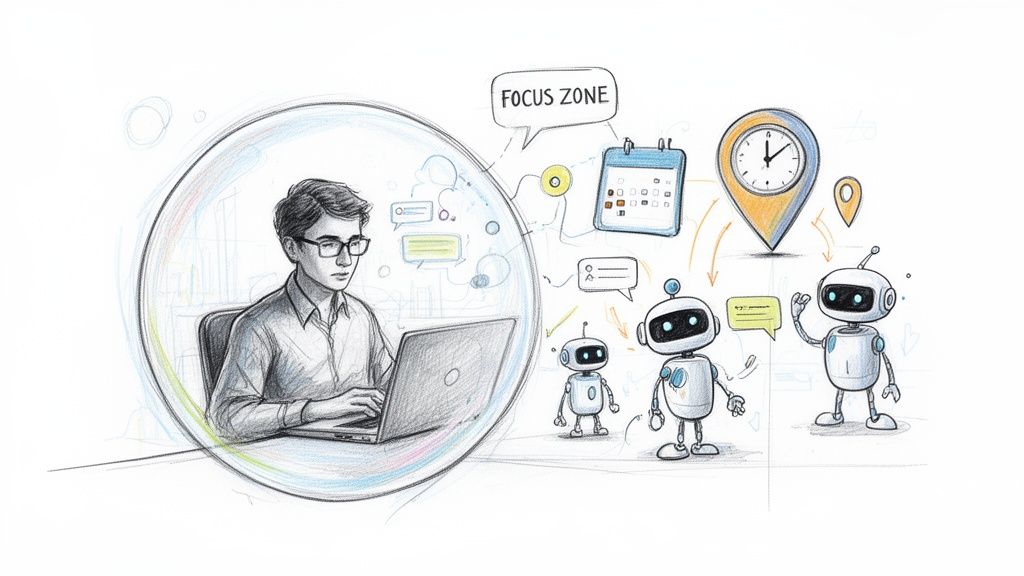
New tools and workflows are a great start, but they only get you so far. If you want to build a truly high-performing team, you need a culture that actively protects and values deep, uninterrupted work. It's about giving your people the space to sink their teeth into complex problems without being constantly derailed by distractions.
This is where AI automation steps in as a cultural architect, not just a task-doer. Think about it: what if your team was shielded from the constant barrage of minor interruptions? When an AI employee handles routine customer queries or fields internal status requests, your team finally gets the sustained focus they need to have real breakthroughs. The dream is a workplace where "I had a great, productive day" becomes the norm, not the exception.
The modern workplace is a battlefield for attention. We're interrupted, on average, every three minutes. The real killer? It can take over 23 minutes to fully get back on track after each distraction. That constant context-switching destroys momentum and makes it nearly impossible for your team to get into a state of flow.
By automating those interruptions, you’re sending a clear message: you value your team's creative and strategic energy. You're freeing them from the tyranny of the urgent so they can finally tackle the important work—the kind that drives real progress and gives them a sense of accomplishment.
When you automate the noise, you create a culture of focus. Your team’s most valuable asset is their ability to think deeply, and your job is to fiercely protect it.
A culture built on deep work pairs perfectly with the shift toward flexible schedules. This isn't just about offering a nice perk; it's a massive productivity driver. In fact, 69% of managers report that hybrid and remote work actually boosts their team's output. You can discover more insights on workplace productivity trends and see the full impact for yourself.
AI employees make this transition incredibly smooth. Imagine an AI teammate that manages schedules across time zones or acts as a 24/7 point of contact for routine questions. For example, a team member in a different country can ask the AI for a project update at their 9 AM, without having to wait for their US-based manager to log on. This empowers your team to work when and where they’re most effective, without forcing everyone to be online at the same time.
For more ideas on creating a productive work environment, check out the resources on the Dooza blog. This approach builds a system of trust, allowing your team to do their best work, supported by AI that handles the rest.
Adopting AI to handle parts of your workflow is a big step, and it's totally normal to have questions. It represents a different way of thinking about work, so let's tackle some of the most common concerns head-on. The goal here isn't just about bolting on new tech; it's about fundamentally changing your team's day-to-day for the better.
We're aiming for that sweet spot where your team is no longer drowning in the small stuff. Instead, they're freed up to think bigger, get creative, and solve the problems that actually move the needle.
Nope. Not even close. The whole point is to supercharge your current team, not replace them.
Think of an AI employee as the ultimate assistant—one that actually enjoys the tedious, repetitive tasks your team can't stand. This frees your people from the daily grind and lets them focus on the work that truly requires a human brain: things like strategic planning, creative brainstorming, and building genuine relationships with your customers.
For example, when an AI like Dooza's Seomi handles the nitty-gritty of SEO data-pulling, your marketing specialist suddenly has their day back. They can stop wrestling with spreadsheets and start crafting a killer campaign strategy or digging into new market opportunities. It’s about elevating their role from a doer to a thinker.
You’d be surprised how straightforward it is. Modern AI platforms are built for business owners and managers, not just developers. Many tools, including the AI employees at Dooza, are designed with a simple, intuitive interface that feels more like hiring a person than setting up software.
Honestly, it’s often as simple as telling your AI what to do in plain English and connecting it to the tools you already know, like Google Calendar or your project management software. No coding required.
For instance, you could tell it: "When a new lead comes in from our website form, create a contact in our CRM, and assign a follow-up task to the sales team for two days from now." It's that easy. This means you can get an AI up and running to manage your meeting schedule or triage customer emails in a matter of minutes. The power of automation is no longer locked away for the tech-savvy—it's ready for everyone.
Start small. Seriously. Find one repetitive task that eats up a surprising amount of time but follows a clear set of rules. This is your "quick win"—the perfect test case to prove the value of automation and get your team excited about what's possible.
Looking for ideas? Here are a few great places to start:
Tackling just one of these can instantly free up hours every week. It’s the fastest way to see a real impact and build the confidence to automate even more.
Ready to stop the busywork and let your team focus on what matters? Explore the team of AI employees at Dooza.co and see what you can automate today.
Automate your business with AI employees that work 24/7.
Discover the leading AI automation companies transforming business workflows in 2026. Learn how agentic AI and digital workers can boost your efficiency.
Discover the hidden ChatGPT features that can save you hours every day, and learn how Dooza's AI employees like Maily, Somi, Ranky, and Stan can automate your business beyond what any chatbot can do.
Join thousands of companies using Workforce to automate their work. Get started for free today.
No credit card required · 7-day money-back guarantee · Cancel anytime