What Is Operation Strategy and How Does It Drive Growth
Discover what is operation strategy and how to transform your business. Learn to align processes, people, and AI for unstoppable efficiency and growth.
22 min read
February 1, 2026
Imagine your company's most ambitious goals—the "what" and "why" of your business. Your operation strategy is the detailed, practical roadmap that answers "how" you're actually going to get there. It’s the master plan for using your resources—people, technology, and processes—in the most effective way possible to conquer your market.
This strategy is the crucial bridge between your high-level vision and the everyday work your team does. It ensures that every action taken, every process improved, and every dollar spent pushes you closer to your ultimate business objectives.
What Is Operation Strategy, Really?
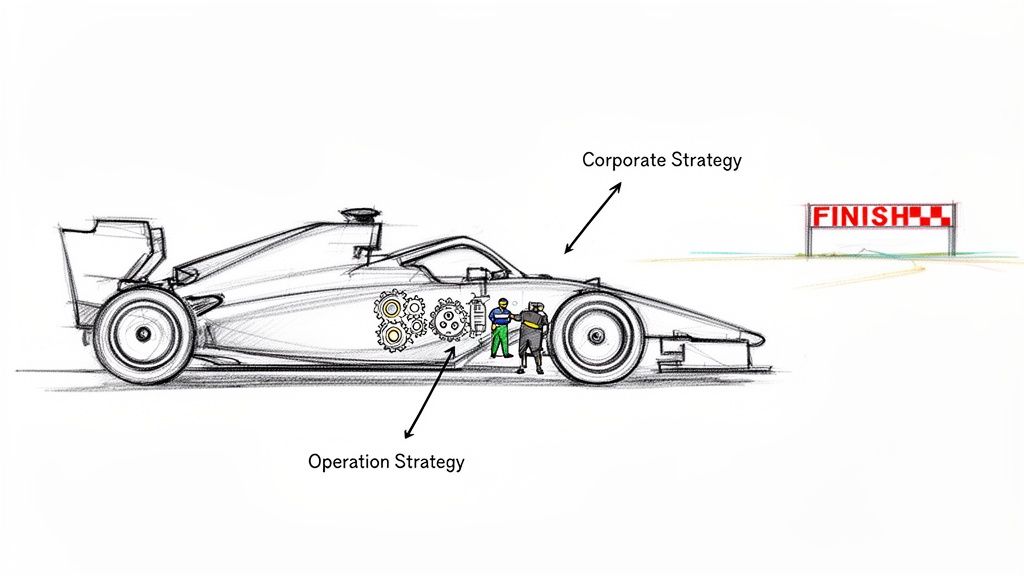
Let’s use an analogy. Imagine your business is a high-performance race car, and your corporate strategy is the finish line you're aiming for. Your operation strategy is everything that makes the car a winner: the engine, the pit crew, and the aerodynamic design, all working in perfect sync to get you across that finish line faster and more efficiently than the competition.
This isn’t just about making to-do lists or managing projects. It's about intentionally designing a powerful, resource-smart system that creates a real competitive advantage. A well-crafted operation strategy answers the tough questions: How will we build our product or deliver our service? How do we guarantee quality every time? What tools and tech will we use to make our workflows smoother?
The Dream of Effortless Operations
The end goal here is to achieve true operational excellence, where the business runs so smoothly it almost feels like it's on autopilot. Just think about all the time your team sinks into repetitive, manual work each week—updating spreadsheets, answering the same five customer questions, scheduling meetings. Now, imagine a reality where those tasks are already done by smart AI agents before you even pour your morning coffee.
This is the promise of a great operation strategy. It's about building a system where:
Customer questions get answered instantly, 24/7, by an AI receptionist that never needs a break.
Marketing reports are compiled, analyzed, and delivered to your inbox overnight, highlighting key insights.
New hire onboarding becomes a perfectly consistent, hands-off process managed by an AI HR assistant, freeing up your managers.
When your operations are dialed in like this, you free up your single most precious resource: your team's brainpower for creativity and big-picture thinking. You shift from constantly putting out fires to actively innovating. You’re no longer just running the business; you're consciously designing its future. For more on modern business tactics, check out some of the insightful articles on our blog.
An effective operation strategy isn't about working harder; it's about building a smarter system that works for you. It transforms your role from a day-to-day manager into a forward-thinking architect of growth.
Ultimately, grasping what an operation strategy is means seeing it as your blueprint for long-term success. It's how you build a resilient, scalable business machine that thrives on change instead of cracking under pressure—paving the way for you to lead your market.
The Four Goals of a Winning Operation Strategy
A powerful operations strategy doesn't just happen by accident. It's carefully designed to hit specific, game-changing targets that support your company's growth and stability. Every single decision, process, and tech investment you make should tie directly back to one of these core goals.
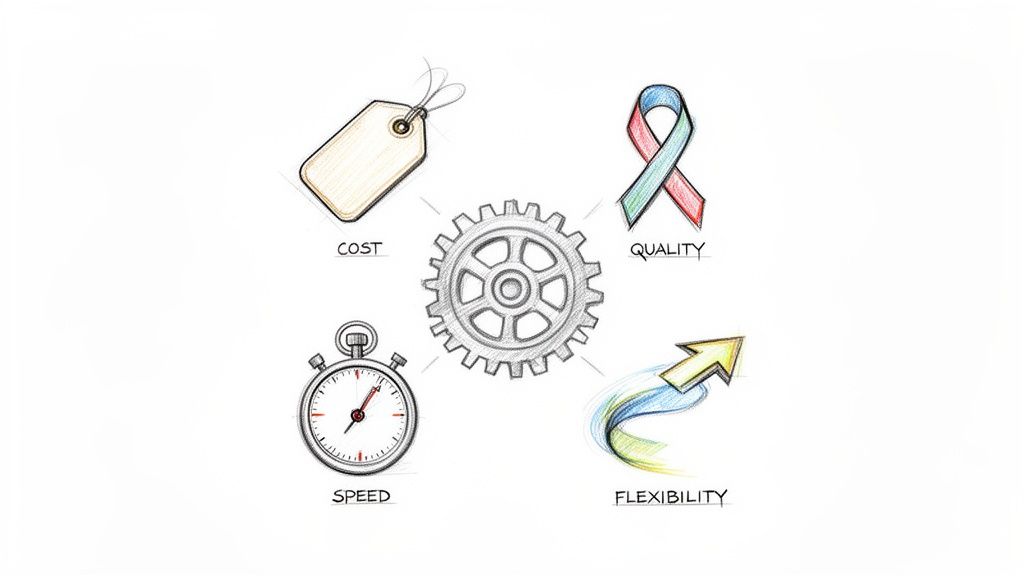
Think of these goals as working together, like gears in an engine driving efficiency and keeping customers happy. When you nail them, you stop just putting out fires and start proactively building a business that can actually scale. Let's break each one down.
1. Slashing Costs Through Smart Automation
The first goal, cost reduction, isn't about being cheap or cutting corners. It's about being incredibly smart with your resources and stamping out waste. This is where modern automation becomes your secret weapon.
Imagine replacing repetitive manual tasks with AI agents that work around the clock without needing a salary, benefits, or a coffee break. For example, a small e-commerce business can "hire" an AI agent to handle all incoming customer service chats and emails. That single move can eliminate thousands of dollars in monthly labor costs while ensuring no lead is ever missed, even at 3 AM. It’s not just about saving cash; it’s about freeing up your human team for the high-value work that actually grows the business.
2. Elevating Quality for a Flawless Experience
Next up is quality. In today’s world, quality isn't just a product feature—it defines the entire customer experience. An operations strategy laser-focused on quality aims to deliver a consistent, flawless, and positive interaction at every single touchpoint.
Consistency is everything here, and it's something humans can struggle with but AI aces. Think about an AI support agent. It never has a bad day, it never gets tired, and it can pull the right answer from your entire knowledge base in a split second. For instance, an AI can manage the onboarding process for a new SaaS customer, ensuring every single step is followed perfectly, every time. This means every customer gets the same high standard of service. That’s how you build serious brand loyalty and trust.
An operations strategy built on AI-powered quality creates a customer experience so seamless and reliable that it becomes your most powerful marketing tool.
3. Accelerating Speed to Market and Service
Speed is a massive competitive advantage. This goal is all about shrinking the time it takes to get things done—from launching a product to closing a support ticket. The faster you move, the more nimble your business becomes. Slow, manual processes are the enemy of speed.
Let's say your marketing team needs to launch a new social media campaign. The old way could take weeks of scripting, shooting, and editing. With an AI agent, they could generate a dozen high-quality promotional videos from a simple text prompt in minutes. This kind of acceleration lets you jump on market trends instantly and simply out-hustle your competitors. You can react in real-time while they're still in planning meetings.
4. Boosting Flexibility to Adapt and Overcome
Finally, a winning operations strategy has to deliver flexibility. This is your ability to adapt to shifting market demands, new customer needs, or unexpected problems without your entire workflow grinding to a halt. Rigid systems are brittle and break under pressure; automated systems are resilient.
An AI workforce gives you flexibility like nothing else. Imagine a sudden Black Friday sales rush triples your customer inquiries. Instead of a frantic panic to hire and train temporary staff, you simply scale up your AI support agents instantly to handle the load. This lets your business pivot on a dime, grab new opportunities, and navigate uncertainty with confidence.
The Building Blocks of a Bulletproof Operation Strategy
Moving from high-level goals to what actually happens on the ground requires a solid foundation. A truly bulletproof operation strategy isn't a single big idea. It's a system, a machine built from interlocking parts that are designed to work together seamlessly. When you get this right, you create a business that’s resilient and scalable—one that thrives on change instead of breaking under pressure.
These components are the tangible, hands-on parts of your strategy. They turn your vision into repeatable, efficient actions that your team can follow every day. This covers everything from managing your resources to the tech you use to get the job done. Nailing these components is the difference between a strategy that lives on a whiteboard and one that actually drives results in the real world.
Core Components of Your Operations Plan
Think of these as the main pillars holding up your entire operational structure. Each one tackles a critical part of your business, and you really need to master them all for smooth, predictable growth. If even one pillar is weak, the whole thing can get wobbly, so it's crucial to give each one the attention it deserves.
Capacity Planning: This is all about making sure you have the right amount of resources—people, equipment, capital—to meet customer demand without overspending. For example, a restaurant uses capacity planning to decide how many cooks and servers to schedule for a Friday night versus a quiet Tuesday afternoon.
Supply Chain Management: This covers the entire journey of your product or service, from sourcing the raw materials all the way to final delivery. A coffee shop's supply chain management involves everything from sourcing beans from Ethiopia to ensuring they have enough milk and cups for the morning rush.
Process Design: This is where you map out the "how" of your daily work. It means creating standardized, repeatable workflows for every key task, like how a hotel front desk checks in a guest or how a software company handles a bug report. Clear process design gets rid of confusion and makes your output consistent.
It's also important to remember these elements are all connected. Your supply chain, for instance, has a direct effect on your capacity needs, and your process design determines how efficiently you use that capacity.
The Power of Technology Integration
The final, and arguably most impactful, building block is technology integration. This is the nervous system of your operation strategy. It connects all the other components, making them smarter, faster, and more responsive. Today, that means going way beyond just having basic software and starting to embrace intelligent automation.
Imagine hiring a smart AI employee like "Seomi" to run your entire SEO strategy. She doesn't just track keywords; she optimizes content, builds reports, and collaborates with your human marketing team right in Slack. She syncs data across tools like Google Analytics and your CRM, creating a seamless flow of information that used to take hours of manual work. The dream is to have your SEO running on autopilot, constantly improving while your team sleeps.
For startups, standardizing workflows is a constant battle. AI employees solve this by acting as the consistent, un-trainable layer of your operations, ensuring key processes are executed perfectly every time, freeing your team for strategic work.
This is the dream of a truly automated business. Instead of your team wrestling with a dozen disconnected tools, AI agents act as the glue. You could have one AI employee manage your customer support intake through automated forms, then pass qualified leads directly to another AI that handles scheduling and follow-ups. The customer gets an instant response, and your sales team only talks to pre-qualified, scheduled leads.
This level of integration isn't some far-off concept anymore. In the fast-moving world of 2025, a strong operation strategy is what keeps businesses agile, especially with all the global disruptions we see. The late 2024 2025 Deloitte GBS Survey found that 82% of organizations are prioritizing AI initiatives to boost efficiency by up to 30% in core areas like procurement and HR.
By thoughtfully combining these building blocks—capacity, supply chain, process, and technology—you build an operation strategy that’s more than just a plan. It becomes a real competitive advantage. It becomes a self-optimizing engine that powers your company toward its biggest goals. And with AI as the central nervous system, you free up an incredible amount of time and energy, letting you focus on leading, not just managing.
How to Create Your Operation Strategy Step by Step
Building a solid operation strategy isn't about some sudden stroke of genius. It's a structured process of looking at your business with a clear eye, figuring out what's working and what's broken, and then building a smarter way forward. And no, this isn't just for huge corporations—even a solo entrepreneur can benefit immensely.
This process is about moving from reacting to daily fires to proactively shaping your company’s future. Let's walk through the essential steps, using a real-world example to make these ideas stick.
Step 1: Define Your Business Goals
Before you can draw a map, you need to know where you're going. What does success actually look like for your business in the next one to three years? Your operation strategy needs to be in direct service of these big-picture goals.
Are you trying to boost revenue by 40%? Maybe you want to break into a new market. Or is the main goal to get customer satisfaction scores above a 95% average? The key is to be specific and make it measurable.
Your operation strategy isn't some separate document you file away. Think of it as the engine built specifically to power your main corporate strategy. Every single operational decision should answer the question: "Does this get us closer to our main business goals?"
For instance, a growing e-commerce store might set a goal to "double revenue within 18 months by shifting focus to premium, high-margin products." This one clear objective becomes the North Star for every decision that follows.
Step 2: Audit Your Current Operations
With your destination locked in, it’s time for an honest look under the hood. You have to map out how you do things right now to find the bottlenecks, wasted effort, and resource drains that are slowing you down. This is where business analysis is non-negotiable.
This kind of analysis is becoming a huge strategic advantage for businesses. The 2025 Global State of Business Analysis Report found that 76% of professionals see its impact growing, with 25% of companies now integrating it deeply into their standards. This shift toward data-driven decisions is exactly where Dooza.co excels, helping businesses standardize their processes with AI.
Back to our e-commerce store. The audit might reveal the owner is burning 15 hours a week just manually updating inventory spreadsheets. They also spend another 10 hours sending post-purchase follow-up emails. These are giant time sinks and prime targets for improvement.
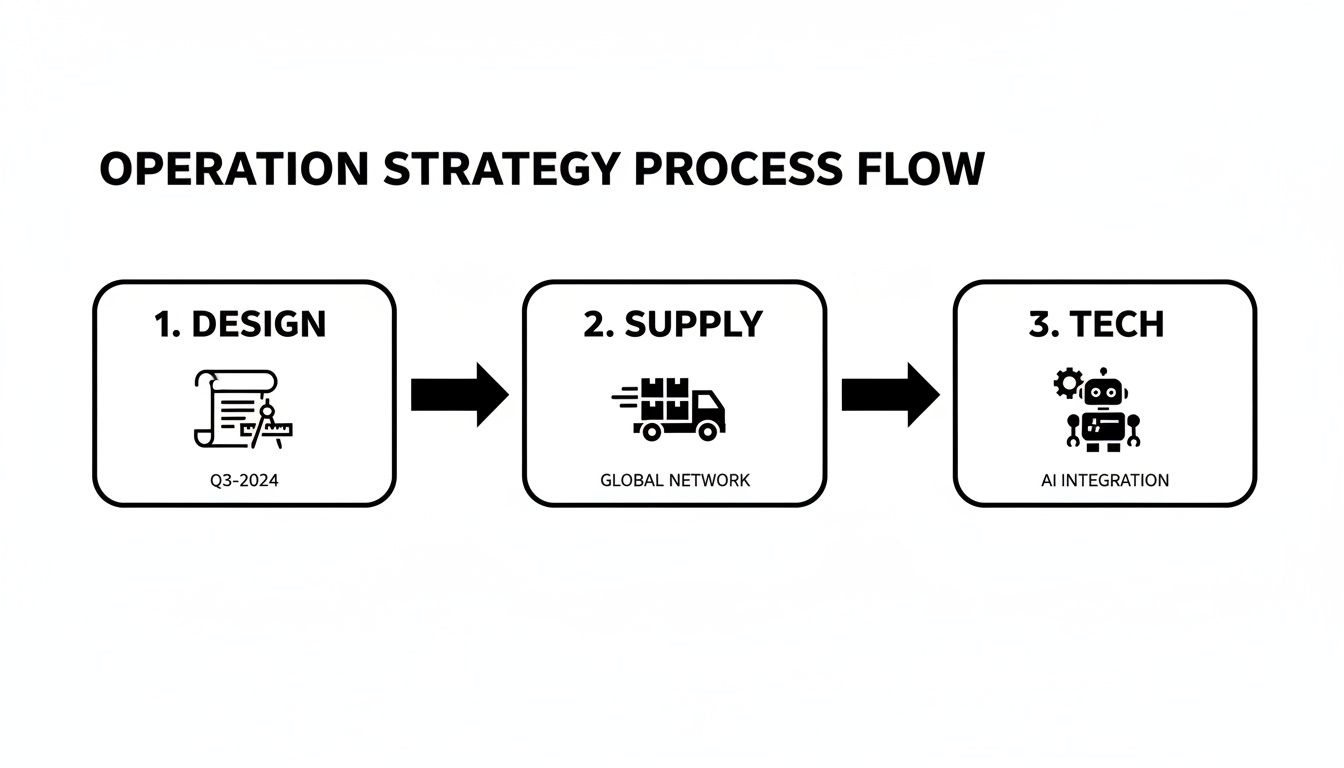
The diagram below shows the key stages of building and launching an operation strategy, from the initial design phase through supply chain logistics and tech integration.
This visual makes it clear: a winning strategy needs a balanced approach. You have to get the process design, supply chain, and technology all working together seamlessly.
Step 3: Identify High-Impact Opportunities
Now, it's time to connect the dots. Look at what you found in your audit and see how it lines up with your business goals. Which problems, if you solved them, would give you the biggest push toward your objectives? You’re searching for the levers that will deliver the most bang for your buck.
It's easy to get overwhelmed and try to fix everything at once. Don't. A great strategy is about focusing on the vital few. For our e-commerce owner, the goal is to double revenue. Getting 25 hours of their week back is a massive opportunity. That's time they could pour into sourcing new products, marketing, and building supplier relationships—the exact activities that actually grow the business.
Step 4: Design and Implement New Processes
This is where the plan turns into action, often with a little help from technology. You design new, more efficient processes that use automation to kill off the manual drudgery. For our e-commerce owner, this means "hiring" an AI employee from Dooza.co.
Here's how that plays out:
The New Inventory Process: The AI employee connects directly to the store's sales platform. It automatically updates inventory in real-time, sends an alert when stock runs low, and can even draft purchase orders for approval. Just like that, 15 hours of spreadsheet work are gone, freed up for strategic thinking.
The New Customer Follow-Up Process: The AI agent also takes over post-purchase communication. It sends a thank-you email, follows up a week later to ask for a review, and answers common shipping questions. The other 10 hours of manual emailing are eliminated, giving the owner more time to build real customer relationships.
By following these steps, you create a strategy that isn't just a theory on a whiteboard. It becomes a practical, actionable plan that frees up your most valuable resource—your time—so you can focus on what really matters. If you need a better way to structure your operational data for this kind of analysis, check out our guide on creating a lightweight database with Dooza's table feature.
Putting Your Operations on Autopilot with AI
You’ve done the hard work of crafting a solid operations strategy. Now comes the execution. But what if bringing that plan to life didn’t mean piling more tasks onto your team? What if it meant taking them away?
Imagine an operation so finely tuned that key tasks get done before you even open your laptop. This isn’t some far-off dream; it's what's possible today with intelligent automation.
This is where the real magic happens. By handing off the repetitive, time-sucking parts of your strategy to a dedicated AI workforce, you can put your operations on true autopilot. This frees up your people from the daily grind so they can focus on what they do best: creative problem-solving, innovating, and building relationships.
The AI Workforce Your Strategy Deserves
Think of AI employees as the perfect executors for your operational plan. They don't just blindly follow instructions; they plug right into your existing tools, collaborate with your team, and work 24/7 to keep your strategy moving forward. In today's economic climate, making this shift is a game-changer for growth.
An operation strategy for 2025 has to be about growing through smart tech investments. A recent JPMorgan's outlook for 2025 found that while 77% of executives are feeling cost pressures, 74% still expect to see revenue grow. How? Over half (53%) are launching new products and 43% are building new partnerships. That’s a clear sign that the strategy is to fuel expansion, and it points to one thing: businesses are using technology to do more with less.
The goal is to automate the predictable so your team can excel at the exceptional. An AI workforce doesn't replace your team; it empowers them by handling the operational noise.
Real-World Examples of AI-Driven Execution
So, let's get practical. How does an AI employee actually execute parts of your operation strategy? The possibilities are huge, but here are a few high-impact examples that make the dream of an automated business feel real.
Email and Calendar Management: An AI agent can take over your inbox, sorting emails by priority, drafting replies to common inquiries, and scheduling meetings based on your availability. This one automation tackles the administrative bloat that often sinks a cost-reduction strategy, freeing up dozens of hours a week for your key leaders.
Social Media and Content Creation: Imagine an AI employee that not only schedules your posts but also creates a week's worth of engaging video clips from a single webinar recording. This is a massive accelerator for your marketing, letting you jump on trends in hours, not weeks. You can explore how to automate social media management with an AI workforce.
Customer Support and Onboarding: An AI receptionist can field initial customer questions 24/7, route complex tickets to the right person, and even handle the first few steps of client onboarding paperwork. This guarantees a consistent, high-quality experience every time, hitting the quality and speed goals in your strategy.
Waking Up to a Business That Runs Itself
When you add all this automation up, the effect is profound. Picture starting your day not with a frantic scramble through urgent tasks, but with a simple summary of what your AI team accomplished overnight.
You could wake up to find:
SEO reports already generated and sitting in your inbox, complete with performance highlights and suggested content improvements.
A week's worth of social media content scheduled and queued up across all your platforms, tailored to each network.
Tier-one customer support tickets already resolved, with only the tricky issues escalated for human review, along with a summary of the conversation so far.
This is the real-world outcome of weaving an AI workforce into your operation strategy. You’re not just making a plan; you’re building a self-executing system that pushes your business forward, day and night. It’s a shift from just managing operations to architecting an intelligent, automated engine for growth. By letting AI handle the "doing," you free up your people for the brilliant, creative work that actually defines your company's future.
Common Pitfalls to Avoid in Your Strategy
Coming up with a brilliant operations strategy is only half the battle. The other half is making sure you don't fall into the common traps that can completely derail even the best-laid plans. Think of it this way: a well-designed plan can easily fall apart if it hits one of these classic roadblocks. Steering clear of them is what turns your strategic vision into something real.
One of the most common mistakes I see is setting fuzzy, undefined goals. A target like "improve customer satisfaction" sounds great, but it’s not a strategy—it’s a wish. It has no teeth. Without specific, measurable objectives, your team is flying blind, and you have no real way of knowing if you're actually making progress.
Resisting Essential Technology
In today's world, another major pitfall is sticking your head in the sand when it comes to technology, especially automation. Some leaders still see AI as this complex, expensive "nice-to-have" rather than a fundamental operational tool. That mindset just doesn't work anymore; it's like trying to win a Formula 1 race on a bicycle. Failing to automate puts you at a huge disadvantage in speed, cost, and quality.
Just picture this: your competitor's team is completely free from mind-numbing data entry, scheduling nightmares, and endless follow-up emails because their AI employees handle it all. They get to spend their days innovating and actually talking to customers, while your team is still drowning in busywork. This isn't some sci-fi fantasy—it's what's happening right now.
An operations strategy that ignores AI is a strategy built for yesterday's market. Embracing automation isn't about replacing people; it's about freeing them from robotic work so they can focus on what they do best—drive real growth.
Failing to Get Your Team on Board
You can draw up the most elegant process on a whiteboard, but if your team doesn't get it or believe in it, it’s dead on arrival. A strategy that's just handed down from on high, without any input or a clear explanation of the "why," is almost guaranteed to be met with resistance. People need to see how the changes will make their jobs better and help the company succeed.
The fix is simple: involve your team from the start. Ask them what their biggest headaches and bottlenecks are. When you clearly communicate how a new tool or an AI assistant will eliminate their most tedious tasks—for example, "This AI will handle all the initial data entry for new leads, so you can spend your time building relationships instead of copying and pasting"—they become your biggest champions, not your biggest obstacles.
Forgetting to Track and Adapt
Finally, a massive mistake is treating your operations strategy like a stone tablet—something you create once and never touch again. Markets shift, customers change, and your initial assumptions might turn out to be completely wrong. Without consistently tracking your Key Performance Indicators (KPIs), you're just guessing.
To stay on course, you need a rhythm of regular review. It boils down to a few key things:
Establish Clear KPIs: Define the metrics that truly measure success, like customer response time, cost per acquisition, or employee turnover.
Hold Regular Check-ins: Set up monthly or quarterly reviews to see how you're performing against those KPIs.
Stay Agile: Be ready and willing to pivot your tactics based on what the data is telling you.
Avoiding these pitfalls is all about de-risking your plan. It’s what ensures your operations strategy becomes a powerful engine for growth, not just another document gathering dust on a shelf. For more on managing customer interactions efficiently, check out some powerful alternatives to popular helpdesk software.
Got Questions? Let's Clear a Few Things Up
Even with the best map, you might still have a few questions about the road ahead. Let's tackle some of the most common queries about operation strategy to make sure everything is crystal clear.
Corporate Strategy vs. Operation Strategy: What's the Difference?
Think of your corporate strategy as picking a destination on a map. It’s the big-picture goal, answering the question, "Where do we want our company to be in five years?" Maybe the goal is to become the most recognized luxury brand in your industry.
Your operation strategy is the vehicle you choose for the journey and the route you plan to take. It answers, "How, exactly, are we going to get there?" It gets into the nitty-gritty of designing premium products, creating a white-glove customer experience, and sourcing the finest materials. The corporate strategy sets the vision; the operation strategy builds the engine to power you there.
How Often Should I Revisit My Operation Strategy?
An operation strategy isn't something you carve in stone and forget about. The business world just moves too fast for that.
Plan for a deep dive and major review annually, usually when you're doing your overall business planning for the year ahead. But don't wait 12 months to see if you're on track. You should be holding quarterly check-ins to monitor your KPIs, see what's working, and make quick adjustments.
Sticking to an outdated plan for a full year is a recipe for falling behind. Agility is your competitive advantage, and those regular quarterly tweaks ensure your day-to-day operations are always pushing you toward your biggest goals.
Is This Something a Small Business Can Actually Do?
Yes, and you absolutely should. For a small business, a focused operation strategy isn't just a "nice-to-have"—it's a critical tool for survival and growth.
You don’t need a massive, 50-page document. Start small. Pinpoint your single biggest operational headache. Is it the hours you lose every week manually responding to customer questions? Is it keeping up with your social media accounts?
Your first strategic move could be as simple as "hiring" one AI employee to take over that single task. Picture an AI assistant handling all your appointment scheduling or customer service chats. That one change frees you up to work on the business, not just in it. That's an operation strategy in action, and you can build on it from there.
Ready to stop managing tasks and start building a self-running business? With Dooza.co, you can hire AI employees to execute your operational plans for you—from boosting your SEO and managing social media to delivering 24/7 customer support. Hire your first AI employee today at Dooza.co.
Ready to Get Started?
Automate your business with AI employees that work 24/7.
Unlock the Full Power of AI: 24 ChatGPT Hacks That Will Transform Your Productivity (And How Dooza’s AI Employees Take It Even Further)
Discover the hidden ChatGPT features that can save you hours every day, and learn how Dooza's AI employees like Maily, Somi, Ranky, and Stan can automate your business beyond what any chatbot can do.