AI Agent Frameworks: A Practical Buyer's Guide for 2026
Compare the top AI agent frameworks for 2026. Learn architecture, tradeoffs, and how to pick the right stack for customer support, sales, and voice.
16 min read
August 1, 2026
You probably know the feeling already. A founder, ops lead, or agency owner looks at the same inbox, the same lead list, the same support queue, and the same call backlog, and realizes the team is spending too many hours doing work a machine should handle. That's where ai agent frameworks enter the conversation, but that's also where many teams take the wrong turn.
The default advice is to start comparing frameworks. The smarter move is to ask a sharper question, do you need to build an agent system at all, or do you need an AI employee that can start working now. For many SMBs, BPOs, and agencies, the answer is the second one. If you want a practical way to think about the space, PlotStudio's guide on agentic analytics capabilities is a useful complement because it shows how teams evaluate action-oriented AI beyond simple dashboards.
The pressure usually shows up in small, boring ways. A support manager sees the same password-reset questions for the hundredth time. A sales lead watches good inbound names sit untouched until the lead goes cold. An agency owner knows the team is doing outbound manually, one message at a time, and every follow-up eats another hour.
That's the moment when people start searching for an automation answer. The fork appears fast: either build on top of an ai agent framework, or put a pre-built AI employee to work and skip the orchestration headache. One path gives you control, the other gives you speed. Many teams say they want both, then discover they rarely need both on day one.
Practical rule: if the work is repetitive, high-volume, and close to revenue or customer experience, the first question is not “which framework?”. It's “what should this AI employee own from end to end?”
That distinction matters because a lot of “agent” projects are really just workflow replacements with a fancy label. If you're trying to understand where the line sits between a chatbot and something that can act, the clearest short explainer I've seen is Dooza's own breakdown of ai agent vs chatbot. Use that lens before you get lost in feature grids.
For teams that already know the workload is substantial, the decision becomes simpler. Do you need custom logic, or do you need the work done. Do you have engineers who want to compose orchestration from scratch, or do you need customer support, lead qualification, outbound sales, and voice calls handled without building an internal platform first. That's the question in front of you.
What AI Agent Frameworks Actually Are
A good way to think about ai agent frameworks is the kitchen analogy. The model is the chef, the framework is the kitchen, and the tools are the appliances. A chef with no kitchen can't do much, and a kitchen with no chef is just infrastructure. The framework is what gives the model a place to plan, use tools, remember context, and finish work instead of just chatting about it.
IBM describes these systems as platforms with built-in architecture, communication protocols, task management, function-calling integration, and monitoring tools, which is the right mental model for buyers IBM's overview of agent frameworks. In plain English, a real framework turns an LLM into a system that can take action. It doesn't just answer. It can decide what to do next, call external systems, and keep moving until the task is done.
The market already looks real, not hypothetical
The category is no longer a toy market. Mordor Intelligence estimates the agentic AI frameworks market was worth USD 2.99 billion in 2025, is projected to reach USD 19.32 billion by 2031, and implies a 36.3% CAGR over 2026 to 2031, with open-source frameworks at 63.81% and cloud-hosted deployments at 71.32% in 2025 Mordor Intelligence report. That market shape says something important. Buyers are leaning toward flexible stacks and cloud delivery, not heavy proprietary infrastructure.
The same point shows up in the way teams talk about these systems. A recent review says frameworks support agents that dynamically interpret tasks, orchestrate tool use, and adapt to real-time environmentsarXiv review. That's the core value, not the branding around the framework itself.
When you hear someone pitch a framework, translate the pitch into four questions. Does it help the model decide. Does it remember what happened. Does it call tools safely. Does it let you see and control what happened after the fact. If the answer is yes, you're looking at a true framework. If the answer is no, you're looking at a wrapper.
The Four Components Every Framework Shares
Every framework eventually resolves into the same four parts. The names vary, the packaging varies, and the vendor story varies, but the mechanics don't. If you can spot these four components, you can read almost any pitch deck or docs page without getting fooled by the surface area.
Orchestration, memory, tools, and observability
Orchestration is the decision engine. It tells the agent what to do next, whether that's asking a follow-up question, calling a CRM, or escalating to a human. In a lead-qualification flow, orchestration decides whether the prospect is ready for sales or needs more context first.
Memory keeps the work coherent across turns. A support agent should remember the case number, the last response, and the escalation path. Without memory, you get a polite machine that acts like it forgot the customer five seconds ago.
Tools and APIs are how the agent reaches the actual world. Gmail, Outlook, WhatsApp, CRMs, calendars, databases, internal endpoints, and external services all sit behind this layer. If the agent can't touch systems, it can't do useful business work.
Observability is what keeps production sane. Logs, traces, approval points, and human-in-the-loop controls tell you what the agent did and why. That matters the moment an agent can send an email, update a CRM, or touch a customer-facing workflow.
Practical rule: if a framework demo doesn't show these four pieces clearly, it's selling you a prototype, not an operating system for work.
What to ask when someone shows you a demo
The fastest audit is simple. Ask which part owns the workflow graph, which part stores state, which part integrates with tools, and which part gives you traces and approvals. If the answer is “we glue that on later,” the platform may still be fine, but it's not giving you production-grade completeness out of the box.
That's why the planning layer matters so much. Microsoft's Agent Framework, for example, makes workflows explicit with graph-based routing, checkpointing, and human-in-the-loop support Microsoft Agent Framework overview. That's not a cosmetic detail. It's the difference between a system that can survive a long task and one that collapses when something goes wrong halfway through.
For a more hands-on build perspective, their guide on how to build ai agents is useful if you're trying to understand the implementation burden before you commit to a stack.
The Dominant Framework Patterns in 2026
The market is no longer one generic bucket. It splits into a few clear patterns, and the orchestration style matters more than the logo on the homepage. Pick the wrong one and you will fight the system every week.
Graph-based, role-based, conversational, and code-as-action
Graph-based orchestration is the strongest choice when work has branches, retries, or a real audit trail. Microsoft Agent Framework's Workflows use graph-based multi-step task structures with type-safe routing, checkpointing, and human-in-the-loop supportMicrosoft Agent Framework overview. That matters for long-running automations because a failed step should not poison the whole flow.
Role-based orchestration distributes work across specialist agents. CrewAI and AutoGen made this style popular because it is easy to picture one agent researching, another drafting, and a supervisor coordinating the result. It works when the task benefits from a cast of roles, but it can turn into theater if the workflow is simple.
Conversational handoff patterns fit support operations. One agent collects the issue, another handles a billing edge case, and a human steps in when the policy boundary gets crossed. This model fits customer experience work that depends on smooth escalation rather than heavy branching.
Code-as-action gives the model the ability to write or execute code as part of the task. That is powerful for engineering-heavy use cases, but it is overkill for most SMB operations teams. If the goal is to answer tickets or book meetings, you do not need an agent that behaves like a junior programmer.
The production signal is already clear. A 2026 report citing LangChain's State of Agent Engineering survey says 57% of organizations now have AI agents in production, up from 51% a year earlier, and 67% among enterprises with 10,000+ employeesagent landscape report. That is not a hobby market anymore. It is infrastructure.
What I'd choose by workload
If the work is process-heavy and irreversible, choose graph-based. If the work is coordination-heavy, role-based can help. If the work is mostly customer conversation with occasional human escalation, conversational handoff is enough. If the work is developer-facing or data-heavy, code-as-action can be the sharpest tool, but it is also the easiest one to misuse.
The practical benchmark is less about framework branding and more about whether the pattern matches the job. For many SMBs, BPOs, and agencies, the better first move is a pre-built AI employee that already does one job well, then a framework only if custom logic becomes unavoidable. That is the logic behind an AI agent orchestration platform when the workflow needs coordination without asking your team to assemble every piece from scratch.
One more thing matters. LangChain's ecosystem scale is hard to ignore, with 100M+ monthly downloads and 139k+ GitHub stars in the cited market summary agent landscape report. That does not make it the right choice for everyone, but it does show that the category's center of gravity has moved into mainstream production use.
Choose the orchestration pattern first, then the framework. If you start with the brand, you will probably overbuild.
When a Framework Is the Wrong Starting Point
Most comparison posts get timid. They tell you every framework is interesting, then politely avoid saying that for many teams a framework is the wrong first move. I'm not going to dodge it. If you're a small business, BPO, agency, or lean ops team, building on a framework can be the slowest route to ROI.
Why SMBs usually need outcomes, not infrastructure
A framework asks for engineering time, integration work, deployment choices, and ongoing maintenance before it delivers business value. That's fine if you have a strong product team and a unique workflow that needs custom logic. It's a poor trade if your priority is just getting support, sales outreach, or voice handling off the team's plate this quarter.
There's also a control illusion in some framework shopping. Teams think they need abstraction, but what they need is a narrow system that answers, escalates, updates the CRM, and logs the result. For that job, a pre-built AI employee is often the cleaner answer. Dooza Agents is positioned that way, as AI employees for customer support, lead generation, outbound sales, social media, and voice calls, not as another chatbot layer to babysit.
That's the part people miss. The best system is the one that removes work from your team, not the one that gives your engineers a prettier way to assemble it.
The fastest path to ROI is often a narrow production stack with one job and one owner, not a general-purpose framework with more abstraction than the workflow needs.
For teams that want a no-code route, the relevant question is whether the platform gives you approvals, routing, and visibility without making you build a control plane first. That's where the practical guide on no code ai agents becomes helpful, especially if your team doesn't want to turn agent setup into an engineering project.
When to still pick a framework
Use a framework when you have a workflow that's unique, when you need deep customization, or when your team already has the engineering bandwidth to own the stack. That includes complex stateful processes, specialized compliance logic, or product features that need tight integration with your own systems.
If not, start with a pre-built AI employee. Dooza Agents fits that category for many SMB and agency workloads because the business outcome is the point. Frameworks are the escape hatch when your process is unusual, not the default starting line.
Selection Criteria That Actually Matter
Most framework comparisons obsess over feature lists and ignore the questions founders have to answer. That's backwards. The selection criteria are about workload fit, integration breadth, governance, observability, deployment model, and total cost of ownership. If a vendor can't speak to those, the demo doesn't matter.
The checklist I'd use in a buying meeting
Workload Fit: Does the system match the work, meaning graph-based for branching workflows, conversational for support, or role-based for delegated tasks.
Integration Breadth: Can it reach Gmail, Outlook, WhatsApp, CRMs, Zapier, and custom APIs, or is it trapped in a narrow sandbox.
Governance and Authorization: Can you control who lets the agent act, how budgets are enforced, and how safety is verified before customer-facing actions go out.
Observability: Do you get logs, traces, approvals, and escalation paths, or are you expected to inspect failures manually.
Deployment Model: Is it cloud-hosted, open-source, or vendor-hosted, and does that match your compliance and ops reality.
Total Cost of Ownership: Are you paying only for software, or also for engineering time, infrastructure, and maintenance.
That governance piece is the one many teams underestimate. A recent critique argues that many framework comparisons still skip threshold authorization, consumable budget tokens, and formal safety verification, even though those are exactly the controls business users need when agents can send emails, update CRMs, or take customer-facing actions Red Hat's production-capabilities critique. If you can't answer who approves an action, you don't have a production system.
The interoperability angle matters too. The Open Agent Specification describes a framework-agnostic declarative language for defining agents and workflows so they can move across stacks with high fidelity Open Agent Specification report. In practice, that reduces lock-in. MCP is becoming the common tool layer, and A2A is the communication layer for agents talking to other agents.
Framework selection criteria at a glance
Criterion
What to look for
Red flag
Workload fit
The orchestration style matches the job
A multi-agent demo for a simple workflow
Integration breadth
Native access to your tools and systems
A pile of custom connectors
Governance and authorization
Action approvals, budgets, and safety controls
“We'll add policy later”
Observability
Traces, logs, escalation paths
Debugging through raw prompts only
Deployment model
Cloud, open-source, or vendor-hosted that fits your ops
A stack that forces an unwanted hosting choice
Total cost of ownership
Low maintenance and limited engineering drag
Weeks of integration before first value
If you run this checklist, the answer becomes obvious quickly. Many teams don't need a framework-first strategy. They need a production agent that already knows how to work.
What These Agents Actually Do in Production
The cleanest way to judge this space is to watch the work, not the architecture. AI agents in production do a handful of repetitive, high-value jobs very well when they're wired to the right systems. That's why the framework conversation should always end in a business workflow.
Four workloads that matter right now
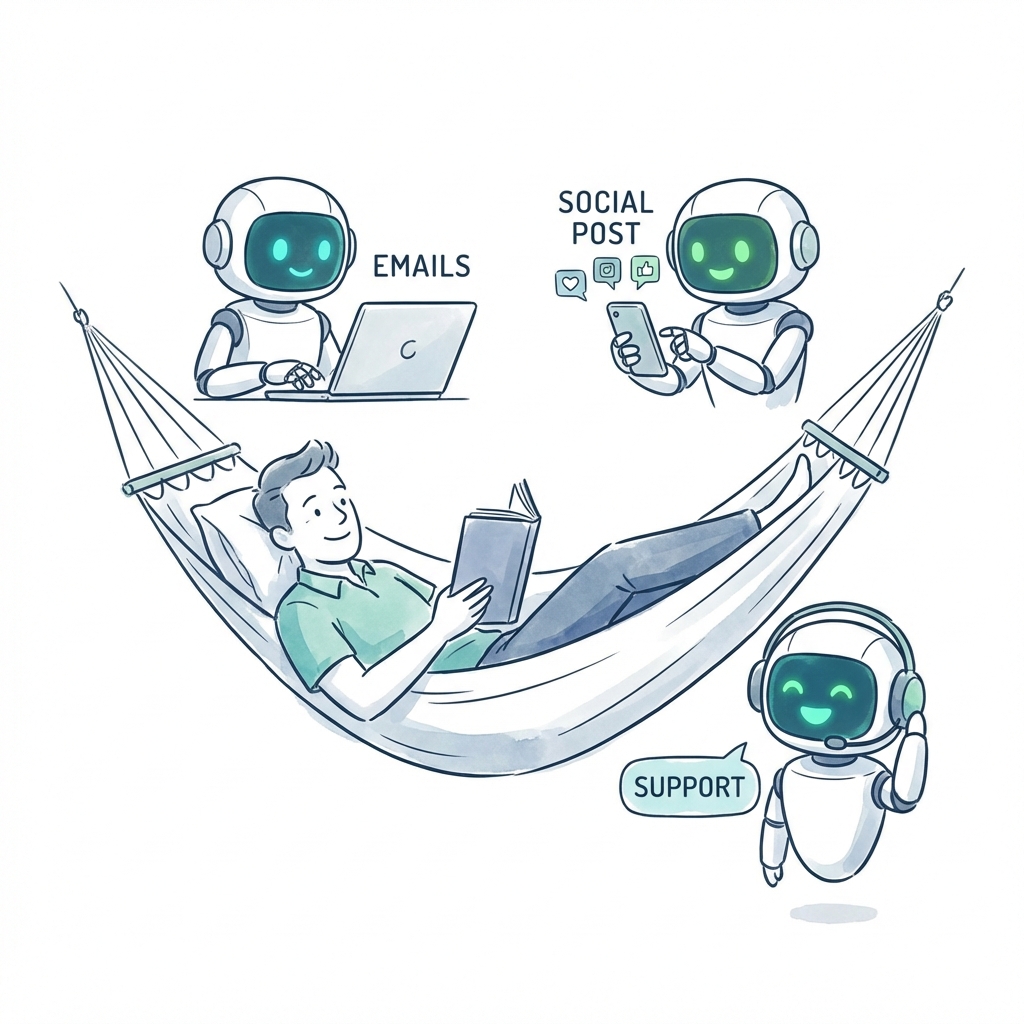
An AI customer support agent receives a ticket, checks the knowledge base, drafts the answer, escalates when needed, and logs the whole interaction. That's not a chatbot with a nicer skin. That's a support operator with rules and memory.
An AI lead generation agent monitors prospects, enriches records, qualifies interest, and hands off good leads to sales. If you want to keep tabs on the signal side of outreach, tools for autonomous LinkedIn lead monitoring show how specific the workflow can get when the task is focused on one channel and one outcome.
An AI outbound sales agent personalizes sequences, handles replies, books meetings, and updates the CRM. A good one knows when to stop pushing and when to hand the conversation to a human.
An AI voice agent answers inbound calls, routes the caller, captures details, and follows up. In a BPO or service business, that means fewer missed calls and less time spent on repetitive intake work.
For teams using Dooza Agents, the point is that the system is positioned as an AI employee that handles these workflows end to end. It plugs into Gmail, Outlook, WhatsApp, CRMs, Zapier, and custom APIs through MCP connectors, so the work doesn't stay trapped in one channel. If you want the broader automation context, their overview of ai agents for workflow automation is worth reading.
Your Next Move
If you have unique workflows and real engineering capacity, start with a framework like Microsoft Agent Framework, CrewAI, or AutoGen. If you need ROI this quarter, start with pre-built AI employees like Dooza Agents and treat the framework as an escape hatch, not the foundation.
Pick one workload that burns the most hours. Decide whether you want to build or deploy. Then put that choice against a live business case, not a demo. The cleanest pilot is the one that touches real support, lead gen, outbound sales, or voice work and proves value fast.
Dooza builds and deploys AI employees for SMBs, BPOs, and agencies that want customer support, lead generation, outbound sales, and voice calls handled without adding more software to manage. If you want the first agent live on real workloads, visit Dooza and book a pilot at dooza.ai/book.
Ready to Get Started?
Automate your business with AI employees that work 24/7.
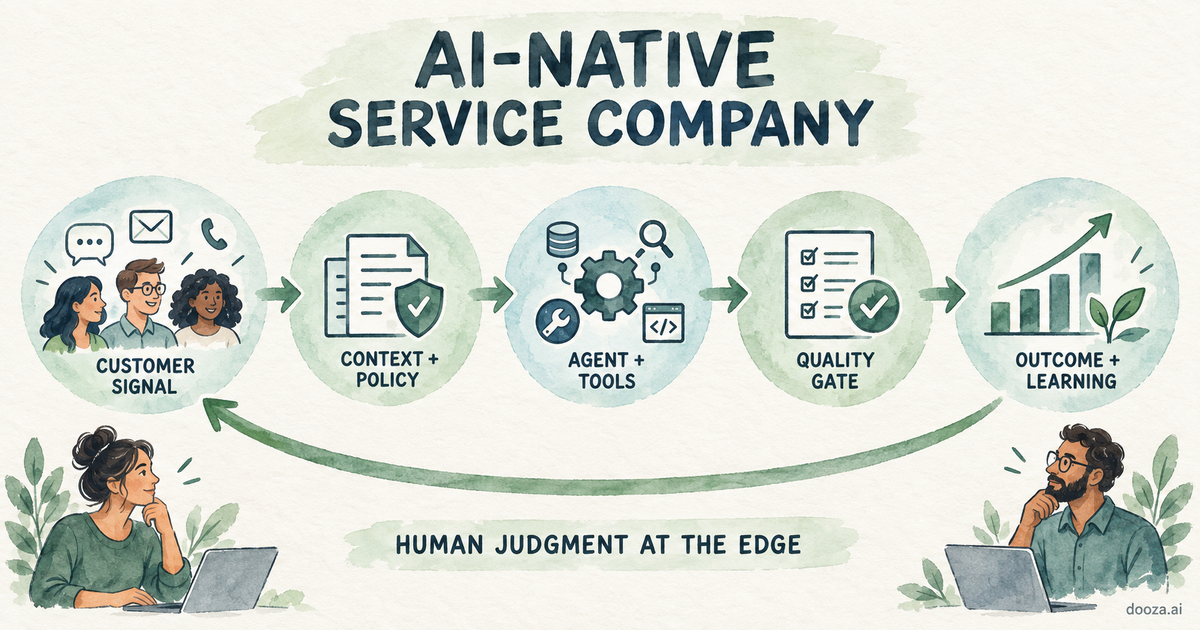
AI-Native Service Company: How It Works and How to Build One
An AI-native service company sells a completed outcome while agents run the repeatable work. See how the model works, where Dooza fits, and how to build one.