AI Employees
AI Chatbot vs AI Employee for Customer Support
Compare an AI chatbot with an AI employee for customer support, including tool access, approvals, reporting, and deployment needs.
12 min read
ReadA comprehensive comparison of AI Chatbots vs AI Employees for business automation. Learn which solution is right for your business in 2025.
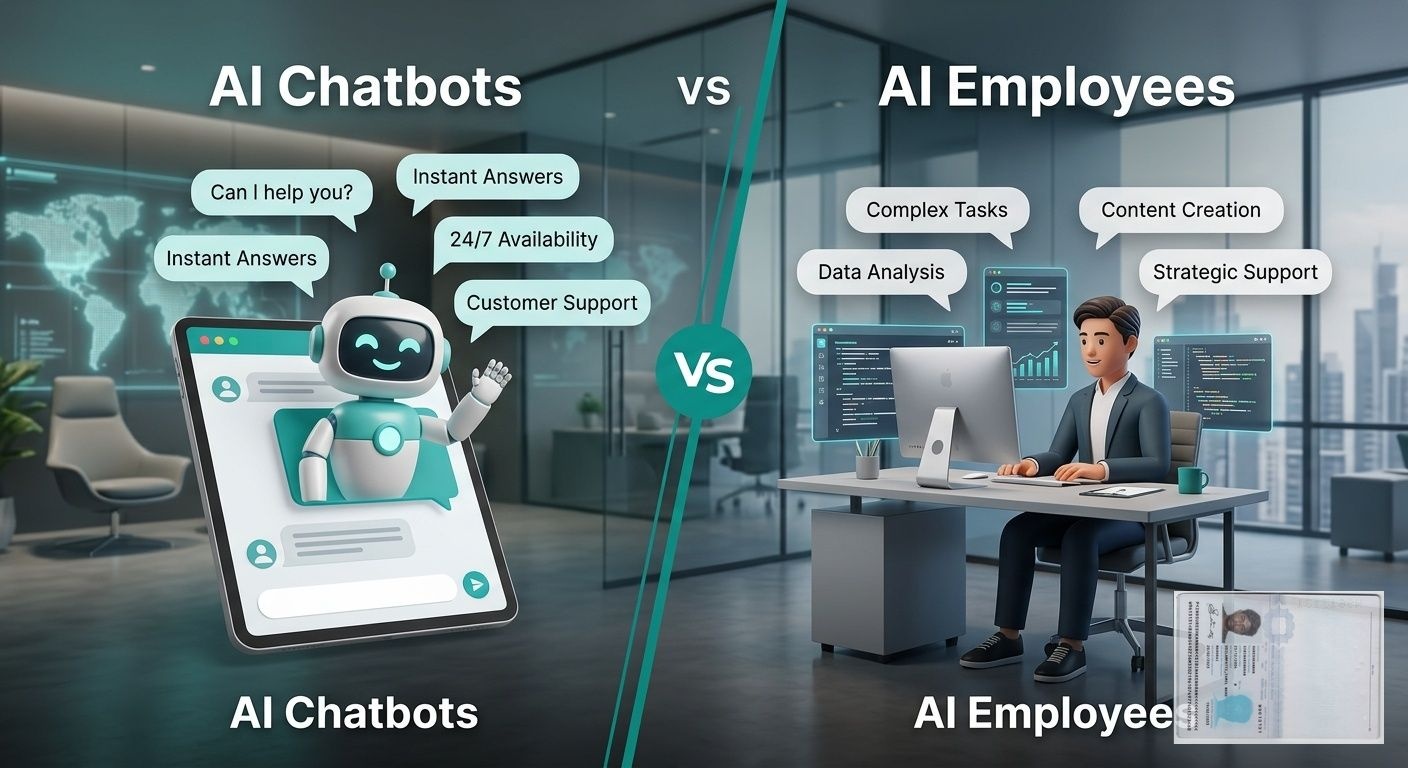
You've probably interacted with an AI chatbot before. Maybe it helped you track a package, answered a quick question on a website, or guided you through booking an appointment. These tools have become ubiquitous in customer service and business operations.
But there's a new player in the AI workplace revolution: AI Employees. Unlike chatbots that handle simple, scripted interactions, AI Employees are autonomous digital workers capable of executing complex business tasks—from managing inboxes and conducting sales calls to handling SEO optimization and beyond.
In this comprehensive guide, we'll break down everything you need to know about AI Chatbots vs AI Employees, helping you understand which solution is right for your business in 2025.
AI chatbots are conversational AI systems designed to simulate human dialogue through text or voice interfaces. They use natural language processing (NLP) to understand user queries and respond with pre-programmed or dynamically generated answers.
Modern chatbots have come a long way from their early rule-based ancestors. Today's AI-powered chatbots can:
Popular examples include Intercom and Zendesk. These tools excel at handling high-volume, repetitive customer queries and freeing up human agents for more complex tasks.
AI Employees represent the next evolution in workplace automation. Unlike chatbots that focus primarily on conversation, AI Employees are autonomous agents designed to perform entire job functions, with a human approving anything sensitive.
Think of them as digital team members who can:
Dooza is one example. Dooza Workforce offers ready-made AI employees for email (Maily), social media (Somi), SEO and AI visibility (Ranky), lead generation and sales outreach (Stan), legal documents (Linda), and phone calls and reception (Rachel). Dooza Agents builds custom agents, maintained by Dooza engineers. Both connect to your existing business tools.
AI Chatbots: Primarily focused on customer communication and support. Their capabilities are centered around answering questions, providing information, and routing inquiries.
AI Employees: Designed to handle complete business functions across multiple domains—communications, marketing, sales, operations, and more. They're not limited to conversation; they can take actions across your entire tech stack.
AI Chatbots: Typically operate in a reactive mode—responding to user inputs. They may suggest actions but rarely execute complex workflows autonomously.
AI Employees: Work proactively and autonomously. Given a task or objective, they determine the necessary steps and execute them without constant human guidance.
AI Chatbots: Usually integrate with customer service platforms, CRMs, and knowledge bases. Their integration focus is on accessing information to answer queries.
AI Employees: Connect deeply with your entire business infrastructure—email systems, calendars, CRM, marketing tools, analytics platforms, and more. They can orchestrate workflows across multiple applications.
AI Chatbots: Learn from conversation history to improve responses within their defined scope. They're trained on customer service interactions and support content.
AI Employees: Continuously improve across all business functions they handle. They learn from outcomes, optimize processes, and adapt to your specific business context and preferences.
AI Chatbots: Typically priced per user or per conversation. Costs scale with interaction volume.
AI Employees: Often priced per employee or per agent rather than per conversation. This can be more cost-effective for businesses needing comprehensive automation, so compare each vendor's pricing page.
| Feature | AI Chatbots | AI Employees |
|---|---|---|
| Primary Function | Customer communication | Business task automation |
| Autonomy | Reactive (responds to inputs) | Proactive (executes workflows) |
| Task Complexity | Simple to moderate | Simple to complex |
| Multi-app Integration | Limited (mostly helpdesk/CRM) | Full-stack (all business tools) |
| 24/7 Operation | Yes | Yes |
| Sales Capabilities | Lead qualification only | Full sales cycle automation |
| Content Creation | Limited responses | Full content generation |
| Data Analysis | Basic | Advanced |
| Implementation Time | Days to weeks | Hours to days |
| Best For | Customer support teams | Complete business automation |
AI chatbots remain an excellent choice for specific use cases:
If your primary need is handling customer inquiries, FAQ responses, and support ticket deflection, chatbots deliver exceptional value. They excel at:
For small businesses or startups with limited automation budgets, chatbots offer a lower barrier to entry. Many chatbot vendors have low-cost entry plans (check each vendor's pricing page), while AI Employees may cost more but cover more functions.
If your customer interactions follow predictable patterns—product questions, troubleshooting steps, booking inquiries—chatbots handle these efficiently without needing the complexity of full AI Employees.
AI Employees are the right choice when you need comprehensive business automation:
If you need automation across email management, social media, sales, AND operations, AI Employees provide unified automation that chatbots can't match. Dooza's AI employees cover email, social media, SEO, lead generation, legal documents, and phone calls from one platform.
When tasks require multiple steps across different applications—like researching a lead, updating your CRM, sending a personalized email, and scheduling a follow-up—AI Employees excel where chatbots fall short.
Growing businesses need automation that scales with them. AI Employees adapt to increasing workloads without requiring new integrations or additional tools for each function.
Rather than hiring additional staff for repetitive tasks, AI Employees work continuously without benefits, holidays, or sick days.
With AI Chatbot: A chatbot handles order status inquiries, return policy questions, and product recommendations. It deflects routine tickets and escalates complex issues to human agents.
With AI Employee: Beyond handling inquiries, an AI Employee processes returns autonomously, updates inventory systems, coordinates with shipping providers, follows up with customers post-delivery, and identifies upsell opportunities based on purchase history.
With AI Chatbot: Captures website visitors, qualifies leads based on questionnaire responses, and schedules sales callbacks.
With AI Employee: Researches prospects on LinkedIn and company databases, personalizes outreach emails, handles inbound inquiries, conducts initial discovery calls, updates CRM with interaction notes, and nurtures leads through automated follow-up sequences.
With AI Chatbot: Answers questions about blog content and suggests related articles to readers.
With AI Employee: Conducts keyword research, creates content briefs, writes and optimizes blog posts, schedules social media distribution, monitors performance metrics, and iterates on content based on engagement data.
The trajectory is clear: businesses are moving from point solutions (chatbots for support) to comprehensive AI solutions (AI Employees for everything).
Published productivity figures vary widely by survey, so measure your own results. Track hours saved, response time, and cost per task during a pilot before you scale.
The key driver? AI Employees don't just answer questions—they get things done.
Dooza is an AI-native company that builds AI products and services for small businesses. Dooza Workforce provides ready-made AI employees:
Maily manages email: sorting, prioritizing, drafting replies to routine inquiries, and flagging important messages for your attention.
Somi handles social media content creation and posting schedules.
Ranky works on SEO and AI visibility: keyword research, content improvements, and tracking how your site shows up in search.
Stan handles lead generation and sales outreach. Rachel answers phone calls as a receptionist. Together they free your human team to focus on closing deals.
Unlike human employees who need sleep, breaks, and time off, AI employees can work around the clock, so inquiries get a response regardless of time zone or hour.
The decision between AI Chatbots and AI Employees ultimately depends on your business needs:
Choose AI Chatbots if:
Choose AI Employees if:
For most growing businesses in 2025, AI Employees offer far greater value—providing comprehensive automation that chatbots simply can't match. The question isn't whether AI will transform your business, but whether you'll lead the transformation or play catch-up.
Ready to explore AI Employees for your business? Here's how to begin:
The debate between AI Chatbots vs AI Employees isn't about which is "better"—it's about which is right for your current needs and growth trajectory.
AI Chatbots remain valuable for specific customer service applications. But for businesses seeking comprehensive automation that transforms operations, AI Employees represent the future—and that future is here today.
Dooza offers AI employees for small businesses. Every Dooza product starts with a refundable pilot: 100% refund within 14 days. See pricing or book a free pilot call.
Build, grow, and scale your business with AI employees. Automate inbox, social media, SEO, sales calls 24/7 with Dooza.ai.
Learn more about AI in the workplace from these valuable resources:
Check out this comprehensive overview of AI agents and their business applications:
And this deep dive into AI automation for business:
Answer: The main difference lies in scope and autonomy. AI chatbots are designed primarily for conversational interactions—answering questions and handling customer service inquiries. AI employees, like those from Dooza.ai, are autonomous digital workers capable of executing complex business tasks across multiple functions including email management, social media, SEO, and sales calls. Chatbots respond to inputs; AI employees take proactive action to complete workflows.
Answer: AI employees are designed to augment human workers, not entirely replace them. They handle repetitive, time-consuming tasks freeing humans to focus on creative, strategic, and relationship-building work. Most businesses use AI employees alongside their human teams, with AI handling the automation while humans provide oversight, creativity, and complex decision-making that requires emotional intelligence.
Answer: AI employees typically cost a fraction of human employee expenses. A full-time employee costs salary, benefits, taxes, and training. Dooza prices each product separately and publishes prices on its pricing page, and every product starts with a refundable pilot (100% refund within 14 days). Compare that against your own cost of the hours you want to hand off.
Answer: Leading AI employee platforms, including Dooza.ai, use encrypted connections and ask for your approval on anything sensitive. Dooza is not SOC 2 certified. As with any technology, businesses should review each vendor's security practices, implement appropriate access controls, and follow best practices for data handling when granting AI systems access to sensitive information.
Answer: AI employees can automate a wide range of business tasks including: email management and response, calendar scheduling, social media content creation and posting, SEO research and optimization, outbound sales calls and lead follow-up, data entry and report generation, customer support (more complex than chatbots), CRM updates, and cross-platform workflow automation. The specific capabilities depend on the AI employee platform chosen.
Answer: Implementation time varies by platform and complexity. With Dooza, Workforce employees can start working the same day and custom agents are live in days, depending on the integrations required. A Dooza engineer scopes your pilot on a free 30-minute call.
Answer: Yes, most AI employee platforms integrate with popular business tools including Gmail, Outlook, Slack, Salesforce, HubSpot, WordPress, Shopify, Google Analytics, and many more. Dooza offers 1,000+ app integrations, so its AI employees can work across your existing tools.
Answer: For small businesses with limited resources, AI employees often provide better value despite higher upfront costs. While chatbots cost less initially, they only address customer service. AI employees handle multiple functions (inbox, social, sales, SEO) that would otherwise require multiple tools or part-time hires. The comprehensive automation often delivers superior ROI for small businesses looking to compete with larger competitors.
Answer: AI employees use machine learning algorithms to improve their performance. They analyze outcomes of their actions, identify patterns, and refine their approaches. For example, an AI employee handling sales calls learns which messaging resonates best, optimal call times, and how to handle objections more effectively. Platform providers also continuously update their AI models with improvements that benefit all users.
Answer: AI employees can handle customer service beyond what chatbots offer. While chatbots answer questions, AI employees can actually resolve issues—processing returns, updating accounts, scheduling appointments, and following through on requests. They combine conversational ability with action-oriented execution, providing a more complete customer service solution.
Answer: AI employees benefit virtually every industry, but particularly those with high volumes of repetitive tasks: e-commerce (customer service, order processing, marketing), professional services (client communication, scheduling, follow-ups), real estate (lead nurturing, property inquiries, scheduling), SaaS companies (customer onboarding, support, feature adoption), and any business with significant email/social media management needs.
Answer: Key metrics include: time saved (hours/week redirected from manual tasks), cost savings (compared to equivalent staffing), revenue impact (lead response time, conversion rates), productivity gains (tasks completed per day), and customer satisfaction (response times, resolution rates). Compare these numbers before and after your pilot.
Answer: Yes, one of the major advantages of AI employees is continuous 24/7 operation. Unlike human employees who require sleep, breaks, time off, and sick days, AI employees work around the clock. This means instant lead response, round-the-clock customer service, and never missing an opportunity regardless of time zone or hour.
Answer: Modern AI employee platforms are designed for ease of use. Most require no coding knowledge and feature intuitive interfaces for setup and management. With Dooza, a Dooza engineer scopes your pilot on a free 30-minute call, and Workforce employees can start the same day.
This comprehensive guide should help you make an informed decision about AI Chatbots vs AI Employees for your business. Remember: the best choice depends on your specific needs, budget, and growth objectives.
Automate your business with AI employees that work 24/7. Start with a refundable pilot: 100% refund within 14 days.
Compare an AI chatbot with an AI employee for customer support, including tool access, approvals, reporting, and deployment needs.
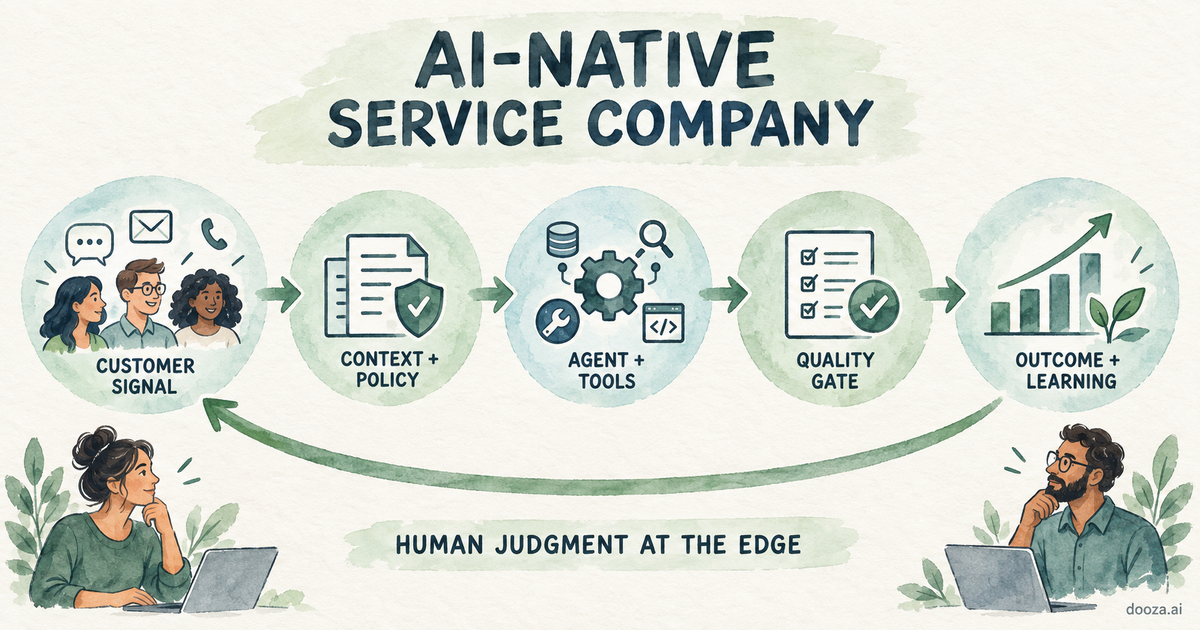
An AI-native service company sells a completed outcome while agents run the repeatable work. See how the model works, where Dooza fits, and how to build one.
Start with a refundable pilot — 100% refund within 14 days. A Dooza engineer scopes it with you on a free 30-minute call. Pricing depends on the product; see pricing.
Refundable pilot · 100% refund within 14 days · No contracts