AI Sales Funnel Automation Tools: Build a Pipeline That Runs Itself
How to automate every stage of your sales funnel with AI — from awareness to close. Tool comparisons, setup guide, and funnel architecture for 2026.
13 min read
July 5, 2026
What Is AI Sales Funnel Automation?
A sales funnel is the journey from "never heard of you" to "signed customer." Traditionally, humans manage every stage — researching prospects, writing emails, making calls, following up, qualifying, booking meetings. It's labor-intensive, inconsistent, and doesn't scale without headcount.
AI sales funnel automation replaces that manual work at each stage. AI finds your prospects, writes personalized outreach, follows up on schedule, scores leads by buying intent, books meetings, and even handles initial qualification conversations. The funnel runs 24/7 whether you're working or sleeping.
This isn't about replacing your salespeople with robots. It's about building a system where AI handles the repetitive 80% (research, outreach, follow-up) so your team focuses on the valuable 20% (relationships, negotiation, closing).
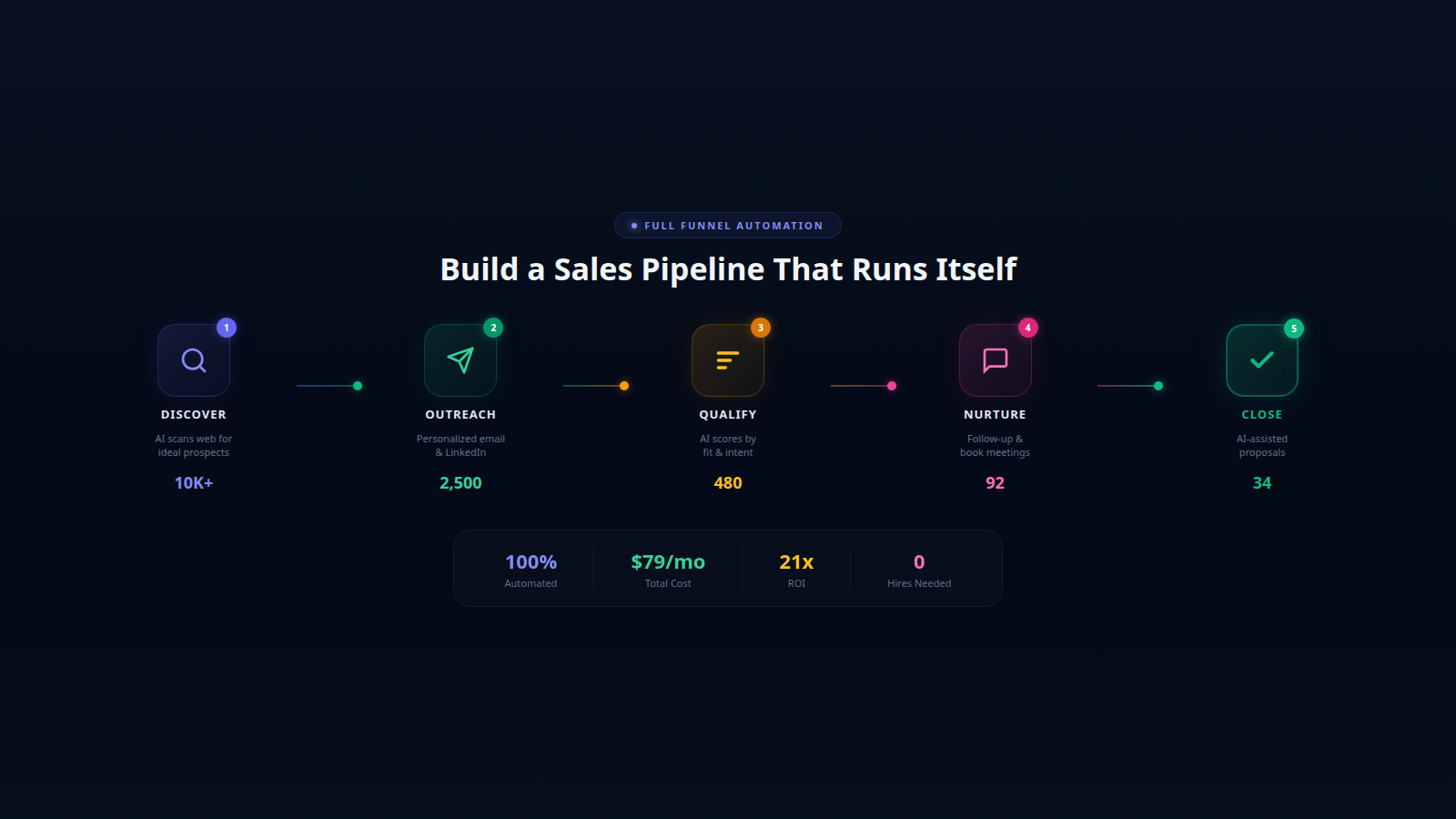
The 5 Stages of an AI-Automated Sales Funnel
Stage 1: Awareness — AI Prospect Discovery
The top of your funnel starts with finding people who might need what you sell. AI automates this by:
Scanning job boards for companies hiring roles your product replaces or supports
Monitoring funding announcements — companies that just raised have budget
Analyzing intent data — companies researching your category are ready to evaluate
A good AI prospecting engine delivers 50-200 new, qualified prospects daily — something that would take a human researcher 6-8 hours.
Stage 2: Interest — AI Personalized Outreach
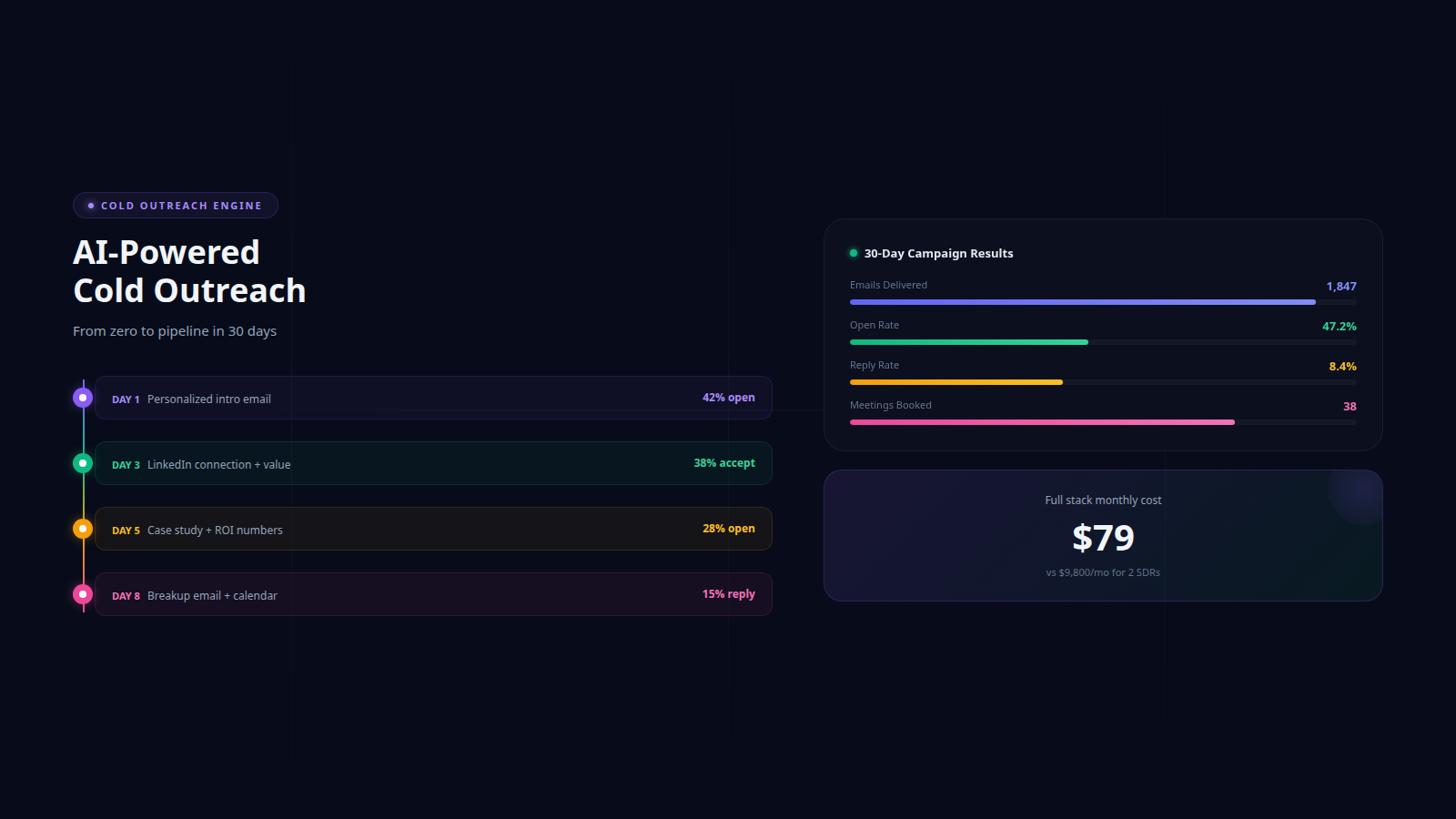
Getting attention in a world of inbox overload requires genuine personalization. AI creates unique outreach for each prospect by:
Researching the prospect's company, role, and recent activity
Identifying specific pain points relevant to their situation
Writing emails that reference real details — not mail-merge templates
Timing delivery for maximum open rates based on recipient behavior
AI-personalized outreach achieves 40-55% open rates versus 15-20% for generic templates.
Stage 3: Consideration — AI Lead Scoring & Nurture
Not every lead is ready to buy today. AI separates hot leads from nurture candidates by scoring engagement signals: email opens, link clicks, website visits, content downloads, and reply sentiment. Hot leads go straight to booking. Warm leads enter an automated nurture sequence with educational content, case studies, and social proof — dripped at intervals that maintain interest without overwhelming.
Stage 4: Intent — AI Qualification & Booking
When a lead engages — replies to an email, fills out a form, clicks a CTA — AI handles the immediate response. It asks qualifying questions (budget, timeline, decision process), answers common objections with relevant case studies, and books meetings directly on your calendar. The best AI qualification bots handle 90% of initial conversations without human involvement.
Stage 5: Decision — AI-Assisted Closing
The final stage is where human involvement adds the most value, but AI still helps:
Pre-call research briefs: AI summarizes everything known about the prospect — company details, previous interactions, likely objections
Proposal generation: AI drafts customized proposals based on the prospect's stated needs
Follow-up automation: After the call, AI sends recap emails, handles next-step scheduling, and manages deal-stage transitions
Best AI Tools for Each Funnel Stage (2026)
Funnel Stage
Best Tool
What It Does
Price
Prospect Discovery
Apollo.io / Ocean.io
B2B database + intent signals
$49-$99/mo
Data Enrichment
Clay / Clearbit
80+ data providers, email verification
$149-$299/mo
Email Outreach
Instantly / Smartlead
Multi-account sending + warm-up
$30-$59/mo
LinkedIn Outreach
Expandi / Dripify
Automated connections + messaging
$79-$99/mo
Lead Scoring
HubSpot / Salesforce
Behavioral scoring + routing
$45-$150/mo
Qualification
Drift / Intercom
AI chatbot + meeting booking
$50-$100/mo
Meeting Booking
Calendly / SavvyCal
Self-serve scheduling
$12-$20/mo
Total (modular)
$414-$826/mo
That's 7 different tools, 7 subscriptions, 7 logins, and 7 integration points that can break. The modular approach works but it's fragile, expensive, and requires constant maintenance.
Full-Stack vs. Modular: Which Approach Wins?
Modular (DIY Tool Stack)
Pros: Maximum flexibility, best-in-class at each stage, easy to swap individual tools
Cons: Complex integration, higher total cost ($400-$800/month), breaks at connection points, requires technical setup, data silos between tools
Full-Stack (All-in-One Platform)
Pros: Single platform, unified data, lower total cost, no integration maintenance, works out of the box
Cons: Less flexibility at individual stages, dependent on one vendor, may not be best-in-class at every stage
Our recommendation: For small businesses and startups, start with a full-stack platform. You need speed and simplicity more than optimization at each stage. Once you're generating consistent revenue from outbound, you can switch individual stages to best-in-class tools based on what your data shows needs improvement.
Build Your AI Sales Funnel: The Practical Blueprint
Week 1: Foundation
Define your ICP with specific criteria (industry, size, role, signals)
Set up email infrastructure (secondary domains, warm-up)
Choose your tool stack or full-stack platform
Write your first outreach sequence (4 emails + 2 LinkedIn touches)
Weeks 2-3: Warm-Up Period
Email accounts warm up automatically (don't skip this — it protects deliverability)
Build your prospect list (1,000 contacts for first campaign)
Set up CRM integration and lead routing rules
Configure calendar booking and qualification questions
Week 4: Launch
Start sending: 25-50 emails per day per account
Monitor deliverability daily (open rate should be 35%+ from day one)
Analyze which ICP segments convert best — double down
Increase sending volume as deliverability proves stable
Add new channels (LinkedIn, retargeting ads) based on data
The Only 6 Metrics You Need to Track
Metric
Target
Why It Matters
Email deliverability rate
>95%
Below 95% means infrastructure problems
Open rate
>40%
Tests subject line + sender reputation
Reply rate
>5%
Tests message relevance + personalization
Meeting booking rate
>2% of sends
Tests overall funnel effectiveness
Cost per meeting
<$15
Tests efficiency vs. alternatives
Pipeline velocity
<30 days
Tests how fast leads move through funnel
Don't track vanity metrics. "Emails sent" means nothing if nobody replies. Focus on downstream conversion: what percentage of outreach turns into revenue?
The Optimization Playbook: Double Your Conversion in 90 Days
Split test everything. Run two subject lines against each other with 100 sends each. Pick the winner, challenge it with a new variant. Repeat weekly. Small gains compound.
Segment aggressively. Don't send the same email to a 10-person startup and a 500-person enterprise. Write segment-specific sequences that speak to their specific world.
Time your sends. Test Tuesday 9 AM vs. Thursday 2 PM. Different industries have different peak engagement windows. Let the data decide.
Improve your follow-ups. Most people optimize email 1 and ignore emails 2-4. Your follow-ups should add new information, not just "checking in." Each touch should give the prospect a reason to reply.
Clean your list monthly. Remove non-openers after 2 sequences. Remove bounces immediately. A clean list with high engagement beats a large list with poor metrics.
How Dooza Automates Your Entire Sales Funnel
Dooza replaces the 7-tool stack with a single AI Employee platform that handles every funnel stage:
Top of Funnel: AI Employees scan the web for prospects matching your ICP, enrich them with contact data, and add them to your pipeline automatically
Middle of Funnel: Personalized outreach sequences run across email and LinkedIn — AI writes unique messages for each prospect and follows up on schedule
Bottom of Funnel: AI handles replies, qualifies leads, answers questions, and books meetings directly on your calendar
Post-Meeting:Dooza Agents send follow-up emails, update your CRM, notify your team in Slack, and prepare pre-call briefs for your next meeting
One platform. One refundable pilot. No integration headaches. No sales hires needed until you're ready to scale past $1M ARR.
Get started and build your automated funnel today.
Watch: Automated Sales Funnels with AI
See how AI-powered sales funnels automate every stage from prospect discovery to closing deals — and why this is the future of business growth.
Bottom Line
Your sales funnel shouldn't depend on how many people you can hire. AI automation handles prospecting, outreach, qualification, and booking — the stages that consume 80% of a sales team's time. Build once, optimize continuously, and let the funnel run while you focus on closing deals. The companies winning in 2026 aren't the ones with the biggest sales floors — they're the ones with the smartest funnels. Start building yours with Dooza.
Frequently Asked Questions
What is AI sales funnel automation?
AI sales funnel automation uses artificial intelligence to manage every stage of your sales process — from finding prospects to closing deals. AI handles prospecting, outreach, lead scoring, nurture sequences, meeting booking, and follow-up without human intervention. You only step in for high-value conversations.
How much does it cost to automate a sales funnel with AI?
A complete AI sales funnel can run for $79-$300/month depending on volume and tools used. This includes prospecting, outreach, qualification, and CRM integration. Compare that to $15,000-$25,000/month for a traditional 3-person sales team with equivalent output.
Can AI handle the entire sales funnel or just parts of it?
AI can now handle 90-95% of the sales funnel autonomously. The stages that benefit most from human involvement are final negotiations, complex objection handling, and enterprise deal closing. For deals under $10K, many businesses run fully automated funnels with zero human touchpoints until the demo call.
What's the best AI sales funnel tool for startups?
For startups, all-in-one platforms like Dooza offer the best value because they eliminate the need to stitch together 5-6 separate tools. If you prefer a modular approach, combine Apollo (prospecting) + Instantly (email) + Calendly (booking) — but expect more setup and maintenance overhead.
How long does it take to set up an automated sales funnel?
A basic automated sales funnel can be set up in 1-2 days. Email warm-up takes an additional 2-3 weeks before you can start sending at scale. Most businesses see their first automated meetings within 3-4 weeks of starting setup. Full optimization takes 2-3 months of data-driven iteration.
Ready to Start Your Pilot?
Automate your business with AI employees that work 24/7. Start with a refundable pilot: 100% refund within 14 days.
AI Cold Outreach Automation for Startups: From Zero to Pipeline in 30 Days
The complete startup guide to AI-powered cold outreach. Setup playbook, email sequences, deliverability tips, and how to book 30+ meetings per month for under $100.
Start with a refundable pilot — 100% refund within 14 days. A Dooza engineer scopes it with you on a free 30-minute call. Pricing depends on the product; see pricing.