Boston Dynamics Atlas New Hands: 13 Degrees of Freedom, Explained
Boston Dynamics' new GR3 hand for Atlas almost doubles its degrees of freedom, drops the pinky, and is built to be simulated for reinforcement learning. Here is what the video shows, and what physical AI means for small businesses compared with the AI agents they can use today.
7 min read
October 6, 2026
What did Boston Dynamics announce about Atlas's new hands?
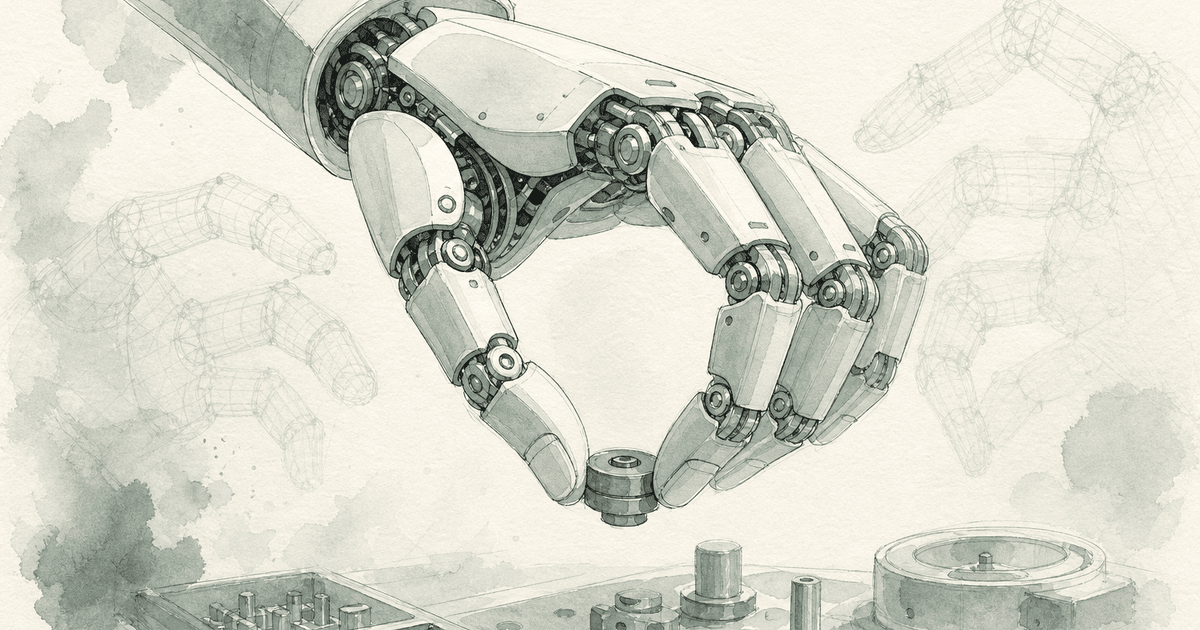
In a short video called "New Hands for Atlas," published October 1, 2026, Boston Dynamics introduces the next-generation hand for its Atlas humanoid robot. The engineers call the new hand GR3. It has 13 degrees of freedom, up from 7 on the previous GR2 hand. It is slightly larger than an average human hand and, on average, a bit stronger.
The team says the hand was designed with simplicity in mind, as Atlas moves toward mass manufacturing. It was also built to be simulated cleanly, so that reinforcement learning (RL) policies trained in simulation carry over to the real robot. That transfer is called sim-to-real. And it has no pinky, a choice made partly after the engineers spent a day with their own pinkies taped down.
More dexterity: 13 degrees of freedom (GR3) vs 7 (GR2), with four fingers instead of five.
Built for learning: designed to be easy to simulate and "transparent" to force and motion, which suits RL.
Built to survive bumps: back-drivable joints let the hand give way on impact instead of breaking the gearbox.
Close to human: similar enough to a human hand that human demonstrations map onto it well.
For small businesses: this is research-stage physical AI. The AI agents that save time today are digital.
Video credit: “New Hands for Atlas | Boston Dynamics” by Boston Dynamics, published October 1, 2026 on YouTube (2.3 million views when we wrote this). Watch on YouTube. All rights to the video belong to its creator; we embed it with YouTube's standard player and add our own commentary.
What is new in the GR3 hand compared with GR2?
The headline number comes in the first few seconds:
We have increased the number of degrees of freedom. GR2 had seven degrees of freedom. GR3 now has 13.
A degree of freedom is one independent way a joint can move. More degrees of freedom let the hand take more grasps and do more in-hand moves, but every extra one adds a motor, weight, power use, and control complexity. Here is what the video says about each design goal:
Design goal
What the video says
Why it matters
Dexterous grasps
A pinch that can roll small objects against the thumb, a three-finger grip that holds firmly while still adjusting, and gripping a tool handle while pressing its trigger
These are the moves behind using real tools and assembling parts
Size and strength
Slightly larger than an average human hand, and a bit stronger on average
It can handle objects and tools made for people
Simulatable
Designed so it can be simulated cleanly for RL
Skills can be learned in simulation before they run on hardware
Force and motion transparency
Forces on the fingers can be sensed through proprioception, and commanded motion passes cleanly to the world
The robot can "feel" contact without extra fragile sensors
Back-drivability
Joints can be pushed backwards and move out of the way on hard impacts
Better dexterity and better durability, because the gearbox is not damaged
Manufacturability
Designed with simplicity in mind on the path to mass manufacturing
Fewer parts means lower cost and fewer failures at scale
One engineer sums up why hands are so hard:
The multi-fingered hand is like a whole mini robot.
How does Atlas learn to use its hands with sim-to-real reinforcement learning?
Reinforcement learning trains a control policy by trial and error, mostly in simulation, where a robot can practice far more than it could in the real world. According to the video, Boston Dynamics already uses RL heavily for Atlas's whole-body control. The team is now working out how to use the same tools for arms and hands.
You can simulate it cleanly, and it enables very interesting work in reinforcement learning, but it's also close to anthropomorphic.
Being close to human-shaped matters because, as the engineer explains, it leaves only a small gap between human demonstrations and the robot's body. People can show a task, and the motion carries over more easily.
The video lists three things a simulator has to get right for the hand:
Kinematics: the geometry, meaning where the links and joints are.
Dynamics: friction, the torques the motors can apply, and backlash in the gears.
Contact dynamics: how the fingers interact with objects and surfaces.
The team says it closes the sim-to-real gap "from both directions." It improves the simulator to match the hardware, and it designs the hardware to be easier to simulate. The current test tasks focus on reorienting objects in the hand, which the team sees as a stand-in for future work with tools and assembling parts.
Why does the new Atlas hand have no pinky?
The engineers say they weighed many options, including two thumbs, and decided using simulation, 3D-printed mock-ups, and their own hands. At one point the CTO asked the team to tape their pinky to the next finger for a day. The next day they decided the robot probably didn't need one. The reasoning:
There's no pinky because the team determined that the additional dexterity and tasks you'd be able to accomplish is not worth the extra complexity of three additional degrees of freedom.
The engineer adds that size and power use also weighed against it. It is a useful reminder that good engineering, like a good business process, often means removing the parts that don't pay for themselves.
What does physical AI like Atlas mean for small businesses?
In the near term, very little directly. The video presents GR3 as a step on a long road. One engineer says the journey for the hand is a long one. The video gives no pricing, availability, or customer deployments for small businesses, and you shouldn't plan around a humanoid robot arriving at your shop soon.
It is still worth watching for three reasons:
Direction of travel. The same methods behind today's software agents, learning from data and practicing in simulation, are being applied to physical tasks. Warehousing, manufacturing, and logistics will feel it first.
Design lessons. Building for simplicity and manufacturability, and dropping features that aren't worth their complexity, applies to any operations project.
Expectations. Clients and staff will see robot videos and ask what AI can do for your business. You need an answer that fits what is actually available today.
Physical AI vs digital AI agents: which helps a small business now?
Physical AI (humanoids like Atlas)
Digital AI agents
What it does
Moves, grasps, and handles objects in the physical world
Answers calls, writes and sends emails, updates CRMs, publishes content, and runs workflows
Stage, per the video
Active research and development, moving toward mass manufacturing
Available to small businesses today
Main constraint
Hardware, safety, and the sim-to-real gap
Good instructions, access to your tools, and approval rules
Who benefits first
Large industrial and logistics operators
Any business with phones, inboxes, and repetitive admin
What to do now
Follow the progress and learn the vocabulary
Pick one workflow, pilot an agent on it, and measure the result
Dooza is an AI-native company that builds AI products and services for small businesses, from the Dooza Workforce app to the Dooza Agents platform. Every product starts with a refundable pilot: 100% refund within 14 days.
Dooza doesn't build robots. Its products are the digital side of AI: agents that do real work in your inbox, phone line, CRM, and website. Dooza Workforce gives you ready-made AI employees for email, social media, SEO, lead generation, legal documents, and phone calls. Dooza Agents are custom agents that Dooza engineers build and maintain around your workflows.
Book a free 30-minute call and a Dooza engineer will scope your pilot around one workflow. Every product starts with a refundable pilot: 100% refund within 14 days. Book a free pilot call.
Frequently Asked Questions
What is new in the Boston Dynamics Atlas hands?
The new GR3 hand has 13 degrees of freedom, up from 7 on GR2. It is slightly larger and, on average, stronger than a human hand, and it is designed to be simulated for reinforcement learning and built for mass manufacturing.
How many fingers does the new Atlas hand have?
Four. Boston Dynamics dropped the pinky because the extra dexterity was not worth three additional degrees of freedom and the added size, power use, and complexity.
What is sim-to-real reinforcement learning?
It means training a robot control policy by trial and error in simulation, then running it on the real robot. It only works if the simulator matches the hardware, including kinematics, dynamics, and contact.
What does back-drivable mean for a robot hand?
The joints can be pushed backwards by outside forces. That lets the hand sense contact through proprioception and give way on hard impacts instead of damaging its gearbox.
Can a small business buy an Atlas robot?
The video gives no pricing or availability for small businesses. It presents the GR3 hand as part of ongoing research on the path to mass manufacturing.
What AI can a small business use today instead?
Digital AI agents. They answer calls, handle customer emails, follow up on leads, and run workflows. Dooza offers these through Dooza Workforce and Dooza Agents, each starting with a refundable pilot.
Ready to Start Your Pilot?
Automate your business with AI employees that work 24/7. Start with a refundable pilot: 100% refund within 14 days.
Dyna-2.1: The Robot That Ran an Hour-Long Laundry Shift Uncut
Dyna Robotics released Dyna-2.1, a wheeled semi-humanoid it calls a physical agent, with uncut footage of it running an hour-long laundry room workflow. Here is what is new, how it compares with other robots, and what laundromats, hotels, and cleaning businesses should realistically expect.
Kurzgesagt "AI Just Crossed the Terrifying Line" Explained
Kurzgesagt's viral video describes thousands of AI agents organizing, cheating their scorer, and attacking Hugging Face. We summarize what the video says, what is still unknown, and the practical guardrails any business running AI agents should have.
Start with a refundable pilot — 100% refund within 14 days. A Dooza engineer scopes it with you on a free 30-minute call. Pricing depends on the product; see pricing.