ChatGPT Shopping: How Products Get Recommended and How to Get Yours In (2026)
ChatGPT now shows product cards and merchants for shopping questions. Here is how products get selected, why your product data matters more than ads, and how to track whether ChatGPT recommends you.
10 min read
September 29, 2026
How does ChatGPT Shopping choose products?
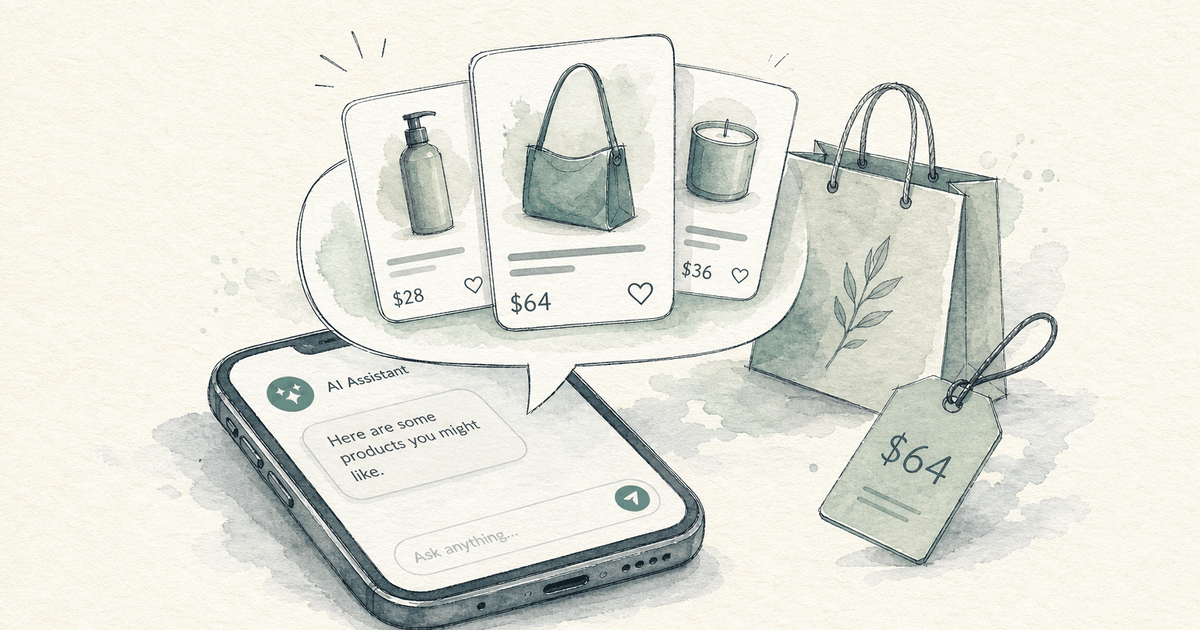
ChatGPT Shopping shows product cards when a question has shopping intent, and it picks products from web search results and merchant product data, not from paid placement. OpenAI's help center states that product results are selected independently and are not ads. Merchants can also submit product feeds and support checkout through OpenAI's Agentic Commerce Protocol.
In practice, the brands that get recommended have clean, detailed product data in the places ChatGPT looks: their product pages, structured data, Google Shopping listings, and the reviews and editorial roundups that search results return.
How does ChatGPT Shopping work?
A user asks a shopping question, like "best waterproof hiking boots under $200".
ChatGPT expands it into several searches and adds attributes (waterproof, wide fit, lightweight).
It retrieves products, prices, and reviews from the web and merchant data.
It shows product cards with merchants, and may explain trade-offs.
Where supported, the user can buy through Instant Checkout.
According to OpenAI's commerce documentation, merchants can provide a regularly refreshed product feed with identifiers, descriptions, pricing, inventory, media, and fulfillment details, and "rich media, reviews, and performance signals" improve ranking and relevance. See also Shopping with ChatGPT search.
How does ChatGPT actually find your products?
Re:signal's Cal has studied this closely. His most practical point is about where product data lives:
When we talk about product data enrichment, it’s about getting those attributes that ChatGPT is looking for into the areas where it’s looking for it, not into just your PIM and then it’s never used or just your CMS and it’s never used.
Yeah, in a way that product feeds matter, but your product feed in Google matters more than one that you would submit directly to ChatGPT at the moment.
He reports seeing ChatGPT send requests to Google Shopping in his own tests, and describes a pattern where the top merchant in Google's shopping results tends to become the recommended seller in ChatGPT. He is clear that this is his own inference from testing, so treat it as a hypothesis to check in your category, not a rule. He also notes that about a third of product recommendations in the studies he cites also appeared in Reddit threads.
What should ecommerce brands fix first?
Technical basics: product pages indexable, fast, and readable in raw HTML; OAI-SearchBot and Bingbot allowed.
Product data at the source: clear product names, materials, sizes, use cases, and compatibility in your PIM or CMS, so every channel inherits them.
Google Merchant Center: a complete, error-free feed; it influences more than Google.
Structured data: Product, Offer, AggregateRating, and Review schema on every product page.
Reviews: recent, detailed reviews on your site and on third-party platforms.
Editorial and community: get into the "best X" roundups and Reddit threads for your category.
OpenAI merchant feed and checkout: apply once the basics are solid.
Product recommendation prompts: 30–100 buying-intent prompts by category, price band, and use case.
Recommendation rate: % of prompts where your product is shown or named.
Merchant share: whether you, a retailer, or a marketplace is shown as the seller.
Attribute gaps: which attributes ChatGPT adds to searches that your pages do not mention.
AI referral revenue: sessions and orders from chatgpt.com in analytics.
Profound sells a dedicated Shopping module for this, and Peec AI has a shopping report. For smaller catalogs, a prompt-level tracker is enough to start. See AI visibility tools.
How does Dooza help ecommerce brands show up in ChatGPT?
Dooza is an AI-native company that builds AI products and services for small businesses. For AI search, Ranky does the work. Ranky tracks how ChatGPT, Perplexity, Gemini, Claude, Microsoft Copilot, and Google AI Overviews answer the prompts your buyers ask, maps which sources those answers cite, and then does the fixes: it drafts and publishes answer-ready pages, fixes schema, and flags the third-party threads worth joining, all behind your approval. Every Dooza product starts with a refundable pilot — 100% refund within 14 days.
For stores on Shopify, WooCommerce, and custom platforms, Dooza tracks product-recommendation prompts, finds the attributes and comparisons missing from your pages, and has Ranky rewrite product copy, add schema, and publish "best for" and comparison pages for approval. More for store owners in AI for Shopify stores.
See whether ChatGPT recommends your products
Book a free pilot call to scope a refundable pilot with a product-recommendation baseline for your top categories.
Frequently Asked Questions
Are ChatGPT Shopping results ads?
No. OpenAI states that product results in ChatGPT shopping are selected independently and are not ads.
How do I get my products into ChatGPT Shopping?
Make product pages crawlable and rich in attributes, add Product and Offer schema, keep a complete Google Merchant Center feed, earn reviews and roundup mentions, and apply to OpenAI's merchant program to submit a product feed.
Does ChatGPT use Google Shopping data?
Practitioners such as Re:signal report seeing ChatGPT query Google Shopping in tests, and some studies link many ChatGPT product results to Google Shopping. OpenAI has not published its full selection method.
What is the Agentic Commerce Protocol?
It is OpenAI's specification that lets merchants provide product feeds and support purchases inside ChatGPT through Instant Checkout, with the merchant handling fulfillment and payment through its own systems.
How do I track if ChatGPT recommends my products?
Run a fixed set of product-recommendation prompts on a schedule and record whether your products appear, which merchant is shown, and which attributes ChatGPT searched for.
Ready to Start Your Pilot?
Automate your business with AI employees that work 24/7. Start with a refundable pilot: 100% refund within 14 days.
AI Visibility Tools in 2026: How to Choose a Platform That Tracks and Improves Your Brand in AI Search
AI visibility tools show how ChatGPT, Perplexity, Gemini, and Google AI Overviews talk about your brand. This guide explains the metrics, how to run a free manual audit first, and how to pick a platform that turns the numbers into fixes.
Answer Engine Optimization (AEO): The 2026 Guide to Getting Cited by AI
Answer engine optimization is how you get mentioned and cited when people ask ChatGPT, Perplexity, Gemini, and Google AI a question. Here is how it works, what to do first, and how to measure it.
Start with a refundable pilot — 100% refund within 14 days. A Dooza engineer scopes it with you on a free 30-minute call. Pricing depends on the product; see pricing.