Fireship's 5 Open Source Tools to Cut AI Costs: Worth Self-Hosting?
Fireship's Code Report replaces paid AI subscriptions with five open source tools: Ollama, 9router, Headroom, Dify, and OpenHands. Here is what each one does, and an honest look at when self-hosting actually saves a small team money.
8 min read
October 6, 2026
What is Fireship's "5 open source tools" video about?
In this September 2026 episode of The Code Report, Fireship argues you can cancel most paid AI subscriptions and self-host a cheaper AI stack built from five open source tools: Ollama, 9router, Headroom, Dify, and OpenHands. Ollama runs models locally. 9router puts all your model providers behind one endpoint with automatic fallback. Headroom compresses context to cut input tokens. Dify is a visual builder for AI workflows. OpenHands is an autonomous coding agent.
The video tallies the subscriptions behind the "$320 a month" in its title: Cursor, Claude Max, GPT Pro, and Gemini Ultra. It's aimed at developers, and the episode is sponsored. The ideas apply to any small team watching its AI bill, but self-hosting is not automatically cheaper.
Local models (Ollama) cost nothing per token but need hardware, and small models can't match frontier ones.
Routing (9router) and compression (Headroom) cut spend without giving up the big models.
Dify and OpenHands are the "build things" layer: workflows and coding agents.
Self-hosting saves money when usage is high and someone on the team can run servers. Otherwise, it can cost more in time.
Video credit: “5 open source tools that replaced my $320/mo AI stack...” by Fireship, published September 7, 2026 on YouTube (1.26 million views when we wrote this). Watch on YouTube. All rights to the video belong to its creator; we embed it with YouTube's standard player and add our own commentary.
Fireship opens with the math that started it:
Cursor, $20. Claude Max, $100. GPT Pro, another 100. Gemini Ultra, another 100.
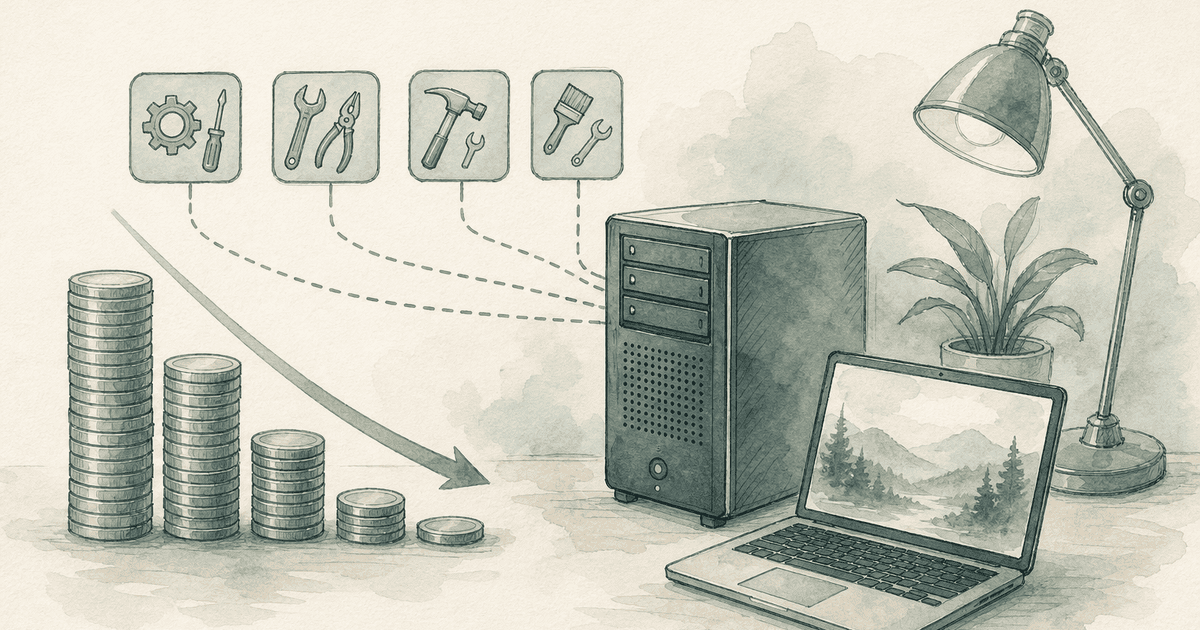
The video builds a stack in layers, and it's worth seeing it that way because each tool solves a different cost problem:
Models: Ollama runs small and mid-size open models locally for cheap, private work.
Routing: 9router sends each request to the right provider. According to the video, if you max out a subscription like Claude Max, it rolls over to a pay-per-token backup and then to free providers automatically.
Compression: Headroom trims what you send. Fireship highlights one design choice: the compressed content is cached locally, so the model can retrieve the original if it needs it.
Apps: Dify turns AI steps into workflows your product can call. His joke example is a horse-matchmaking app that pulls matches from a database and has a model explain each one.
Agents: OpenHands runs coding agents in the background on your own server, picking up GitHub issues.
One clever design feature of this tool is that it's reversible.
The key idea is that you don't have to choose between local and frontier models. Fireship keeps the option to tap Claude and GPT for hard tasks while routing everything else to cheaper options.
When does self-hosting AI actually save money for a small team?
Fireship is honest about the biggest limit:
The big problem though is that you probably don't own the hardware to run anything close to state-of-the-art.
One subscription costs less than the server and the time
Nobody on the team can maintain servers
Usually no
Breakages, updates, and security become unpaid work
Tasks that need frontier-level reasoning
No
You still pay a big provider; self-hosting only trims the edges
What are the hidden costs of a self-hosted AI stack?
A subscription bundles things you don't see. When you self-host, you take them on:
Hardware or a server. Either a capable machine for local models or a rented server. A small server is fine for routing, compression, and Dify. It won't run large models.
Setup and upkeep. Five tools means five things to update, monitor, and debug. Someone's hours go here.
Security. A proxy that holds all your API keys is a valuable target. Lock it down, don't expose it to the internet without auth, and rotate keys.
Quality trade-offs. Local models are good at many tasks, but swapping a frontier model for a small one on hard work can cost more in rework than it saves.
Runaway agents. Always-on agents connected to paid models need usage caps. A routing layer that tracks usage helps.
The fair summary: self-hosting turns a monthly bill into a mix of a smaller bill plus your time. That trade is great for developers who enjoy it, and expensive for a business owner who doesn't.
What should a small team actually do?
If you want lower AI costs without rebuilding your stack, start small:
Audit your subscriptions. Fireship's forgotten API keys line is relatable. List every AI tool, who uses it, and what it costs.
Cut duplicates first. Most teams don't need four chat assistants. This is the fastest saving and needs no servers.
Try Ollama on one task. Pick a simple, high-volume job like summarizing notes and see if a local model is good enough.
Add routing or compression only if you have a real API bill. These tools pay off at volume.
Decide who owns it. If no one does, buy a managed product instead.
Dooza is an AI-native company that builds AI products and services for small businesses, from the Dooza Workforce app to the Dooza Agents platform. Every product starts with a refundable pilot: 100% refund within 14 days.
Fireship's stack is built for developers who want to run their own infrastructure. Most small business owners we talk to want the result, not the servers. That's the gap Dooza fills.
What 5 open source tools does Fireship recommend to cut AI costs?
Ollama for running models locally, 9router for routing requests across providers with fallback tiers, Headroom for compressing context, Dify for visual AI workflows, and OpenHands for autonomous coding agents.
What does the $320/mo in the video title refer to?
Fireship adds up Cursor at $20 plus Claude Max, GPT Pro, and Gemini Ultra at $100 each, as quoted in the video, which comes to $320 a month.
Is self-hosting AI cheaper than paying for subscriptions?
Only sometimes. It saves money when API usage is high, tasks suit small local models, and someone can maintain the servers. For light use or teams without technical staff, a subscription is usually cheaper overall.
Can Ollama replace ChatGPT or Claude?
For simple tasks, often yes. But as Fireship notes, most people do not own hardware to run anything close to state-of-the-art models, so frontier-level work still needs a big provider.
What does Headroom do?
According to the video, Headroom sits between your app and the model provider and compresses tool outputs, logs, and other noise before they become billable input tokens. The compression is reversible because the original is cached locally.
Is there a managed option for small businesses that do not want to self-host?
Yes. Dooza Workforce provides ready-made AI employees and Dooza Agents provides custom agents built and maintained by Dooza engineers. Every Dooza product starts with a refundable pilot: 100% refund within 14 days.
Ready to Start Your Pilot?
Automate your business with AI employees that work 24/7. Start with a refundable pilot: 100% refund within 14 days.
Mrwhosetheboss Thinnest Tech 2026: Every Gadget and His Verdict
In his viral video, Mrwhosetheboss tests a keyboard PC, a 16 mm mechanical keyboard, a 6.4 mm pair of earbuds, paintable light, and more. Here is every device, its thickness, his verdict, and the lessons for anyone buying gear for work.
OpenAI's Navier-Stokes Math Claim and the NYU Dispute, Explained
Fireship's Code Report covers OpenAI's claim that its agents cracked the Navier-Stokes Millennium Prize Problem, and an NYU mathematician's account of why the story is more complicated. Here is a balanced summary and the lesson for anyone relying on AI output.
Start with a refundable pilot — 100% refund within 14 days. A Dooza engineer scopes it with you on a free 30-minute call. Pricing depends on the product; see pricing.